@crisboarna/pi-switchboard
Classifier-driven model tiers for pi: routes the main session and pi-subagents children by complexity, with several models per tier, health tracking and an audit trail.
Package details
Install @crisboarna/pi-switchboard from npm and Pi will load the resources declared by the package manifest.
$ pi install npm:@crisboarna/pi-switchboard- Package
@crisboarna/pi-switchboard- Version
0.1.0- Published
- Nov 13, 2026
- Downloads
- 247/mo · 247/wk
- Author
- crisboarna
- License
- MIT
- Types
- extension, skill
- Size
- 485.4 KB
- Dependencies
- 1 dependency · 3 peers
Pi manifest JSON
{
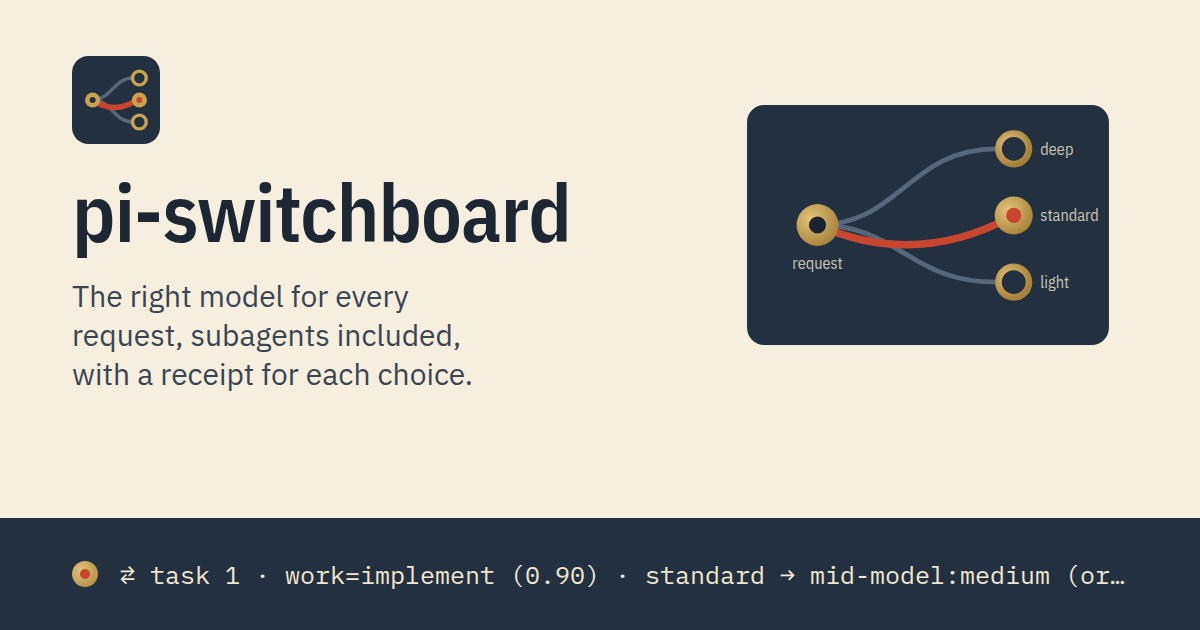
  "image": "https://raw.githubusercontent.com/crisboarna/pi-extensions/main/packages/pi-switchboard/media/cover.png",
  "video": "https://raw.githubusercontent.com/crisboarna/pi-extensions/main/packages/pi-switchboard/media/hero.mp4",
  "skills": [
    "./skills"
  ],
  "extensions": [
    "./src/index.ts"
  ]
}
Security note
Pi packages can execute code and influence agent behavior. Review the source before installing third-party packages.
README
@crisboarna/pi-switchboard





Every request in pi goes to a model that fits it: small jobs to small models, design and review to the strongest, and each subagent to its own tier. A local classifier answers three questions about the request, your rules turn the answers into a tier, and a strategy picks one of the tier's models, moving to another account when a subscription runs dry. Every choice is recorded, so you can see why each model ran and what it cost.

▶ Watch the two-minute demo, with narration: real pi, pi-switchboard and pi-subagents; only the model replies are scripted.
Install
pi install npm:@crisboarna/pi-switchboardRestart pi.
Try it first
None of these runs a model; only /tier init writes a file, after you confirm the diff:
/tier tour                                      # a two-minute walkthrough with sample decisions
/tier init                                      # propose a config from your signed-in models; shows the diff first
/tier try rename foo to bar in utils.ts         # how this request would route
/tier try work=plan depth=1.8 risky=no design the billing service   # the same with typed answers, no classifier needed
/tier doctor                                    # check the setup, with what to fix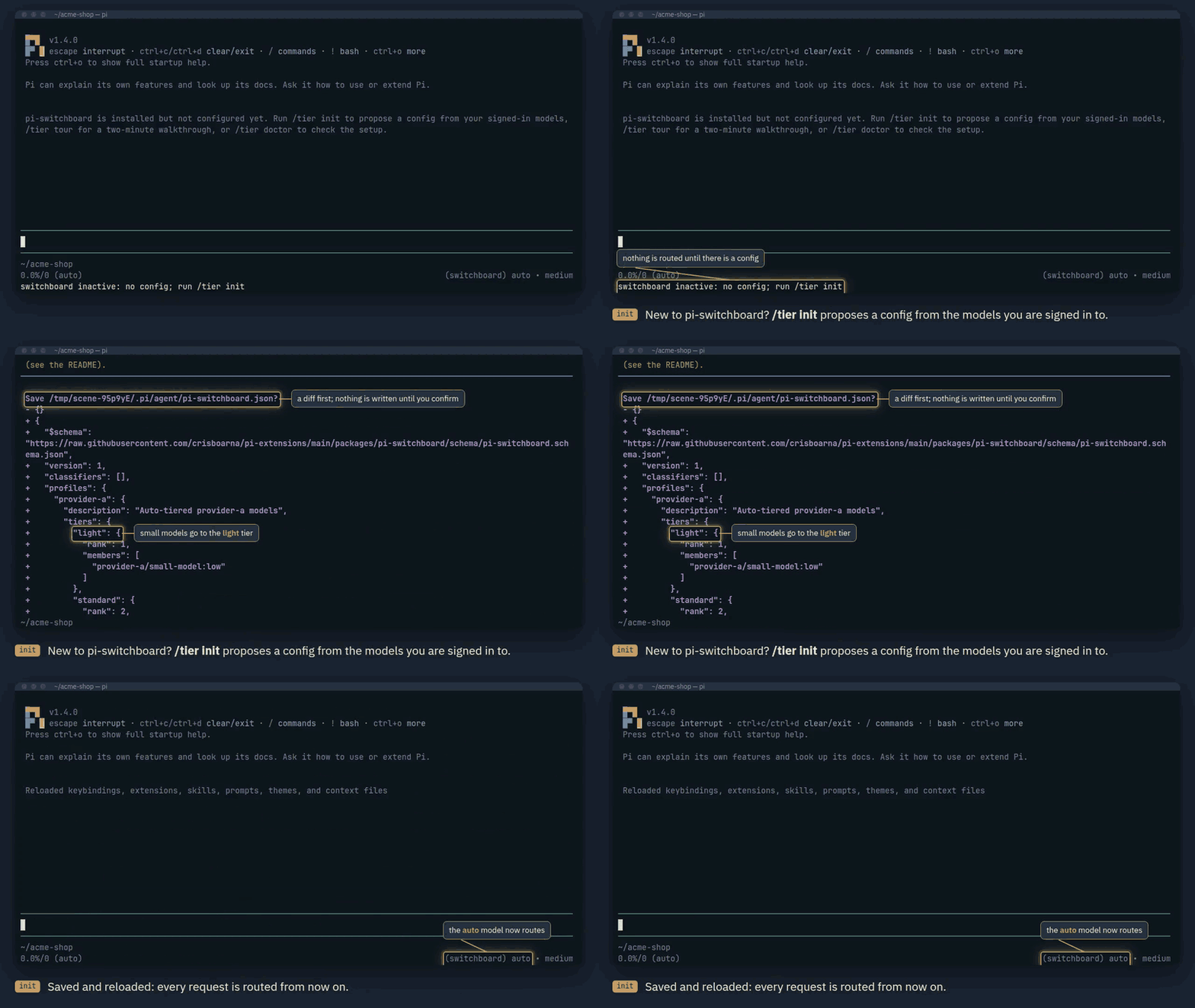
Then pick switchboard/auto in /model. To watch decisions before trusting them, /tier dry-run on classifies and records every request but runs your baseline tier (see it).
The classifier is a small local model (about 0.2–0.7 s per decision on a GPU): pi-switchboard classifier detect finds one already running and pi-switchboard classifier setup <lmstudio|ollama|llamacpp|llamacpp-chat> sets one up, or follow classifier setup for LM Studio, llama.cpp, Ollama, MLX or a hosted classifier such as GPT-6 Luna. Without one, requests use your fallback tier and everything else still works.
What you get
- The right model per request: three typed answers (what kind of work, how deep, how risky) and your rules pick the tier, with a confidence gate so an unsure answer never sends a design task to a small model.
- Subagents routed too: each pi-subagents task gets its own tier, and pi-switchboard runs inside every child, so failover and escalation work there as well.
- Work keeps going when a limit hits: several models per tier, a usage limit benches the whole account, a rate limit benches the model, and a tier with nothing left borrows from its neighbour.
- A receipt for every choice: the answers, the rule, the tier and why that member was picked, in
/tier explain, a live navigator, and an offline HTML inspector that also estimates what a task would have cost on another tier. - Private, cheap decisions: the classifier runs on your machine, request text is redacted before it sees it, and remote classifiers are opt-in.
- Your models, your rules: any provider pi supports, 15 selection strategies, custom rulesets and thresholds; the source names no provider or model.
How a decision is made
- The request, the plan phase and recent tool outcomes go to the local classifier, redacted.
- It answers
work(plan, research, implement, review, mechanical),depth(0 to 2) andrisky(yes or no), each with a confidence. - The first matching rule picks a tier; if its answers are not confident enough, the fallback tier runs instead. Floor rules can raise the tier: in the built-in rules, confidently risky work runs on at least the middle tier.
- The tier's strategy picks a healthy member: cooling-down members sit out, and the previous member is kept so the prompt cache survives.
- The request runs on that model, and the decision is recorded next to the conversation, outside the model's context.

/tier explain prints the same reasoning for any real decision (see it).
More: rules and confidence, strategies and failover.
When a subscription runs dry
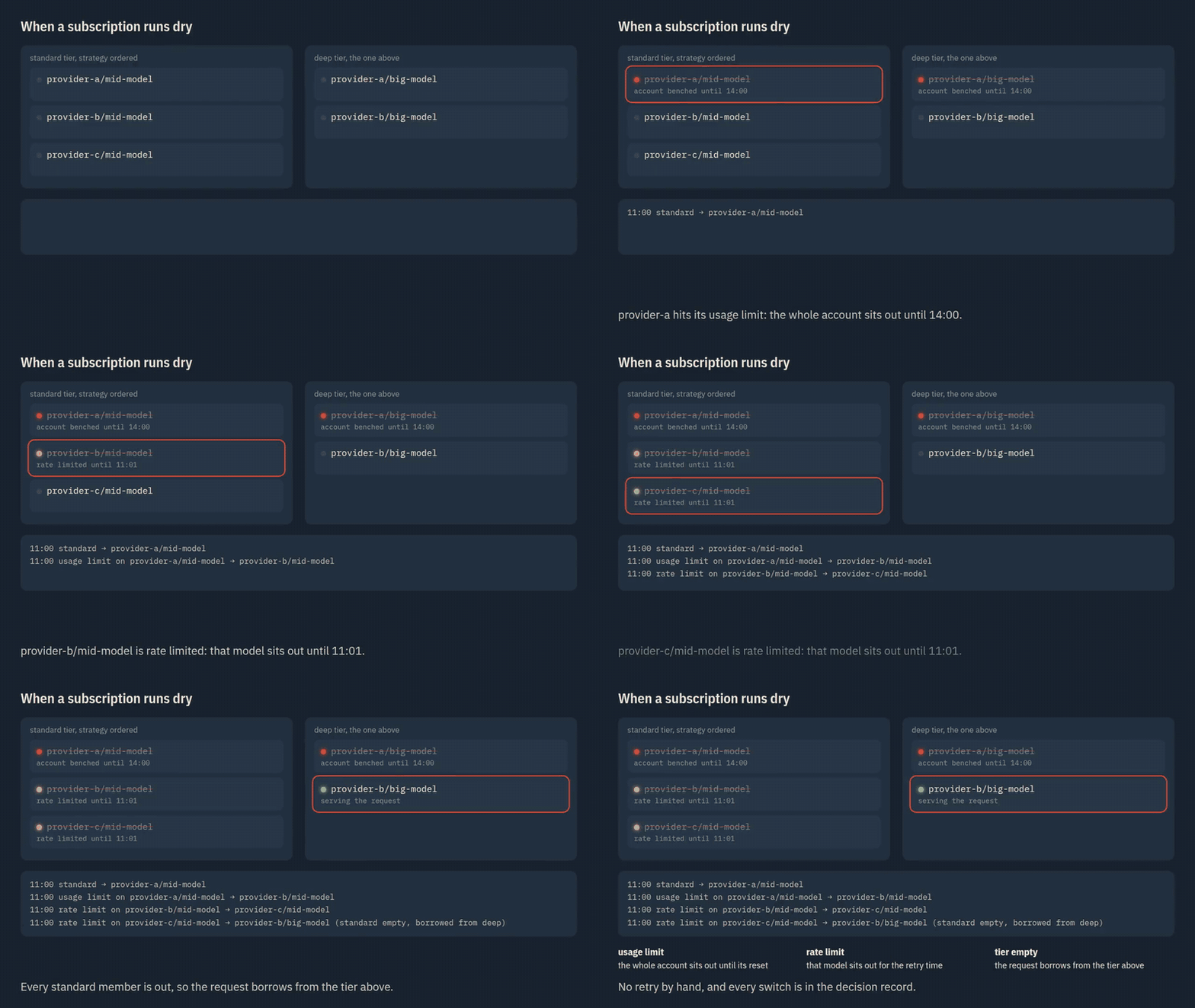
pi does not retry a usage-limit error itself, so pi-switchboard moves the request to another member when one can take over, and keeps the original error in the record. When every tier is out, the turn ends with the earliest reset, and opt-in auto-continue resumes then.
Subagents

Each task of a subagent call is classified at launch and given a tier-pinned model such as switchboard/work.deep, within the agent's own limits. Explicit models, agent frontmatter and external runners are never overridden. Ctrl+Alt+W opens a live navigator over the children (see it). How it works.
How it compares
Model routing for pi usually takes one of three approaches:
- Decide once per session. Cache-friendly and cheap, but a session that starts with a small question stays on the small model when the work gets hard.
- Decide every turn, one model per tier. Adapts to the work, but one rate limit stops the tier, and subagents are usually left on their own model.
- Rotate accounts on limits. Keeps work going, but every request runs on the same kind of model, whatever it is.
pi-switchboard decides per request with a confidence gate, holds several models per tier with a strategy and shared health, fails over by account, model or tier, and adds three things these approaches leave out: routing inside each subagent, a recorded explanation of every choice with an inspector, and previews (/tier try, dry-run) before you trust it.
Configuration
~/.pi/agent/pi-switchboard.json, written by /tier init and edited by /tier models or by hand (schema).
| Setting | Effect |
|---|---|
profiles.<name>.tiers.<tier>.members |
which models a tier may use |
profiles.<name>.tiers.<tier>.strategy |
how a tier picks a member (default sticky) |
classifiers[].threshold |
how sure the classifier must be before a rule fires (default 0.85) |
profiles.<name>.ruleset |
which answers map to which tier (default: the built-in ruleset) |
subagents.agents.<agent> |
minTier, maxTier or fixedTier for a subagent |
A trusted project may add or adjust profiles in .pi/pi-switchboard.json; it can never change classifiers. Four examples cover two subscriptions, mixed providers, local-only models and a single tier; try one with PI_SWITCHBOARD_CONFIG=examples/<file>.json pi.
Reference
- Classifier setup: choosing a route,
classifier detect,setupandeval, tuning, remote classifiers, what the classifier sees; one page each for LM Studio, llama.cpp, Ollama, MLX, cloud classifiers and other servers, and the models compared. - Configuration: profiles, tiers, members, profile selection, virtual models, project files.
- Rules and confidence: the built-in ruleset, writing rules, thresholds, tuning.
- Strategies, failover and quota: every strategy, error classes, borrowing, pi-usage, budgets.
- Subagents: launch classification, child and launch mode, agent limits, accounts.
- Commands: every
/tiercommand and its output. - Footer: the powerline items and placeholders.
- Inspector, replay and report: the HTML inspector and the
pi-switchboardCLI. - Upgrading: what an upgrade keeps and how a breaking change is announced.
- Benchmarks: what loading the package adds to pi's start and how long a routing decision takes, measured and charted.
- Alternatives: other routers and failover tools, and when to choose them.
- Troubleshooting and FAQ.
- Design of record: DESIGN.md, terms: GLOSSARY.md, decisions: docs/adr/.
Requirements
Node 22.19 or later; pi 1.4 up to, not including, 2.0, the range CI tests. Linux is tested in CI; macOS is checked by hand, not in CI; Windows is not tested, so use WSL.
| How pi runs | What works | What does not |
|---|---|---|
| Interactive | Routing, failover and subagent tiers, every /tier command, the tier editor, the navigator and the footer |
|
Print (-p) |
Routing and failover, tested with real prompts | /tier output, which print mode does not show. Use the pi-switchboard CLI |
| RPC | Routing and failover, tested through pi's RPC mode | The editor and the navigator, which need a screen |
JSON mode is not tested on its own. The pi-switchboard CLI needs no pi at all.
Data and privacy
- Network: requests go only to a classifier you configured: a local server, or a cloud model through a pi provider.
/tier doctorsends the configured classifier one test request.pi-switchboard classifier detectreads the model lists of the three default local servers (Ollama on127.0.0.1:11434, LM Studio on127.0.0.1:1234, llama.cpp on127.0.0.1:8080) and sends one test request to a decision model it finds.classifier setupreads the same lists while it waits for a server, tests once it is ready, and can ask a router to load a model.classifier evalsends 24 labelled requests to the classifier you name. There is no telemetry and no update check. - Processes:
classifier setupshows the install and server commands, and asks before it runs them and before it writes the config, unless you pass--yes./tier inspect --openopens the HTML it wrote with the platform's file opener (open,xdg-openorcmd /c start). - What the classifier sees: the request text and short tool errors, redacted once (the home directory and common token, key and password shapes) before they reach the classifier, the session entry or any log. Errors a provider or a classifier sends back are redacted the same way before they are recorded. The inspector,
replayandreportredact the request text, tool output and errors they read from a session file the same way, so an inspector file holds no more than the session entries do. The rules match known shapes, not every secret: add your own withclassification.evidence.redact. - Files it reads: the config (
pi-switchboard.jsonin the agent directory, and the nearest.pi/pi-switchboard.jsonfrom the project upward),multi-pass.jsonfor account names only, pi-subagents agent files for their front matter, and session files forinspectandreclassify. pi-usage answers over pi's event bus; this package makes no request for it. - Files it writes under
~/.pi/agent/pi-switchboard/:health.json(shared cooldowns and pointers),usage.jsonl(usage ledger),state.json(global profile and one-time notices),live/(subagent status and transcript mirrors, deleted 24 hours after a child ends),inspect/(the HTML inspector), anddecisions.jsonl(only withdebug.log)./tier modelsandclassifier setupwrite the config; the editor saves a timestamped.bakcopy first. - What it tells other extensions: on pi's event bus it answers
switchboard:members:v1with the provider and model id of every model a virtual model can route to, so pi-account-guard can check each one's account (ADR 0004). No prompt text, config or credential is in the answer. - Credentials: it never reads
auth.jsonor other credential files.
Limitations
- Workflow-script children (
workflow: true,runs.run,runs.all) get no tier at launch: their script text comes from the model's reply, so no hook can change it. pi-switchboard still runs inside each child and classifies its first request there. - Exact child linking needs the next pi-subagents release after 0.82.1 (#3049, merged); before that, foreground children are matched to their launch by agent and start time. Routing works on every version.
- Agents with an external runner (
claude-code,codex-exec) are never routed. /modellists every tier of every profile asswitchboard/<profile>.<tier>./tieroutput uses pi's notifications, which print mode (pi -p) does not show.- The tier editor's save is tested with keystrokes in real pi on a virtual terminal, including the diff, the write and the
.bakcopy; nobody has saved a real config with it at a real terminal yet. Real pi-subagents children, the navigator,/tier init, dry-run, pin and report were run live for the terminal clips. - Quota data is best effort: the first decision after start-up may run before pi-usage answers, and then the quota strategy's fallback chooses.
Uninstall
pi remove npm:@crisboarna/pi-switchboard
rm -rf ~/.pi/agent/pi-switchboard ~/.pi/agent/pi-switchboard.json
Remove the footer items if you added them.
Development
This package lives in the pi-extensions monorepo. Run npm install at the repository root, then from this folder:
npm test                   # unit tests (node --test)
npm run test:integration   # loads the extension through jiti against a fake pi host
npm run coverage           # unit and integration tests, 90% line, branch and function thresholds
npm run test:e2e           # from the packed tarball, in real pi: the classifier CLI and commands, routing, failover and subagents
E2E_SERVERS=docker npm run test:e2e   # adds classifier setup against Ollama, llama.cpp and LiteLLM in Docker
npm run media              # rebuilds the banner, cover, animations, hero video and terminal clips (Docker)
Repository-wide gates run from the root with npm run check; see the root CONTRIBUTING.md. test/support/lmstudio-chat.ts registers LM Studio's chat models as a pi provider for free local end-to-end runs:
PI_SWITCHBOARD_CONFIG=/path/to/local.json pi -ne -e ./src/index.ts -e ./test/support/lmstudio-chat.ts \
  --model switchboard/auto -p "rename foo to bar"