@goodali/pi-dispatch
Programmable subagent dispatch for pi: queue, spawn, watch, stop, and account for child agents
Package details
Install @goodali/pi-dispatch from npm and Pi will load the resources declared by the package manifest.
$ pi install npm:@goodali/pi-dispatch- Package
@goodali/pi-dispatch- Version
0.4.0- Published
- Nov 29, 2026
- Downloads
- 1,096/mo · 1,096/wk
- Author
- goodali
- License
- MIT
- Types
- extension
- Size
- 371 KB
- Dependencies
- 0 dependencies · 1 peer
Pi manifest JSON
{
  "image": "https://raw.githubusercontent.com/a1121611810/pi-dispatch/main/assets/social-preview.png",
  "extensions": [
    "./dist/index.js"
  ]
}Security note
Pi packages can execute code and influence agent behavior. Review the source before installing third-party packages.
README
pi-dispatch


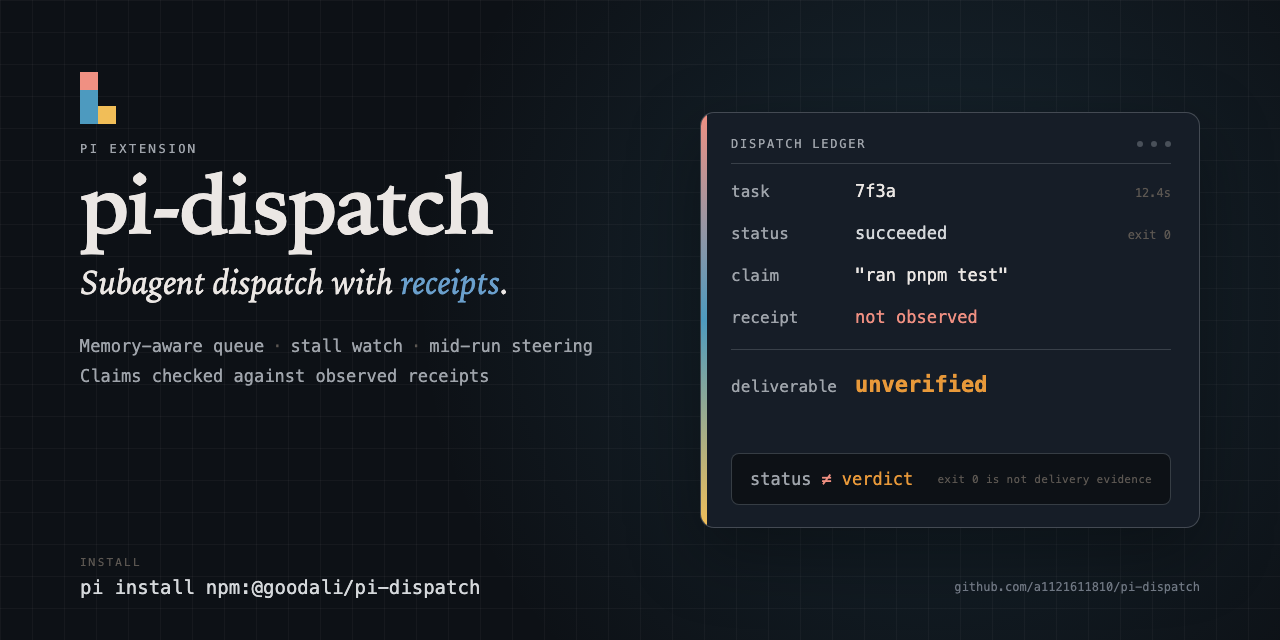
Two jobs for pi: run child agents, and check what they say they did.
- Dispatch sizes seats from a memory budget, queues when they run out, and can stop or steer a running child. It runs inside pi.
- Audit reads any session log — pi, Codex, Claude Code — and matches each claim against the receipts the agent's own actions left behind. No model call, and it works on logs pi never wrote.
Dispatch (live, inside pi)
  dispatch_task ──▶ seat pool ──▶ child pi ──▶ tool calls
                    (memory budget; no seat free? queue, FIFO, never reject)
  dispatch_steer ──▶ mailbox ──▶ child reads at next turn boundary
  dispatch_stop  ──▶ SIGTERM ──▶ SIGKILL
  dispatch_list  ◀── ledger ──▶ status      = exit code
                     ~/.pi/…      deliverable = claims vs receipts

Audit (after the fact, anywhere)
  codex / claude / pi .jsonl ──▶ claims vs receipts ──▶ verdict
  CLI: session-audit          library: @goodali/pi-dispatch/audit
Install
Either one installs the same build:
pi install npm:@goodali/pi-dispatchpi install git:github.com/a1121611810/pi-dispatchAuditing needs neither: npx @goodali/pi-dispatch session-audit ./session.jsonl --format codex
runs straight from the package.
The git form tracks main; append @v0.1.1 to pin. The npm form takes @0.1.1.
Use the scoped name. pi-dispatch on npm is a different project by another author.
pi does not report an extension whose entry point is missing — it skips it silently. Confirm the extension actually loaded:
pi -p "dispatch a task and give me its taskId"A taskId in the reply means it is installed. If there is none, check whether dispatch_task
appears in the tool list — a missing entry point is the failure this check is looking for.
Compatibility
- Node.js >= 22.19.0
@earendil-works/pi-coding-agent>= 1.0.0 (peer)- Host modes:
rpcandtuidispatch asynchronously and notify on completion;printandjsonwait for the terminal state, because a one-shot host process exits before a background child could deliver anything.
Dispatch
Queue. Seats come from a memory pool: available memory, minus a reserve of 10% of total memory.
Each seat is 512 MiB or 2% of total, whichever is larger. In a long-lived host, tasks wait in FIFO
order when the seats run out. A one-shot host cannot free a seat, so it returns
machine is too tight instead of waiting.
Watch. A child with no activity and no tool call in flight counts as stalled and is shut down. The threshold is 5 minutes by default; it is configurable, and 0 turns it off.
Stop. dispatch_stop removes a queued task, or sends SIGTERM then SIGKILL to a running one.
Stopping one child leaves the others running.
Steer. dispatch_steer writes into a mailbox the child reads at its next turn boundary. In-flight
tool calls are not interrupted. Up to 4096 characters per message, 16 messages per task.
Keep a ledger. Every accepted dispatch writes a record under ~/.pi/dispatch/<project bucket>/,
with atomic writes, compressed archives, and restore on restart. A dispatch rejected before it is
assigned an id — by a gate, or by the one-shot capacity check — leaves no record.
Audit
The final report a child writes is a claim. The receipts are what pi observed it do. A dispatch ends with two values that are computed separately:
status— the process outcome. An exit code decidessucceededorfailed;canceled(removed from the queue before running) andlost(reconciled away) are lifecycle outcomes with no exit code behind them. None of these is a quality verdict.deliverable— whether claims are supported by receipts.
deliverable |
Meaning |
|---|---|
verified |
Every claimed path and command was found in the receipts. |
unclaimed |
A report arrived, but it claimed no paths or commands to check. A read-only analysis looks like this. |
partial |
Some claims matched; the child reports how many of each. |
unverified |
Claims exist and the receipts do not support them. |
absent |
No report, empty text, no paths touched. A child that exits 0 having done nothing lands here. |
unverified also covers a body with no report, a report older than the last steer, a vacuous
self-assessment, and a truncated receipt that still leaves a claim unmatched. It means no observed
evidence, not proof of lying. A file changed through bash or
sed -i cannot appear as a path receipt (the command itself can), and a path written as .. has to
be resolved against the working directory before it can be matched, so an honest child can be marked
unverified. The record states what was observed; it does not conclude that the child lied.
The exact matching rules — suffix matching for paths, per-segment trust for compound commands — are in
docs/spec/core-spec.html. Inside pi, the receipt window is capped at 20
entries; the CLI below keeps every one unless you ask for a cap.
Checking a log that pi did not produce
dispatch_list can only audit children pi itself started. The same check also runs offline against a
raw session log, for runs that happened elsewhere:
npx @goodali/pi-dispatch session-audit ./session.jsonl --format codex --json
# {"deliverable":"verified","claims":{"paths":["src/a.ts"],"commands":["pnpm test"]},
#  "receipts":{...},"mismatch":{"paths":[],"commands":[]},"truncated":false,"notes":[]}
The plain-text render prints in Chinese (判词 verified 自述 2 路径 / 1 命令); --json is the
language-neutral form.
--format codex|claude|pi|kimi|minimax— which log shape to read.kimitakes either thewire.jsonlor the session directory (it resolvesagents/main/wire.jsonl).minimaxreadsmessages.jsonlfrom the per-session directory under~/.minimax/v2/sessions/YYYY/MM/DD/(it auto-detects bothexecution/ptc/flatlayouts).--cwd DIR— base for relative paths in claims.--max N— keep only the last N command / first N path receipts (default: keep all).--json— the full record;--strict— treatunclaimedas a failure.
Exit codes: 0 for verified, and for unclaimed with nothing observed; 1 for the rest, including
unclaimed after files were touched; 2 when the log cannot be parsed.
It runs no model and opens no socket — it is regex matching over the log you already have. On 50 real session logs that measured ~100 ms per run (CPU only), against ~13 s and ~19k tokens for asking a model the same question.
Notes ride along with the verdict: self-reported failure, no auditable claim,
vague success claim, report predates last steer.
Known blind spots: a path receipt only comes from a write tool or a shell redirect (>, >>, tee).
Edit files through vim, an IDE, or a subagent, and no receipt exists — the report can be honest and
still come back unverified. That is stated, not hidden.
Minimax blind spots (beyond the generic ones above): the PTC layout has completed bash sub-calls with
no exit-code marker in the output (roughly 9 out of 10 PTC bash calls fall into this bucket) — they
do not produce receipts, so a child's "ran through" claim lands in unverified. Same for timed-out
or cancelled bash commands in the flat layout — no exit code, no receipt. In both cases the record says
"no evidence observed"; it does not say the child lied.
import { audit } from "@goodali/pi-dispatch/audit";Where it fits
Pi ships with powerful defaults but skips features like sub-agents and plan mode. Ask Pi to build what you want, or install a package that does it your way. — pi's own README
pi ships examples/extensions/subagent as a copyable reference: a single agent, up to eight parallel
tasks with four running at once, or a chain. It is an example, not a maintained package. If that
shape fits, copy it.
The ecosystem already has mature packages. Each line is what that package is best at, from its own documentation:
pi-subagents— scripted multi-agent workflows, missions, configurable acceptance gates.@tintinweb/pi-subagents— Claude Code-style named agents, with a queue and a live fleet view.@quintinshaw/pi-dynamic-workflows— JavaScript fan-out with journaled resume.pi-better-subagents— detached runs in an OS sandbox.
Two design choices separate this package, and both are about defaults rather than features:
| pi-dispatch | A configured concurrency cap | |
|---|---|---|
| When a child waits | seats sized from available memory, minus a 10% reserve | the number you wrote down |
| What a dispatch returns | exit code plus a verdict checked against receipts | exit code plus the child's summary |
The packages above check work too: by running a command you configure, or by asking other models to
vote. This one reads the edit, write, and command receipts the parent already observed, so there
is nothing to configure. That is a different mechanism, not a stronger one.
Where they are ahead: OS sandboxing, journaled resume, workflow and persona systems, and a live UI. If you need those, use them.
Package descriptions were checked against upstream documentation on 2026-11-26. Upstreams move quickly; verify before relying on any claim here.
Dispatch tools
| Tool | What it does |
|---|---|
dispatch_task |
Dispatch a child. taskDescription is required; everything else is optional. |
dispatch_list |
Read records: status, duration, usage, report, receipts. |
dispatch_blackboard |
Read this session's shared blackboard. Read-only. |
dispatch_steer |
Change a running child's direction. Running tasks only. |
dispatch_stop |
Stop a task: remove it from the queue, or signal it. |
Optional dispatch_task parameters include readOnly (strict or lenient), model,
thinkingLevel, timeoutMs, projectContext, allowScripts, isolation, blackboard, and
usageBudget.
Isolation and blackboard
Both are off by default. With both off, records, argv, the child's tool list, and the on-disk layout are unchanged from a plain dispatch.
isolation: "worktree" puts the child in a separate git worktree with a clean checkout. Three
costs: the checkout has no node_modules, so running tests means installing dependencies; the
child must commit its own work, because the parent does not commit for it; and merging is the
parent's job — review, then git merge --ff-only pi-dispatch/<taskId>, then remove the worktree
and delete the branch. Outside a git repository the check refuses the dispatch, leaving no record.
Isolation is not a sandbox — it isolates the working directory, not the network, the process
tree, or the home directory.
blackboard: true gives children in this session a shared board they can read and write.
dispatch_blackboard reads it from the parent. Nothing on the board is trusted: every message
arrives with trust=unverified, and any trust a file claims about itself is ignored. Treat it as
leads, not facts. The author stamp is a tool contract, not a security boundary. readOnly: "strict"
children can still read and write the board. With a single child there is nothing to exchange, so
the board is just noise.
Dispatch limits
- Steering lands at a turn boundary. A long tool call in progress is not interrupted; the
message enters the child's context after the current tool batch finishes.
sentonly means the message reached the mailbox. Delivery is a separate receipt state:queued,delivered,seen,undelivered. - A steer written after the child's last
turn_endis never delivered. The child is done; it will not be replayed. The parent seesundeliveredand must dispatch again. - A report can predate the last steer. If the tool-channel report is older than the last delivered steer, the record is marked stale and loses its short-window eligibility.
- One-shot hosts have no steering window. In
printandjsonthe parent is blocked insidedispatch_task, so steering only makes sense inrpcandtui. - Notifications arrive at a turn boundary. In long-lived hosts the completion notification is delivered on the next turn, so a child finishing at the end of turn N is seen at turn N+1.
- A synchronous wait can be long. In
printandjsonthe parent's tool call stays open for the child's whole run.timeoutMsand the stall check bound it. - Zero seats returns immediately. Under memory pressure
seatCapis 0; no child in this process can finish and free a seat, so the dispatch returns "machine is too tight" rather than hanging. readOnly: "strict"is not a sandbox. It blocks writes, not reads.
Documentation
docs/spec/core-spec.html— design and the delivery verdict rulesGLOSSARY.md— terms used in records, receipts, and specsCHANGELOG.md— what changed in each versionCONTRIBUTING.md— build, test, and the breakpoint disciplineAGENTS.md— working notes for coding agents (in Chinese)workflows/release.md— release procedure (in Chinese)
License
MIT, see LICENSE.