@mrclrchtr/supi-extras
Compact codemode rows, session capability controls, prompt stash, shortcuts, and activity indicators
Package details
Install @mrclrchtr/supi-extras from npm and Pi will load the resources declared by the package manifest.
$ pi install npm:@mrclrchtr/supi-extras- Package
@mrclrchtr/supi-extras- Version
14.1.0- Published
- Nov 21, 2026
- Downloads
- 2,238/mo · 506/wk
- Author
- mrclrchtr
- License
- MIT
- Types
- extension
- Size
- 307.6 KB
- Dependencies
- 2 dependencies · 2 peers
Pi manifest JSON
{
  "image": "https://raw.githubusercontent.com/mrclrchtr/supi/main/packages/supi-extras/assets/social-preview.png",
  "extensions": [
    "./src/extension.ts"
  ]
}
Security note
Pi packages can execute code and influence agent behavior. Review the source before installing third-party packages.
README
@mrclrchtr/supi-extras


Adds a bundle of small quality-of-life features to the pi coding agent.
- Compact codemode rows — see the nested tool calls of a
codemodescript at a glance instead of a wall of code. - Session capabilities — choose extension tools and model-visible skills per session, with reusable profiles.
- Prompt stash — save, restore, and copy prompt drafts across restarts.
- Footer and activity — Git status, cache-hit rate, context usage, and a tab-title spinner.
- Safe defaults — headless git editors and a default
bashtimeout.
Install
pi install npm:@mrclrchtr/supi-extras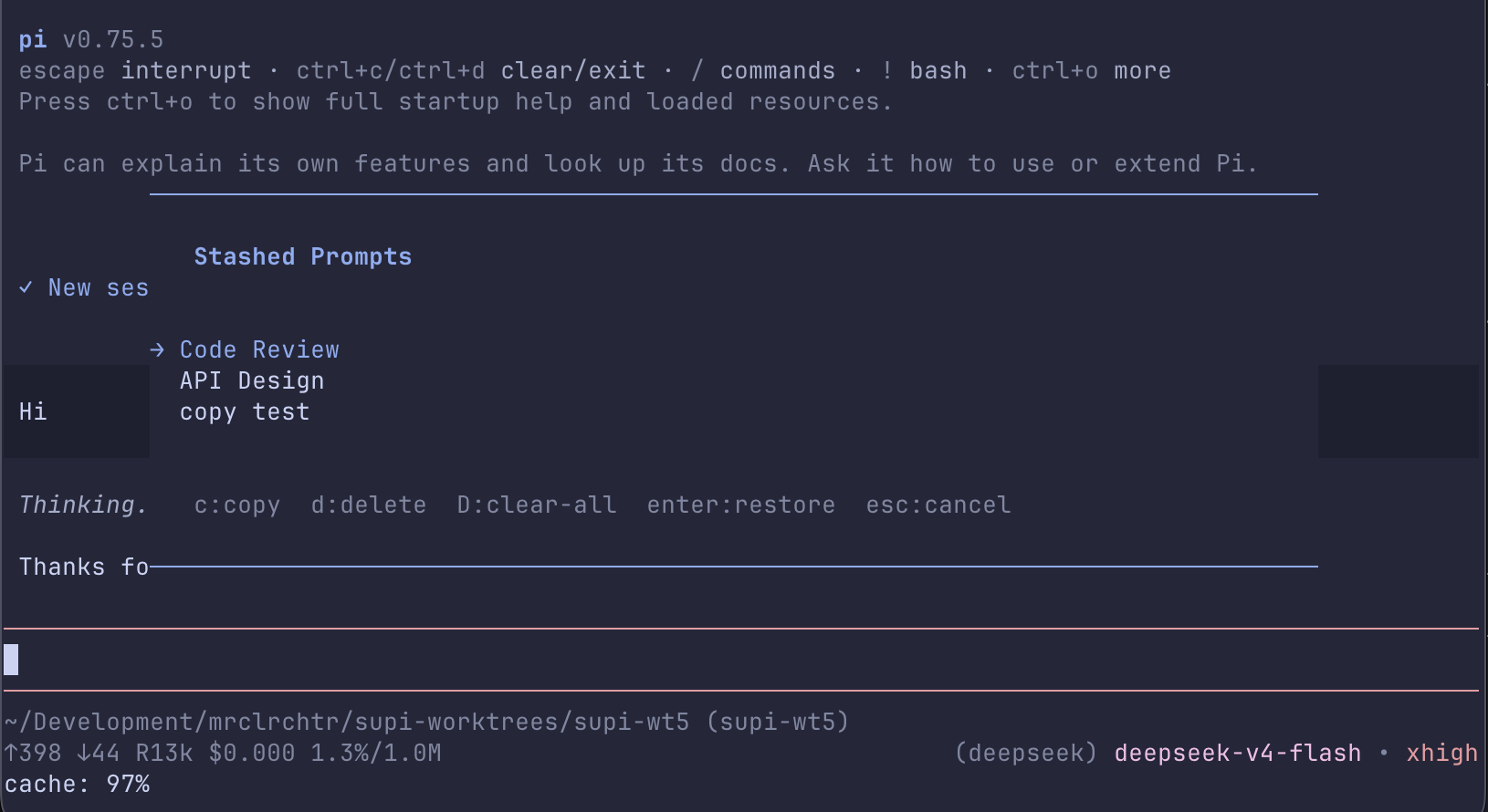
Commands
/exit— exit pi/e— alias for/exit/clear— start a new session (alias for/new)/clone-session <session-id>— clone a session into the current worktree and switch to it; autocomplete searches IDs and session names/supi-stash— browse, restore, copy, delete, or clear saved prompt drafts/supi-capabilities— choose extension tools and model-visible skills for this session
Session capabilities
/supi-capabilities opens a searchable selector. Use it to change extension tool and skill visibility for the current session.
- The selector lists only extension tools that were active at startup. It does not list PI built-in tools or tools supplied by integrations.
- Tool and skill overrides are stored in the session. Resume restores them. Fork and
/clone-sessioncopy them. New sessions use the optional default profile; without a default, they start without overrides. - Tree navigation keeps explicit capability tool choices and does not change other tool choices.
- The selector waits until the agent is idle before it opens. It does not interrupt a running tool call.
- Saved tool and skill exclusions remain stored when an item is absent. They apply if the item becomes eligible later.
- Skill changes affect the model skill catalog only. Explicit
/skill:namecommands and$nameshortcuts stay available. - Use Reset Tools, Reset Skills, or Reset All to remove overrides.
- The footer shows an override count and the applied profile name.
Modifiedmeans session exclusions differ from the copy captured when the profile was applied.
Install @mrclrchtr/supi-skills to manage skills. Tool controls work without that package.
Session Capability Profiles
Use Tab to open Profiles in /supi-capabilities. Apply a saved profile, save current exclusions under a new name, replace or delete a saved profile, or choose a default. Saving requires an explicit global or project scope. Replacement and deletion require confirmation.
Profiles contain exclusions, not a fixed list of available capabilities. New eligible tools and skills remain available unless their exact names are excluded. Package rows select current tools only; they do not create rules for future tools. Profiles do not change the model, instructions, child Agent Profiles, or security permissions.
Store definitions in ~/.pi/agent/supi/config.json or a trusted project's .pi/supi/config.json:
{
  "sessionCapabilities": {
    "profiles": {
      "research": {
        "excludedTools": ["agent_run"],
        "hiddenSkills": ["implement"]
      }
    },
    "defaultProfile": "research"
  }
}- Profile IDs contain lowercase words separated by optional hyphens. Omitted exclusion lists are empty. Unknown fields and invalid values produce errors.
- Project profiles and defaults require Pi project trust. A project definition replaces the complete global definition with the same ID. An invalid project definition blocks that ID; it does not use the global definition instead.
- An absent project
defaultProfileinherits the global default. Set it tonullto use no default in that project. Missing or invalid defaults produce a warning and normal startup without profile exclusions. - Applying a profile replaces both session selections and stores a separate session copy. Later configuration edits, deletion, and reload do not change that copy. Resume and fork do not apply a new default.
- Saving a profile does not apply it. Apply it explicitly to use its current saved definition.
- Deletion leaves default references unchanged. Deleting a project definition can expose a same-ID global definition; the confirmation explains this effect.
- Reset All clears session exclusions and profile identity. It does not change saved profiles or defaults, and it does not reapply the default in the current session.
- Manual profile management is TUI-only. Configured startup defaults also work in non-interactive modes.
Shortcuts
Alt+S— stash the current editor textAlt+C— copy the current editor text to the system clipboard
Prompt stash
Prompt stash stores drafts in ~/.pi/agent/supi/prompt-stash.json so they survive restarts.
/supi-stash opens an overlay with these actions:
Enter— restore the selected draft into the editorc— copy the selected draft to the clipboardd— delete the selected draftD— clear all draftsEsc— close the overlay
If the stash file cannot be read or written, drafts are kept in memory only and can be lost when pi closes.
Passive behavior
Tab-title spinner
While the agent is working, the package animates a spinner in the terminal tab title. When the turn finishes, it shows a done marker. The spinner pauses while a question waits for your answer.
Footer replacement
The package replaces pi's default footer with two lines, each split into sections separated by a dim ·:
~/Development/supi  main !9                                       λ 3✓ ◫43
↑112 ↓52k · R4.5M W146k CH96.9% · $3.113 sub · ▰▱▱▱▱ 11.8%/1.0M   ✦ (anthropic) claude · high
The path line holds workspace state. It shows the Git branch with ahead/behind and file counts, for example main ⇡2 +1 !3 ?1. Counts refresh after tool runs, at most once per second. The stash count includes only stashes created on the current branch, because all worktrees of a repository share one stash stack. Workspace status from other SuPi packages, such as the LSP status, appears on the right.
The session line groups token totals, cache totals with the session cache-hit rate, cost, and context usage. Cache-hit and context values change color at their thresholds; context usage also shows a small bar unless icons are set to ascii. The model and thinking level appear on the right in theme colors, after status icons from other SuPi packages. When the window is narrow, the right side of each line shortens first.
Statuses that other extensions set with Pi's setStatus() appear on a third line.
Configure the footer under /supi-settings → Footer:
| Setting | Values | Default |
|---|---|---|
icons |
auto, nerd, unicode, ascii |
auto |
gitStatus |
true, false |
true |
auto cannot detect the terminal font. It uses Nerd Font icons on a local UTF-8 terminal, Unicode symbols over SSH, and ASCII otherwise. If icons render as boxes, choose unicode. ascii keeps the former path (branch) layout.
Compact codemode rows

One codemode script can chain many tool calls. The compact row shows what the script did, not just its source: in the example above, a 13-line health check ran 7 calls in 1.3 s. Its leading comment becomes the headline, each code_health, code_resolve, and bash call has its own line with its key argument, status, and duration, and the script's one-line result closes the row.
Pi's codemode tool (including wrappers that keep its code input) shows a compact row while collapsed: the script's first line (a leading // comment appears as plain text, so start scripts with one that states their purpose), its nested calls, a status line with duration, call count, failures, and model cost, and the first output line. Expand tool output (ctrl+o by default) to see Pi's full view with the script and output. Nested calls show their key argument (for example a path, command, or code-intelligence query), the error of failed calls, and durations of 100 ms or more. Consecutive identical calls merge into one row with a count (×5) and their summed duration. Long scripts show at most 8 call rows: running and failed calls stay visible, the latest other calls fill the rest, and one … N more calls: bash ×4, read ×4 row stands in for the hidden ones.
Turn compact rows off under /supi-settings → Codemode View; the change applies to new rows and to rows rebuilt on /reload.
| Setting | Default | Description |
|---|---|---|
codemode-view.compact |
true |
Collapse codemode rows to a summary |
Headless git safety
The package sets:
GIT_EDITOR=trueGIT_SEQUENCE_EDITOR=true
That prevents git subprocesses from hanging while waiting for an interactive editor.
Default bash timeout
PI's bash tool has no default timeout. When the model calls bash without timeout, the package fills in a default (600 seconds) so a hung command cannot stall an unattended session. The limit is long enough for typical test and check runs; set an explicit timeout or lower the default for faster failure. Explicit timeout values are kept; other tools are untouched.
Configure it in /supi-settings → Bash Timeout → Default Timeout (seconds), stored in the bash-timeout section of ~/.pi/agent/supi/config.json or .pi/supi/config.json. This replaces the former @mrclrchtr/supi-bash-timeout package; existing settings keep working.