@puglab/pi-claude-bridge
Claude Agent SDK as Pi's model backend, with Pi executing the tools
Package details
Install @puglab/pi-claude-bridge from npm and Pi will load the resources declared by the package manifest.
$ pi install npm:@puglab/pi-claude-bridge- Package
@puglab/pi-claude-bridge- Version
1.0.27- Published
- Nov 26, 2026
- Downloads
- 586/mo · 72/wk
- Author
- brunoorsolon
- License
- MIT
- Types
- extension
- Size
- 204.5 KB
- Dependencies
- 4 dependencies · 2 peers
Pi manifest JSON
{
  "extensions": [
    "./index.ts"
  ]
}
Security note
Pi packages can execute code and influence agent behavior. Review the source before installing third-party packages.
README
Pi Claude Bridge
Use Claude Agent SDK as Pi's model backend while Pi executes the tools and renders tool results in the TUI. Install as @puglab/pi-claude-bridge.
Continuation of claude-agent-sdk-pi
An independent continuation of prateekmedia/claude-agent-sdk-pi, originally created by Prateek Sunal. Maintained by Bruno Orsolon at brunoorsolon/pi-claude-bridge, with the original Git history and MIT notice preserved. Not affiliated with or endorsed by the original maintainer or Anthropic. Project history, validation, and release instructions.
Highlights
- Claude Agent SDK is used as the LLM backend (Claude Code auth or API key).
- Tool execution is blocked in Claude Code; pi executes tools natively.
- Built-in tool calls are mapped to Claude Code tool names.
- Custom tools are exposed to Claude Code via in-process MCP.
- Pi’s complete effective system prompt reaches the SDK unchanged, including parent context, role instructions, project instructions, and skills.
Demo
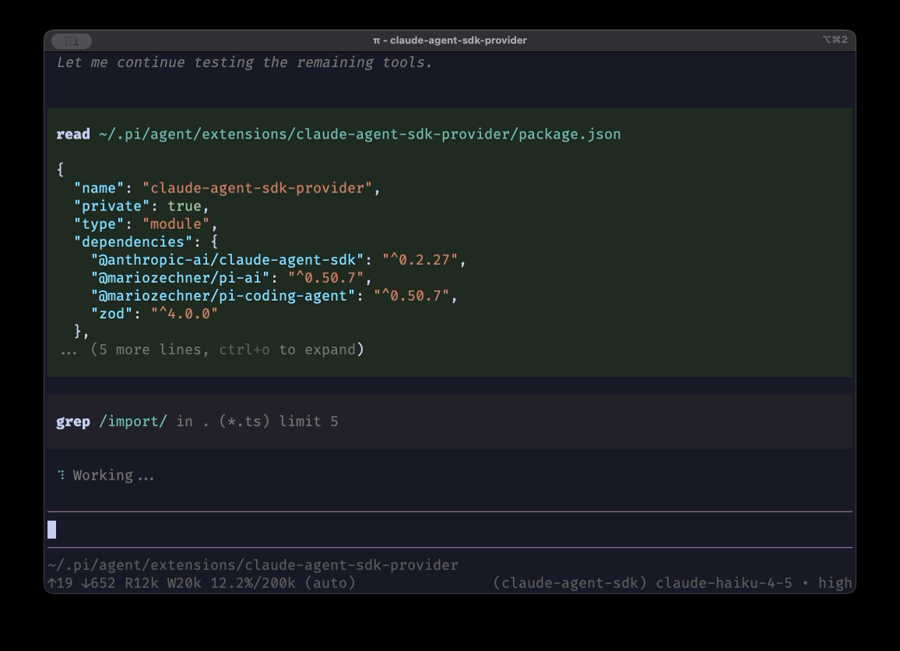
Setup
- Install the extension globally (npm is the preferred source now):
pi install npm:@puglab/pi-claude-bridge@1.0.27Keep the exact version in consumer configuration and preserve the consumer lockfile where applicable.
Alternative (git):
pi install git:github.com/brunoorsolon/pi-claude-bridge@v1.0.27See pi-coding-agent install docs for other install sources and paths.
- Authenticate (choose one):
Claude Code login (Pro/Max):
npx @anthropic-ai/claude-codeEnsure no API key env vars are set.
API key (API plan):
export ANTHROPIC_API_KEY=sk-ant-...
- Reload pi:
/reloadMigrating from the previous package
Once @puglab/pi-claude-bridge@1.0.27 is published, replace the old package rather than loading both:
pi remove npm:@puglab/claude-agent-sdk-pi
pi install npm:@puglab/pi-claude-bridge@1.0.27
If your Pi configuration owns installation, replace the old npm or Git source there instead and preserve its lockfile where applicable. Then reload Pi. The provider ID claude-agent-sdk and the settings keys claudeAgentSdkProvider / claude-agent-sdk-provider are unchanged, so existing model selections and settings still apply. Do not load the original upstream package alongside this one either; it registers the same provider ID.
Provider ID
claude-agent-sdk
Use /model to select:
claude-agent-sdk/claude-opus-4-5claude-agent-sdk/claude-haiku-4-5
Tool Behavior
- Claude Code proposes tool calls.
- pi executes them.
- Tool execution in Claude Code is denied.
Built-in tool mapping (Claude Code → pi):
- Read → read
- Write → write
- Edit → edit
- Bash → bash
- Grep → grep
- Glob → find
Claude Code only sees the tools that are active in pi.
Custom tools
Any extra tools registered in pi are exposed to Claude Code via an in-process MCP server:
- MCP server name:
custom-tools - Claude Code tool name format:
mcp__custom-tools__<toolName> - Example:
mcp__custom-tools__subagent
The provider automatically maps these back to the pi tool name (e.g. subagent).
Subscription quota
Claude Code reports a subscription login's quota in a rate_limit_event after each response. The provider keeps the latest one and serves it on Pi's event bus, so another extension can show it without reading the login:
- Emit
claude-agent-sdk:quota:requestwith{ reply }. The provider callsreply({ ok: true, quota })once, wherequotais the latestrate_limit_info(nullbefore the first response). Claude Code 2.1.332 includesunifiedWindows.five_hourandunifiedWindows.seven_day, each withutilization(0–1),resetsAt(epoch seconds), andstatus. claude-agent-sdk:quota:changedfires whenever a new event arrives.
The values are as of the latest completed reply: a turn that ends in a tool call hands control back to Pi before Claude Code sends that turn's event. The provider makes no extra request for quota.
Thinking and output limits
Claude Code counts thinking and text against one output limit, and clamps a manual thinking budget to one token below it. The provider therefore sets the budget (--max-thinking-tokens) and the limit (CLAUDE_CODE_MAX_OUTPUT_TOKENS) from the same numbers:
- Adaptive models (every model except Claude 3, Opus 4.0, 4.1 and 4.5, Sonnet 4.0 and 4.5, and Haiku 4.5, matching Claude Code’s own list) get
--thinking adaptiveand an effort level from Pi’s thinking level. The provider sends no budget and leaves the output limit to Claude Code’s model default or your ownCLAUDE_CODE_MAX_OUTPUT_TOKENS. Pi’s per-requestmaxTokensis not forwarded. - Other reasoning models get a manual budget from Pi’s thinking level or your
thinkingBudgets. The output limit is the budget plus 32,000 tokens of text room, capped at the model’s output limit; 32,000 is assumed when Pi’s model metadata has no valid limit. When the limit is too small for that text room, thinking takes at most half of it, but never less than the API’s 1,024-token minimum budget. A limit of 1,024 tokens or less disables thinking. - Explicit caps bound manual budgets. Pi’s per-request
maxTokens(Pi compaction sets one) and your ownCLAUDE_CODE_MAX_OUTPUT_TOKENSare each a ceiling for the whole output; the lower one applies, still capped at the model’s output limit. The provider never raises a cap to make room for thinking; it shrinks the thinking budget instead. Claude Code 2.1.126 readsCLAUDE_CODE_MAX_OUTPUT_TOKENSas a leading integer (20000.5is 20,000); 2.1.316 also accepts scientific notation and digit groups (2e4,64,000). The provider honors the lowest of these readings. It passes your value through as written only when both versions accept it and neither reading exceeds Pi’s cap; otherwise it sends the lowest cap as a plain integer. A value every version rejects counts as unset. - Requests without a thinking level send no thinking or output settings.
Context loading
The provider always transmits Pi’s effective system prompt verbatim: context.systemPrompt under Pi 0.74, or, because Pi 1.x passes providers only a { messages } transcript, the prompt and tool list rebuilt from its system messages with Pi’s own getCurrentSystemPrompt and getCurrentTools. Pi owns instruction assembly. The provider does not reread AGENTS.md, extract selected skills, rename tools in instructions, or rewrite instruction text or paths. Built-in tool-name and argument-key mapping described above remains unchanged; tool paths are no longer rewritten to compensate for rewritten skill instructions.
- Default (
appendSystemPrompt: true): append the complete Pi prompt once to the SDK’sclaude_codepreset. - Changed behavior (
appendSystemPrompt: false): use the complete Pi prompt as the SDK’s replacement system prompt, without the Claude Code preset. This setting no longer suppresses Pi instructions. Existing users who relied on Claude-only instructions must migrate; there is no silent instruction opt-out. If you followed the previous symlink setup, remove the~/.claude/CLAUDE.mdand~/.claude/skillslinks to Pi resources when they duplicate Pi’s prompt; remove only the symlinks, not their targets. settingSourcesstill selects Claude Code filesystem settings. WithappendSystemPrompt: false, its default remains["user", "project"]. Explicitly selected Claude resources are additional to Pi’s prompt; avoid linking the same instructions into both systems.strictMcpConfigstill defaults tofalsein append mode andtruein replacement mode. Enable it to prevent unrelated MCP servers from being auto-loaded. SDK-side execution remains denied in either mode.excludeDynamicSectionsis off by default. Enable it to strip Claude Code’s per-user dynamic preset sections (working directory, auto-memory, git status) from the system prompt so it stays static and cacheable; the supplied Pi prompt is still appended unchanged. It only affects the Claude Code preset, so replacement mode (appendSystemPrompt: false) has no preset sections to exclude and ignores it.
For the Claude Code preset plus Pi’s complete prompt, without inherited settings or MCP servers:
{
  "claudeAgentSdkProvider": {
    "appendSystemPrompt": true,
    "settingSources": [],
    "strictMcpConfig": true
  }
}
Custom-tool schema compatibility
Pi supplies JSON Schema, while the Agent SDK’s high-level tools[].inputSchema interface expects a Zod raw shape. The provider uses the public low-level MCP request handlers on the SDK-created server instead: tools/list advertises Pi’s original JSON Schema without conversion, and tools/call returns the existing execution-denied error. This preserves required fields, nested objects, arrays, enums, references, records, and validation constraints without a lossy Zod round trip. Invalid MCP tool envelopes fail with the offending Pi tool’s name rather than falling back to an empty schema. Pi remains responsible for validating and executing actual calls.
Compatibility checks
Development dependencies retain upstream’s Pi 0.74.x baseline; peer ranges also allow Pi 1.4 and later compatible 1.x releases. Pi 1.x’s extension loader supplies the legacy API compatibility view used by this extension. Run npm ci --ignore-scripts, npm test, and npm run typecheck on Node 24. To repeat the same seam checks with another installed Pi version, set PI_TEST_AGENT_ENTRY to the file URL of that installation’s dist/index.js. The tests load the extension through Pi’s actual loader and run the official SDK against a disposable, credential-free transport fixture. Under Pi 1.x loaders each provider call receives a { messages } transcript shaped like Pi’s own: the prompt in system-message sections, and tools as additions and removals. They check effective instruction transmission, actual MCP discovery, Pi-side tool argument/result delivery, SDK execution denial, streaming, adaptive and manual thinking settings with the child process's output limit, invalid contracts, and cancellation. They do not contact Claude or prove live subscription access.