pi-herdsman
Asynchronous Pi subagents and agent fleet orchestration for parallel coding agents with nested delegation, background work, and supervision in herdr.
Package details
Install pi-herdsman from npm and Pi will load the resources declared by the package manifest.
$ pi install npm:pi-herdsman- Package
pi-herdsman- Version
0.47.1- Published
- Nov 14, 2026
- Downloads
- 9,899/mo · 2,633/wk
- Author
- boadij
- License
- Apache-2.0
- Types
- extension, skill
- Size
- 6.7 MB
- Dependencies
- 1 dependency · 4 peers
Pi manifest JSON
{
  "image": "https://raw.githubusercontent.com/boadij/pi-herdsman/main/docs/assets/thumbnail.webp",
  "skills": [
    "./SKILL.md",
    "./skills"
  ],
  "extensions": [
    "./dist/index.js"
  ]
}
Security note
Pi packages can execute code and influence agent behavior. Review the source before installing third-party packages.
README
Pi Herdsman 🐏
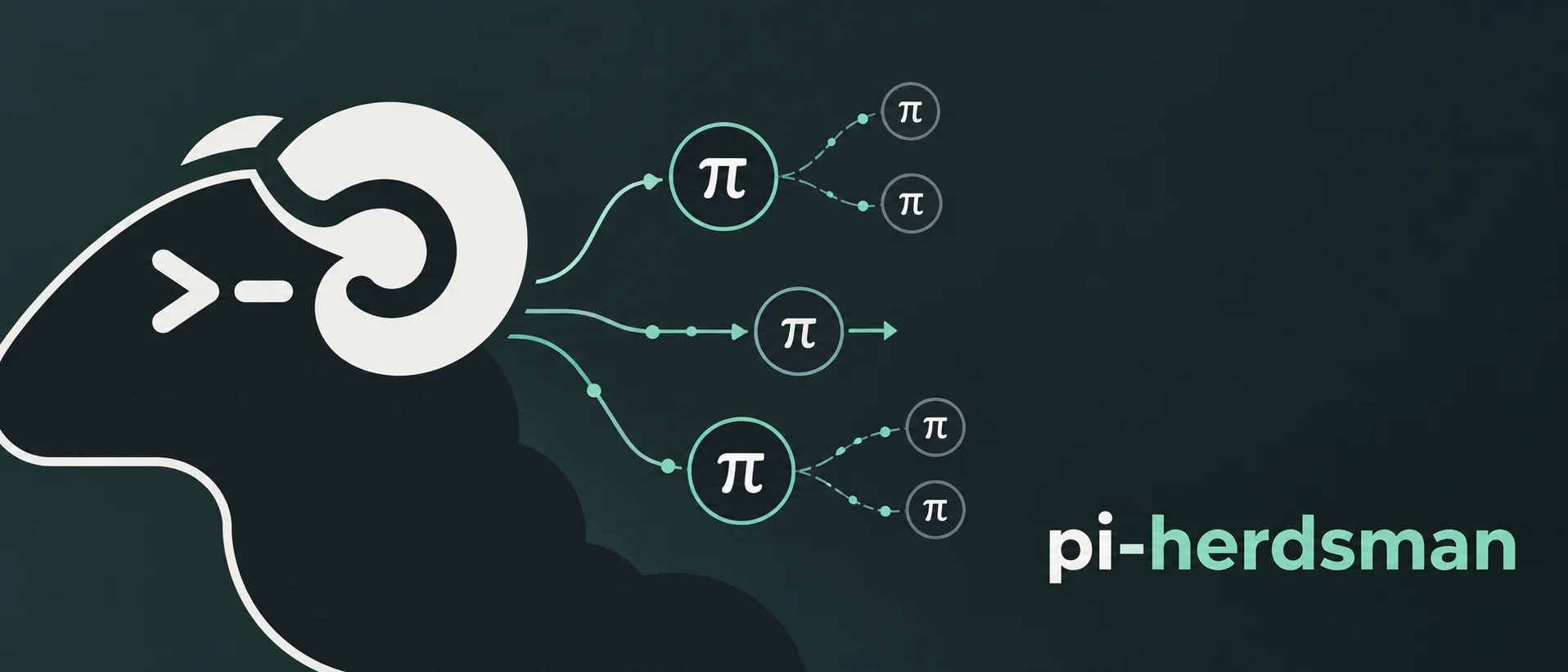




The orchestration layer between Pi and herdr.
Pi Herdsman lets your AI coding assistant delegate work to background Agents while your conversation stays interactive, or coordinate larger projects across independent, branch-based Leads. Pi handles model conversations, herdr manages terminal sessions and workspaces, and Herdsman coordinates delegation, ownership, and supervision.
Emergent agentic workflows
Define the boundaries, not the workflow.
Fixed agent pipelines prescribe the next handoff. Pi Herdsman instead lets models decide how to split work, delegate to permitted Agents or Leads, and sequence or parallelize tasks as results arrive. The execution path emerges at runtime, while Herdsman enforces delegation permissions, ownership, project assignments, and supervision.
Specialize Agents by responsibility and compose their execution capabilities through models, instructions, tools, and Pi extensions. Reuse shared expertise as preloaded instructions or on-demand skills. Herdsman coordinates bounded work without owning domain-specific behavior. Bring your own definitions or workflows; see Agent definitions and Coordination.
Demo
Advanced orchestration: a live Manager → Lead → Agent workflow.
Quick start
Linux/macOS:
curl -fsSL https://raw.githubusercontent.com/boadij/pi-herdsman/main/install.sh | shWindows (PowerShell):
irm https://raw.githubusercontent.com/boadij/pi-herdsman/main/install.ps1 | iexAlready using Pi and herdr?
pi install npm:pi-herdsman
herdr integration install pi
Start herdr in your project directory, then run pi in its pane. Try:
Use scout to identify this repository's main entry points.
Explain how the application starts.
The Agent works asynchronously and returns its result to your Pi conversation.
Use /herdsman to discover controls. See Getting started
for prerequisites, model login, and troubleshooting, or
Container deployment for Docker Compose.
What Pi Herdsman gives you
- Background Agents. Delegate bounded work without blocking your conversation.
- Parallel and nested delegation. Run independent work concurrently; permitted Agents can delegate their own subtasks.
- Project orchestration. A Manager coordinates durable, branch-based work across independent Leads.
- Explicit authority. Chief, Manager, Lead, and Agent responsibilities have distinct supervision and ownership boundaries.
- Peer communication. Eligible sessions can exchange messages locally and, where supported, across connected machines.
- Usage visibility. Inspect Pi-native token and cost records for owned Agents and, for an active Manager, assigned Leads.
- Your tools, your workflow. Bring your own Agent definitions, Coordinator profiles, models, tools, skills, extensions, and development process.
From one Agent to a project
A normal Pi session is a Lead. It can own Agents, including permitted nested Agents:
You ↔ Lead
      ├─ Agent
      │  └─ Agent
      └─ Agent
For independent project work, an eligible Lead can enter Manager mode. The Manager assigns branch-based objectives to Leads, which direct their own Agent trees:
You ↔ Manager
      ├─ Lead → Agents
      └─ Lead → Agents
An optional Chief supervises Managers and eligible ordinary Leads without an active project Manager. These roles define authority, not a mandatory task sequence. Project assignments remain durable across Manager turnover.
See Coordination for role boundaries and Project orchestration for assignments, recovery, and integration.
Project status & roadmap
Pi Herdsman is pre-1.0. These capabilities are available today:
- Lead & Agent orchestration. Background and nested delegation, result handoffs, and local peer communication.
- Manager orchestration. Branch-based work assignments, supervision, pause/resume, and authorized local integration.
- Chief supervision. Supervises current Managers and eligible ordinary Leads within one herdr runtime.
- Federated peer messaging. Eligible Managers and ordinary Leads can communicate across connected machines, with durable replies.
Current federation limitations: Independent discovery and initiation require an SSH route from the initiating machine; an existing correspondence allows replies without reverse SSH. Different Herdsman builds cannot yet exchange ordinary messages. See Peer communication.
Open proposals: bidirectional initiation over one-way connections (#790), cross-build messaging (#688), and portable repository runtime (#755).
Early-stage project: Pre-1.0 releases may introduce breaking changes. See the changelog for release and migration guidance.
Choose your next step
Browse the documentation index, or jump to:
- Start: Getting started
- Orchestrate: Project orchestration and Coordination
- Customize: Agent definitions
- Integrate: Coordination API and Peer communication
- Contribute: Contributing
Community
Questions, workflows, examples, and ideas are welcome in GitHub Discussions.
For reproducible bugs and concrete actionable work, use GitHub Issues.
Thanks to everyone who improves Pi Herdsman through code, reports, and investigations. See Community contributors for acknowledgments.