pi-tui-status-beautifier
Clean up your Pi terminal status bar — non-destructive extension badge formatting (Claude, Stream, Nord, Glow), incremental narrow-pane folding, live spinners, and opt-in Pi 1.7 footer.
Package details
Install pi-tui-status-beautifier from npm and Pi will load the resources declared by the package manifest.
$ pi install npm:pi-tui-status-beautifier- Package
pi-tui-status-beautifier- Version
1.10.1- Published
- Nov 29, 2026
- Downloads
- 1,192/mo · 109/wk
- Author
- jason-zeros
- License
- MIT
- Types
- extension
- Size
- 74.1 KB
- Dependencies
- 0 dependencies · 2 peers
Pi manifest JSON
{
  "image": "https://raw.githubusercontent.com/3ZEROS12/pi-tui-status-beautifier/master/assets/hero-en.svg",
  "extensions": [
    "./extensions/tui-status-beautifier.ts"
  ]
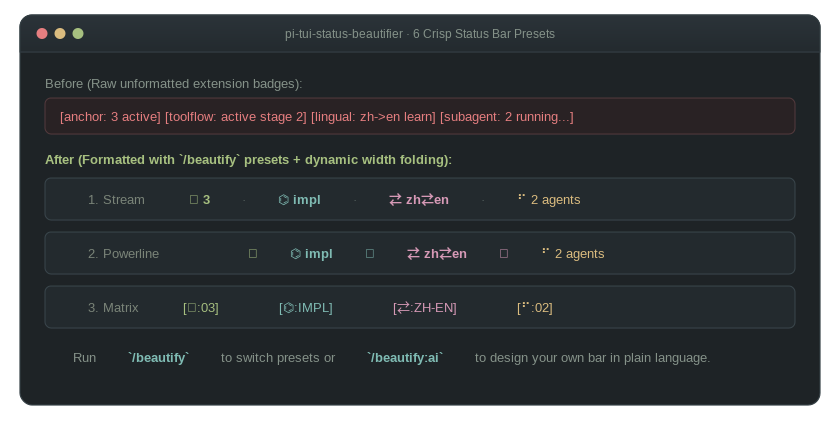
}
Security note
Pi packages can execute code and influence agent behavior. Review the source before installing third-party packages.
README
pi-tui-status-beautifier
Formats Pi extension status badges consistently, with an opt-in Pi 1.7 telemetry footer and priority badge folding on narrow panes.



English | 简体中文
Overview
Pi extensions write status text in different conventions — package prefixes, ANSI wrappers, brackets, and emojis — that wrap unevenly inside split terminal panes. pi-tui-status-beautifier normalizes extension names (pi-anchor → anchor, pi-control-chrome → chrome) without truncating away meaningful status words like "error: port 3000 in use" or "tsserver ready".
- Non-invasive default (
status-only): keeps Pi's native footer untouched and only styles extension status items unless you explicitly enable the two-line footer. - Opt-in 2-line footer (
footer: on): replacessetFooterwith Pi 1.7 parity metrics (~/path,sessionName,↑↓RW, latest-turnCH%,$cost,(sub),?/<win>, multi-provider prefix) on Line 1, plus greedy priority badge folding and a live 300ms spinner interval on Line 2.
Visual Demo

Before: [anchor: ⌖ 3]  [toolflow: 3 chained]  [pi-lingual: zh ⇄ en]  [subagent: working]
After:  anchor · ⌖ (3)  toolflow · ⌬ (3 chained)  lingual · ⇄ (zh ⇄ en)  subagent · ◐ (working)
4 font-safe presets (claude default, stream, nord, glow), plus custom (edited directly via JSON) and off.
Install & Usage
pi install npm:pi-tui-status-beautifier/beautify supports interactive Tab completions:
/beautify                  # interactive preset + scope picker
/beautify info             # show current style, scope, and settings target
/beautify nord             # switch preset while keeping current scope
/beautify footer           # toggle the opt-in 2-line telemetry footer
/beautify stream full      # set preset and enable the 2-line footer
/beautify custom           # activate custom config, or open multi-line JSON editor
/beautify custom edit      # open ctx.ui.editor() directly to edit custom style JSON
/beautify off              # restore native Pi status/footer and remove config keys
Add --local (e.g. /beautify claude --local) to store overrides in ./.pi/settings.json instead of ~/.pi/agent/settings.json.
Configuration & Architecture
Settings live under "beautifier" in ~/.pi/agent/settings.json (or ./.pi/settings.json when project-scoped):
{
  "beautifier": {
    "style": "claude",
    "fullFooter": false
  }
}- Priority & folding: unified severity classification (
error,warning,runningstay high priority) packs compact idle badges greedily alongside(+N idle)withinwidth - 2using@earendil-works/pi-tuicell widths. - Retired config migration: older saved names (
linear,minimal,powerline,glass,tokyo,matrix,openai,gemini) migrate automatically when loaded fromsettings.json. - Clean revert:
/beautify off(ordefault) deletesbeautifierfrom both local and global settings files and restores original status strings. - Ecosystem: preserves
⌖(pi-anchor),⌬(toolflow), and⇄(pi-lingual).
npm run check # tsc --noEmit + eslint + 24 Vitest testsMIT © Jason