@99percentpeople/pi-todo
A minimal atomic todo tool with omission-based deletion, compaction-safe state, dependencies, and a read-only Pi widget
Package details
Install @99percentpeople/pi-todo from npm and Pi will load the resources declared by the package manifest.
$ pi install npm:@99percentpeople/pi-todo- Package
@99percentpeople/pi-todo- Version
1.2.8- Published
- Sep 21, 2026
- Downloads
- 1,109/mo · 119/wk
- Author
- 99percentpeople
- License
- MIT
- Types
- extension
- Size
- 118.4 KB
- Dependencies
- 0 dependencies · 4 peers
Pi manifest JSON
{
  "extensions": [
    "./index.min.js"
  ]
}
Security note
Pi packages can execute code and influence agent behavior. Review the source before installing third-party packages.
README
@99percentpeople/pi-todo
A minimal, atomic todo tool for the Pi coding agent.
The model writes the complete task plan in one call instead of issuing one
create call per task.
You see your plan as a live list above the input box: progress, active task, and dependencies update as the model works, and finished tasks roll off automatically. No commands to learn — just let the model maintain the plan.
The extension intentionally has no todo-specific slash commands, interactive manager, or user-editable todo interface. Todo state belongs to the model. A read-only list is rendered above Pi's input box.
Demo
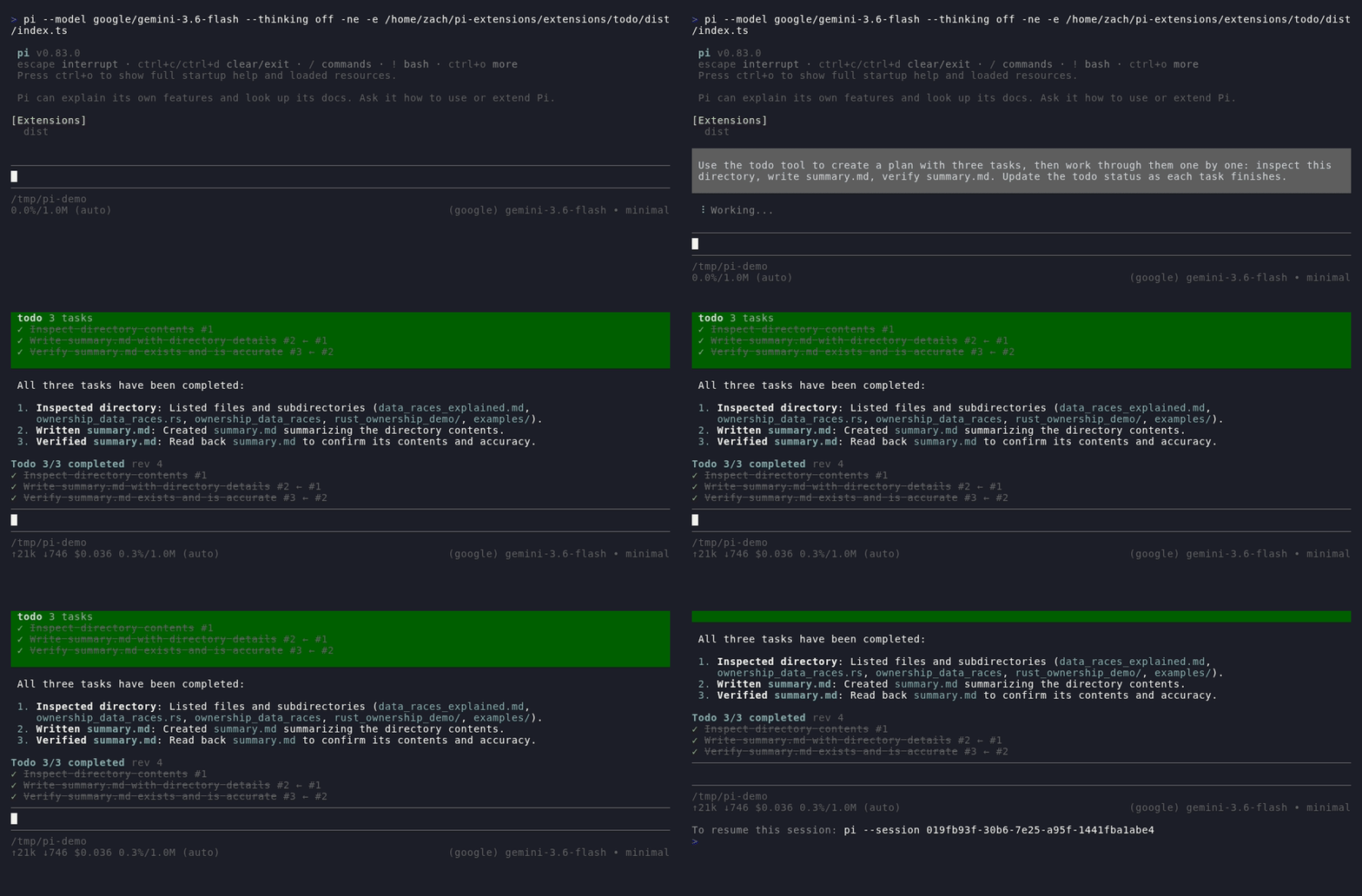
The model creates the plan, works through it, and the widget tracks progress
from 0/3 to 3/3 completed:
Features
- One-call creation of a complete plan
- One-call completion and handoff to the next task
- Omission-based deletion without retained cancelled or archived tasks
- Stable task keys and key-based dependencies
- Atomic validation with optional optimistic revisions
- Branch- and compaction-aware state that survives
/reloadand/tree - Configurable compact reminders that keep the plan salient to the model
- Read-only collapsible list above the input box
Install
This extension registers the todo tool. Remove another extension that owns the
same tool name before installing it:
pi remove npm:@juicesharp/rpiv-todo
pi install npm:@99percentpeople/pi-todo
During local development:
pi -e ./extensions/todo/index.tsTool schema
The todo tool accepts the complete authoritative list of tasks to retain.
Existing tasks may omit unchanged fields; a new key requires subject and
status. Any current key omitted from tasks is permanently deleted:
todo({
  baseRevision?: number,
  tasks: Array<{
    key: string,
    subject?: string,
    description?: string,
    status?: "pending" | "in_progress" | "completed",
    dependsOn?: string[],
  }>,
})
Example:
{
  "baseRevision": 0,
  "tasks": [
    {
      "key": "inspect",
      "subject": "Inspect the existing implementation",
      "status": "in_progress"
    },
    {
      "key": "implement",
      "subject": "Implement the optimized protocol",
      "status": "pending",
      "dependsOn": ["inspect"]
    },
    {
      "key": "verify",
      "subject": "Verify the implementation",
      "status": "pending",
      "dependsOn": ["implement"]
    }
  ]
}
To hand work off, include every current key but only send changed fields:
{
  "baseRevision": 1,
  "tasks": [
    { "key": "inspect", "status": "completed" },
    { "key": "implement", "status": "in_progress" },
    { "key": "verify" }
  ]
}
Subjects and dependencies are inherited from the previous snapshot. Both status changes commit atomically.
To cancel or otherwise delete work, omit its key from the next complete plan:
{
  "baseRevision": 2,
  "tasks": [
    { "key": "inspect" },
    { "key": "implement" }
  ]
}
Deletion is permanent state removal. The extension stores no cancelled status
or archived task record. A completed task may retain a dependency only as
history: when its completed prerequisite is omitted, that soft reference is
automatically removed. A pending or in-progress task cannot retain a dependency
on an omitted key.
Semantics
keyis the task identity while that task remains in the plan.- Existing keys inherit omitted fields from their previous state.
- New keys require
subjectandstatus. description: ""anddependsOn: []explicitly clear those fields.- Every key present in
tasksremains in the plan; omitted current keys are permanently deleted. - Completed tasks remain visible for the current turn, then are automatically removed on the next turn. Completed tasks that still block pending or in-progress work are preserved.
tasks: []clears the plan.baseRevision, when provided, rejects stale writes.- Every dependency must refer to another key in the resulting snapshot, except completed-to-completed references are automatically pruned when the target is deleted.
- Dependency cycles are rejected.
- An
in_progressorcompletedtask requires all dependencies to be completed. - Validation is all-or-nothing; failed writes do not mutate state.
- Multiple independent tasks may be
in_progressconcurrently.
Each successful result includes the current revision and complete retained plan. When next-turn cleanup changes the plan, the extension emits one hidden custom message containing the new revision and snapshot so the model never works from stale tool history.
State schema v2 removes internal numeric IDs, archived records, and the
cancelled status. Valid v1 session state is migrated on replay; archived and
cancelled legacy tasks are discarded, and one hidden v2 checkpoint updates the
model on the next prompt.
Model reminders
While unfinished work remains, the extension periodically appends a compact, hidden reminder immediately before an LLM call. The reminder contains only the current revision and complete key/status list—not task subjects, descriptions, or dependency payloads—and asks the model to reconcile changed progress before its final response. It is context-only and is not written to the session, so reminders do not accumulate in conversation history.
The default interval is every three LLM calls. The counter resets after a
successful todo write, session or branch restoration, an injected exact
checkpoint, or a reminder-setting change. No reminder is sent for an empty or
fully completed plan. Use /99settings to select Off, every call, or an interval
of 2, 3, 5, 8, 10, or 20 calls.
Rendering
The task list is rendered in a read-only widget above Pi's input box. In native
Pi TUI mode, it follows Pi's standard tool-output expansion state (Ctrl+O by
default):
- collapsed: overall progress and a configurable number of tasks (three by default);
- expanded: the complete todo list with status glyphs, task names, and resolved prerequisites.
In RPC mode, the extension sends a plain-text widget compatible with clients such as FrostPi. It shows the same collapsed task window and reports how many additional tasks are hidden because RPC widgets do not expose Pi's expand/collapse control.
While the model is streaming a todo call, the tool row updates in place and
shows each task name and its compact dependency references as they are written
instead of only showing a task count.
Sparse updates reuse the current task name and status until their changed fields
arrive. Fields that are not yet known are omitted: a new task appears after its
subject is written, and its status glyph appears only after its status is
available. This live preview uses the configured collapsed-item limit and shows
all tasks when expanded. After a successful write, the result renderer stays
empty because the completed tool call already contains the final list;
validation errors are still displayed below the attempted list.
Tasks always keep their plan order. When collapsed, the widget selects a window
around the first in_progress task where possible. If no task is active, it
shows the first configured number of tasks. Once every task is completed, it
shows the last configured number instead so the most recently finished work
remains visible. The expand/collapse hint is shown only when the complete list
exceeds that limit.
in_progress task labels are rendered in bold in both the live tool call and
widget. The model-facing result still includes keys, dependencies, and
descriptions. In the user-facing display, dependency numbering can be shown or
hidden. When shown, tasks participating in the dependency graph receive
plan-order display numbers after their names, such as ○ Inspect #1 and
○ Implement #2 ← #1. Independent tasks stay unnumbered, multiple prerequisites
use ← #1, #2, and stable task keys remain hidden. These numbers are
display-only and may be reassigned when the plan changes. The shortcut respects
the user's app.tools.expand keybinding.
Persistence
Normal writes are stored in tool-result details. Automatic next-turn removals
are stored in hidden custom-message details; the same message also tells the
model which snapshot and revision are current. On session_start, /reload,
and /tree navigation, the extension restores the latest valid state entry from
the active branch.
After compaction, the extension stores an exact schema-v2 checkpoint outside the model context. It injects that snapshot as one hidden model-facing message on the next prompt, or immediately as steering context when overflow recovery or an already queued continuation proceeds without a new prompt. This preserves exact keys, dependencies, and revision numbers without triggering an extra model turn.
Shared settings
Use the shared /99settings menu to choose how many Todo items are shown while
the widget and streaming tool call are collapsed, whether display-only
dependency numbers are shown, and how often compact model reminders are
injected. Collapsed-item presets are 1, 2, 3, 5, 8, and 10; the default remains
3. Dependency numbers default to shown. Model reminders default to every three
LLM calls and can be disabled. Values are stored under the todo namespace in
~/.pi/agent/99extensions.json.
License
MIT