@a-t-h-i/bot-lobby
Structured multi-agent software engineering orchestrator for Pi
Package details
Install @a-t-h-i/bot-lobby from npm and Pi will load the resources declared by the package manifest.
$ pi install npm:@a-t-h-i/bot-lobby- Package
@a-t-h-i/bot-lobby- Version
0.7.9- Published
- Nov 3, 2026
- Downloads
- 10.5K/mo · 4,537/wk
- Author
- a-t-h-i
- License
- Apache-2.0
- Types
- extension
- Size
- 13.5 MB
- Dependencies
- 0 dependencies · 4 peers
Pi manifest JSON
{
  "image": "https://raw.githubusercontent.com/a-t-h-i/bot-lobby/main/docs/media/lobby.png",
  "extensions": [
    "./src/index.ts"
  ]
}
Security note
Pi packages can execute code and influence agent behavior. Review the source before installing third-party packages.
README
Bot-Lobby
Bot-lobby is a determenistic agentic coding engine. You can come up with a vague description of what you want to create, the agents (Oracle, Dev, Design, QA and Research) ask you a series of questions to help you form a clear picture from the vague description you've provided. The agents can even generate UI mockups that you can pick from. Once you come to an agreement with the agents, they will then get to work, and the harness will enforce the agreed upon plan. The agents are required to follow it faithfully.
I came up with the name bot-lobby from my 6+ years worth of experience in playing online FPS games. The name is normally used as a joke or to mock the other players by stating that you're playing in a bot lobby (playing with robots) because of how incompetent they appear to be. The contrary is true for the bots in bot-lobby though, they are quite smart and capable... Well, depending on the models you choose of course.
Agents ask with real mockups. Expand one, pick it, move on.
AI written wall of text below:
Install
pi install npm:@a-t-h-i/bot-lobbyTry it first with pi -e npm:@a-t-h-i/bot-lobby, or from a checkout with pi -e ./src/index.ts.
Needs Pi 1.4.x (1.4.0 or later). The questionnaire and web tools are built in, so don't also
install extensions with the same tool names.
Then run /bot-lobby in Pi to open the lobby. Ctrl+Shift+M or /bot-lobby on|off turns it on or
off; a new Pi session starts with it off.
What it does
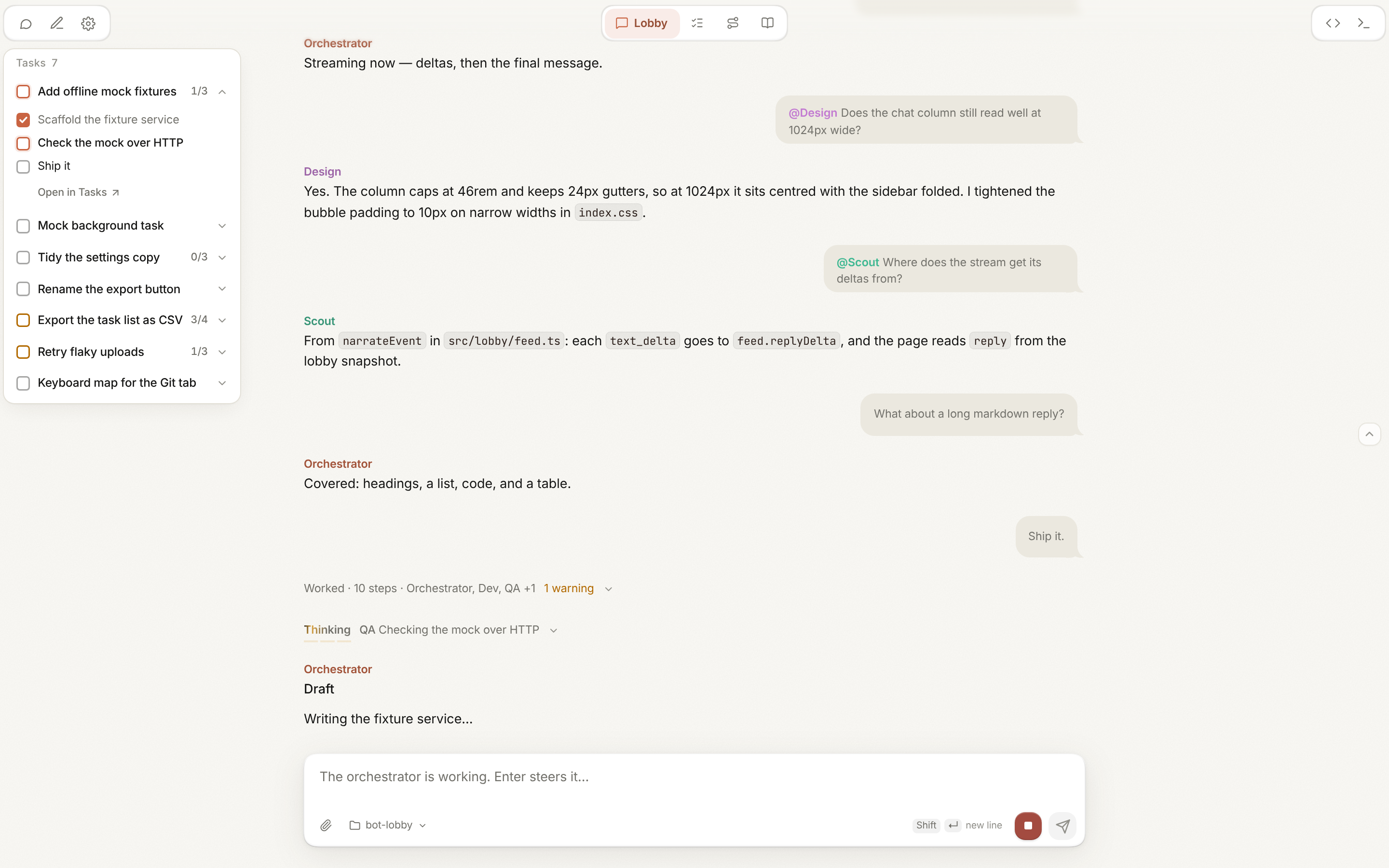
Chat with the whole team
Type / for commands: /plan to plan an idea with the panel, /task to hand it straight to the
team, plus Pi commands, your /skill:name skills and prompt templates.
Start a message with @ to choose who answers. Otherwise a classifier hands each message to the
agent whose area it is, and every reply carries its agent's name.
Watch agents think and work
Each run of agent steps folds into one line in the chat. Open it to see every step, or open Thinking to read what each agent is reasoning about, live.
Plan in rounds
On Plan, a panel of agents asks what it needs to know, round by round. View plan (V)
opens the draft, and any line takes a comment that goes into the next round.
Follow every task
Tasks lists every task across sessions with its steps, timings, approvals and blockers. Resume carries a stopped task on in the background, and a toast tells you it happened.
Read the changes, run commands
The code viewer shows what the agents changed, as a diff or side by side, and opens any file.
The terminal drawer is a real shell in your project, one click away.
Tune each agent
Pick each agent's model and effort, run agents on other coding tools (Codex CLI, Claude Code and more), narrow their MCP tools and skills, and set the workflow and lint gate. Changes save as you make them.
The agents
| Agent | Does |
|---|---|
| Orchestrator | Your Pi session: questions, plan, delegation and approvals |
| Design | UI, frontend logic, styling and accessibility |
| Dev | Backend, APIs, data, security and integrations |
| QA | The final quality gate, as deep as the change's risk calls for |
| Research | Outside facts, with sources |
| Scout | Reads the code and explains how something works |
/bot-lobby <request> in Pi also starts a task. --fast / --full picks the workflow, and
--branch / --worktree isolates it in git. Workers never commit: the orchestrator commits only
the files the task changed, after the project's linter and a QA pass sized to the change's risk.
Knowledge holds what each agent has learned about your project, which you can edit, annotate
or ask about. The project switcher (P) opens any folder on the machine running bot-lobby.
Keys
Every button shows its key. Alt+1…Alt+9 switch tabs, j / k move through lists, / focuses
search or the message box, p switches project, d flips the theme and ? lists every key.
Configuration
Settings live in ~/.pi/bot-lobby/config.json (BOT_LOBBY_CONFIG_DIR moves them), and
/bot-lobby config shows what is in effect. Most are also in the lobby's Settings. Tasks and
project knowledge stay in .pi/bot-lobby/ inside your project.
The guide covers the rest: delivery and commits, crash recovery, knowledge and shared scripts, the classifier, delegation, compaction, and MCP tools and skills.