@a-t-h-i/bot-lobby
Structured multi-agent software engineering orchestrator for Pi
Package details
Install @a-t-h-i/bot-lobby from npm and Pi will load the resources declared by the package manifest.
$ pi install npm:@a-t-h-i/bot-lobby- Package
@a-t-h-i/bot-lobby- Version
0.6.31- Published
- Oct 8, 2026
- Downloads
- 4,654/mo · 3,232/wk
- Author
- a-t-h-i
- License
- Apache-2.0
- Types
- extension
- Size
- 2.8 MB
- Dependencies
- 2 dependencies · 4 peers
Pi manifest JSON
{
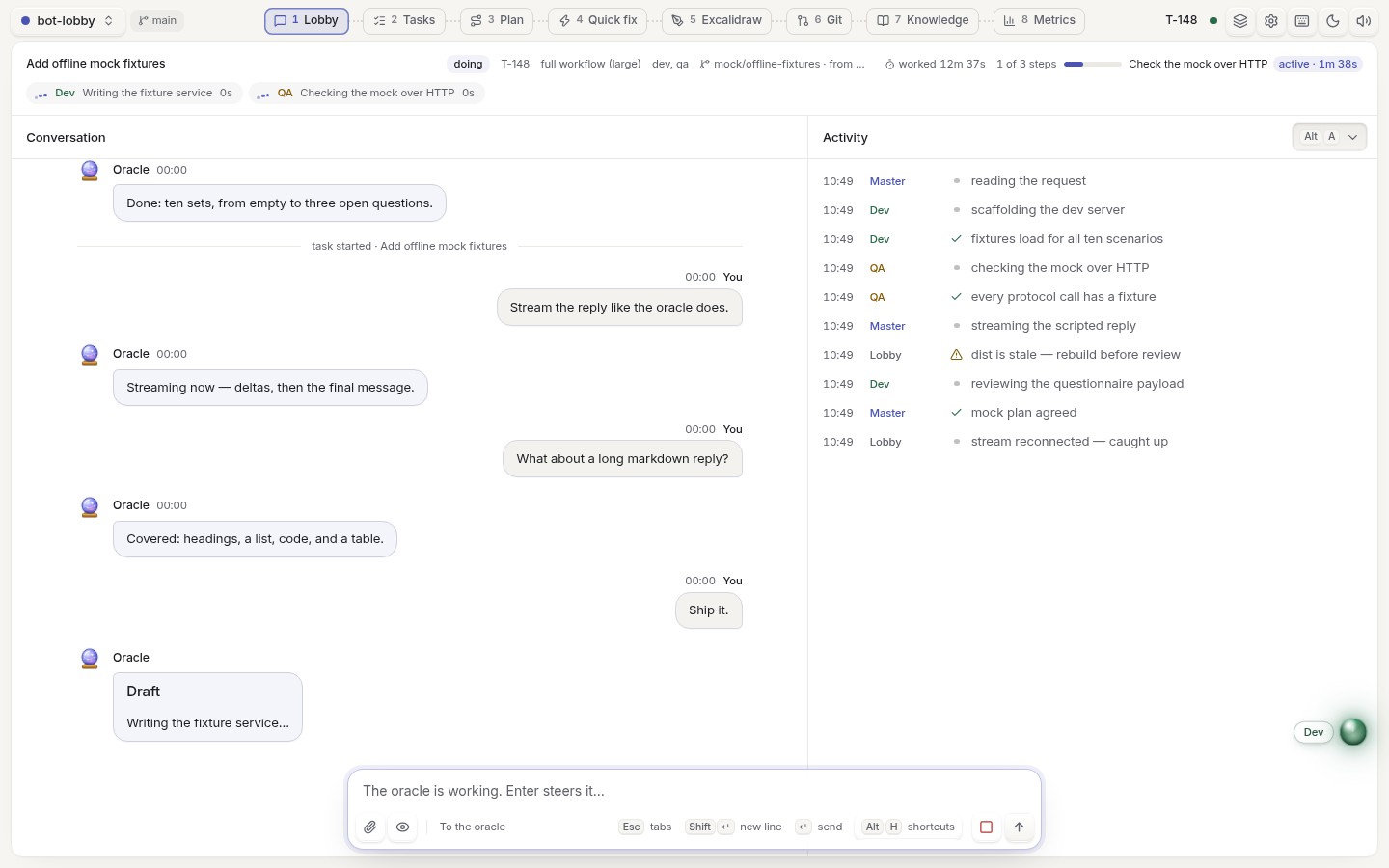
  "image": "https://raw.githubusercontent.com/a-t-h-i/bot-lobby/main/.github/screenshots/lobby.png",
  "extensions": [
    "./src/index.ts"
  ]
}
Security note
Pi packages can execute code and influence agent behavior. Review the source before installing third-party packages.
README
Bot-Lobby
A Pi extension for multi-agent software development. Describe a change, agree on a plan with the oracle, and follow the agents in a local browser lobby. Approvals, domain boundaries and QA are enforced before anything is called done.

Install
pi install npm:@a-t-h-i/bot-lobbyTry it first with pi -e npm:@a-t-h-i/bot-lobby, or from a checkout with pi -e ./src/index.ts.
The questionnaire and web tools are built in, so don't also install extensions with the same tool names.
Use
- In Pi, run
/bot-lobby add a login page. Bot-lobby turns on and the lobby opens in your browser. A new Pi session starts with bot-lobby off, as plain Pi:Ctrl+Shift+Mor/bot-lobby on|offswitches it. - Answer the oracle's questions and approve its plan, or agree on one with the panel in Plan first. A plan opens with a short list of steps; the detail of each follows for whoever wants it. Plans you leave without saving them as a task wait under Plan → Previous. You can read, carry on, archive or delete them there. A plan saved as a task leaves that list.
- Follow the agents in Lobby: the step being worked on reads
active · 1m 12s, and each task shows how long its agents have worked on it (idle time left out). Models, effort and time limits are in Settings.
Issues lists the repository's open issues (with lobby.issues on), and Plan it starts a
planning session from one. Git lists open pull requests; an agent reviews one on request,
read-only, and nothing is posted to GitHub. Both read GitHub through gh.
Small changes go to Quick fix. --task forces a full task, --fast / --full picks the workflow,
and --branch / --worktree isolates it in git. When an isolated task completes, the oracle asks
you to confirm merging and pushing main, then removes its worktree after verifying the merge.
Declining or failed verification keeps the worktree. Delivery can also be reviewed in Tasks,
where you can create a PR instead. The task branch is kept.
After every worker step, before QA and at completion, the engine runs the project's own linter (ESLint, Biome, Oxlint, Ruff, or a command you set) on the files the task touched. Only problems on changed lines count, and QA judges any lint suppression a worker adds. Settings → Linting sets it to off, advise or block. Visual questions come with mockups that expand and scroll side by side.
QA is sized to what was built, not to the request. Once the work is in, Jev (the fast classifier) reads the diff and sets the QA risk. A change with nothing that runs (docs, styles, comments) passes on the engine's checks with no QA agent, and a small one gets a light check. One that touches security, data, concurrency or orchestration gets a deep, adversarial review. The test budget is a ceiling, never a quota, and the Tasks tab shows Jev's read and why. With Jev off, the engine's rules decide.
If Pi crashes, is killed or loses its terminal, the lobby page keeps everything on screen and
reconnects when Pi is back. The next Pi started in the project carries on what was running. The
planning session returns as it was, and a round that was cut off runs again. Queued quick fixes
run, and every task's session starts again from its saved file, picking up where it stopped. A
quit on purpose stops this work, and pi -c brings back the planning session.
A task that is paused, or that no running session drives, shows Resume (R) in Tasks.
It carries the task on without moving your window: a paused task is unpaused where it runs, and a
stopped one carries on in a background session, which restarts its own session when its file is found.
The Tasks screen has List and Board subtabs. Board groups saved plans and new tasks in Backlog, active work in In progress, and finished work in Completed. Abandoned work stays labeled in Backlog until archived. Cards open the existing task details and actions; archiving removes a card immediately, while the List view can still show the archive.
| Agent | Does |
|---|---|
| Oracle | Your Pi session: questions, plan, delegation and approvals |
| DESIGN | UI, frontend logic, styling and accessibility |
| DEV | Backend, APIs, data, security and integrations |
| QA | The final quality gate, at the depth the change's risk calls for |
| RESEARCH | External facts, with sources |
Projects
Click the project name (or press P) to switch between running projects or choose Open folder….
The folder browser lists directories on the machine running bot-lobby, not the browser's machine;
you can browse, go to a parent, or enter an absolute path. An existing project is reused; otherwise
a dedicated Pi session starts for the folder's detected project root. It loads this copy of bot-lobby
without other extensions and does not automatically trust project-local resources. Switching projects
reloads the page and discards unsent drafts. Projects opened this way stop when their hosting lobby
stops; opening a folder does not start a task or merge work.
Knowledge
Each agent keeps what it learns about your project in .pi/bot-lobby/<Agent>/knowledge/:
stable facts (knowledge.md), its standards (design language, engineering or testing standards),
decisions with their reasons, and a short history of completed tasks. Workers only propose
knowledge and the oracle records it, so nothing gets in unchecked; research stays evidence until
the oracle keeps it. When a file is long, Jev picks the parts that matter to each step, so prompts
stay short. A task cannot complete while a file is over knowledge.compactionThreshold (20,000
characters): the oracle rewrites it shorter, and the version before is kept under archive/.
The Knowledge tab shows the files as a tree, from the project to each agent and the model it runs on. Open a file to edit, add or delete its entries, or leave a note on one ("outdated, we moved to Redis"). A note travels with its entry into every agent's prompt.

Ask project questions directly from the Knowledge composer. The oracle checks saved knowledge first, searches the codebase for missing information, and records verified findings in the relevant agent's knowledge. Answers appear in the side pane; the Chat / Docs toggle inside the composer switches back to the selected document. Questions do not create tasks.
Keys
The lobby is keyboard-first, and every action button shows its key (Archive E, Delete Del).
Alt+1…Alt+9 switch tabs, j / k move through lists, / focuses search or the message box,
p switches project, d flips the theme and ? lists every key. Alt and Ctrl shortcuts can be
rebound with lobby.keys. In Pi, Alt+G toggles auto mode and Ctrl+Shift+M turns bot-lobby on or off.
Screenshots
| Planning | Tasks |
|---|---|
 |
 |
| Thinking | Questionnaire |
 |
 |
| Issues | Git |
 |
 |
Configuration
Settings live in ~/.pi/bot-lobby/config.json (BOT_LOBBY_CONFIG_DIR moves them), and
/bot-lobby config shows what is in effect. Colour themes you import, under a name you choose,
are kept in themes.json beside it, so every Pi session and project shows them. Tasks and
project knowledge stay in .pi/bot-lobby/ inside your project.