@a-t-h-i/bot-lobby
Structured multi-agent software engineering orchestrator for Pi
Package details
Install @a-t-h-i/bot-lobby from npm and Pi will load the resources declared by the package manifest.
$ pi install npm:@a-t-h-i/bot-lobby- Package
@a-t-h-i/bot-lobby- Version
0.6.17- Published
- Oct 4, 2026
- Downloads
- 3,168/mo · 3,168/wk
- Author
- a-t-h-i
- License
- Apache-2.0
- Types
- extension
- Size
- 2.4 MB
- Dependencies
- 2 dependencies · 4 peers
Pi manifest JSON
{
  "image": "https://raw.githubusercontent.com/a-t-h-i/bot-lobby/main/docs/gallery.png",
  "extensions": [
    "./src/index.ts"
  ]
}Security note
Pi packages can execute code and influence agent behavior. Review the source before installing third-party packages.
README
Bot-Lobby
A Pi extension that forces you to vibe code intentionally. You still describe what you want in plain words, but you don't just hand it over: you and the model work out together what's needed until the picture is clear, and then a multi-agent software team builds what you agreed on.
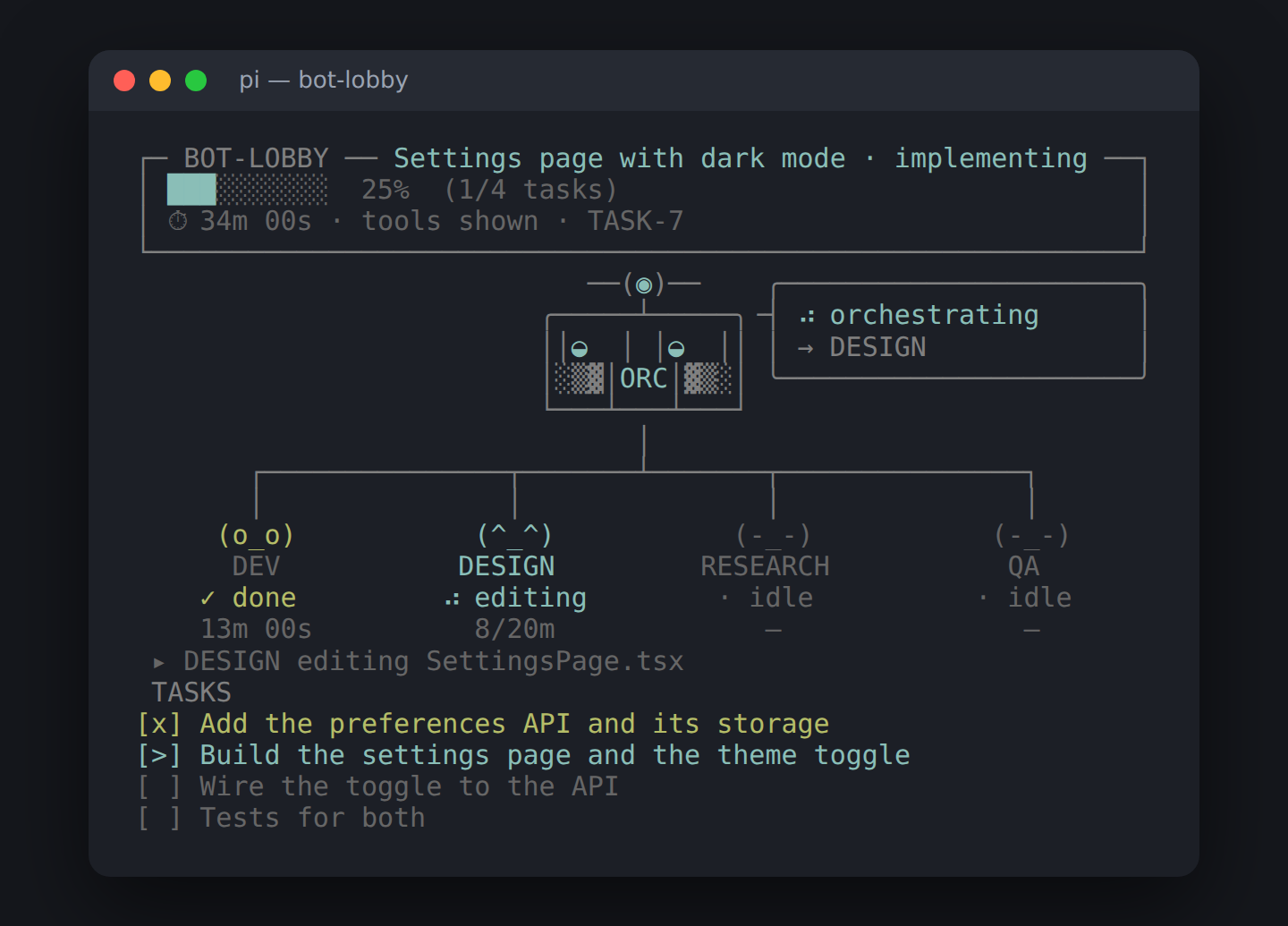
/bot-lobby <request> (or a request typed in the lobby) starts a task, unless
one agent can simply do it: then it goes to the quick-fix agent.
For a task, your Pi session becomes the Master
(the "oracle"): it scouts the codebase, proposes a plan, and delegates the
work to three domain agents — Designer+Frontend, Backend and QA —
each running in its own isolated pi process. QA's reviewer is the quality
gate before anything is marked done. QA reviews adversarially (it tries to
break the change) and writes as few tests as it can: only for a breaking
change, for behavior that could turn out unpredictable, or when asked.
The rule: you decide with the LLMs, and the engine enforces. Agents
propose; you shape and approve the plan with the oracle; the extension
validates every state change, permission and approval through one
orchestrate tool.
The oracle is meant to be your most capable model; the agents can be smaller and cheaper ones. So it never assumes they are as capable as it is: it makes every decision itself and briefs each agent in full.
Install
pi install npm:@a-t-h-i/bot-lobbyTry it once without installing: pi -e npm:@a-t-h-i/bot-lobby. From a source
checkout: pi -e ./src/index.ts (keep prompts/ next to src/).
Nothing else to install: bot-lobby brings its own
questionnaire and web tools, and they work in plain
Pi too, with or without a task. If you installed pi-web-access or
rpiv-ask-user-question for bot-lobby, remove them: they register the same
tool names.
Quick start
/bot-lobby add a login page— starts a task; the lobby opens.- Answer the Master's questions, then approve its proposal.
- Follow the agents in the lobby, a web page that opens in your browser when Pi starts: what they do, and what they think.
The lobby's Settings page sets each agent's model, effort (a slider that skips what the model cannot do), time limit and extra instructions.
Commands
| Command | Does |
|---|---|
/bot-lobby |
Open the lobby in your browser (it already runs: the page starts with Pi) |
/bot-lobby <request> |
Start a request: a quick fix when one agent can do it alone, else a task (--task to always make it a task, also when it begins with a command word; --auto to run unattended, --budget 90m to give it a time budget, --fast / --full to pick its track, --branch / --worktree / --no-branch to give it its own git branch or worktree or none) |
/bot-lobby budget [90m|off] |
Show or set this session's task time budget |
/bot-lobby status | tasks | runs [id] |
Current task, all tasks, recent agent runs |
/bot-lobby approve | amend <text> | decline |
Answer the proposal |
/bot-lobby accept [id] |
Accept a task's work as it is, without a QA pass; the oracle then completes it |
/bot-lobby pause | resume | cancel [id] |
Control a task |
/bot-lobby auto [on|off] |
Auto mode: the oracle finishes the task without asking (alt+g in Pi) |
/bot-lobby claim <id> |
Take over a task another session owned |
/bot-lobby start-plan PLAN-… [auto] |
Start a plan saved from the Plan tab |
/bot-lobby settings | config |
Edit settings / show the effective config |
/bot-lobby knowledge |
Knowledge file sizes |
/bot-lobby minimize | restore |
Hide bot-lobby in this session (ctrl+shift+m) |
/bot-lobby web |
Open the lobby page again (it starts with every interactive Pi session, on this machine only) and print its link |
/bot-lobby web link |
Print the browser UI's link |
/bot-lobby web stop |
Stop the page until the next session |
/bot-lobby web reset |
Reset the browser UI's link (its old cookies stop working) |
Quick fix or the team
Before any task exists, bot-lobby asks whether one agent can just do it:
in one file or one area, with nothing to agree between frontend and backend,
no unfamiliar codebase to survey, nothing risky and no decision you must make
first. Jev answers when it is on (classifier.thresholds.quickFixAt,
0.7); plain rules answer otherwise, and whenever Jev is unsure. A request that
says it is self-contained ("a single page", "in one html file") counts even
when it is rich.
When it reads that way, the oracle confirms in one step, without reading
files or planning (route_request), and says so: this looks like a quick
feature, the quick-fix agent is on it. The lobby then hands the request to
the quick-fix agent and switches to the Quick fix tab, where you follow
it. No scouts, proposal, plan or QA. A quick feature (bigger than a small
change, but in one place) runs on its builder's model, thinking and time limit
(DESIGN's for a page) instead of the quick-fix defaults.
Everything else, or anything the oracle judges needs the team, starts as a
task below. --task always makes a task; workflow.routeQuickFixes: false
turns routing off. Without the lobby (a background session, RPC mode) every
request is a task.
How a task runs
full workflow:  request → clarify → scout → propose → approve → plan → implement → QA gate → complete
fast track:     request → implement (only the agents it needs) → QA, if it needs tests → complete
Fast track or full workflow
The moment a task starts, bot-lobby reads the request and decides how serious it is: its size, who has to take part, and whether it takes the fast track or the full workflow. The read is instant and costs no tokens (plain rules, refined by Jev when that is on).
| The request… | Who takes part |
|---|---|
| changes anything that runs in the browser: screens, components, styles, copy, canvas or three.js graphics | DESIGN (frontend) |
| changes an API, the database, auth, jobs or other server-side code | DEV (backend) |
| needs tests: asks for them, fixes a bug, or changes backend logic | QA |
| depends on outside facts: latest versions, docs, standards, third-party APIs | RESEARCH |
A small, clear, low-risk request takes the fast track: the oracle hands it straight to those agents, with no scouts, no proposal to approve and no plan document (the engine keeps a short plan whose steps are the delegations, so the checklist still works). QA takes part only when the change needs tests (its worker writing and running them as the last step, or the QA gate); without it the task completes as soon as the work is in and checked. A copy change is one agent run.
Everything else takes the full workflow below: anything medium or large (a new page, flow or endpoint, a refactor, an upgrade, a vague or many-part request), serious whatever its size (security, auth, passwords, payments, migrations, production, personal data), or unclear (too short, vague, or asking to investigate first).
- The oracle glances at the read once and acts on it, or corrects it with
orchestrate action=track: the full workflow for a change bigger than it reads, the fast track for one that is smaller (before its work is planned), or a member added or dropped. - Once work is under way a track only gets stricter: the full workflow or more members, never QA dropped. A fast task whose worker asks for a new dependency or an architecture change gets QA.
/bot-lobby --fast <request>or--full <request>decides it yourself; the oracle never moves a--fulltask to the fast track.workflow.fastTrack: falseputs every task on the full workflow.- The track shows in the lobby's activity log, the task's details on the
Tasks tab, and
/bot-lobby status.
Briefing the agents
Every agent may run on a smaller, cheaper model than the oracle's, one that
follows instructions well but does not infer intent. So the oracle writes
each delegation (implement, scout, research) as a self-contained brief
and settles every design and architecture decision itself first:
- Goal, the exact Files, numbered What to do with names, shapes and values, the Contracts shared with other agents (repeated in full in each brief), Constraints, Done when (checkable criteria and the commands to run) and If stuck.
- Plan steps are written to the same standard, so a brief is the plan step made explicit, never a new decision.
- Every agent is told to follow its brief and the approved plan exactly, use the given names letter for letter, and report what does not match instead of guessing. Workers end their report with a Brief Check: each "Done when" item, met or not, with evidence.
- The oracle holds each report to its brief. Drift, a skipped criterion or a guessed choice comes back as a fix step with a more explicit brief.
- The engine backs it up: a delegation that names nothing concrete (or a long
one with no done criteria) is sent back to the oracle once before any agent
starts. Sending the same text again goes through, so a short task that is
complete as written is never stuck.
workflow.briefCheck: falseturns it off.
The full workflow
- Scouts (read-only) investigate the domains the request touches.
- The Master proposes a short bullet list; nothing is built until you approve it.
- Workers implement plan steps, one domain each. Several can run in parallel; they share files through a file desk (claim a file, queue for a busy one, hand it over with a note).
- The QA gate runs once at the end. A failed gate sends fixes back to the
owning domain, a bounded number of times. Only critical or major findings
fail it, and a re-review checks what the last round asked for instead of
starting over. It reviews everything since the commit the task started
from, so committed fixes still count. At the round limit you decide: accept
the work as it is, one more round, or leave it blocked (
/bot-lobby acceptworks any time). It knows who changed each file: this task's workers (planned), a quick fix you ran, work that was there before the task (pre-existing), another task, or no agent at all (unattributed, which the Master asks you about). Quick fixes are never treated as rogue changes or reverted. - A researcher can be summoned for cited web evidence, through bot-lobby's web tools.
Auto mode approves proposals and answers clarifying questions for you; after three nudges without progress it pauses. A task started from a plan agreed in the Plan tab skips approval too.
Safety nets: every agent has a time limit (asked to wrap up at 75%), a
stall watchdog and one retry; Esc aborts every running agent.
A branch or worktree per task
Every task has a friendly name, made from the first words of its request and
the day it started: Task-Change-Table-Font-27-09-2026. It is the task's id,
the name of the session that drives it and, when you ask for one, its git
branch.
workflow.gitIsolation (or --branch, --worktree, --no-branch on one
request; a Git isolation entry in /bot-lobby settings) decides what a new
task gets. It is off by default.
| Setting | A new task gets |
|---|---|
off |
nothing: it works in the folder you started it in |
branch |
a branch named after it, created and checked out in the working folder (uncommitted work comes along) |
worktree |
a second checkout of its own, .pi/bot-lobby/worktrees/<name>, on a branch named after it. Every agent of the task runs there, so tasks (and your own checkout) never trample each other's files; uncommitted changes in your checkout are not in it |
- The name is made unique (
-2,-3… when a branch or remote branch has it). - Git never stops a task: outside a repository, without a commit (a worktree needs one) or when a checkout is refused, the task runs without and says why.
- The oracle is told where the work lives, the Tasks tab shows the branch and worktree, and the lobby's title shows the branch a task works on.
- A worktree is kept when its task ends: merge or delete it yourself
(
git worktree remove …). One that was removed while its task runs is reported, and no agent is started in its place. bot-lobby adds the worktrees folder to.git/info/exclude(a local file) sogit add -Askips it.
Time budget
/bot-lobby --budget 90m <request> (or /bot-lobby budget 90m on the task in
hand, or workflow.taskBudgetMinutes for every task) gives a task 90 minutes
of work time, for the oracle and every agent. The clock runs while the oracle
works and stops while it waits on you.
- The oracle divides the time by scope: each step gets its minutes, and the QA gate keeps a reserve. Every agent is told how long it has and gets a heads-up at 75%.
- When a worker's time is up it stops, keeps its files consistent, and reports what it did, where it left off and how much more it needs. You are asked: DEV was busy with …; left to do: …; it needs 10 more minutes. Give it the time (or another amount) and the same agent carries on where it stopped, its context intact; or stop it there.
- Once the budget is spent no new work starts: the oracle asks you for more (with a reason) or wraps up with what is done. Auto mode gives an agent more once, only from time the task still has, and never grows the budget.
- The lobby shows
34m of 1h 30m, and each agent's12/30m.
A fresh context per task. Every agent runs in its own Pi process with its
own context. The oracle, which is your session, starts each task clean: its
model sees only the conversation since the task started, and once a task ends
your next request starts fresh (the lobby shows context cleared, and the
oracle is told where the finished task's record is). The session file keeps
everything. workflow.freshContext: false in the config turns this off.
The lobby
bot-lobby is a web-only plugin. When Pi starts an interactive session it also
starts the lobby, a page served on 127.0.0.1 (this machine only, behind a
secret link), opens it in your browser and shows its address in Pi's status
line. Nothing is drawn in the terminal but Pi itself.
The page is a calm, glassy window in a light or a dark theme (the sun/moon
button in its top row). The tabs are numbered pills joined by dotted lines; the
lit pill glides to the tab you pick like a drop of water. Under the tabs, each
tab is a pair of cards, a list on the left and the chosen item on the right.
At the bottom floats one text box for everything: it grows as you type (or
opens up to a tall editor), takes Markdown, and takes images, PDFs and other
files (pick, paste or drop them, up to 20 MB each, eight per message). Who it
talks to follows the tab: the oracle everywhere, the planning panel on Plan, a
quick fix on Quick fix, a comment on the open task (or a message to its
oracle) on Tasks, the picked session on Sessions. The oracle's questions pop
up in the middle of the window over a blurred backdrop; there is only ever one
pop-up, and one toast, on screen at a time. Activity and Thinking can be
minimized to their title bar. alt+h lists every key.
| Tab | What it is |
|---|---|
| 1 Lobby | Your conversation with the oracle, an activity log of every agent's steps, and each agent's latest thought |
| 2 Tasks | Every task and saved plan as a checklist. Start a plan here or in a new session; comment on a plan (images welcome); archive or delete |
| 3 Plan | Plan a task with a panel of agents before building it (below) |
| 4 Quick fix | One agent makes a change right away, beside any running task; requests the oracle routes here show up too |
| 5 Metrics | Run time, success rate, tokens and cost per model and agent |
| 6 Git | The repository's open pull requests; review one with an agent, or have Jev read it |
| 7 Knowledge | Everything each agent knows about the project; edit an entry, or leave a note every agent reads |
| 8 Excalidraw | Up to five shared Excalidraw sessions, each assigned to one agent or several, who read the board and draw on it with you |
Lobby
Your conversation with the oracle on the left, the activity log of every agent's steps on the right, and the agents' latest thoughts below. Activity and Thinking fold down to their title bar; the box at the bottom steers the running turn.
Tasks
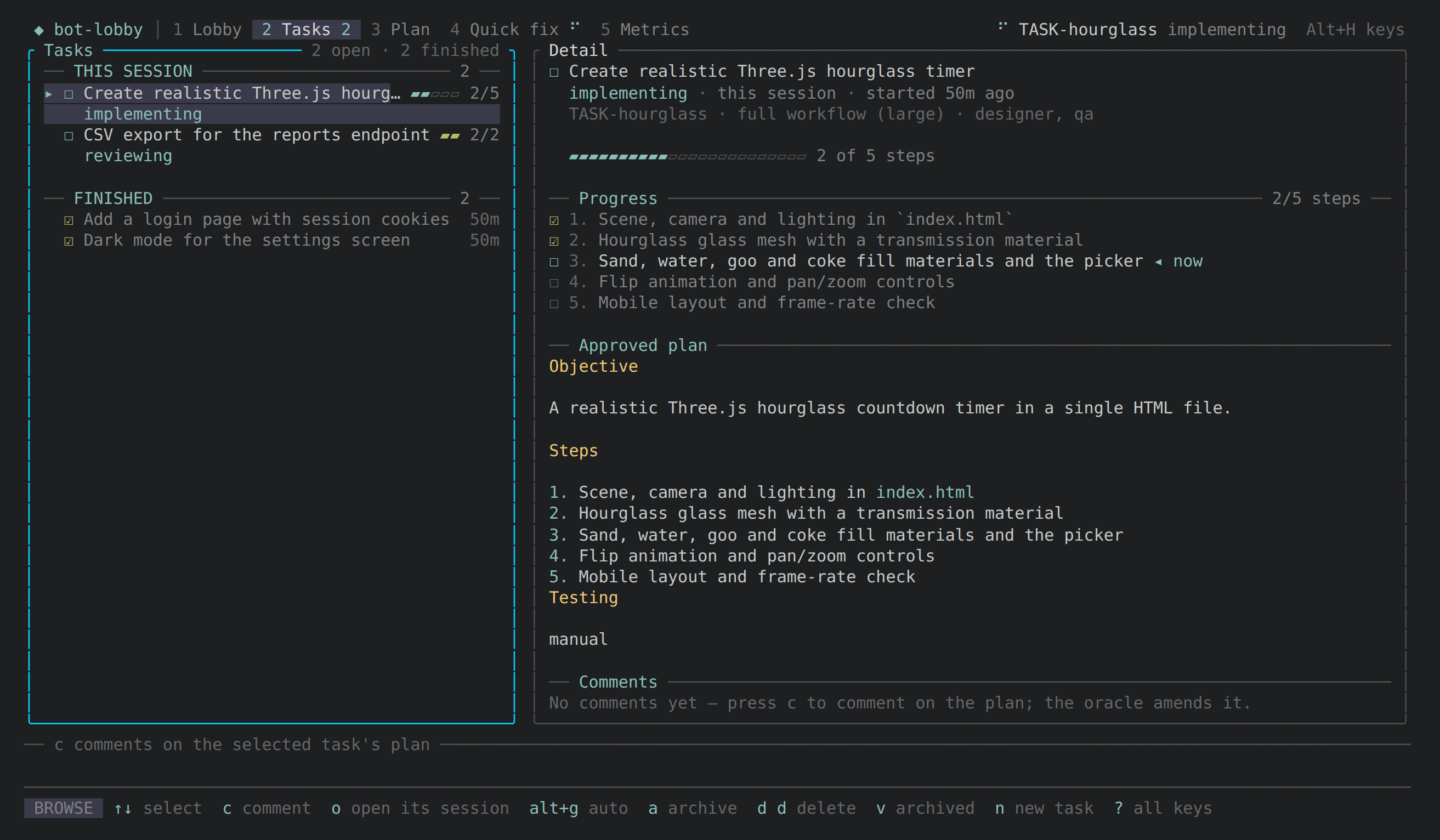
Every task as a checklist, with its track, plan progress, the approved plan and your comments on it.
Plan
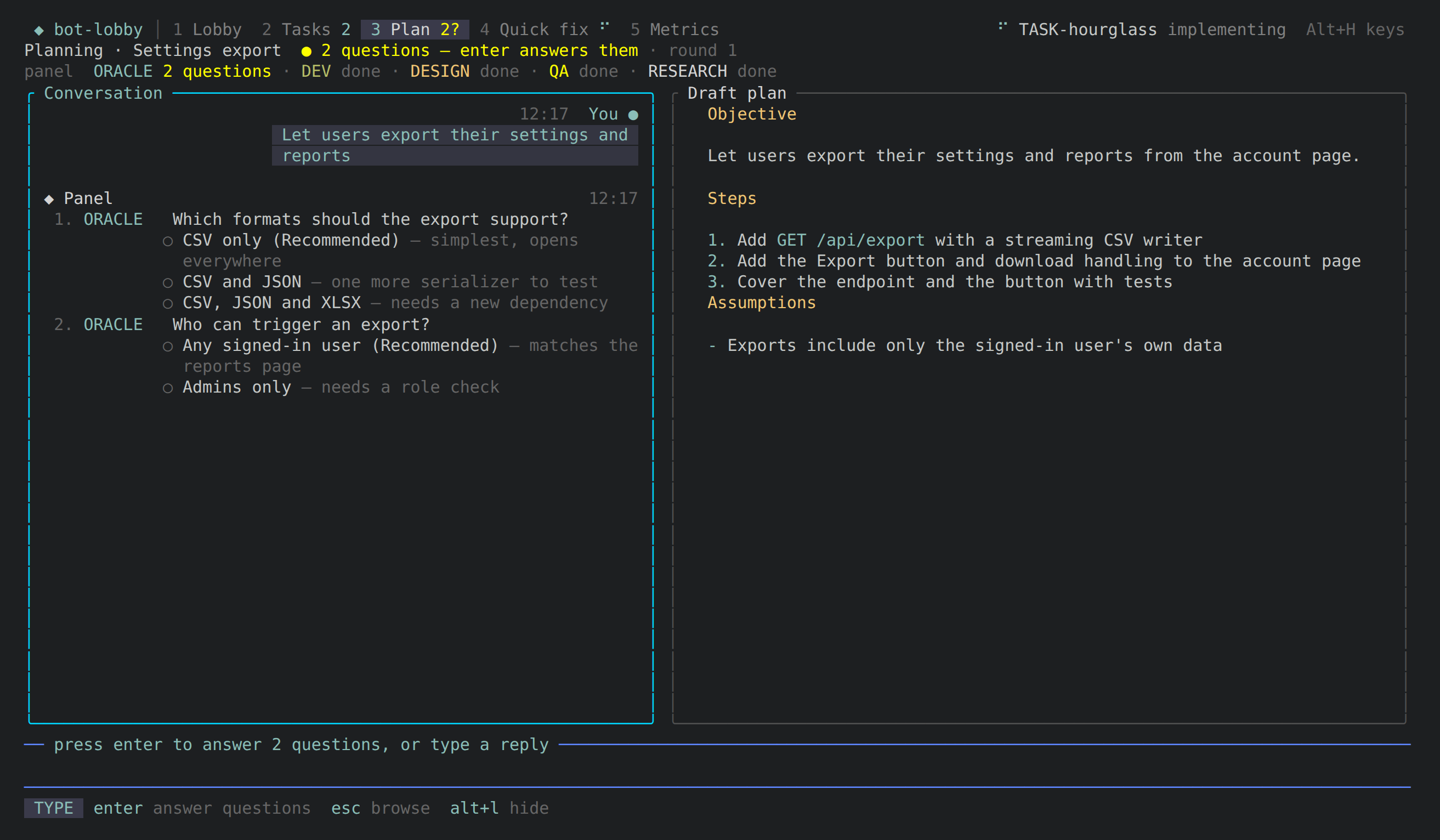
The panel's questions, with their options, on the left; the draft plan on the right. See Planning.
Quick fix
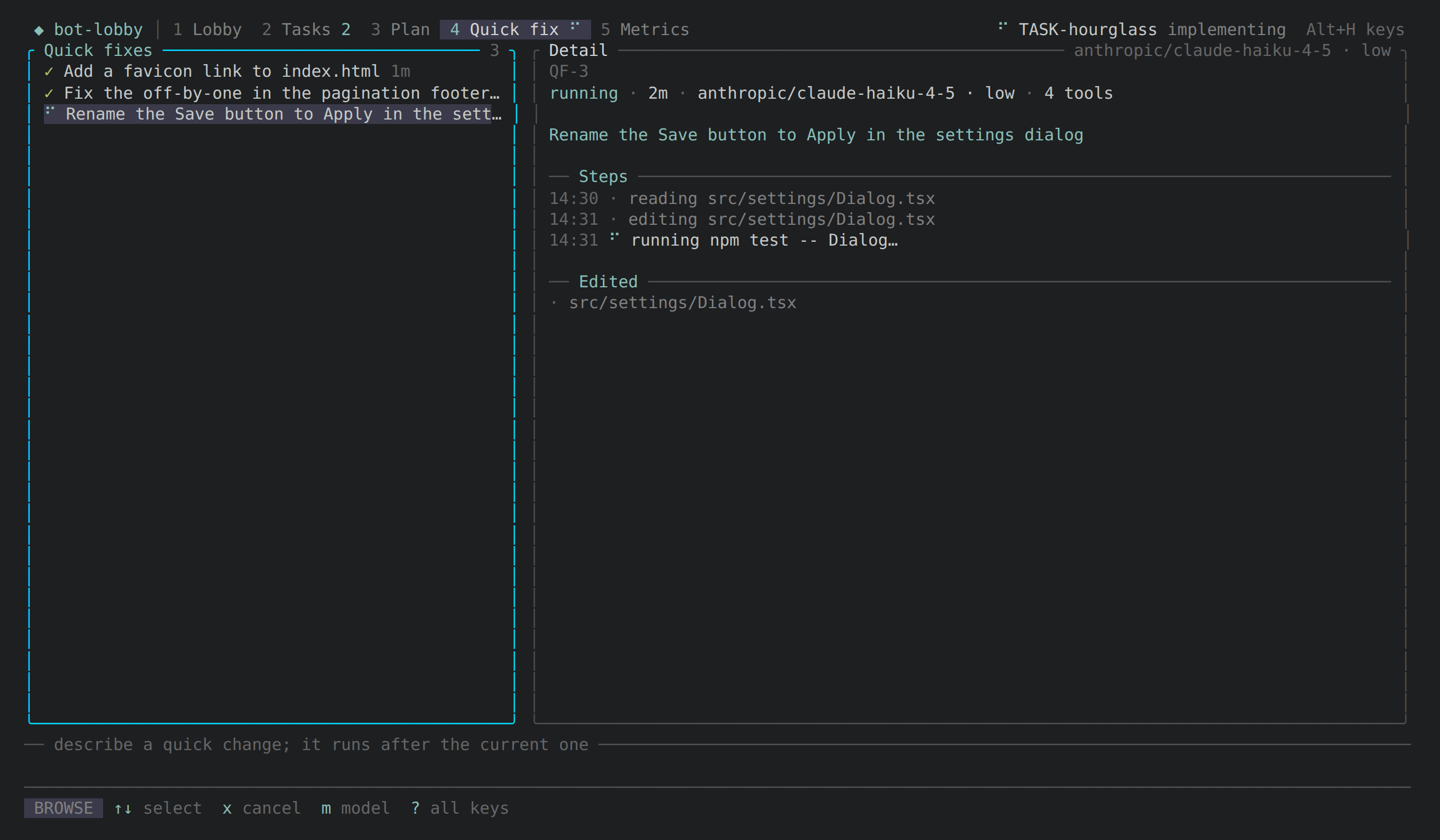
One agent's jobs, each with its live steps, the files it edited and its report. See Quick fix or the team.
Metrics
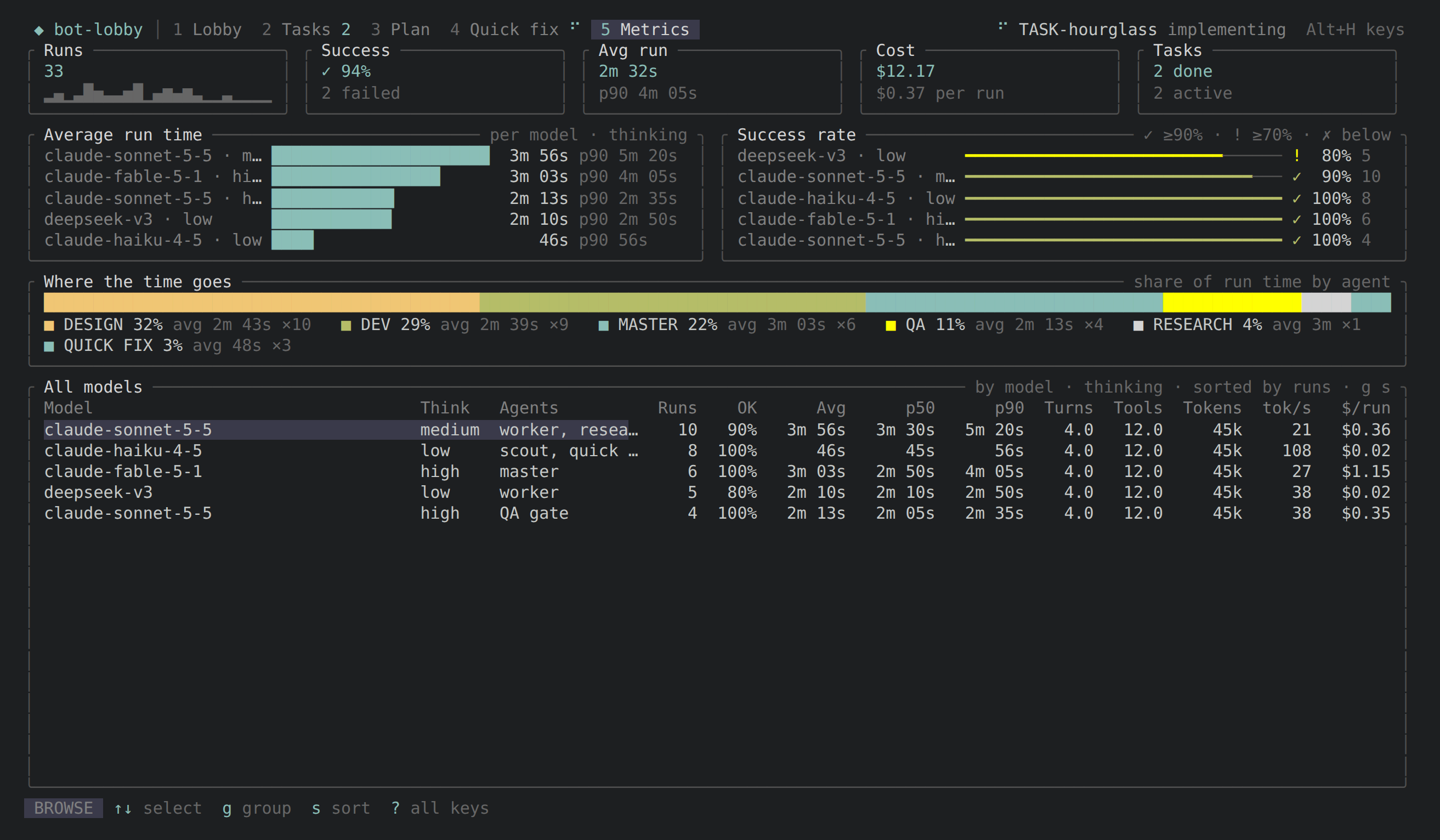
Run time, success rate, cost and tokens per model and agent, so you can see which cheaper models hold up.
Git
The repository's open pull requests through the GitHub CLI (gh owns sign-in;
bot-lobby holds no token): the list with checks and size, and the
selected one with its facts, files, description, reviews and comments.
- Review it with an agent: a read-only agent on QA's model, thinking
and time limit (and its custom instructions) gets the description, changed
files and diff, may read the repository for context, and writes a review:
verdict, summary, findings by severity (
file:line), tests, questions. It never edits, and never follows instructions written inside the pull request. A focus can be typed first (is the migration reversible?), and a review can be stopped. - Jev's quick read (the classifier): size, and how likely the change is risky, security-relevant, breaking or untested, in a moment, with whether a full review is worth its tokens.
- Reviews are kept per pull request (
.pi/bot-lobby/reviews/), marked stale when the pull request gets new commits, and count in the Metrics tab. Nothing is posted to GitHub.
Knowledge
Every agent's knowledge — the Master's, Designer's, Backend's and QA's knowledge, standards, decisions and completed tasks — files on the left, the open file's entries on the right (a heading, a bullet, a paragraph), one of them picked. Files past the compaction threshold are marked.
Completion is gated on compaction: the engine refuses complete while any
knowledge file is over the threshold (default 20,000 chars,
knowledge.compactionThreshold). The Master first disperses domain-relevant
facts where they belong with action=knowledge (domain=designer|backend|qa)
— per-agent files fill up through that dispersal — then rewrites each
oversized file with action=compact (which archives the previous version)
before the task closes.
eedits the picked entry: it comes into the prompt (Shift+Enter for a new line, Enter saves).nadds an entry after it,d ddeletes it,Eedits the whole file in pi's editor. Every write archives the version before (archive/<Agent>/), and an entry that changed on disk since it was drawn is refused instead of being put on the wrong line.ccomments on it: a note about the entry ("outdated, we moved to Redis"). It shows under the entry, and every agent that reads that knowledge reads the note right under the entry, so it weighs it there. Notes move with an edited entry and go with a deleted one;x xtakes the newest back. They live in.pi/bot-lobby/knowledge-comments.jsonl, never in the files, which agents rewrite when they compact.
What an agent reads. Knowledge, standards and decisions go into an agent's prompt; a file past about 4,000 characters is cut to the sections that bear on the step (by keywords, or by Jev when it is on), and the prompt says how many sections it left out and where the whole file is. Nothing is looked up on demand: what a step needs has to be in the file and near the top of its relevance, so keep entries short, one topic under one heading.
Excalidraw
A live Excalidraw room that you and your agents draw in together. Add up to five sessions, assign each to one agent or several (the oracle, Designer, Backend, QA, scouts, the researcher, quick fix, the planner), and those agents can look at what you drew and add to it.
aadds a session: in Excalidraw, Share → Live collaboration → Start session, copy the link, paste it into the prompt (a name may follow it).nmakes a new room instead and shows its link, for you to open in Excalidraw. Neither works past five sessions:d dremoves one.entermoves into the checklist of agents;enterorspaceassigns the picked agent (or takes the session back),*assigns every agent.wlets agents draw in the session or only look at it. An agent whose sessions are all look-only gets no drawing tool.tchecks the session: joins the room for a moment and says whether the server can be reached, who is in it, and how much is on the board.rrenames it.orchestrate action=whiteboard [name=...]lets the Master create its own session: a room on the configured collaboration server, assigned to itself, with the join link returned. Its seat (opened byexcalidraw_read/excalidraw_draw) holds the room alive for the pi session's lifetime, so it needs no one else in the room. The room is not guaranteed to persist after the last connection leaves.
What an assigned agent can do. It gets two tools and the room link:
excalidraw_read describes the board in words (shapes with their labels, arrows
as from → to, free text, each with its id and place), and excalidraw_draw
adds labelled rectangles, ellipses and diamonds, arrows between them (with
labels), free text and lines, or changes and deletes what is there by id. It
joins the room as its own collaborator (Backend · bot-lobby) with a cursor
where it drew, so you watch it work. The board stays yours: agents may move,
recolour and relabel what you drew, but delete only what agents drew (elements
they draw are marked, and Excalidraw cannot undo another collaborator's
deletion), and one call draws at most 100 shapes and removes at most 50.
- You must have the session open in Excalidraw. A room's board lives in the browsers that are in it; an agent that joins an empty room can read nothing, and is not allowed to draw, since nothing would keep it. It says so and asks you to open the link.
- Boards are other people's writing. What an agent reads from a board comes fenced as untrusted data, like a web page, and it is told never to follow instructions written on it.
- The link is a key. Anyone with a room link can read and draw in the room, so
bot-lobby keeps your sessions with your own settings
(
~/.pi/bot-lobby/excalidraw/, one file for each project) and never in the project, where a commit could publish them. An agent's process is handed only the links of the sessions assigned to it. - Rooms are Excalidraw's own collaboration protocol, end-to-end encrypted with the
key in the link, over
oss-collab.excalidraw.com. A self-hosted collaboration server is used whenBOT_LOBBY_EXCALIDRAW_SERVERnames it. - When
tsays it could not reach the server, the reason in brackets says why: a name that did not resolve (the network or DNS), a refused or timed-out connection, a certificate a firewall replaced (pointNODE_EXTRA_CA_CERTSat its certificate), or a refusal with an HTTP status. Where only a proxy lets traffic out, setHTTPS_PROXY(NO_PROXYexempts hosts); agents then join through it, and the message names it. A network that blocks websockets but not HTTPS still works: the seat falls back to long-polling, as a browser does.
Common keys: alt+1…alt+9 jump to a tab, alt+[ and alt+] cycle them,
ctrl+s saves the plan on Plan, alt+o browses sessions, alt+s opens
settings, alt+a and alt+t fold Activity and Thinking on the Lobby, alt+h
shows them all. Rebind any key under lobby.keys in the
config.
Themes. Settings > Appearance picks light, dark or system and one of a few
colour themes. A theme from tweakcn can be
pasted (its Code panel: the :root and .dark blocks) or uploaded as a .css
or .json file. It stays in your browser, and only its colours and fonts are
used.
Several sessions from one window. The Sessions page starts a task in a background Pi session (the box's New session target). The page can show any session, and your messages steer it; a badge on its row means it has a question for you.
A question put away. Esc (or the cross) puts a question pop-up away without losing a word; the waiting button in the top row brings it back.
The conversation keeps its newest 100 messages in memory; scroll to the top to load the rest.
Planning
Describe an idea on the Plan tab. Each round, the seats — DEV, DESIGN, QA
and RESEARCH, each on its domain's model — question it in parallel, and the
oracle turns their input into a draft plan plus at most four questions
for you (options with a recommendation first; accept with enter). Whatever
you don't answer is decided with the recommendation and listed under
Assumptions.
- Comment on any line of the draft: click it, or
enter, pick the line,c. 1–4seat or unseat a member;rretries a round;nstarts over.- Round limit: 5 by default (
lobby.maxPlanningRounds, 0 = unlimited). In the last round the oracle alone settles everything still open. ctrl+ssaves the plan as a pending task.- A long plan is split into tasks when you save it.
ctrl+son a plan with more than 8 steps (lobby.splitPlanAbove;0turns it off; Split long plans in/bot-lobby settings→ Lobby) has the oracle propose two to five tasks, each a part that leaves the project working and can be reviewed on its own, and asks you in the questionnaire, with the split as a preview: take it, keep the plan whole, or write what to change (merge 2 and 3; it revises, up to three times). Nothing is saved until you answer, and a question you put away saves nothing.- The oracle decides where the lines go; the engine enforces the rest: at most five tasks, every step of the plan in exactly one of them, and a task building only on earlier ones. A split that breaks a rule goes back once with the problems and never reaches you; if it still fails you are asked whether to save the plan whole.
- Each part's brief is the plan as written (objective, decisions,
assumptions, risks) with only its own steps, renumbered, under a header with
its goal, what it builds on and its done when points, so nothing you
agreed is lost in a retelling. The parts are saved as pending tasks in
order, numbered
(1/3)in the Tasks tab, and each knows the others: the oracle is told which part it is and to do only that part. - Starting a part before the parts it builds on are finished warns and starts anyway: the order is yours to keep.
- A question you answered (or left for the oracle to decide) is never asked
again. Your answers are kept per question and every seat and the oracle
read them as a closed list; a question that repeats a settled one, however
it is worded, is held back before it reaches you (the activity log says so).
A round that fails or is stopped after you answered no longer puts the same
questionnaire up again:
rretries it.
Questions and the web
bot-lobby registers these tools in every Pi session it loads in, so plain Pi has them as well.
The questionnaire
ask_user_question puts up to four questions to you in one pop-up in the
lobby page, each with two to four options. Agents do not recommend an answer, so you think it through; only a quite obvious one is marked (Recommended).
Questions, option descriptions and previews are Markdown: an option's
preview (a layout sketch, a component mockup, a code snippet, a config) shows
beside the list while that option is focused, under it in a narrow window, so
design choices can be compared by looking at them.
Click an option, or press 1–4; several can be picked in a multi-select;
the last field takes an answer in your own words. Later (Esc) puts the
pop-up away without losing anything, Cancel asks whether to leave, so a
stray click does nothing. Questions you leave are never answered for you: the
oracle waits and asks again when you next write, and the designer asks again
before it may decide. A question with nobody to answer it (a one-shot
pi -p run) is put away at once.
Images. An option can also carry an image: a PNG, JPEG, GIF or WebP
file (a screenshot, a rendered mockup), shown above its preview text.
The designer asks you directly. During a task (not in auto mode) the designer worker can put its visual choices to you: its questions reach you through the oracle in the same questionnaire, titled DESIGN asks, with wireframes as previews and, when it can render them, screenshots of each option (saved outside the repository). Its clock and the task's budget stop while you answer, and your answers are recorded as the task's decisions.
The web
| Tool | Does |
|---|---|
web_search |
Numbered results (title, URL, snippet, date) under a search id; filters for recency and sites |
get_search_content |
Reads several results of a search at once |
fetch_content |
Reads one page as Markdown with its title and dates; long pages in parts |
source_check |
Before citing: reachable?, final URL, title, the date the page states |
Search uses the first provider set up: BRAVE_API_KEY, TAVILY_API_KEY,
EXA_API_KEY, SEARXNG_URL (your own instance), else DuckDuckGo, which needs
no key but throttles automated searches; BOT_LOBBY_SEARCH=<provider> picks
one. A provider that fails hands over to the next, and the result says so.
Pages are read as Markdown without menus, scripts, forms or cookie banners,
and marked as untrusted content that is never to be followed as instructions.
Only public http(s) addresses are fetched, redirects included (no
localhost, private networks or cloud metadata endpoints;
BOT_LOBBY_WEB_ALLOW_PRIVATE=1 lifts that, e.g. for a local docs server).
PDFs and images are not read. While a task runs, the oracle leaves the web to
the researcher; the tools come back once the task ends.
The classifier (Jev)
Jev is a fast "System One" model: it answers yes/no, multiple-choice and score questions with probabilities in a few hundred milliseconds, without writing text. With it on, bot-lobby hands Jev the obvious decisions so the large models spend fewer tokens and less time.
Setup. It uses a key Pi already holds:
- OpenCode (free): if you're signed into OpenCode in Pi (
/login opencodeoropencode-go, orOPENCODE_API_KEY), Jev runs on OpenCode Zen's freejev-1.13-free. - TypeSafe: otherwise
/login typesafe→ Use an API key, orTYPESAFE_API_KEY.
Then /bot-lobby settings → Classifier (Jev) → turn it on, and Test
connection. The default host, Auto, picks OpenCode when you have that key,
else TypeSafe.
What it decides (each can be switched off):
| Decision | Effect |
|---|---|
| Planning seats | Each round, only the seats the idea or your latest answers touch sit; 1–4 pins a seat |
| Obvious answers | Answers a question itself when the conversation already makes an option marked (Recommended) clearly right (≥ 0.9); listed under Assumptions |
| File hints | Agents start with a short list of the files they most likely need, and get a find_relevant_files tool |
| Relevant knowledge | When an agent's knowledge, standards or decisions file is too long for its prompt (over 4,000 characters), Jev keeps the sections that bear on the step, and the prompt says how many it left out and where the whole file is, so the agent can read the rest. A file that fits goes in whole, untouched; standards are never left empty |
| Quick fix or task | Whether one engineer can do a new request alone decides whether it goes to the quick-fix agent (the oracle confirms) |
| Task triage | The task's track and roster use its read (size, domains, research, ambiguity), and the Master gets it as hints; a quick fix that is really a task (large, and not one engineer's work) is held (r run anyway, t make it a task) |
| Effort routing | Simple steps run one thinking level lower; trivial ones on a cheaper model you pick. A routed run that falls short re-runs on your normal settings |
| Pull request read | The Git tab's t: a pull request's size, and how likely it is risky, security-relevant, breaking or untested |
It never gets in the way: any failure, timeout or missing key means bot-lobby decides as it would without it; three failures in a row pause it for ten minutes. Calls and savings show on the Metrics tab.
What is sent: the planning conversation, task text, file excerpts of
at most 400 characters (never whole files), and, for a knowledge file too long
for a prompt, the first 700 characters of each of its sections. Gitignored files, .env*, keys,
certificates and anything in classifier.exclude are never sent. If
OpenCode's free model ends, set Model to jev-1.13 (paid); bot-lobby won't
switch on its own.
Configuration
Settings live in ~/.pi/bot-lobby/config.json (BOT_LOBBY_CONFIG_DIR
overrides). Edit them on the lobby's Settings page (the cog in its top row;
it saves as you go); /bot-lobby config shows the result.
{
  "master": { "model": "inherit", "thinking": "high" },
  "agents": {
    "backend": { "model": "anthropic/claude-sonnet-5", "thinking": "medium", "timeoutMs": 900000, "instructions": "" }
  },
  "scout": { "model": "anthropic/claude-haiku-4-5-20251001", "timeoutMs": 480000 },
  "planner": { "thinking": "high", "timeoutMs": 300000 },
  "lobby": { "planningPanel": ["backend", "designer", "qa", "researcher"], "maxPlanningRounds": 5, "splitPlanAbove": 8, "web": { "port": 7347, "openBrowser": true } },
  "workflow": { "maxReviewIterations": 2, "maxParallelWorkers": 3, "stallTimeoutMs": 300000, "wrapUpAt": 0.75, "taskBudgetMinutes": 0, "fastTrack": true, "briefCheck": true, "routeQuickFixes": true, "gitIsolation": "off" },
  "classifier": { "enabled": false, "provider": "auto", "effort": { "cheapModel": "inherit" } }
}- Entries:
master,agents.designer|backend|qa,scout,researcher,quickFix,planner,lobby,workflow,knowledge,classifier. - An agent without a model runs on the session's model. Thinking is one of
off, minimal, low, medium, high, xhigh, max, limited to what the model supports: on the Settings page it is a slider whose unsupported stops are struck through and cannot be chosen. Scouts always think atlow. instructionsadds your own text to an agent's built-in prompt.fallbackModelandfallbackThinkingon any agent (and the master): see Fallback models.- Classifier thresholds and limits (
classifier.thresholds, such asknowledgeRelevantAt, 0.4, andclassifier.fileHints) are edited in the file.
Fallback models
Running the oracle on a subscription model and the agents on another provider
means one of them can run out of usage mid-task. Give each agent class a
fallback model and the thinking level to run it at (/bot-lobby settings → the agent → Fallback model / Fallback thinking). When a run
fails because its model is out of usage, rate-limited, out of credit or
unavailable, it runs again on the fallback instead of failing the task.
- Works for the master, DESIGN, DEV, QA, the researcher, scouts (their fallback
thinks at
lowtoo), quick fixes and the planner and its panel seats. - The exhausted model is skipped for 20 minutes, so the next agents go straight to their fallback instead of each spending a failed run finding out.
- The master is your own Pi session: on a usage failure the session
switches to its fallback model and thinking level, tells you, and the oracle
carries on from where it stopped. Switch back with
/modelwhen your usage returns. - Only usage, limit and availability errors switch model; an ordinary failure still retries on the same model. If the fallback fails the same way, the run fails: it does not chain to a third model.
- The activity log says when an agent switched, and the run's receipts and the Metrics tab show the model that actually ran.
{
  "master": { "model": "anthropic/claude-fable-5-1", "thinking": "high", "fallbackModel": "deepseek/deepseek-v3", "fallbackThinking": "medium" },
  "agents": { "backend": { "model": "zai/glm-4.6", "thinking": "medium", "fallbackModel": "deepseek/deepseek-v3", "fallbackThinking": "low" } },
  "scout": { "model": "zai/glm-4.6", "fallbackModel": "deepseek/deepseek-v3" }
}
What the engine enforces
| Rule | How |
|---|---|
| Steps happen in order | A state machine validates every action |
| Nothing is built before approval | On the full workflow implement refuses earlier states; only a fast-track task (small, clear, low-risk) starts straight away |
| Scouts and the QA gate can't edit code | Scouts get read-only tools; the QA gate adds only bash for tests |
| New dependencies and architecture changes need approval | Parsed from worker reports; the domain is blocked until resolved |
| Only the Master writes knowledge | Agents can only propose it |
| Knowledge is compacted before done | complete is refused while any knowledge file is over the threshold; disperse with action=knowledge (domain=designer|backend|qa), then action=compact |
| "Done" is earned | Needs a plan, a passing QA gate that ran checks (or your explicit acceptance), and no open blockers; on the fast track, a finished worker step, and QA's part only when the change needs tests |
| Parallel workers don't clobber files | Edits need a file-desk claim |
| A crash doesn't corrupt a task | State is on disk; tasks resume from their state |
Files on disk
.pi/bot-lobby/
├── <Agent>/knowledge/      knowledge, standards and decisions per agent
├── tasks/Task-…/           state.json, budget.json, scratchpads, scout and research reports
├── worktrees/Task-…/       a task's own worktree, when workflow.gitIsolation is worktree
├── reviews/pr-<n>.json     the agent's review of a pull request (Git tab)
├── knowledge-comments.jsonl  your notes on knowledge entries (Knowledge tab)
├── backlog/PLAN-….json     plans saved from the Plan tab
├── archive/                archived tasks and old knowledge, and the version before each knowledge edit
├── sessions/               heartbeats of running Pi sessions
├── cache/files.json        file excerpts for the classifier
├── changes.jsonl           the files each quick fix and worker edited
└── metrics.jsonl           one line per agent run and classifier call
Development
npm install
npm run typecheck
npm test
Live checks (spend tokens or need a key and network):
BOT_LOBBY_E2E=1 node --test test/e2e.test.ts
BOT_LOBBY_LIVE_WEB=1 node --test test/web.test.ts
BOT_LOBBY_JEV_E2E=1 OPENCODE_API_KEY=… node --test test/jev-e2e.test.ts
BOT_LOBBY_LIVE_EXCALIDRAW=1 node --test test/excalidraw-live.test.ts
Source layout: src/workflow (engine), src/master (delegation),
src/execution (subagent processes), src/lobby (the lobby's state and service), src/webui and webui/ (the
server and the page; rebuild with npm run web:build),
src/classifier (Jev), src/state (persistence), src/ask (the
questionnaire), src/web (the web tools), src/excalidraw (shared
Excalidraw sessions: the room protocol, the sessions, the agents' tools),
prompts/ (agent prompts).
Publishing
Bump the version, then npm publish --access public. Check the tarball
with npm pack --dry-run; it ships src and prompts only.