@abix5/pi-beads
Context-lean beads (bd) task tracking for pi: compact beads_* tools, once-per-segment lean prime, umbrella multi-repo reads with prefix-routed writes, an in-progress widget, and a bundled beads skill.
Package details
Install @abix5/pi-beads from npm and Pi will load the resources declared by the package manifest.
$ pi install npm:@abix5/pi-beads- Package
@abix5/pi-beads- Version
0.2.2- Published
- Aug 24, 2026
- Downloads
- 256/mo · 256/wk
- Author
- abix5
- License
- MIT
- Types
- extension, skill
- Size
- 65.1 KB
- Dependencies
- 0 dependencies · 1 peer
Pi manifest JSON
{
  "extensions": [
    "./src/index.ts"
  ],
  "skills": [
    "./skills"
  ],
  "image": "https://raw.githubusercontent.com/abix5/pi-beads/main/docs/assets/widget.png"
}Security note
Pi packages can execute code and influence agent behavior. Review the source before installing third-party packages.
README
@abix5/pi-beads


A context-lean bridge between the pi coding-agent
and the beads issue tracker (bd). The agent
gets compact in-process beads_* tools instead of a beads MCP server, a short prime
once per segment instead of once per turn, reads that span every repository of an
umbrella workspace, and writes routed to the owning repository by issue-id prefix.
Next to the editor sits a widget of the work in progress; not one of its lines costs
the model a token.
[!TIP] You need the
bdbinary onPATHand a.beads/directory in the project. Without.beads/the extension stays quiet —bd✗in the status line, tools answer with a refusal — so it is safe to install globally and forget about it in projects that do not use beads.
Why
There are two usual ways to put an agent in front of beads, and both are paid for in
context: either a full bd prime is poured into every turn, or a beads MCP server is
started and its tool schemas occupy context for as long as the session lives. This
package does neither.
| Approach | Context cost |
|---|---|
Full bd prime every turn |
~1065 tokens × N turns |
| beads MCP server | tool schemas resident for the whole session |
@abix5/pi-beads |
bd prime --mcp ~141 tokens once per segment, plus ~16–208 token digests per read |
The beads MCP server is skipped deliberately: by the beads documentation it exists for
clients that have no shell. pi has a shell, so calling bd directly and folding its
JSON into a digest is the lighter path. Writes go through bd directly too — they are
cheap either way.
The numbers above are the estimates recorded in the header of src/index.ts during
development, not a measurement on your project; the order of magnitude is right.
What a session looks like
An umbrella workspace, three issues in progress and one just closed, at 80 columns:

Every shot here is the real widget: the pictures are rendered by
scripts/widget-shots.mjs, which imports src/widget-lines.mjs and calls
widgetLines(state, width - 1, theme) with one leading space — exactly the way
src/index.ts drives it — so nothing in this README is hand-drawn.
Besides the widget there is a status-line segment: bd✓ when beads is ready, bd✗
when the project has no .beads/.
Widget legend

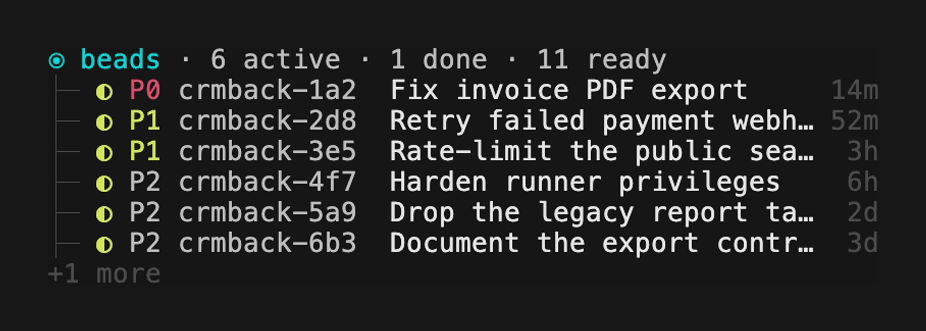
⦿ beads— the header; it dims when nothing is in progress.- The header counters: issues moved to
in_progressin this session, issues closed in this session, and how many are ready to work — open and unblocked. When the ready number is unknown the segment disappears entirely: a0is never shown. ◐is in progress,✓is closed. A closed row survives one agent turn and then leaves; the header counter stays until the session ends.P0…P4— priority:P0red,P1yellow, the rest muted.[crm-backend]— the owning repository; in a single-repo project the column is gone.- The right-hand column is how long the issue has been in progress, pinned to the right edge.
- A closed issue's title is struck through.
At most six rows are drawn; the rest collapse into a +N tail, and closed rows are
evicted first. In a narrow pane the titles are cut with an ellipsis and the repository
column disappears:
Umbrella mode: many repositories, one list
If an umbrella workspace is nearby — a directory whose bd aggregates several
repositories — the extension finds it on its own. It can also be named explicitly with
PI_BEADS_ROOT.
Reads (beads_ready, beads_list, beads_show, beads_deps and the prime) run
against the aggregate, so the agent sees the issues of every repository at once, and an
issue's owner is read off its id prefix: crmback-1a2 belongs to crm-backend.
Writes (beads_create, beads_update, beads_close, beads_dep, beads_undep,
beads_comment) are routed to the owning repository by that same prefix; afterwards the
repository's JSONL is re-exported and the aggregate re-synced, so the next read is
fresh. Writing straight into the aggregate is not allowed: what lives there are
throw-away copies.
With no umbrella around, the extension quietly works in ordinary single-repo mode. The
current mode and the routing table are always one /beads-mode away.
How it works
Prime. Instead of a full bd prime on every turn, the extension injects a short
bd prime --mcp block once per context segment, plus one line naming the id prefixes
and the repositories they route to.
Reads. Every read runs bd in-process and returns a digest — the fields an agent
acts on — rather than raw JSON.
Writes. Each write is dispatched to the owning repository by id prefix, then the aggregate is re-hydrated so the next read cannot show a stale list.
Widget. Widget state lives in session memory: it shows what this session moved into progress and closed. Rendering happens in the UI process only, so it costs no tokens.
Install
pi install npm:@abix5/pi-beads
Then restart pi or /reload. The bundled beads skill — how to read across
repositories, where to create, how to link — ships inside the package and registers
itself; there is nothing to copy by hand.
Requirements
- pi — the extension declares
@earendil-works/pi-coding-agentinpeerDependencies, as the pi packages documentation prescribes. - Node.js 22.6 or newer — the code is ESM with
node:prefixes and the extension is loaded as.tsthrough built-in type stripping. - The
bdbinary onPATH— this is a wrapper, not an implementation of beads. Verified againstbd version 1.0.5 (Homebrew). - A
.beads/directory in the project — created by/beads-initorbd init.
Configuration
| Variable | Default | Meaning |
|---|---|---|
PI_BEADS_ROOT |
auto-detected | Directory of the umbrella aggregate; understands ~. Unset, the umbrella is searched for; not found, the extension runs in ordinary single-repo mode |
There is nothing else to configure: the rest is worked out at session start.
Commands & tools
Commands are run by a person and their output never reaches the model's context.
| Command | What it does |
|---|---|
/beads |
A compact board: what is in progress and what is ready, across all repositories |
/beads-sync |
Re-hydrate the umbrella aggregate from every repository right now |
/beads-init |
Quiet initialization of beads in the current project (see below) |
/beads-mode |
Current mode, umbrella, default repository, prefix table, context economics |
The agent gets ten tools. All of them are direct in-process bd calls with no MCP
transport, and what comes back is a digest rather than raw JSON.
| Tool | What it does |
|---|---|
beads_ready |
Issues ready to work (open and unblocked) across all repositories |
beads_list |
A list filtered by status (open,in_progress,blocked,deferred,closed) |
beads_show |
The essential fields of one issue: status, priority, type, description, dependency counts |
beads_deps |
Blockers or dependents: a tree for one id, compact lines for several |
beads_create |
Create an issue in the right repository (repo is a folder name or a prefix), return its id |
beads_update |
Status, priority, title, notes, labels; routed by id prefix |
beads_close |
Close one or more ids, with a reason |
beads_dep |
Add a dependency (blocker blocks issue) within one repository |
beads_undep |
Remove a dependency |
beads_comment |
Add a progress comment to an issue |
Quiet init
/beads-init runs bd init --skip-agents --skip-hooks. Those two flags mean bd will
not write AGENTS.md, CLAUDE.md, the .claude/, .codex/ and .agents/ directories,
and will not point core.hooksPath at its own git hooks. Your instructions to agents stay
as you wrote them.
[!NOTE] What the flags do not cancel: outside a repository
bd initstill runsgit init, it still appends its lines to the root.gitignore, and it commits the files it created. That isbd's own behaviour and the extension has no say in it.
Limitations
The widget exists only in pi's interactive interface. Subagents and workflow runs have no
UI context, so nothing is drawn there — the beads_* tools work as usual.
Widget state is session memory. Changes made in another window, or straight through bd,
appear only after the next read. A closed row survives one agent turn; the closed counter
survives until the session ends. At most six rows are drawn, the rest collapse into a
+N tail.
beads dependencies live inside a single repository, so beads_dep across repositories is
impossible — that is how the storage works. For the same reason writing directly into the
umbrella aggregate is not allowed: routing by id prefix is the only path.
Finally, bd's output format is not a stable contract. Verified against 1.0.5; on other
versions the parsing may drift away from reality.
Not to be confused with
npm carries an older pi-beads package by a different author, depending on the retired
@mariozechner/* namespace. That is not this project.
Development
make test     # node --test src/widget-lines.test.mjs
make shots    # re-render the README screenshots from the shipped code (needs vhs + imagemagick)
Source lives in src/ and there is no build step: after editing, /reload in pi.
Licensed MIT.