@alexeiled/pi-plan-exec
Turn a Markdown execution plan into an isolated, resumable Pi run - durable controller state, one writer, deliberate recovery
Package details
Install @alexeiled/pi-plan-exec from npm and Pi will load the resources declared by the package manifest.
$ pi install npm:@alexeiled/pi-plan-exec- Package
@alexeiled/pi-plan-exec- Version
1.6.1- Published
- Sep 30, 2026
- Downloads
- 1,609/mo · 478/wk
- Author
- alexeiled
- License
- MIT
- Types
- extension, skill
- Size
- 675 KB
- Dependencies
- 0 dependencies · 6 peers
Pi manifest JSON
{
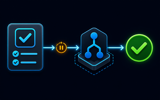
  "image": "https://raw.githubusercontent.com/alexei-led/pi-plan-exec/main/assets/plan-exec-card.png",
  "skills": [
    "./skills"
  ],
  "extensions": [
    "./src/index.ts"
  ]
}
Security note
Pi packages can execute code and influence agent behavior. Review the source before installing third-party packages.
README
pi-plan-exec





Turn a Markdown execution plan into an isolated, resumable Pi run.
pi-plan-exec solves the control problem of long-running AI implementation.
A capable agent can lose context, repeat work, skip verification, or start a
second writer after a restart. This extension moves task order, automatic
recovery, worktree checks, commit acceptance, and provider reconciliation out of
prompt prose into durable controller state.
The controller keeps polling and reconciles durable operations after a restart.
The default subagent backend uses the strict runtime contract on POSIX hosts
with the prerequisites and limits documented below.
It executes ready checked-list tasks in a Git checkout you choose, then runs the required review and fix stages with fresh Pi subagents or an explicitly selected review backend. A worker saying “done” is not enough: the plan’s checked items, accepted commit, required checks, and a clean worktree with no uncommitted or untracked non-ignored files are the implementation record.
Pre-release feature. The strict controller requires the released
pi-subagentsruntime plus the matching Bridge release. A worker or host that cannot prove process retirement remains fenced; see runtime contracts.
Local bootstrap and required-check batches run through plan-exec's owned POSIX process-group runner, with unbounded user-stoppable lifetime and durable writer-exit retirement proof. Detached descendants that leave the process group are best-effort, matching the released runtime.
What it does
- Keeps one writer per execution lane.
/execcan create an isolated Git worktree, work in place, or use an explicitly selected existing worktree. Existing-worktree runs keep that worktree and branch, and move the interactive Pi session there. - Executes plans deterministically. It selects the next dependency-ready task, starts a fresh worker, and verifies completion from a committed plan candidate.
- Recovers deliberately. A reload reattaches a matching run owned by the
returning session.
/exec resumetakes over a run whose owning session is proven dead, and reconciles its existing operation before continuing it. Compare-and-set records, operation IDs, controller locks, and leases avoid intentionally starting another writer or losing a pause or cancellation. - Requires a valid candidate before completion. A task is accepted only after its committed plan checkboxes, ancestry, frozen required checks, and a clean worktree with no uncommitted or untracked non-ignored files are verified. The default review is one required subagent reviewer; blocking findings remain unmet and schedule recovery.
- Schedules dependencies and preserves partial work. Omitted
dependsOnmetadata keeps legacy sequential order.dependsOn: []declares an independent task. A failed partial task stays in its lane while an eligible independent task can use a clean lane from the last accepted commit. Completed lane work is promoted back to the original output branch by a guarded fast-forward after required review and verification.
Install and run
The development baseline is Pi 0.99.1, pi-subagents@0.73.1, and
@alexeiled/pi-subagents-bridge@0.5.0. Install the providers as independent Pi
packages; no Git dependency or allow-git=all setting is required:
pi install -l npm:pi-subagents@0.73.1
pi install -l npm:@alexeiled/pi-subagents-bridge@0.5.0
pi install -l /absolute/path/to/pi-plan-exec
The default review backend is one required subagent reviewer with an empty
fallback list (none). Fusion 0.9.3 is current, but cannot satisfy this
extension's strict review ownership contract. Revmux's required lifecycle
support is still in an unmerged PR, not its latest release. Do not select these
backends for an unattended run; see runtime contracts.
@tintinweb/pi-tasks@0.9.x is an optional, session-scoped projection cache.
The development checkout and CI use npm 12.0.2.
Pi supplies its SDK, TUI and TypeBox modules. This extension declares them as
"*" peers, never runtime dependencies. If startup reports “Host-provided
extension packages must be declared in peerDependencies”, check the
package.json path in the warning: another installed extension can cause it.
Update or fix that package's declarations; do not suppress the warning or add
private SDK copies here. See the upstream audit for
known dependency limitations and upgrade priorities.
Reload Pi. From an interactive session in a Git repository, start a goal or run an existing executable plan:
/reload
/goal Fix the failing tests
/goal Add a greeting endpoint --check "npm test"
/exec docs/plans/20260713-add-greeting.md
/exec --worktree ../project-feature docs/plans/20260713-add-greeting.md
/goal <goal text> pursues a goal autonomously in place on the current branch
and needs no plan file or checkbox list. It requires a clean worktree and at
least one required check, auto-detected from the project or supplied with
--check "<command>". The controller runs one worker turn per iteration through
the same owned runtime, registry, leases, stop fences, and recovery as /exec:
the worker inspects the state, chooses and executes the next useful action, and
commits. An ordinary turn summary is an intermediate answer and the controller
schedules the next turn automatically. A completion claim only starts
verification: the required checks, then the configured review and final
verification, must pass on the committed work. Deleting test files or adding
skip/only markers pauses completion for confirmation; three turns without
progress pause the goal with a recorded reason, and a blocker pauses it until
/goal resume <run-id>. /goal status, /goal pause, /goal cancel, and
/goal help manage the run.
While an execution runs, Pi shows the execution-worktree path, branch, stage, and worker. Four verbs cover everything after the start:
/exec statusnever interrupts or restarts a run. It may idempotently repair the advisory pi-tasks and Fleet visibility caches fromrun.json. With no run ID it lists every run, groups the ones that claim a worker by the evidence for that claim, reports any missing package with its install command, and ends every row in one next command. Add a full run ID for one run in detail, or--allto include terminal runs older than a day./exec resumecontinues or recovers anything stuck. It takes the lease over from a session proven dead, reconciles the existing operation when its worker is provably gone and then continues it, and asks before retrying a task blocked outside the run or rebinding the execution branch after external work moved the worktree. It never launches on partial evidence: a run whose worker cannot be proven gone is reported, not reconciled. A model or provider failure is retried with the model this Pi session is signed in to and does not consume an implementation retry;--model currentor--model provider/modelis an advanced override for that one replacement child and never pins later workers. When a child pauses for a supervisor reply, the live controller preserves and polls that workflow, then continues automatically after the reply. After a restart, resume consumes its durable result or reattaches the same operation; it does not launch a duplicate. Missing bridge memory, a missing async directory, and v1 absence are inconclusive; only a matching owned-tree terminal proof, an authoritative never-started fence, or v2 durable absence for an unbound launch permits recovery to launch again./exec stopasks whether to pause the run (resumable) or cancel it (final, worktree preserved)./exec cleanupretires run records. It previews by default and deletes nothing;--applyremoves the registry entry — never the worktree, branch, or progress file — for terminal runs that finished more than 7 days ago.failedruns are excluded, because their record is what/exec resumeneeds.
After Pi starts or reloads, the native controller restores unfinished runs when
their lease is claimable and reattaches durable operations by ID. Its widget and
/exec status show task counts, dependency/retry waits, the next automatic
action, verified activity, cumulative usage, selected review backend, and
lifetime. Optional task projections are visibility caches and cannot gate
recovery. Statistics are deterministic usage/task bookkeeping by default;
statsEnabled: true opts into an additional report child.
A worker that reports <<<RALPHEX:TASK_FAILED>>> with incomplete checkboxes
keeps the run in automatic recovery with its blocker reason. The controller
schedules another evidence-gathering attempt with backoff; diagnostic status
failure counters do not become a terminal retry cap or a second writer. The
worktree, accepted commits, and completed tasks are preserved; a successful
workflow transport result does not mean the task succeeded.
When the worker supplies an observed Prerequisite: value of credentials,
permission, missing_executable, or runtime together with Evidence:,
the task enters waiting_external and receives an automatic wake. Generic
blocker wording does not create that classification.
Task dependencies control eligibility, while plan-exec still runs one child at
a time per controller and keeps one writer per lane. When a provider operation
may still exist, plan-exec keeps its recorded operation ID and reconciles it
before any retry. If an optional review or statistics stage
cannot recover, /exec skip <full-run-id> --reason <text> stops the tracked
child before recording an explicit waiver and advancing. Required review and
final verification cannot be skipped; implementation and archival never can.
The run finishes as completed_with_findings.
The installed exec-plan skill is also available as /skill:exec-plan for the
plan format, the recovery rules, and the retired names and flags a scripted agent
uses instead of a prompt.
The Guide defines the accepted
heading-based formats and checkbox rules. Omit the path to select an eligible
Markdown plan below docs/plans/.
Runtime model
flowchart LR
    plan["Markdown plan"] --> controller["durable controller"]
    controller --> bridge["pi-subagents-bridge"]
    bridge --> worker["fresh worker / reviewer"]
    worker --> worktree["Git worktree"]
    worktree --> checks["plan checkboxes"]
    checks --> controller
    controller --> lanes["accepted baseline + task lanes"]
    lanes --> worktree
    controller --> fusion["selected Fusion or Revmux review backend"]
    fusion --> controller
    controller --> result["completed or completed_with_findings"]
pi-plan-exec owns plan-specific control flow. Existing Pi packages retain
ownership of subagent execution, task UI, and multi-model review.
Read next
- Guide — requirements, executable-plan format, commands, lifecycle, recovery, and safety limits.
- Architecture — component ownership, state, RPC contracts, stages, and trust boundaries.
- Development — local verification and release process.
- Changelog — release history and compatibility changes.
- Historical design record — the original design before autonomous recovery.