@alexeiled/pi-subagents-bridge
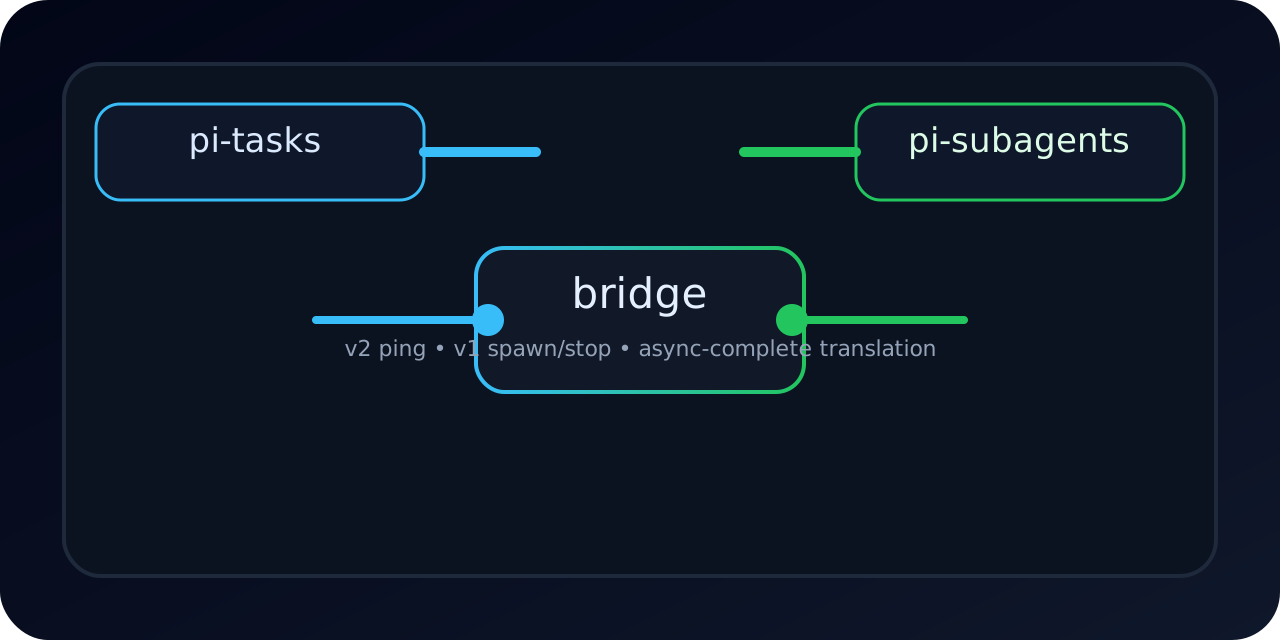
Protocol adapter that lets @tintinweb/pi-tasks TaskExecute spawn nicobailon/pi-subagents.
Package details
Install @alexeiled/pi-subagents-bridge from npm and Pi will load the resources declared by the package manifest.
$ pi install npm:@alexeiled/pi-subagents-bridge- Package
@alexeiled/pi-subagents-bridge- Version
0.5.5- Published
- Oct 6, 2026
- Downloads
- 1,556/mo · 317/wk
- Author
- alexeiled
- License
- MIT
- Types
- extension
- Size
- 156.7 KB
- Dependencies
- 0 dependencies · 2 peers
Pi manifest JSON
{
  "image": "https://raw.githubusercontent.com/alexei-led/pi-subagents-bridge/main/assets/bridge.svg",
  "extensions": [
    "./src/index.ts"
  ]
}
Security note
Pi packages can execute code and influence agent behavior. Review the source before installing third-party packages.
README
pi-subagents-bridge




pi-subagents-bridge is a protocol adapter between two Pi extensions:
It makes TaskExecute work with pi-subagents by translating the pi-tasks subagent RPC into the RPC and completion events that pi-subagents exposes. It also exposes a separate, generic plan-exec RPC for direct execution clients.
What it does
@tintinweb/pi-tasks expects a v2 subagent protocol.
pi-subagents exposes a v1 RPC plus async completion events.
This bridge sits between them and handles the mismatch.
Specifically, it:
- answers the
pi-tasksv2 ping handshake - forwards
spawnandstoprequests topi-subagents - translates
pi-subagentscompletion events back intopi-taskstask updates - falls back to polling
pi-subagentsrunstatusif an async completion event is missed - keeps the generic plan-exec RPC separate from all
pi-taskschannels
Request and completion flow
sequenceDiagram
  autonumber
  participant Tasks as @tintinweb/pi-tasks
  participant Bridge as pi-subagents-bridge
  participant Subs as pi-subagents

  Tasks->>Bridge: ping (v2)
  Bridge-->>Tasks: version 2

  Tasks->>Bridge: spawn(type, prompt, options)
  Bridge->>Subs: spawn(script, async: true)
  Subs-->>Bridge: runId
  Bridge-->>Tasks: id = runId

  Subs-->>Bridge: subagent:async-complete
  Bridge-->>Tasks: subagents:completed / subagents:failed

  alt async completion event is missed
    Bridge->>Subs: status(runId)
    Subs-->>Bridge: state + result path
    Bridge-->>Tasks: subagents:completed / subagents:failed
  end
Install
Install the two extensions being bridged, then install the bridge:
pi install npm:@tintinweb/pi-tasks
pi install npm:pi-subagents
pi install npm:@alexeiled/pi-subagents-bridge
Requirements:
- Node
>= 22.19.0 - Pi
^1.0.2with extension loading enabled; tested with Pi1.0.4 pi-subagents >= 0.76.0 < 0.77.0; tested with0.76.1for RPCscriptinput and native terminal proofs
The npm peer requirement does not verify which Pi extension is active. If a closed workflow status has no native proof field, the bridge reports an error to check the active runtime and durable async status/proof artifacts instead of claiming that the worker exited.
The bridge uses Pi's public extension event API. Future Pi releases still need validation if that API or the upstream subagent protocol changes.
The operation journal migrates schemas 1–6 to schema 7, preserving identity, bindings, cancellation and native fields. Migration never creates rejection or stop-delivery evidence for old rows. Bridge 0.5.4 and earlier cannot reopen schema 7. Stop journal owners and back up the journal before upgrading; keep a compatible Bridge installed afterward. Unknown versions are rejected before database changes.
Usage
Create tasks with TaskCreate, then execute them with TaskExecute.
TaskCreate(subject="Write a short plan", agentType="general-purpose", ...)
TaskExecute(task_ids=["1"])
Agent type mapping
The bridge preserves task agent names except for the compatibility aliases that pi-tasks examples commonly use.
TaskCreate(..., agentType=...) |
pi-subagents agent |
|---|---|
general-purpose |
delegate |
Explore |
scout |
explore |
scout |
| anything else | passed through unchanged |
Use an execution-capable agent for tasks that need shell commands, builds, or tests. A read-only agent can still be useful for read-only tasks such as review or metadata inspection.
Bridge behavior
Request flow
pi-tasks input |
Bridge behavior |
|---|---|
subagents:rpc:ping |
replies locally with protocol version 2 |
subagents:rpc:spawn |
sends a pi-subagents v1 spawn request |
subagents:rpc:stop |
sends a best-effort pi-subagents stop request |
Spawned runs are always forwarded as:
- one-child workflow execution through RPC
script async: truecontext: "fresh"control: { enabled: false }on the outer workflow and its child
The bridge does not send the removed public workflowScript or clarify fields.
The plan-exec capability name workflowScriptSpawn is unchanged; it is not an RPC input field.
The bridge returns the spawned run ID back to pi-tasks and tracks that run as bridge-owned state. It runs at most two bridge-owned tasks at once. A task without an explicit maxTurns receives a 12-turn budget.
Completion flow
For runs the bridge spawned itself, it converts pi-subagents outcomes into pi-tasks events:
- success →
subagents:completed - failure →
subagents:failed - stopped or paused run →
subagents:failedwithstatus: "stopped"
If subagent:async-complete does not arrive, the bridge polls pi-subagents status, reads the result file path from that status output, and emits the same completion event that pi-tasks expects. If a terminal status arrives before its result file is readable, the bridge retries for up to five seconds instead of silently dropping the result.
Generic plan-exec RPC
This protocol is independent of pi-tasks. Version 1 remains available on plan-exec:bridge:v1:request with replies on plan-exec:bridge:v1:reply:<requestId>.
Version 2 uses plan-exec:bridge:v2:request and plan-exec:bridge:v2:reply:<requestId>. It supports ping, spawn, operation, status, result, stop, adopt, cancelOperation, and optional diagnoseOperation with durable launch identity and native process-terminal proof.
pingverifies the livepi-subagentsRPC before advertisingworkflowScriptSpawn,durableOperationLookup, andprocessTerminalProofcapabilities.spawnrequiresoperationId,cwdwhen needed,params.agent,params.task, and an owner{ kind: "pi-plan-exec", runId, key, requestDigest }. The digest is SHA-256 over canonical{ cwd, params }. The bridge rejects mismatches before dispatch.- The durable journal, including the exact native RPC request UUID, is written before the native spawn is emitted. A bound operation survives a full Pi restart. Lost replies can be reconciled by the released native runtime's exact
rpc-spawn-<request UUID>tool-call lookup; the echoed native identity must match before binding. The bridge never redispatches the same operation. operationnever starts work. Version 2 returnsoperationId,requestDigest, andabsent,pending,found,not_started, orunknownbinding state. Lookup is observational and never retries dispatch.statusandadoptinclude a validated nativeprocessTerminalvalue whenpi-subagentsreturns one. Only anobservedproof with the matching run ID proves process termination.resultuses the native status RPC becausepi-subagentshas no separate result RPC.stopdelegates to the native stop RPC.adoptis observational. It does not silently transfer session ownership. Status and stop use native run IDs; the native runtime still enforces its session restrictions.
Explicit execution lifetimes require v2. Set params.executionLifetime to
{ mode: "unbounded" } or { mode: "bounded", timeoutMs: 1800000 }.
Do not combine this field with legacy timeout or timeoutMs. Both paths wrap
the agent and task in a one-child async workflow sent through RPC script.
A bounded lifetime becomes timeoutMs; an unbounded request forwards no timeout.
The lifetime is included in the caller digest and echoed as
effectiveExecutionLifetime; this is bridge intent, not native attestation.
Explicit lifetimes do not accept caller workflow scripts.
ping advertises lifetime support when native async spawn and stop are available.
Ownership is bridge-supervised with best-effort escaped-descendant handling,
not kernel containment. The bridge journal owns operation identity and replay
protection; the released upstream RPC has no operation-ID lookup. A bound run
can be recovered from the journal. New unbound entries retain the native RPC UUID,
so lookup can reattach the same child after a lost reply or restart while the
native tool-call lookup mapping is retained. Bridge also persists exact
toolCallId/run bindings from native completion events while loaded; these events
are not themselves terminal proof. Native terminal cleanup and result delivery
can remove the lookup mapping. If Bridge never received or recovered a binding
before its removal, lookup stays unknown even when other native artifacts remain.
An already-bound journal row does not depend on that alias. Failed, ambiguous or
mismatched lookup never proves absence. Historical unbound entries without a
native request UUID also remain unknown.
cancelOperation records cancellation intent before native lookup or stop.
The durable local fence does not require a native ping. It reports neverStarted: true
when its atomic journal transaction creates a new fence before any dispatch
record exists, or the existing operation has durable correlated rejection evidence.
Other native-correlated unbound operations return unknown and
neverStarted: false, including repeat cancellation of an old fence.
Uncorrelated legacy rows without rejection evidence reject cancellation instead.
Neither response establishes no-start.
It is not safe to infer non-start from a missing run ID or a timeout.
With cancellationDelivery: true advertised by v2 ping, cancellation replies
distinguish cancellationDelivery: "pending" (intent persisted, delivery unconfirmed)
from "delivered" (an exact whole-run native stop receipt persisted).
Exact never-started fences omit this field. Controllers must retry pending
delivery with the same operation, digest and owner; generic success is not a
delivered stop. Retry reconciles late native bindings, and failed stops remain
retryable. Concurrent calls coalesce within one registration. Persisted delivery
receipts prevent another stop on replay or restart; neither receipts nor
nativeState prove retirement. A lost receipt or failed persistence can cause
redelivery to the same immutable run. Bridge does not scan all journals or run
a background cancellation loop; the caller owns retry cadence.
Controllers that explicitly quarantine an execution target can use the identity-bound
cancellationRequested: true acknowledgement as a no-redispatch fence, never as
old-worker termination. If native stop fails after the fence commits, the reply
keeps that acknowledgement with state: "unknown", neverStarted: false, and
an error diagnostic with upstreamCode when available. An unknown old worker
may still run in its old target.
In pi-subagents 0.76.1, RPC stop still rejects paused and queued runs with
invalid_state, despite the model-facing paused-stop fix. Cross-host workflow
stop also needs the original live controller and active session. Bridge reports
these refusals as pending delivery; it does not call a different protocol,
resume the worker, or manufacture terminal proof. Preserve ownership until the
owning controller obtains native terminal evidence.
Reconcile native processTerminalProof (also exposed as processTerminal)
before starting replacement work. A workflow uses native workflowTerminalProof:
dispatch must be closed and each child observed or explicitly not-started.
Pending, unknown, malformed, or absent proofs do not establish completion.
The workflow's hosting Pi process can remain alive.
Advisory activity
V2 ping advertises advisoryObservation: { version: 1 }. Status, result and
adopt may return the following separate, display-only field:
advisoryObservation: {
  version: 1;
  source: 'pi-subagents.async-status-snapshot';
  runId: string;
  generatedAt: number;
  activity?: {
    state?: string;
    currentTool?: string;
    lastActivityAt?: number;
    currentToolStartedAt?: number;
    turnCount?: number;
    toolCount?: number;
  };
  omitted: { runs: number; children: number; byteLimitExceeded: boolean };
}
Bridge accepts only one exact root-run match in native snapshot v1 (at most 20 roots). Native RPC filters its snapshot to the active session; the snapshot itself has no session ID. Its generation time must fall within the status request/receipt window and be no more than 30 seconds old. Counters and timestamps must be nonnegative safe integers, activity times cannot exceed generation time, and text is limited to 160 characters without control/format characters. Missing, stale, foreign, ambiguous or malformed observations stay absent. Omission flags are preserved; missing data is not zero activity.
Workflow step IDs may be display keys rather than child run IDs, so Bridge does not infer child activity from their position, name or key. No usage, cost, failure or expiry fields are synthesized. Keep this advisory field separate from verified progress, ownership, retirement and execution-lifetime decisions.
Diagnostic guidance
When native diagnosticGuidance advertises durable, idempotent follow_up
guidance for confirmed tool failures, diagnoseOperation accepts
{ operationId, owner, params: { diagnosticId, toolCallId, message } }.
The native runtime checks the referenced failed tool and queues guidance into the
existing live session. Reuse the same diagnostic ID and payload after an uncertain
reply: durable native receipts prevent a second enqueue. Replies bind the caller
operation, request digest, diagnostic ID, and tool-call ID, with
guidanceOnly: true and queued, pending, cancelled, or rejected state.
An enqueue receipt does not confirm a repair. Cancellation fences late guidance;
this method does not start or revive a worker.
The Vitest suite checks the released RPC validator, not only capability mocks. An isolated Pi integration test completes both Bridge paths against real pi-subagents workflows and child runtimes, using only a local fixture HTTP model. It verifies lookup, replay identity, native workflow proof, and task completion.
Upgrade and unresolved launches
Bridge 0.5.3 advertises prelaunchRejection: { version: 1 }. A newly observed,
correlated spawn reply with invalid_params is persisted before lookup reports
state: "not_started", neverStarted: true and replaySafe: false.
The launchRejection object contains version: 1, source: "subagents-rpc",
the native requestId, method: "spawn", code: "invalid_params", message,
operationId, requestDigest, and ownerRunId. The released upstream
validator emits this code before invoking the executor. Post-dispatch failures,
malformed replies, missing method, and lost replies do not prove no-start.
A compatible controller must verify this evidence, call cancelOperation,
and persist the returned cancellation fence before allocating a new operation.
Replaying the rejected identity never dispatches, including after restart.
Spawn failures retain error.code: "upstream_error" and add upstreamCode
when a structured upstream code is available.
Install pi-subagents 0.76.x before updating Bridge, then restart Pi after updating
already-loaded packages. A /reload is enough for local Bridge source edits, not
for mixing newly installed upstream packages with modules already loaded in Pi.
Back up the journal while its owners are stopped before the schema upgrade;
do not downgrade over schema 7. The fix applies to newly captured rejection
evidence only. An old unresolved launch is not repaired by this update.
An old error string, missing run ID, dead controller PID, clean worktree, or
elapsed time does not prove that dispatch never happened.
For an old dispatching/unknown row without proof, preserve the run, worktree,
and journal and use the owning controller's read-only status. Repeated
/exec resume cannot establish absence. Recovery needs an authoritative
operation-bound rejection or a verified binding to the original child and its
terminal proof. The released upstream has no operation-ID lookup, and Bridge
has no historical evidence importer or force-clear API. If that evidence is
unavailable, the launch remains unresolved. Do not delete/reset the journal,
cancel to manufacture proof, recreate the run, or launch a replacement worker.
The journal defaults to ~/.pi/pi-subagents-bridge/plan-exec-operations.sqlite. SQLite transactions provide crash recovery and cross-process serialization without a stale application lock. Version 1 clients retain their existing response shape and also benefit from durable bound-operation lookup. Operation identity rows are retained as idempotency records; automatic pruning could make an old operation ID dispatch again. Remove the database only after all referenced plan runs are permanently retired and duplicate-launch protection is no longer needed. Existing v1 accepted-run rows migrate fail-closed with no session identity; they require explicit manual recovery rather than unsafe cross-session delivery.
Failures use { success: false, error: { code, message } }. operation_capacity means the in-process bridge has 128 unresolved active operation IDs and will not evict one to accept another spawn.
TaskExecute-specific safeguards
TaskExecute is queue-style orchestration, not direct subagent supervision.
Because of that, the bridge also applies two execution defaults to bridge-spawned runs:
- disables
pi-subagentsacceptance gating - disables
pi-subagentslive control nudges
This avoids false pauses on missing acceptance reports and avoids misleading background needs attention notices for normal task runs. Repeated copies of one live request are coalesced only after their session and request digest match. The request ID is also journaled before native dispatch, so replay after the in-memory reply cache expires returns the existing run or fails closed as unknown instead of dispatching again. Transient persistence failures for known accepted runs and launch bindings are retried while the bridge process remains active.
Accepted run IDs are tied to the originating Pi session ID and a leased process owner. A foreign Pi session cannot claim or delete them. The same resumed session can reclaim them after the owner exits. An expired heartbeat alone cannot prove exit; a reused or still-live PID leaves ownership unresolved. The owner renews its fence before emitting completion, and failed reconciliation is retried periodically. If another session wins ownership, the bridge stops polling and emits subagents:warning with code accepted_run_ownership_lost instead of silently dropping the run.
The legacy pi-tasks spawn request does not contain task ID, list ID, or attempt generation. Therefore the bridge cannot recover a task binding after a crash that occurs after native dispatch but before the run ID is received. The durable request becomes unknown and is not launched again automatically. The bridge does not use prompt matching.
If the native run ID is known but local accepted-run persistence fails, the bridge acknowledges that known run instead of returning an error that could trigger a duplicate launch. It keeps completion ownership for the current process and logs the durability loss; a subsequent process restart then requires manual completion recovery.
Scope and limits
This package is intentionally narrow.
It does:
- bridge
TaskExecutetask launches topi-subagents - track only runs spawned through this bridge
- ignore unrelated
pi-subagentsruns
It does not:
- replace
pi-taskstask orchestration - act as a generic adapter for
pi-subagentsmethods beyond the documented plan-exec protocol - support loading
@tintinweb/pi-subagentsalongside this bridge
Do not load @tintinweb/pi-subagents at the same time as this package.
More detail
docs/design.md— bridge behavior and maintenance rulesdocs/protocol-research.md— upstream protocol notesDEVELOPMENT.md— local validation and release workflowCHANGELOG.md— release history and RPC compatibility changes