@alexeiled/pi-subagents-bridge
Protocol adapter that lets @tintinweb/pi-tasks TaskExecute spawn nicobailon/pi-subagents.
Package details
Install @alexeiled/pi-subagents-bridge from npm and Pi will load the resources declared by the package manifest.
$ pi install npm:@alexeiled/pi-subagents-bridge- Package
@alexeiled/pi-subagents-bridge- Version
0.2.0- Published
- Jul 16, 2026
- Downloads
- 849/mo · 225/wk
- Author
- alexeiled
- License
- MIT
- Types
- extension
- Size
- 50.4 KB
- Dependencies
- 0 dependencies · 1 peer
Pi manifest JSON
{
  "extensions": [
    "./src/index.ts"
  ],
  "image": "https://raw.githubusercontent.com/alexei-led/pi-subagents-bridge/main/assets/bridge.svg"
}
Security note
Pi packages can execute code and influence agent behavior. Review the source before installing third-party packages.
README
pi-subagents-bridge




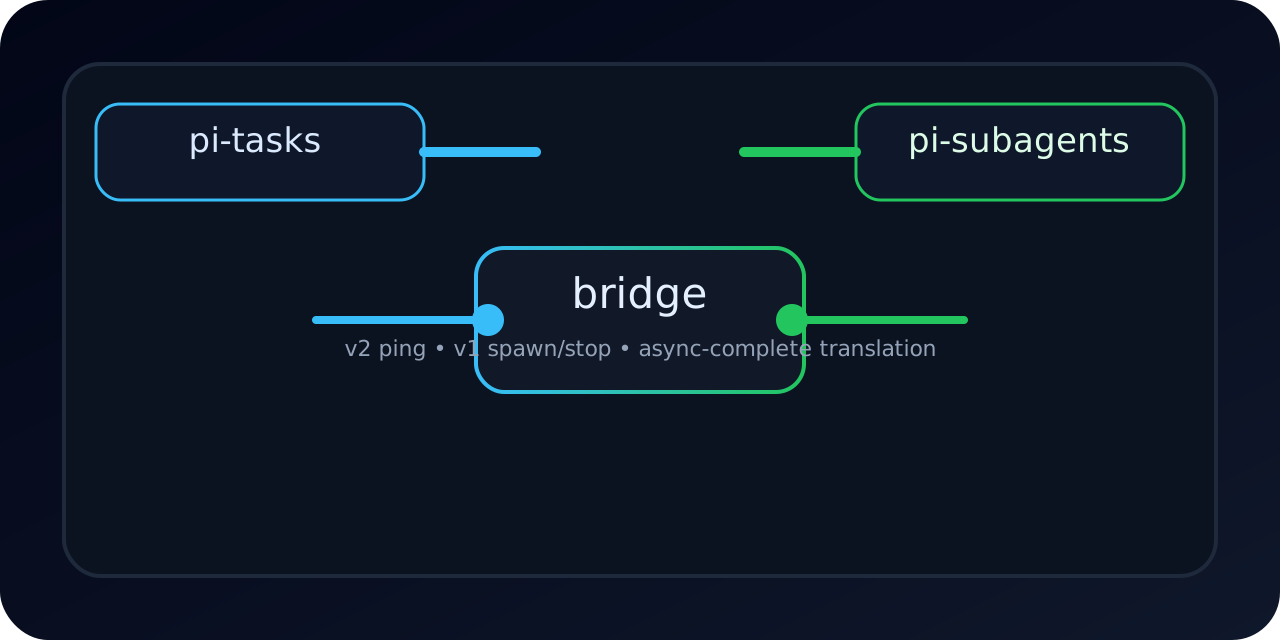
pi-subagents-bridge is a protocol adapter between two Pi extensions:
It makes TaskExecute work with pi-subagents by translating the pi-tasks subagent RPC into the RPC and completion events that pi-subagents exposes. It also exposes a separate, generic plan-exec RPC for direct execution clients.
What it does
@tintinweb/pi-tasks expects a v2 subagent protocol.
pi-subagents exposes a v1 RPC plus async completion events.
This bridge sits between them and handles the mismatch.
Specifically, it:
- answers the
pi-tasksv2 ping handshake - forwards
spawnandstoprequests topi-subagents - translates
pi-subagentscompletion events back intopi-taskstask updates - falls back to polling
pi-subagentsrunstatusif an async completion event is missed - keeps the generic plan-exec RPC separate from all
pi-taskschannels
Request and completion flow
sequenceDiagram
  autonumber
  participant Tasks as @tintinweb/pi-tasks
  participant Bridge as pi-subagents-bridge
  participant Subs as pi-subagents

  Tasks->>Bridge: ping (v2)
  Bridge-->>Tasks: version 2

  Tasks->>Bridge: spawn(type, prompt, options)
  Bridge->>Subs: spawn(agent, task, async: true)
  Subs-->>Bridge: runId
  Bridge-->>Tasks: id = runId

  Subs-->>Bridge: subagent:async-complete
  Bridge-->>Tasks: subagents:completed / subagents:failed

  alt async completion event is missed
    Bridge->>Subs: status(runId)
    Subs-->>Bridge: state + result path
    Bridge-->>Tasks: subagents:completed / subagents:failed
  end
Install
Install the two extensions being bridged, then install the bridge:
pi install npm:@tintinweb/pi-tasks
pi install npm:pi-subagents
pi install npm:@alexeiled/pi-subagents-bridge
Requirements:
- Node
>= 22.19.0 - Pi with extension loading enabled
Usage
Create tasks with TaskCreate, then execute them with TaskExecute.
TaskCreate(subject="Write a short plan", agentType="general-purpose", ...)
TaskExecute(task_ids=["1"])
Agent type mapping
The bridge preserves task agent names except for the compatibility aliases that pi-tasks examples commonly use.
TaskCreate(..., agentType=...) |
pi-subagents agent |
|---|---|
general-purpose |
delegate |
Explore |
scout |
explore |
scout |
| anything else | passed through unchanged |
Use an execution-capable agent for tasks that need shell commands, builds, or tests. A read-only agent can still be useful for read-only tasks such as review or metadata inspection.
Bridge behavior
Request flow
pi-tasks input |
Bridge behavior |
|---|---|
subagents:rpc:ping |
replies locally with protocol version 2 |
subagents:rpc:spawn |
sends a pi-subagents v1 spawn request |
subagents:rpc:stop |
sends a best-effort pi-subagents stop request |
Spawned runs are always forwarded as:
async: trueclarify: falsecontext: "fresh"
The bridge returns the spawned run ID back to pi-tasks and tracks that run as bridge-owned state. It runs at most two bridge-owned tasks at once. A task without an explicit maxTurns receives a 12-turn budget.
Completion flow
For runs the bridge spawned itself, it converts pi-subagents outcomes into pi-tasks events:
- success →
subagents:completed - failure →
subagents:failed - stopped or paused run →
subagents:failedwithstatus: "stopped"
If subagent:async-complete does not arrive, the bridge polls pi-subagents status, reads the result file path from that status output, and emits the same completion event that pi-tasks expects. If a terminal status arrives before its result file is readable, the bridge retries for up to five seconds instead of silently dropping the result.
Generic plan-exec RPC
This protocol is independent of pi-tasks. Send { version: 1, requestId, method, ... } on plan-exec:bridge:v1:request; replies use plan-exec:bridge:v1:reply:<requestId>.
Supported methods are ping, spawn, operation, status, result, stop, and adopt.
spawnrequires a durable top-leveloperationId, top-levelcwdwhen needed, andparams.agentplusparams.task. It forwards supported execution fields (async,clarify,context,model,turnBudget,control,acceptance, andtimeout) topi-subagents. It acceptstimeoutortimeoutMsand rejects mismatched values; either maps to pi-subagentstimeoutMs. It returns{ runId, asyncDir? }. A repeated operation ID reuses the original reply for this Pi process lifetime.operationrequiresoperationIdand never starts a child. It returns{ state: "absent" },{ state: "pending" },{ state: "found", runId, asyncDir? }, or{ state: "unknown", error }. Its lookup map survives bridge re-registration in one Pi process but is not durable across a full Pi restart. It retains at most 127 completed outcomes and never evicts active operations. Clients must use it after an unknown spawn outcome and must not blindly launch a second child.statusandresultreturn normalized observations from thepi-subagentsstatus RPC.resultuses status becausepi-subagentshas no separate result RPC.stopdelegates to thepi-subagentsstop RPC.adoptvalidates and observes a run but does not transfer ownership or promise cross-session stop support.
Failures use { success: false, error: { code, message } }. operation_capacity
means the bridge has 128 unresolved active operation IDs and will not evict any
to accept another spawn.
TaskExecute-specific safeguards
TaskExecute is queue-style orchestration, not direct subagent supervision.
Because of that, the bridge also applies two execution defaults to bridge-spawned runs:
- disables
pi-subagentsacceptance gating - disables
pi-subagentslive control nudges
This avoids false pauses on missing acceptance reports and avoids misleading background needs attention notices for normal task runs. Repeated copies of the same spawn request are coalesced, so retries cannot launch duplicate bridge-owned agents.
Scope and limits
This package is intentionally narrow.
It does:
- bridge
TaskExecutetask launches topi-subagents - track only runs spawned through this bridge
- ignore unrelated
pi-subagentsruns
It does not:
- replace
pi-taskstask orchestration - act as a generic adapter for
pi-subagentsmethods beyond the documented plan-exec protocol - support loading
@tintinweb/pi-subagentsalongside this bridge
Do not load @tintinweb/pi-subagents at the same time as this package.
More detail
docs/design.md— bridge behavior and maintenance rulesdocs/protocol-research.md— upstream protocol notesDEVELOPMENT.md— local validation and release workflowCHANGELOG.md— release history and RPC compatibility changes