@aneviaro/pi-codex-limit-tracking-footer
A Pi footer extension for Codex subscription limit tracking.
Package details
Install @aneviaro/pi-codex-limit-tracking-footer from npm and Pi will load the resources declared by the package manifest.
$ pi install npm:@aneviaro/pi-codex-limit-tracking-footer- Package
@aneviaro/pi-codex-limit-tracking-footer- Version
0.1.1- Published
- Jul 13, 2026
- Downloads
- 238/mo · 166/wk
- Author
- aneviaro
- License
- MIT
- Types
- extension
- Size
- 162.9 KB
- Dependencies
- 0 dependencies · 1 peer
Pi manifest JSON
{
  "extensions": [
    "./extensions/codex-limit-tracking-footer.ts"
  ]
}
Security note
Pi packages can execute code and influence agent behavior. Review the source before installing third-party packages.
README
@aneviaro/pi-codex-limit-tracking-footer
A Pi extension that adds a compact Codex subscription-limit segment to the default footer.
Install
Install the published package globally:
pi install npm:@aneviaro/pi-codex-limit-tracking-footer@0.1.0
For local development or testing:
pi -e ./packages/codex-limit-tracking-footer
# or
pi install ./packages/codex-limit-tracking-footer
The package supports Pi 0.80.6+ and Node.js 20+.
Behavior
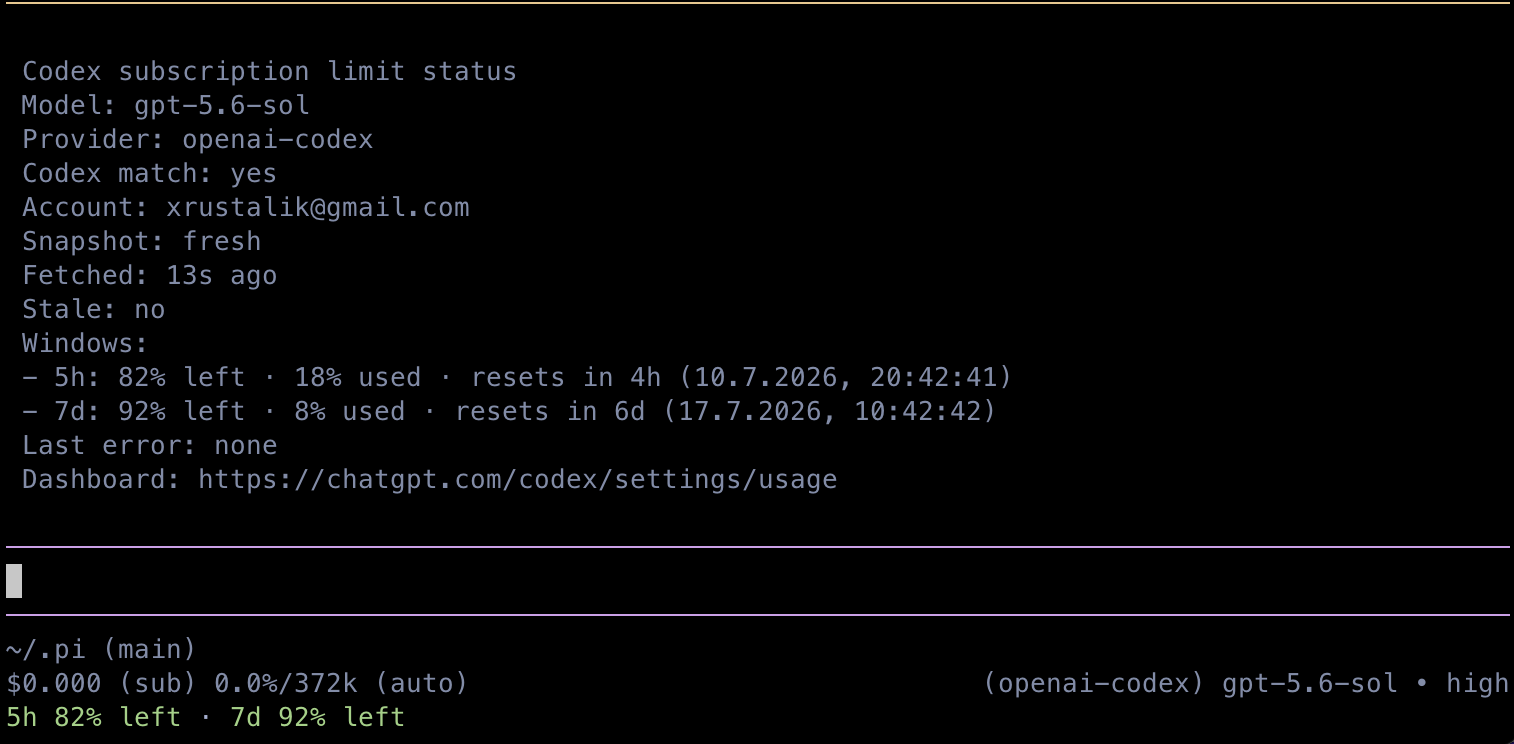
For an active Pi-managed openai-codex model, the footer shows the Codex limit windows returned for the account, for example:
5h 42% left · 7d 81% left
Some accounts currently expose only the weekly window, which renders as 7d 99% left. Each window is themed independently: above 50% is success, 20–50% is warning, and below 20% is error. Failed refreshes retain same-provider data with a stale age marker. Data is refreshed at startup, on provider/model changes, after each completed turn, and no more than once per 15 seconds per provider; background polling runs every minute.
Use /codex-limits for details, or /codex-limits refresh to bypass the cache for a manual refresh.
OAuth and privacy
The extension resolves credentials only through Pi's model registry and requires the active Codex model to use Pi-managed OAuth. It reads no agent/auth.json file, does not persist usage data, and does not log credentials, account IDs, authorization headers, or raw usage payloads. The upstream usage endpoint is an undocumented Codex API and may change; failures are handled without exposing secrets.
Development and release checks
npm ci
npm run typecheck
npm test
npm run pack:check
Tests use sanitized fixtures and mocked auth/fetch boundaries. No live credentials are required.