@axnic/pi-aks-user-question
Pi extension — lets LLMs ask structured questions to the user via an interactive TUI form
Package details
Install @axnic/pi-aks-user-question from npm and Pi will load the resources declared by the package manifest.
$ pi install npm:@axnic/pi-aks-user-question- Package
@axnic/pi-aks-user-question- Version
0.2.0- Published
- Apr 23, 2026
- Downloads
- 895/mo · 517/wk
- Author
- anicolaie
- License
- Apache-2.0
- Types
- extension
- Size
- 3.1 MB
- Dependencies
- 5 dependencies · 0 peers
Pi manifest JSON
{
  "extensions": [
    "./dist/index.js"
  ],
  "video": "https://raw.githubusercontent.com/axnic/pi-aks-user-question/refs/heads/main/docs/assets/demo.webm"
}

Security note
Pi packages can execute code and influence agent behavior. Review the source before installing third-party packages.
README
Why
When an LLM needs user input, it typically asks a plain-text question and waits for a free-form reply. This works for simple follow-ups but quickly breaks down when the agent needs structured data — picking from a set of options, entering validated URLs, confirming a yes/no, or answering multiple related questions at once.
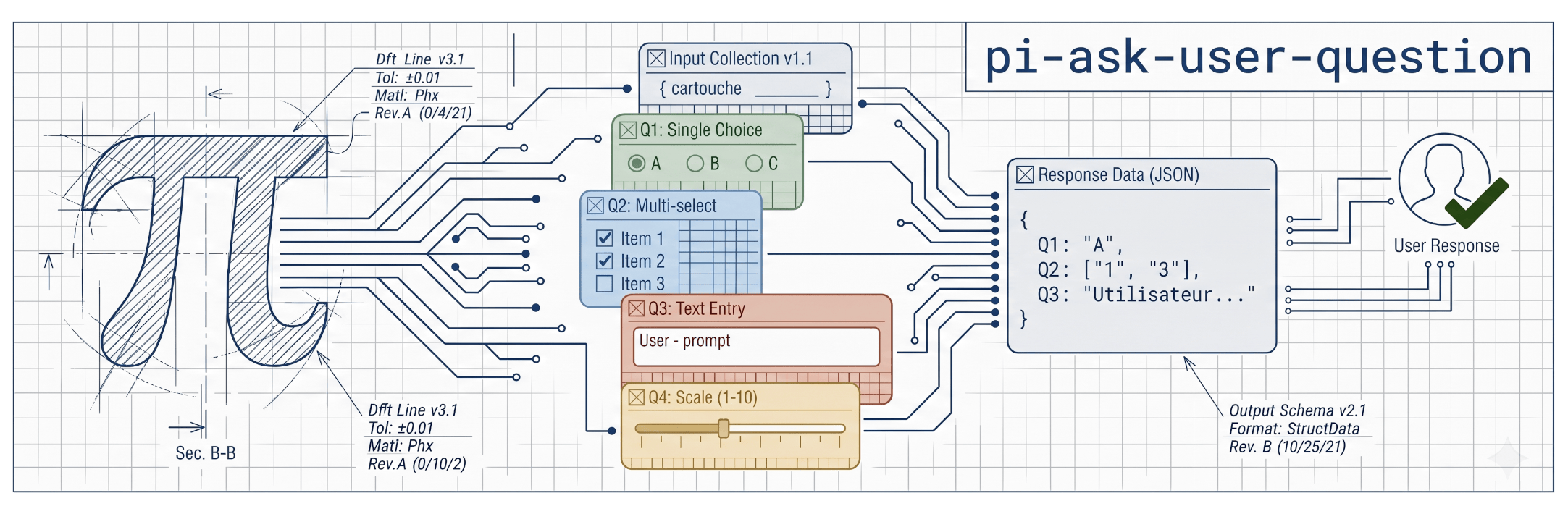
pi-aks-user-question solves this with a single tool call. The LLM describes the questions it needs answered as JSON parameters; the extension renders an interactive TUI form with keyboard navigation, inline validation, and a review screen. The user's typed answers flow back as structured data the LLM can act on immediately.
No free-form parsing. No follow-up clarifications. One call, structured answers.
Features
- 5 question types — text, number, choice (single-select), multichoice (multi-select), and boolean.
- Inline validation — 8 built-in formats (URL, email, IP, IPv4, IPv6, number, integer, regex) with debounced feedback on text inputs.
- Tab navigation — each question gets its own tab; overflow is handled with an expand-from-active algorithm and ellipsis indicators.
- Review screen — summary of all answers with warnings for unanswered required questions. Submit or go back to edit.
- Visual slider — number inputs display a range slider when both
minandmaxare set. - "Other…" free-text — choice and multichoice questions append an "Other…" row by default (opt-out with
allowOther: false). - Customizable boolean — labels ("Yes"/"No") and colors (green/red) are overridable per question.
- Keyboard-first — Tab/Shift+Tab to navigate, Space to select, Enter to advance, Esc to quit.
Install
pi install npm:@axnic/pi-aks-user-question
Restart pi. The extension registers the ask_user_question tool on startup.
Question types
| Type | Widget | Value type |
|---|---|---|
text |
Single-line editor with optional format validation | string |
number |
Numeric field with ↑/↓ step and optional range slider | number |
choice |
Numbered list — Space picks one, Enter advances | string |
multichoice |
Checkbox list — Space toggles, Enter advances | string[] |
boolean |
Yes/No toggle — ↑/↓ or Y/N to switch | boolean |
Usage
The LLM calls ask_user_question with a questions array. Each question specifies a type, question text, a short header for the tab label, and type-specific fields.
Example — mixed question types
{
  "questions": [
    {
      "id": "runtime",
      "type": "choice",
      "question": "Which runtime do you target?",
      "header": "Runtime",
      "options": [
        {
          "label": "Node.js",
          "description": "V8-based, most ecosystem support"
        },
        {
          "label": "Deno",
          "description": "Secure by default, built-in TypeScript"
        },
        { "label": "Bun", "description": "Fast startup, bundler included" }
      ],
      "allowOther": false
    },
    {
      "id": "port",
      "type": "number",
      "question": "Which port?",
      "header": "Port",
      "required": true,
      "validation": { "format": "integer", "min": 1, "max": 65535 }
    },
    {
      "id": "enable-tls",
      "type": "boolean",
      "question": "Enable TLS?",
      "header": "TLS",
      "defaultValue": true
    },
    {
      "id": "api-url",
      "type": "text",
      "question": "What is the API endpoint?",
      "header": "Endpoint",
      "placeholder": "e.g. https://api.example.com",
      "validation": { "format": "url", "protocols": ["https"] }
    }
  ]
}
The form returns structured answers keyed by id:
{
  "runtime": "Deno",
  "port": 8080,
  "enable-tls": true,
  "api-url": "https://api.example.com"
}
Project layout
pi-aks-user-question/
├── index.ts              Extension entry point — registers the tool
├── src/
│   ├── schema.ts         TypeBox schemas for tool parameter validation
│   ├── types.ts          Shared TypeScript interfaces
│   ├── validation.ts     Text/number input validators (8 formats)
│   ├── helpers.ts        Stateless utilities (errorResult, stripAnsi, …)
│   └── form/
│       ├── index.ts      Form factory — wires questions to inputs
│       ├── form.ts       Form class — orchestrates lifecycle
│       ├── tabs.ts       Tab bar with overflow handling
│       ├── review.ts     Review screen with scrollable summary
│       ├── question.ts   FormQuestion interface
│       ├── scrollbar.ts  Shared scrollbar character utility
│       └── inputs/
│           ├── types.ts    Input/BaseInput abstractions
│           ├── text.ts     TextInput — single-line with validation
│           ├── number.ts   NumberInput — numeric with slider
│           ├── boolean.ts  BooleanInput — yes/no toggle
│           └── choice.ts   ChoiceInput — single and multi-select
├── docs/
│   ├── architecture.md   Module interaction and data flow
│   ├── schema.md         JSON Schema reference and design decisions
│   ├── schema.json       Machine-readable tool parameter schema (generated)
│   └── ui.md             TUI layout spec: tab bar, colors, review, footer
├── scripts/
│   └── generate-schema.ts  Generates docs/schema.json from TypeBox
└── vitest.config.ts         Test configuration
Development
All dev tooling is managed via mise.
# Setup (run once after clone)
mise trust && mise install
pnpm install

# Common commands
pnpm test                # run vitest suite
mise run build           # bundle extension → dist/index.js
mise run lint            # run Trunk (check only)
mise run lint:fix        # auto-fix lint issues
mise run docs:schema     # regenerate docs/schema.json from code
See AGENTS.md for architecture details, commit conventions, and coding guidelines.
License
Apache 2.0
This project was vibe-coded with AI assistance and reviewed by the maintainer before publishing.