@barty13/pi-opencode-bridge
Delegate threads to a local OpenCode service from Pi. oc_open returns at once, the thread settling opens a later turn.
Package details
Install @barty13/pi-opencode-bridge from npm and Pi will load the resources declared by the package manifest.
$ pi install npm:@barty13/pi-opencode-bridge- Package
@barty13/pi-opencode-bridge- Version
0.1.2- Published
- Nov 4, 2026
- Downloads
- 361/mo · 361/wk
- Author
- barty13
- License
- MIT
- Types
- extension
- Size
- 287.6 KB
- Dependencies
- 0 dependencies · 2 peers
Pi manifest JSON
{
  "image": "assets/banner.png",
  "extensions": [
    "opencode-bridge.ts"
  ]
}
Security note
Pi packages can execute code and influence agent behavior. Review the source before installing third-party packages.
README
pi-opencode-bridge


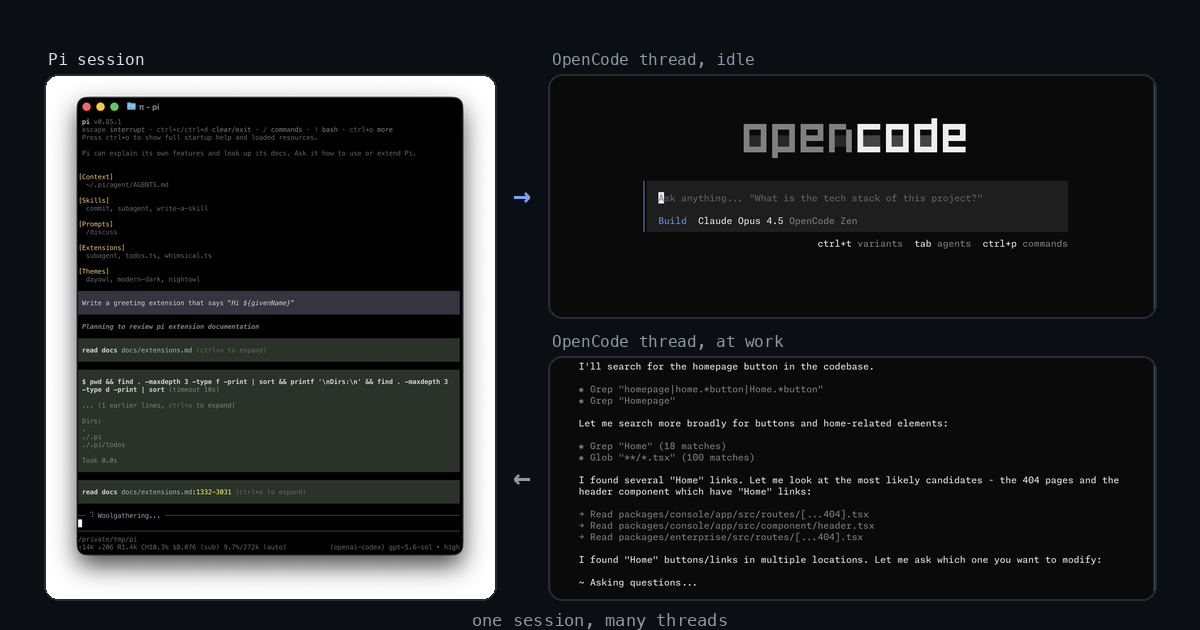
Delegate threads from a Pi session to a local OpenCode
service. oc_open returns while the thread still runs. When the thread settles, Pi opens a new
turn with the answer. Your main session keeps working, and you keep the terminal.
$ pi install npm:@barty13/pi-opencode-bridgeOr from git:
$ pi install git:github.com/Barty13/pi-opencode-bridgeThen start Pi with the thread root set:
$ OC_ROOT=~/work/threads pi> /oc
mode: supervised · service: http://127.0.0.1:… · threads: 0 armed
> oc_models
> oc_open model: <id from oc_models> title: refactor-parser brief: …What it removes
Pi runs one turn at a time, and a turn is the unit that blocks. Delegation with a blocking call holds that turn for the whole run of the other model. Here the send returns in milliseconds. The finish arrives later, as one message, with the answer already inside it.
The bridge adds seven tools and six commands.
| Tool | What it does |
|---|---|
oc_models |
Lists the models the service serves for delegation, with each effort ladder |
oc_open |
Opens a thread for one self-contained task, returns its id |
oc_send |
Hands an instruction to a thread, returns at once |
oc_wait |
Collects the settle inside the current turn, when a wake-up cannot arrive |
oc_read |
Shows the latest messages, parts: "full" adds reasoning and tool calls |
oc_reply |
Answers an open permission or form ask by id |
oc_stop |
Interrupts a running thread, no wake-up follows |
| Command | What it does |
|---|---|
/oc |
Status: mode, service, live threads |
/oc-auto |
The model in this Pi session answers the asks |
/oc-accept |
You answer the asks yourself |
/oc-kill <id> |
Stops a thread |
/oc-clean [force] |
Lists or deletes finished threads |
/oc-panes open|close|list |
Controls the Ghostty columns |
Install
$ pi install npm:@barty13/pi-opencode-bridge # or: pi install <path to a clone>An update takes effect on the next restart or resume: a running pi keeps the code it loaded.
Requirements
- OpenCode already installed and signed in. Free or licensed, your choice. The service must run:
start it with
opencode serve --service. The bridge only talks to that local service, on the portopencode service statusprints, with the password in~/.config/opencode/service.json. It never installs, updates, or configures OpenCode, and it never reads your provider keys. - Ghostty 1.3 or newer, for the live columns. Each live thread gets one column that runs
opencode --session <id>, so you watch the thread work. Ghostty's AppleScript dictionary drives it, so this part is macOS only. SetOC_PANES=0if you do not want columns. - Pi 1.4 or newer. Bun runs the extension; Pi bundles it.
How a thread finishes
oc_sendposts the prompt and returns. The thread is armed: the bridge now owes one wake-up.- The OpenCode event stream reports
session.execution.{succeeded,failed,interrupted}. One detail request per armed thread everyOC_BACKSTOP_MScovers dropped frames. - Detect claims the thread once, snapshots the answer, and releases one debounced message per batch. Two settles produce one message.
oc_waitwaits on that same detector, so a collected answer never wakes the model twice.- A run already reported answers
already reportedinstead of a second copy: the wake-up andoc_waitshare one report per run.oc_waitwithsinceandoc_readread the record freely.
A batch that lands while you type waits for you. A batch held by compaction waits for the compact to end. An escape (abort) holds the batch, so a wake-up cannot reopen a conversation you dropped.
Print, JSON, and a Pi reload carry no wake-up. There oc_wait is the collector.
Context ceiling
A thread that grew past OC_COMPACT_TOKENS compacts before it takes your next instruction. The
bridge reads the newest assistant row of that thread (input + cache.read + cache.write + output + reasoning), orders POST /compact with delivery:"steer", then posts the prompt. OpenCode runs the
compaction at the step boundary, so the prompt lands on the compacted context. Measured on a 716k
thread: compact admitted in 77 ms, reply 98 s later, size down to 34k.
The receipt says so: sent; ... compact ordered at 716k. A thread whose newest compaction row
postdates its last answer reads 0, so one compaction never triggers the next. OpenCode answers a
second steer with 409, so parallel sends order one compaction. Your own opencode.json auto-compact
stays in charge below the ceiling.
Supervision
Every ask from a thread (a permission, a form) goes to you by default. /oc-auto hands asks to
the model in this Pi session, which answers with oc_reply. /oc-accept returns to you. --oc-auto starts a
session in auto mode. Each session start resets to supervised and drops per-thread state, so a
stale run stays safe.
Boundary
Threads live under OC_ROOT. oc_open checks the create path, every other tool checks that
thread's own directory once. Real paths compare, so a symlink cannot escape the root. Threads can
write files, so point OC_ROOT at a scratch tree you own. Without OC_ROOT the root is the
working directory at start.
Environment
| Variable | Default | Effect |
|---|---|---|
OC_ROOT |
working directory | Thread root, all threads must sit under it |
OC_PANES |
oc-panes next to the extension |
Path to the pane script, 0 turns columns off |
OC_PANES_FONT |
13 |
Font size in a new pane window |
OC_PANES_COLS |
0 |
Column width, 0 lets Ghostty split evenly |
OC_HUD |
on | 0 removes the footer and the thread table |
OC_DEBOUNCE_MS |
400 |
Batch window for wake-ups |
OC_BACKSTOP_MS |
5000 |
Poll gap between event frames |
OC_WATCH_TTL_S |
1800 |
How long an armed thread waits before it expires |
OC_WAIT_MAX_S |
300 |
Ceiling for oc_wait |
OC_COMPACT_TOKENS |
500000 |
Thread size in tokens above which a send orders a compaction first; 0 turns the gate off |
OC_SERVICE_FILE |
~/.config/opencode/service.json |
Where to read the local service password |
OC_RETENTION |
{} |
Your own data-policy labels, JSON keyed by model id suffix, for example {"<id>":"zero"}. Display only. The bridge ships no model ids: read each policy from your provider and set it here. |
Checks
Model-free checks run against a stub pi and a stub service. Each has a control build with the fix
removed, which must fail. See checks/README.md.
$ bun install
$ bun run typecheck
$ bun run check
Checks that need a real model drive a Pi TUI in tmux, and take OC_CHECK_MODEL:
$ OC_CHECK_MODEL=<id from oc_models> bash checks/check-tui.sh
$ OC_RPC_MODEL=<id from oc_models> bun run oc-rpc.ts   # wake-up path, costs tokens
Limits
- One OpenCode service per bridge, no remote host, no proxy.
- Live columns need macOS plus Ghostty. They stay off in print, JSON, and RPC mode.
- 32 open threads at most. A watch older than
OC_WATCH_TTL_Sexpires and reports itself. - Message bodies cap at 4000 characters per read;
offsetpages past the cap. - Deleting a thread outside the bridge does not cancel its armed watch, so its wake-up still fires.
Clean up after the settle with
/oc-clean force, not mid-run.
Picture
assets/banner.png comes from gallery/render.py. Run bash gallery/fetch.sh first: it pulls the
producers' own screens, the Pi terminal screenshot from pi-mono and the OpenCode splash and working
screens from opencode. Trademarks belong to their owners. No operator screenshot appears in it.
License
MIT. See LICENSE. Report issues through SECURITY.md.