@cebarks/pi-vertex
Google Vertex AI provider for Pi coding agent with dynamic model discovery
Package details
Install @cebarks/pi-vertex from npm and Pi will load the resources declared by the package manifest.
$ pi install npm:@cebarks/pi-vertex- Package
@cebarks/pi-vertex- Version
3.0.0- Published
- Sep 30, 2026
- Downloads
- 160/mo · 37/wk
- Author
- cebarks
- License
- MIT
- Types
- extension
- Size
- 148.7 KB
- Dependencies
- 3 dependencies · 2 peers
Pi manifest JSON
{
  "extensions": [
    "./index.ts"
  ]
}
Security note
Pi packages can execute code and influence agent behavior. Review the source before installing third-party packages.
README
pi-vertex


A Google Vertex AI provider for the Pi Coding Agent — Gemini, Claude, Llama, DeepSeek, Qwen, Mistral and the rest of the Vertex Model Garden behind a single provider, billed through your GCP project, with dynamic model discovery so models that are enabled in your project show up in the selector without a code change or a release.
pi install npm:@cebarks/pi-vertex
export GOOGLE_CLOUD_PROJECT=your-project-id
export GOOGLE_APPLICATION_CREDENTIALS=/path/to/key.json   # or: gcloud auth application-default login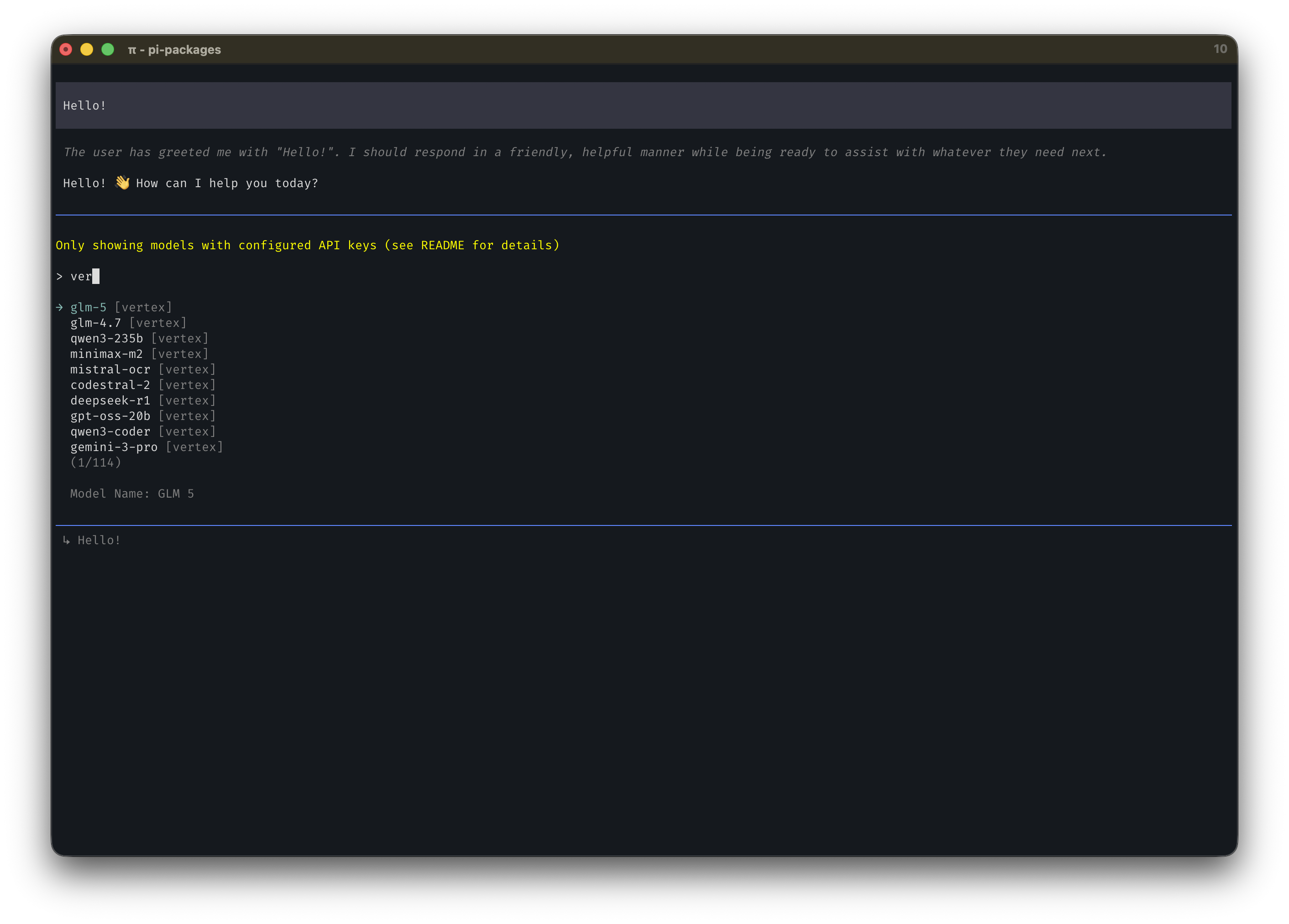
About this fork
Lineage:
ssweens/pi-packages— original@ssweens/pi-vertex, published inside a mono-repolhl/pi-vertex—git filter-repoextraction into a standalone repo with tests, lint and CI (@lhl/pi-vertex, v1.1.5 → v1.1.9)- this repo —
cebarks/pi-vertex(@cebarks/pi-vertex, v2.x → v3.x)
The reason for the second fork is discovery. Up to v1.1.9 the model list was a hand-maintained static table: every new Vertex model required an upstream code change, a release, and a pi-package update on your side — and enabling a model your project has access to was invisible until someone shipped it. This fork queries the Model Garden API at startup, probes each model for project-level access, and registers what actually answers. Static metadata is still used where it exists, so pricing and capability limits for known models stay authoritative rather than guessed.
What this fork adds (v2.x–v3.x, on top of v1.1.9)
| Change | Details |
|---|---|
| Dynamic model discovery | discovery.ts lists publishers/{p}/models (v1beta1) for 11 publishers, filters non-chat models (TTS, embeddings, Imagen), and registers the survivors — new models appear with no code change |
| Probe-based availability | Each candidate is checked with a countTokens request against your project. 200 → available; 400 "…infeasible" → available (Claude/MaaS don't implement countTokens); 404/org-policy/not-servable → skipped. No more offering models your project can't reach |
Disk cache + /vertex-refresh |
Results cached to ~/.pi/agent/cache/pi-vertex-models.json (default TTL 24 h) so startup stays fast; /vertex-refresh clears the cache and re-probes in-session |
| Discovery configuration | discoveryEnabled, discoveryCacheTtlMs, discoveryPublishers in the settings file; falls back to the full static table if discovery is off or fails |
| New models | claude-opus-4-8, claude-opus-4-7, claude-sonnet-5, claude-opus-5, claude-opus-5-5, claude-fable-5, claude-fable-5-1 |
| Thinking mode derived from the model id | Adaptive (thinking: {type: "adaptive"} + output_config.effort) on Claude 4.6+ including every 5.x family, legacy budget_tokens on 4.5 and below. Deciding this from the static table alone meant any newly discovered Claude model — the headline feature of this fork — silently took the legacy branch and Vertex rejected every request with "thinking.type.enabled" is not supported for this model. Effort is clamped to the ladder each model actually accepts (the 4.6 series rejects xhigh but takes max; 4.7+/5.x take all five), and thinkingLevelMap is published so pi only offers levels the model supports. |
| pi-ai 0.87 transcript contract | System prompt and tool declarations are replayed from the message list (getCurrentSystemPrompt / getCurrentTools) instead of the removed context.systemPrompt / context.tools fields, so AGENTS.md, skills and tools reach Vertex again. Tool names Anthropic rejects (^[a-zA-Z0-9_-]{1,128}$) are sanitized outbound and mapped back inbound, so one MCP-namespaced name no longer takes every tool down. |
| pi package scope migration | Moved to @earendil-works/pi-ai / @earendil-works/pi-coding-agent and cleared the npm audit findings that came with the old dependency set |
| Bug fixes | baseUrl: undefined so pi's provider-level fallback wins (empty string used to short-circuit ??); streamSimpleOpenAICompletions imported via the compat root entrypoint (pi's jiti module map exposes root entrypoints only); Gemini maxTokens 65,536 → 65,535 (Vertex treats the bound as exclusive); legacy thinking config for Claude 4.5 and below, adaptive thinking for 4.6+ |
Carried over from the previous fork
Standalone repo; 128 unit tests across 9 files (auth, config, utils, model integrity, discovery enrichment, convertToGeminiMessages, streaming dispatch, mocked Gemini + MaaS streams, thinking payloads and transcript replay); Biome lint/format; GitHub Actions workflow for type-check, lint, coverage; real build/check/test scripts; Anthropic stream lifecycle fixed to end() exactly once; hardcoded maxTokens / 2 halving removed; regional Claude pricing (costRegional) applied when the resolved endpoint isn't global; Gemini cache-token accounting, image tool-result replay, missing-tool-result synthesis, and safety/blocked finish handling.
Provenance
- Upstream:
lhl/pi-vertex→ssweens/pi-packages(pathpi-vertex/, filtered withgit filter-repo --path pi-vertex/ --path-rename pi-vertex/:, so upstream history is intact) - Fork point: v1.1.9 (
f7b1a46), rebranded ind5ca3b3(2026-08-25) - npm:
@cebarks/pi-vertex· repo:cebarks/pi-vertex - Requirements: pi ≥ 0.87 (the provider stream contract changed shape there); developed against 0.87.1, verified live on 0.99.x
Model discovery
At startup the extension runs four phases, then registers the provider once:
- List — one
GET /v1beta1/publishers/{publisher}/models?pageSize=100per publisher (5 s timeout each, all in parallel). Publishers:anthropic,google,meta,mistralai,deepseek-ai,xai,qwen,moonshotai,minimaxai,openai,zai-org. - Filter — drop IDs matching
-tts,-embedding,-imagen,textembedding,-native-audio,-image. - Probe — a
countTokensrequest per candidate, 8 workers, 5 s timeout each. Probing uses each publisher's serving region (us-east5for Anthropic,globalfor Google,us-central1for the rest), which is only an availability check — it does not change the endpoint your requests go to. - Enrich — models present in the static tables keep their real pricing, context window and capability flags; models discovered but not described statically get publisher defaults (below) and show up with a generated display name.
The result is cached as JSON on disk and reused until the TTL expires, so the probe cost is paid once per day. The startup widget reports the count and whether it came from cache:
[pi-vertex] Project: my-gcp-project | 48 models available (cached)Defaults for models that aren't in the static tables (_default catches any publisher not listed):
| Publisher | Endpoint | Context | Max output | Input | Reasoning | Probe region |
|---|---|---|---|---|---|---|
anthropic |
maas | 200K | 64,000 | text, image | yes | us-east5 |
google |
gemini | 1M | 65,535 | text, image | yes | global |
meta |
maas | 128K | 32,000 | text | yes | us-central1 |
mistralai |
maas | 128K | 32,000 | text | no | us-central1 |
deepseek-ai |
maas | 160K | 32,000 | text | yes | us-central1 |
xai |
maas | 200K | 32,000 | text, image | yes | us-central1 |
others (_default) |
maas | 128K | 32,000 | text | yes | us-central1 |
Because defaults include placeholder pricing, costs shown in pi for an unknown model are approximate until you add it to the static tables — that's a deliberate trade-off: surfacing a model beats hiding it, and a one-line PR to models/maas.ts makes it exact.
Features
- 45 statically described models across Gemini (9), Claude (12), Llama (3) and other MaaS (21) — plus whatever else discovery finds in your project
- Unified streaming through one provider: Gemini via
@google/genai, Claude via the native@anthropic-ai/vertex-sdk, everything else via Vertex's OpenAI-compatible endpoint - Full tool calling with multi-turn tool use and tool-result handling on every path
- Thinking / reasoning: Gemini 3 thinking levels, Gemini 2.5 thinking budgets, thought-signature preservation, Claude adaptive and legacy thinking formats
- Automatic auth via Application Default Credentials or a service-account key
- Region awareness: global endpoints by default, regional when required, with regional Claude pricing applied automatically
- Cost tracking for all statically known models, including cache reads/writes and thinking tokens
Installation
# Via pi (recommended)
pi install npm:@cebarks/pi-vertex

# Or via npm
npm install -g @cebarks/pi-vertex

# Or from source
git clone https://github.com/cebarks/pi-vertex.git
cd pi-vertex && npm install
pi install /path/to/pi-vertex
Setup
1. Authenticate with Google Cloud
# Option A: user credentials (development)
gcloud auth application-default login

# Option B: service account (production)
export GOOGLE_APPLICATION_CREDENTIALS=/path/to/service-account-key.json
The project also needs the Vertex AI API enabled (gcloud services enable aiplatform.googleapis.com), and any model you want must be enabled for the project — that's exactly what discovery probes for.
2. Environment variables
export GOOGLE_CLOUD_PROJECT=your-project-id    # required (GCLOUD_PROJECT also accepted)
export GOOGLE_CLOUD_LOCATION=us-central1       # optional: override the per-model region
3. Configuration file (optional)
~/.pi/agent/settings/pi-vertex.json — every field is optional, and file values take priority over environment variables:
{
  "googleCloudProject": "my-gcp-project",
  "googleCloudLocation": "us-central1",
  "googleApplicationCredentials": "/path/to/service-account.json",
  "discoveryEnabled": true,
  "discoveryCacheTtlMs": 86400000,
  "discoveryPublishers": ["anthropic", "google", "meta"]
}| Key | Default | Effect |
|---|---|---|
discoveryEnabled |
true |
false registers the 45 static models only — no network calls at startup |
discoveryCacheTtlMs |
86400000 (24 h) |
Cache lifetime; 0 forces a fresh probe every start |
discoveryPublishers |
all 11 | Narrow the publisher set to cut startup probe time |
4. Verify
pi --provider vertex --model gemini-2.5-pro --versionUsage
pi --provider vertex --model claude-opus-4-8
pi --provider vertex --model gemini-3.1-pro
pi --provider vertex --model llama-4-maverick
pi --provider vertex --model deepseek-v3.2
pi --provider vertex --model claude-sonnet-4-6 --reasoning high
Within a session, /vertex-refresh clears the cache, re-probes, and reports what is now available:
/vertex-refresh
→ Vertex model cache refreshed. 48 models available: claude-opus-4-8, gemini-3.5-flash, …
Shell aliases keep the typing down — note pi's --provider vertex plus a model id, so one alias per model you actually use:
alias pic='GOOGLE_CLOUD_PROJECT=my-project pi --provider vertex --model claude-opus-4-8'
alias pig='GOOGLE_CLOUD_PROJECT=my-project pi --provider vertex --model gemini-3.5-flash'
Model reference
Static metadata; discovery may register additional models, and may omit ones listed here if your project has no access. Prices are USD per 1M tokens on the global endpoint unless noted.
Gemini
| Model | Context | Max output | Input | Reasoning | Price (in/out) | Cache read |
|---|---|---|---|---|---|---|
gemini-3.5-flash |
1M | 65,535 | text, image | yes | $1.50/$9.00 | $0.15 |
gemini-3.1-pro |
1M | 65,535 | text, image | yes | $2.00/$12.00 | $0.20 |
gemini-3.1-flash-lite |
1M | 65,535 | text, image | yes | $0.25/$1.50 | $0.025 |
gemini-3-flash |
1M | 65,535 | text, image | yes | $0.50/$3.00 | $0.05 |
gemini-2.5-pro |
1M | 65,535 | text, image | yes | $1.25/$10.00 | $0.125 |
gemini-2.5-flash |
1M | 65,535 | text, image | yes | $0.30/$2.50 | $0.03 |
gemini-2.5-flash-lite |
1M | 65,535 | text, image | yes | $0.10/$0.40 | $0.01 |
gemini-2.0-flash |
1M | 8,192 | text, image | no | $0.15/$0.60 | $0 |
gemini-2.0-flash-lite |
1M | 8,192 | text, image | no | $0.075/$0.30 | $0 |
Claude
Non-global regions use costRegional where Google publishes a regional premium.
| Model | Context | Max output | Reasoning | Global (in/out) | Regional (in/out) |
|---|---|---|---|---|---|
claude-opus-5-5 |
1M | 128,000 | yes | $4.00/$20.00 | $4.40/$22.00 |
claude-opus-5 |
1M | 128,000 | yes | $5.00/$25.00 | $5.50/$27.50 |
claude-fable-5 |
1M | 128,000 | yes | $10.00/$50.00 | $11.00/$55.00 |
claude-fable-5-1 |
1M | 128,000 | yes | $10.00/$50.00 | $11.00/$55.00 |
claude-opus-4-8 |
1M | 128,000 | yes | $5.00/$25.00 | $5.50/$27.50 |
claude-opus-4-7 |
1M | 128,000 | yes | $5.00/$25.00 | $5.50/$27.50 |
claude-opus-4-6 |
1M | 128,000 | yes | $5.00/$25.00 | $5.50/$27.50 |
claude-sonnet-5 |
1M | 128,000 | yes | $2.00/$10.00 | $2.20/$11.00 |
claude-sonnet-4-6 |
1M | 128,000 | yes | $3.00/$15.00 | $3.30/$16.50 |
claude-opus-4-5 |
200K | 32,000 | yes | $5.00/$25.00 | $5.50/$27.50 |
claude-sonnet-4-5 |
200K | 64,000 | yes | $3.00/$15.00 | $3.30/$16.50 |
claude-haiku-4-5 |
200K | 64,000 | yes | $1.00/$5.00 | $1.10/$5.50 |
claude-opus-4-1 |
200K | 32,000 | yes | $15.00/$75.00 | uniform |
claude-opus-4 |
200K | 32,000 | yes | $15.00/$75.00 | uniform |
claude-sonnet-4 |
200K | 64,000 | yes | $3.00/$15.00 | uniform |
claude-3-5-sonnet-v2 |
200K | 8,192 | no | $3.00/$15.00 | uniform |
Llama
| Model | Context | Max output | Reasoning | Price (in/out) |
|---|---|---|---|---|
llama-4-maverick |
512K | 32,000 | yes | $0.35/$1.15 |
llama-4-scout |
1.25M | 32,000 | yes | $0.25/$0.70 |
llama-3.3-70b |
128K | 8,192 | no | $0.72/$0.72 |
Other MaaS
| Model | Publisher | Context | Max output | Reasoning | Price (in/out) |
|---|---|---|---|---|---|
grok-4.20-reasoning |
xai | 200K | 32,000 | yes | $1.25/$2.50 |
grok-4.1-fast-reasoning |
xai | 128K | 32,000 | yes | $0.20/$0.50 |
gemma-4-26b-a4b-it |
256K | 128,000 | no | $0.15/$0.60 | |
mistral-medium-3 |
mistralai | 128K | 32,000 | no | $0.40/$2.00 |
mistral-small-3.1 |
mistralai | 128K | 32,000 | no | $0.10/$0.30 |
codestral-2 |
mistralai | 256K | 32,000 | no | $0.30/$0.90 |
mistral-ocr |
mistralai | 128K | 32,000 | no | $0.0005 (per page) |
deepseek-v3.2 |
deepseek-ai | 160K | 32,000 | yes | $0.56/$1.68 |
deepseek-v3.1 |
deepseek-ai | 160K | 32,000 | yes | $0.60/$1.70 |
deepseek-r1 |
deepseek-ai | 160K | 32,000 | yes | $1.35/$5.40 |
deepseek-ocr |
deepseek-ai | 160K | 32,000 | no | $0.30/$1.20 |
qwen3-235b |
qwen | 256K | 32,000 | yes | $0.22/$0.88 |
qwen3-next-instruct |
qwen | 256K | 32,000 | yes | $0.15/$1.20 |
qwen3-next-thinking |
qwen | 256K | 32,000 | yes | $0.15/$1.20 |
qwen3-coder |
qwen | 256K | 32,000 | yes | $0.22/$1.80 |
gpt-oss-120b |
openai | 128K | 32,000 | yes | $0.09/$0.36 |
gpt-oss-20b |
openai | 128K | 32,000 | no | $0.07/$0.25 |
kimi-k2-thinking |
moonshotai | 256K | 32,000 | yes | $0.60/$2.50 |
minimax-m2 |
minimaxai | 192K | 32,000 | yes | $0.30/$1.20 |
glm-5 |
zai-org | 200K | 32,000 | yes | $1.00/$3.20 |
glm-4.7 |
zai-org | 200K | 32,000 | yes | $0.60/$2.20 |
mistral-ocr is billed per page ($0.0005/page on both sides) rather than per token; the two *-ocr models do not support tool calling.
Endpoints and regions
Every static model defaults to region: "global", which resolves to https://aiplatform.googleapis.com/v1/projects/{project}/locations/global/.... A regional endpoint looks like https://{location}-aiplatform.googleapis.com/v1/projects/{project}/locations/{location}/....
GOOGLE_CLOUD_LOCATION (or googleCloudLocation) is a global override applied on top of each model's own region — setting it forces every request through that region, including for models that only serve from global. Use it when you have a data-residency requirement and have confirmed the models you rely on are servable there; it also switches Claude pricing to costRegional when a premium is defined.
Architecture
                         ┌─────────────┐
                         │     Pi      │
                         └──────┬──────┘
      registerProvider("vertex")│  /vertex-refresh
                                ▼
   ┌────────────────────────────────────────────────┐
   │                   pi-vertex                    │
   │                                                │
   │  config.ts ─ settings/pi-vertex.json           │
   │  auth.ts ───── ADC / service account, project, │
   │                location, endpoint builder      │
   │  discovery.ts ─ Model Garden list ──┐          │
   │                  countTokens probe ─┤ cache    │
   │                                     ▼          │
   │  models/ ─ static metadata ═══► merged model set (45+ registered)
   └────────────────────────────────┬───────────────┘
                                streamVertex()
                                     │ endpointType
                    ┌────────────────┴────────────────┐
                    ▼                                 ▼
        ┌───────────────────────┐        ┌──────────────────────────┐
        │  gemini (@google/genai)│        │ maas (OpenAI-compat) or  │
        │                        │        │ Claude (vertex-sdk)      │
        └───────────────────────┘        └──────────────────────────┘
Development
npm ci
npm run build         # tsc --noEmit
npm run check         # biome check
npm test              # vitest run
npm run test:coverage
The GitHub Actions workflow (.github/workflows/ci.yml) runs build + check in one job and test:coverage (with a coverage artifact) in another, on every push and PR touching main.
Two conventions worth knowing if you touch this code:
tests/auth.test.tsrebuildsprocess.envfrom a baseline withGOOGLE_CLOUD_PROJECT,GCLOUD_PROJECT,GOOGLE_CLOUD_LOCATION,CLOUD_ML_REGIONandGOOGLE_APPLICATION_CREDENTIALSstripped. Every assertion there is about fallback order, so an ambient value exported by your shell would outrank the fixture and silently invert the test. Keep new auth assertions inside that baseline.biome.jsondisables the formatter forpackage.json: npm rewrites that file on everynpm version/ dependency change, expanding short arrays back onto separate lines, which biome then flags. Same reasoning fortests/**andstreaming/maas.ts, wherenoExplicitAnyis off (mock objects, and the Anthropic normalize/replay pipeline — see the note at the top of that file).
Dependencies
@google/genai— Gemini generateContent streaming@anthropic-ai/vertex-sdk— native Claude-on-Vertex streaminggoogle-auth-library— ADC/service-account tokens@earendil-works/pi-ai,@earendil-works/pi-coding-agent— peer dependencies (provided by pi)
License
MIT — see LICENSE. Copyright for the original work is held by ssweens; this fork preserves the upstream notice and full commit history.