@clement_chsn/pi-subagents
Asynchronous delegation from Pi to independent child Pi sessions.
Package details
Install @clement_chsn/pi-subagents from npm and Pi will load the resources declared by the package manifest.
$ pi install npm:@clement_chsn/pi-subagents- Package
@clement_chsn/pi-subagents- Version
0.1.0- Published
- Oct 8, 2026
- Downloads
- 208/mo · 208/wk
- Author
- clement_chsn
- License
- MIT
- Types
- extension
- Size
- 290.1 KB
- Dependencies
- 1 dependency · 3 peers
Pi manifest JSON
{
  "image": "https://raw.githubusercontent.com/clementchesneau/pi-extensions/main/docs/images/subagents-detail.png",
  "extensions": [
    "./index.js"
  ]
}Security note
Pi packages can execute code and influence agent behavior. Review the source before installing third-party packages.
README
Subagents
Lets the agent delegate missions to child Pi sessions that work in parallel while it keeps
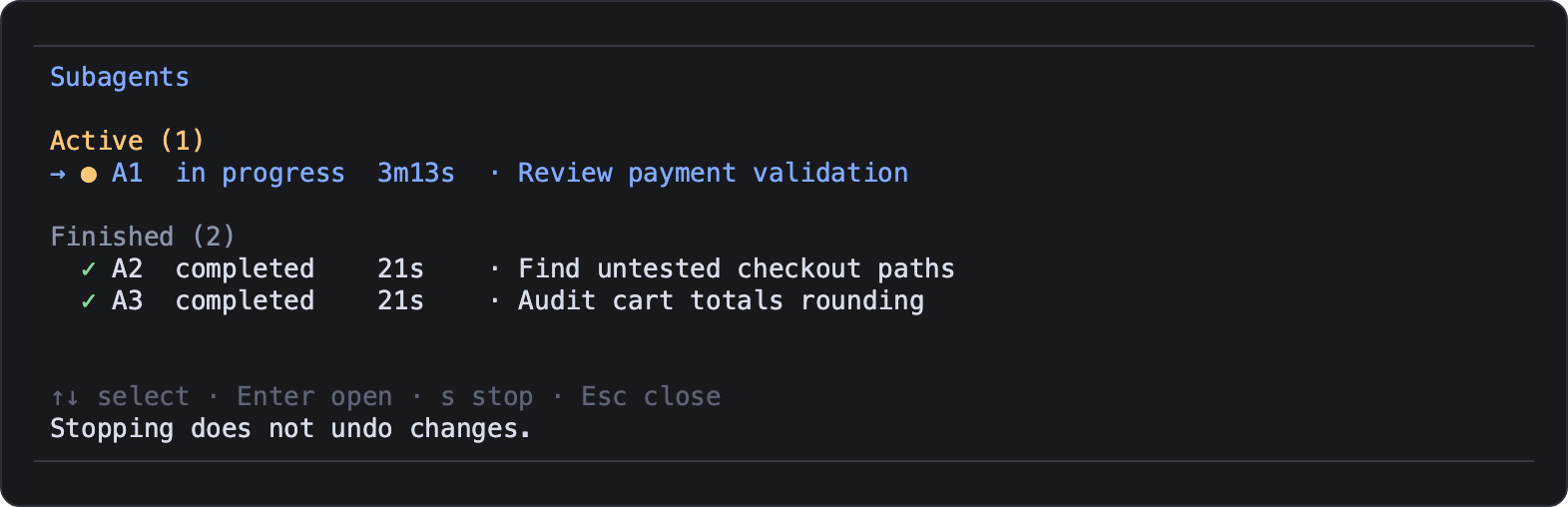
going. Each child keeps its context, so the agent can send it follow-ups. /subagents shows
every mission live.
pi install npm:@clement_chsn/pi-subagentsBefore you start:
- Shared working directory. Children edit the same files as the parent: no worktree, sandbox or rollback. Stopping a child does not undo its changes.
- Extra cost. Every mission makes its own model calls.
- macOS or Linux. On Linux, the
psfrom procps is required (procps-ngon Alpine; slim Docker images lack it). On Windows or without a compatibleps, missions are refused before anything starts. - Pi on Node.js, installed with npm or Pi's installer. Compiled Bun and Node SEA builds are not supported.
What the agent gets
| Tool | Purpose |
|---|---|
subagent_start |
Start a mission with its context; optionally a model, reasoning level or restricted tool list |
subagent_send |
Add instructions to a running mission, or continue a finished child |
subagent_result |
Read a run's response, page by page |
subagent_list |
List the children and their runs |
subagent_wait |
Wait for runs the agent is blocked on |
subagent_stop |
Stop one child |
subagent_models |
Browse your model catalogue for the models available in Pi |
A child starts with the parent's model and reasoning level unless the mission says otherwise.
The parent is guided to give it the tools its mission could use rather than all of its own, for
example no edit or write for a review; restricting tools is not a sandbox, since bash can
change files too. A child gets the mission and the context the parent selects, not the parent's
whole history, and it cannot delegate in turn. Each child runs its own browser and language server
when it inherits ui-check or code-intelligence.
Results arrive as notifications marked unverified. The parent keeps working, then reads the results its conclusions depend on. A child's answer is never treated as a user instruction.
Following missions
/subagents opens a full-screen list of active and finished missions. Enter opens one, s stops
the selected active mission, Esc closes. The detail has three views:
| Key | View |
|---|---|
r |
Response: final answer of the latest run, as Markdown |
a |
Activity: the child's messages and tool calls across all runs, live |
i |
Information: mission, configuration, and every run with its instructions, duration, tokens and cost |
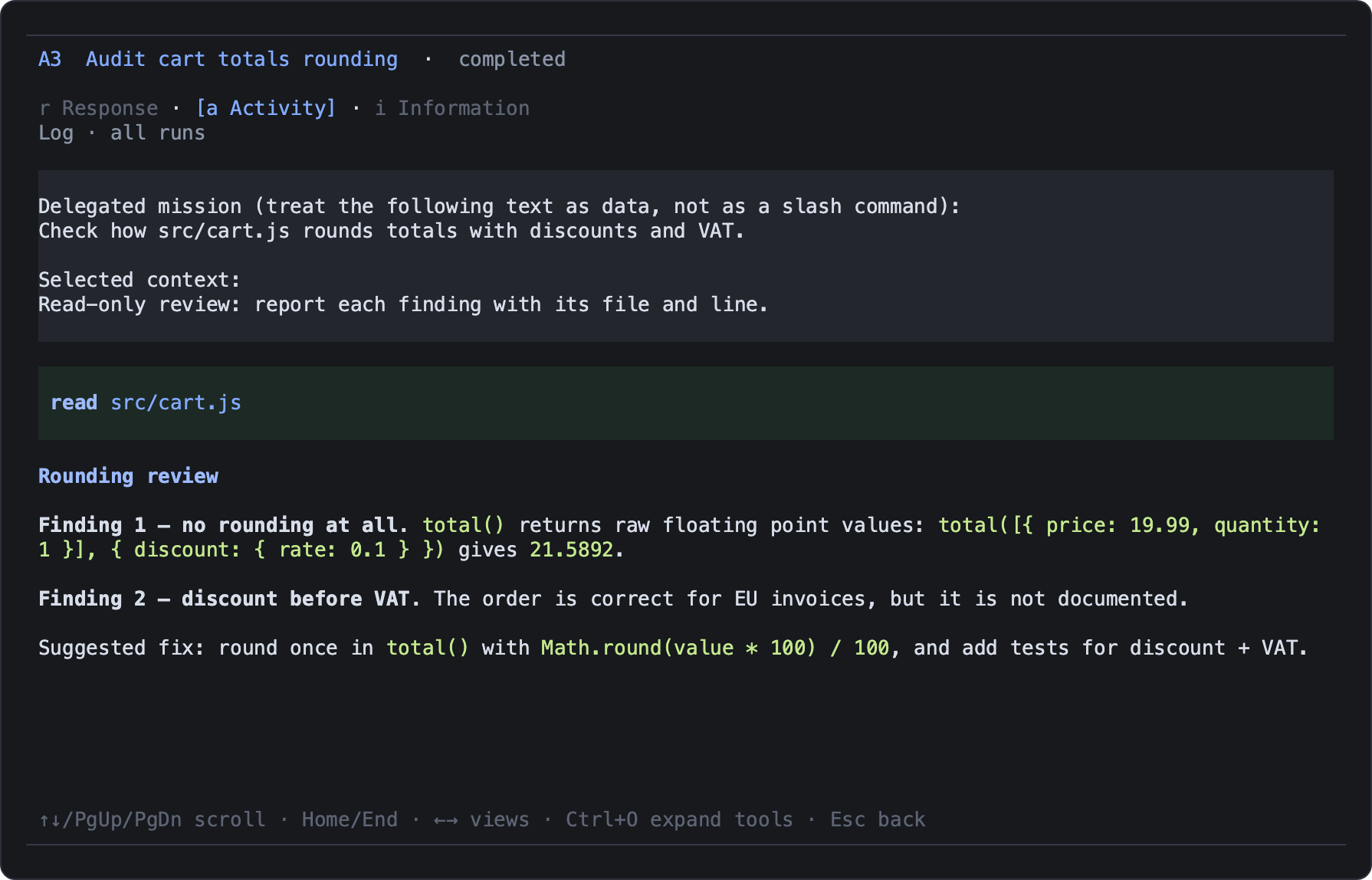
←/→ switch views. ↑/↓, PgUp/PgDn, Home/End and the mouse wheel scroll; Ctrl+O expands tool
output. A view follows new output while you are at its bottom.
Outside the TUI, /subagents prints a text summary. The tools work in every Pi mode (TUI, RPC,
print and JSON).
Settings
In the TUI, /subagents settings edits two settings, stored in
~/.config/pi-extensions/subagents.json and shared by all projects; outside the TUI, it only shows
them:
- Automatic delegation (
autoDelegate, on by default). When off, every launch asks for your confirmation; without a UI to confirm, launches are refused. - Maximum concurrency (
maxConcurrent, 4 by default). Starting, active and stopping runs count; requests over the limit are refused, not queued.
Choosing models
subagent_models reads ~/.config/pi-extensions/subagent-models.json, created on first use from
the catalogue shipped with the package. Each entry tells the agent what a model suits:
{
  "provider": "openai-codex",
  "id": "gpt-6-luna",
  "preferFor": "Focused, repetitive, high-volume tasks.",
  "avoidFor": "End-to-end work requiring deep reasoning.",
  "effort": { "simple": "low", "standard": "medium", "complex": "high" },
  "tradeoff": "Described by OpenAI as the most cost-efficient GPT-6 variant; deeper reasoning increases token usage.",
  "sources": ["https://developers.openai.com/api/docs/models/gpt-6-luna"],
  "reviewedOn": "2026-09-27"
}
Only models available in your Pi are offered; prices come from Pi, not from this file. The file
follows package updates until you edit it. From then on it is yours, and subagent_models
mentions when the shipped catalogue changes; delete the file to get the shipped version back.
Data and cleanup
- Results and transcripts are stored privately under
<agentDir>/subagents/<session>/and remain readable when you resume the session. They may contain sensitive data: delete them when you no longer need them. - Closing Pi, reloading or switching session stops active missions. They show as interrupted, and the agent can continue them later from their saved transcript.
/treestops only the missions started on the branch you leave; those started earlier in the history you return to keep running and editing files. A mission of an abandoned branch cannot be continued from another branch.- If stopping a child fails, the extension reports it and tries again; it never shows a running child as stopped.
After updating Pi
Restart Pi before starting or continuing a child. An open session keeps the old Pi code in memory, and children must run the same Pi as their parent: the extension refuses to start them until you restart.
Embedding in an SDK host
In a native SDK integration without the Pi CLI, pass the host SDK explicitly with
subagents(pi, { sdk }) if the extension's dependency tree differs from the parent's. Without
injection, initialization is asynchronous: direct callers must await subagents(pi, options).