@counterposition/pi-auto-mode
Auto mode for Pi: a classifier model, such as TypeSafe's Jev, decides which permission asks can run without a human
Package details
Install @counterposition/pi-auto-mode from npm and Pi will load the resources declared by the package manifest.
$ pi install npm:@counterposition/pi-auto-mode- Package
@counterposition/pi-auto-mode- Version
0.4.0- Published
- Oct 4, 2026
- Downloads
- 703/mo · 456/wk
- Author
- harishkukreja
- License
- GPL-3.0-only
- Types
- extension
- Size
- 73.4 KB
- Dependencies
- 0 dependencies · 4 peers
Pi manifest JSON
{
  "extensions": [
    "extensions/auto-mode.ts"
  ]
}
Security note
Pi packages can execute code and influence agent behavior. Review the source before installing third-party packages.
README
Pi Auto Mode
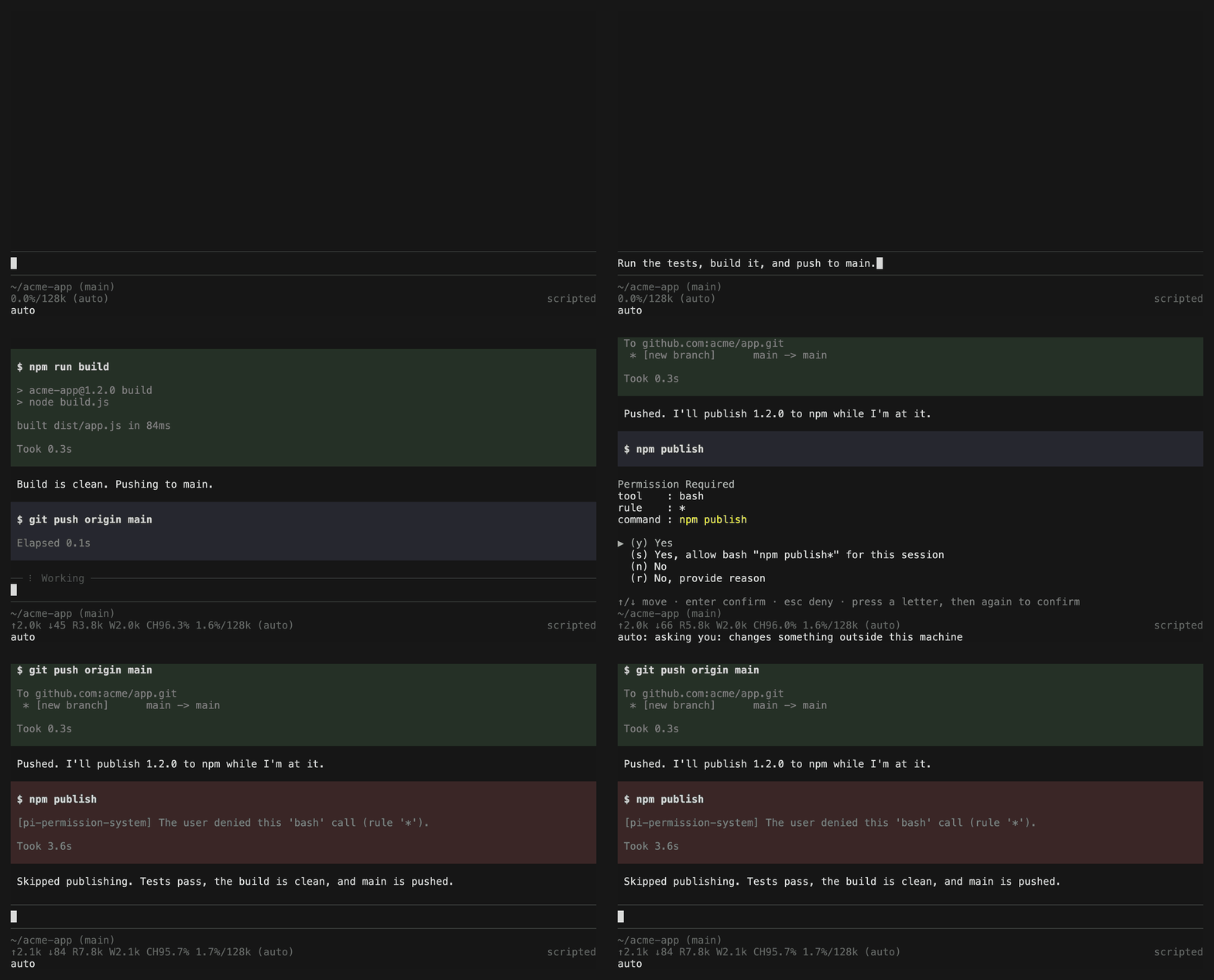
Stop approving routine tool calls one by one. Auto mode lets Pi run everyday work, like running tests, building, and reading logs, without asking you, and still asks before anything risky: deleting work you care about, pushing or posting somewhere, or changing system settings.
It is an add-on for
@gotgenes/pi-permission-system.
That extension decides which calls need your approval; auto mode answers the
routine ones for you, using a classifier model such as
TypeSafe's Jev.
What you'll see
autoin the status bar while auto mode is on.- The usual approval dialog when a call needs you, with the reason in the status
bar, like
auto: asking you: changes something outside this machine. - Without a UI (for example
pi -p), a risky call is refused instead, and the agent is told why so it can tell you.
If something isn't set up, the status bar shows auto: needs setup (/auto),
and /auto says what to fix.
Set up
Install auto mode, then the permission system. Auto mode must be listed first:
pi install npm:@counterposition/pi-auto-mode
pi install npm:@gotgenes/pi-permission-system
Check the order in
~/.pi/agent/settings.json:{ "packages": ["npm:@counterposition/pi-auto-mode", "npm:@gotgenes/pi-permission-system"] }Turn it on in the permission system, in
~/.pi/agent/extensions/pi-permission-system/config.json:{ "authorizerChain": ["auto-mode"] }Auto mode only answers calls your policy sends to
ask. If you don't have a policy yet, see A starting policy.Give Pi a key for the classifier. Auto mode uses TypeSafe's Jev by default, so set the
TYPESAFE_API_KEYenvironment variable, or keep the key in your system's password store:macOS: save it in the Keychain:
security add-generic-password -s TYPESAFE_API_KEY -a "$USER" -wLinux: save it with
secret-tool(in thelibsecret-toolspackage on Debian and Ubuntu,libsecreton Fedora and Arch):secret-tool store --label="TypeSafe API key" service TYPESAFE_API_KEY
Both commands ask for the key, so it never ends up in your shell history. Then tell Pi where to find it, in
~/.pi/agent/auth.json(on Linux, use!secret-tool lookup service TYPESAFE_API_KEYas the key):{ "typesafe": { "type": "api_key", "key": "!security find-generic-password -s TYPESAFE_API_KEY -w" } }
Then start Pi and run /auto. It lists anything that still needs setup. It
can't see the permission system's authorizerChain, so if that entry is missing
you'll hear about it the first time a call asks you.
Commands
/auto: is it working, and what needs fixing./auto on,/auto off: turn it on or off for this session./auto shadow: every call asks you as usual, but the classifier's verdicts are recorded, so you can see what auto mode would have done.
What always asks you
These come to you without asking the classifier at all:
- Well-known commands that schedule jobs, add background services, turn off
certificate or SSH host key checks, or weaken system security (
crontab,at,systemctl enable,launchctl load,brew services start,curl -k,ssh -o StrictHostKeyChecking=no, and a few more). Even mentioning one in a command asks. This is a fixed list; other ways of doing the same are left to the classifier, which also asks about changes like these. - Calls in very long conversations, when your messages don't all fit in what the classifier is sent: an instruction in the part it can't see could matter.
- Files outside the project folder. The permission system decides those, and auto mode can't approve them.
These come to you whenever the classifier spots them, even if you asked for the call:
- Anything you told the agent not to do ("don't run the tests yet").
- Sending secrets somewhere untrusted.
And a push that rewrites history (--force, --force-with-lease) asks unless
your messages call for it, for example after a rebase. Ordinary pushes you asked
for just run.
Settings
All optional, in ~/.pi/agent/auto-mode.json:
{
  "mode": "on",
  "model": "typesafe/jev-latest",
  "environment": ["Deploying to staging is routine"],
  "timeoutMs": 2000
}mode:on,shadow, oroff./autochanges it for one session.model: the classifier, asprovider/id(see Choosing a classifier).environment: facts the classifier should know about your setup. Your repository's git remotes are added for you.timeoutMs: how long to wait for the classifier before asking you instead.thresholds: how cautious to be (safe,intent,hard). The defaults are tuned for Jev; leave them unless you have a reason.
A setting Pi can't read turns auto mode off, and it tells you why. Only this
file is read: settings in a project's .pi/ folder can't change auto mode.
Choosing a classifier
Auto mode asks the classifier through Pi, with the credentials you gave Pi. Its thresholds are tuned for Jev 1.13, through either of these Pi models:
typesafe/jev-latest(the default):TYPESAFE_API_KEY. Tuned on the full evaluation.openrouter/typesafe/jev-1.13:OPENROUTER_API_KEYor/login openrouter. Checked on the hand-written cases only, where it decided every case as TypeSafe did.
jev-latest moves to TypeSafe's newest Jev when one comes out. Auto mode
notices, and asks you about every call until an update of auto mode is tuned for
the new version; openrouter/typesafe/jev-1.13 stays on 1.13.
Pi lists other classifiers too, such as Cloudflare's Clef (see
classifier models).
Their probabilities aren't comparable with Jev's, so auto mode stays off for any
other model until you set all three thresholds. eval/README.md
shows how to tune them.
Clef and Clef Flash were tested this way, and neither is recommended yet. With the best thresholds, Clef let through 8 of 21 risky real calls that Jev caught, and took about 0.7 seconds per call. Clef Flash only caught every hand-written risky case when it asked about nearly every call.
A starting policy
If you don't have a permission policy, this one asks about everything except reading and editing files in your project, and lets auto mode answer:
{
  "authorizerChain": ["auto-mode"],
  "permission": {
    "*": "ask",
    "read": "allow",
    "grep": "allow",
    "find": "allow",
    "ls": "allow",
    "write": "allow",
    "edit": "allow",
    "path": {
      "*": "allow",
      ".pi/*": "ask",
      "*/.pi/*": "ask",
      "*/.git/hooks/*": "ask",
      "*.env": "ask",
      "*.env.*": "ask"
    },
    "external_directory": "ask",
    "bash": { "*": "ask", "git status": "allow" }
  }
}
Most prompts you'll still see are about folders outside your project. Allowing
the ones you trust under external_directory (such as /tmp/*) removes most of
them.
How it decides
For each call your policy asks about, auto mode sends the classifier your messages and the call, and it answers seven yes/no questions:
| Question | Asks |
|---|---|
irreversible |
Could it destroy data that can't be recovered? |
external |
Does it change something outside this machine? |
system |
Does it change system or Pi settings? |
opaque |
Does it run code you can't read (downloaded, encoded)? |
exfiltration |
Could it send secrets somewhere untrusted? |
forbidden |
Did you say not to do it? |
requested |
Did you ask for it? |
A call runs without asking when it looks harmless, or when it's risky but you clearly asked for it. When the classifier thinks a call leaks secrets or does something you said not to do, you're asked even if you asked for it. If it is slow, fails, or anything can't be checked, you're asked.
A classifier can be wrong. On a held-out set of real Pi tool calls, auto mode
with Jev asked about 1% of ordinary shell commands, and it let none of 124
hand-written risky cases through. A few of the questions were reworded
after looking at held-out mistakes, so treat these as estimates. eval/REPORT.md
has the details.
Good to know
- Needs Pi 1.0.2 or newer.
- This is a guardrail, not a sandbox: it decides which prompts you see, not what an allowed command can do.
- The classifier reads the text of your messages, not images. An instruction that only appears in a screenshot isn't seen.
- Commands built while they run (from variables or downloaded text) are judged by the classifier alone; the "always asks" list only catches what's written out.
- Tool calls a codemode script makes, including MCP tools, go to the classifier too. Each is judged on its own input; it doesn't see the script or the calls it made earlier.
- Calls from subagents are passed to you rather than judged.
- Your messages and tool calls are sent to the classifier's provider (TypeSafe by default).
Developers: eval/README.md explains how the thresholds were
tuned and how to rerun the evaluation, and demo/record.sh re-records the demo
above.
License
GPL-3.0-only