@curio-data/pi-intelli-search
Intelligent web research for Pi: search, extract, collate, and cache grounded web context in one tool call.
Package details
Install @curio-data/pi-intelli-search from npm and Pi will load the resources declared by the package manifest.
$ pi install npm:@curio-data/pi-intelli-search- Package
@curio-data/pi-intelli-search- Version
0.13.0- Published
- Sep 7, 2026
- Downloads
- 782/mo · 78/wk
- Author
- miah0x41
- License
- Apache-2.0
- Types
- extension, skill
- Size
- 598.9 KB
- Dependencies
- 3 dependencies · 4 peers
Pi manifest JSON
{
  "image": "https://raw.githubusercontent.com/Curio-Data/pi-intelli-search/main/docs/images/06.png",
  "skills": [
    "./skills"
  ],
  "extensions": [
    "./src/index.ts"
  ]
}
Security note
Pi packages can execute code and influence agent behavior. Review the source before installing third-party packages.
README
pi-intelli-search




Intelligent web research for Pi: search, extract, collate, and cache grounded web context in one tool call.
A Pi extension for deep web research. It searches via a search-grounded model (Perplexity Sonar by default), merges every source the model cited, fetches pages through a dual-fetch comparison (Defuddle versus Markdown endpoint), extracts query-relevant content per page with a dedicated LLM guided by a focused prompt, then collates findings: deduplicating, flagging inconsistencies, and synthesising a concise summary. Everything is cached in .search/ for offline reuse. Cache suggest surfaces related previous searches on each query.
Features:
- 🔍 Search: a search-grounded model, Perplexity Sonar via OpenRouter by default. One API key, no $50 minimum. Any OpenRouter chat model works too via the web search server tool.
- 🔗 Harvest: every source the search model cited, not only the links it wrote into the answer. Machine-readable
url_citationannotations are merged with text links before pages are selected. - 🌐 Fetch: Dual-fetch each page (HTML → Defuddle versus Markdown endpoint), compare quality, pick the cleaner version.
- 📄 Extract: Per-page LLM extraction guided by a focused prompt. Compresses ≈50K to ≈3-5K chars of query-relevant content.
- 🔗 Collate: Cross-source deduplication, inconsistency detection, and synthesis into a focused ≈5K summary.
- 💾 Cache: Persistent
.search/cache with automatic cache suggest. Related previous searches surfaced on each query. - 🎯 Configurable: Swap any pipeline stage (search, extract, collate) to any model
Pisupports. - 💰 Low cost: Approximately $0.06 per research session with default settings.
Search model advisory (2026-09). Perplexity retires the Sonar Chat Completions endpoints on 2026-09-27. Whether the
openrouter/perplexity/sonarroute survives that date is up to OpenRouter, which has published no statement. Two supported configurations do not depend on that route, and both are settings-only changes: the web search server tool (any OpenRouter chat model, from ≈$0.008 per search) andperplexity/sonar-pro-search(drop-in model swap, ≈$0.05 per search). The default is unchanged in v0.13.0.
Launch Blog Post
Read the launch post, pi-intelli-search: LLM-Native Web Research for the Pi Coding Agent, for the design story behind the pipeline: why per-page LLM extraction beats raw page dumps, how collation keeps the agent context clean, and a full cost breakdown at ≈$0.05 per session.
What It Adds Over Other Extensions
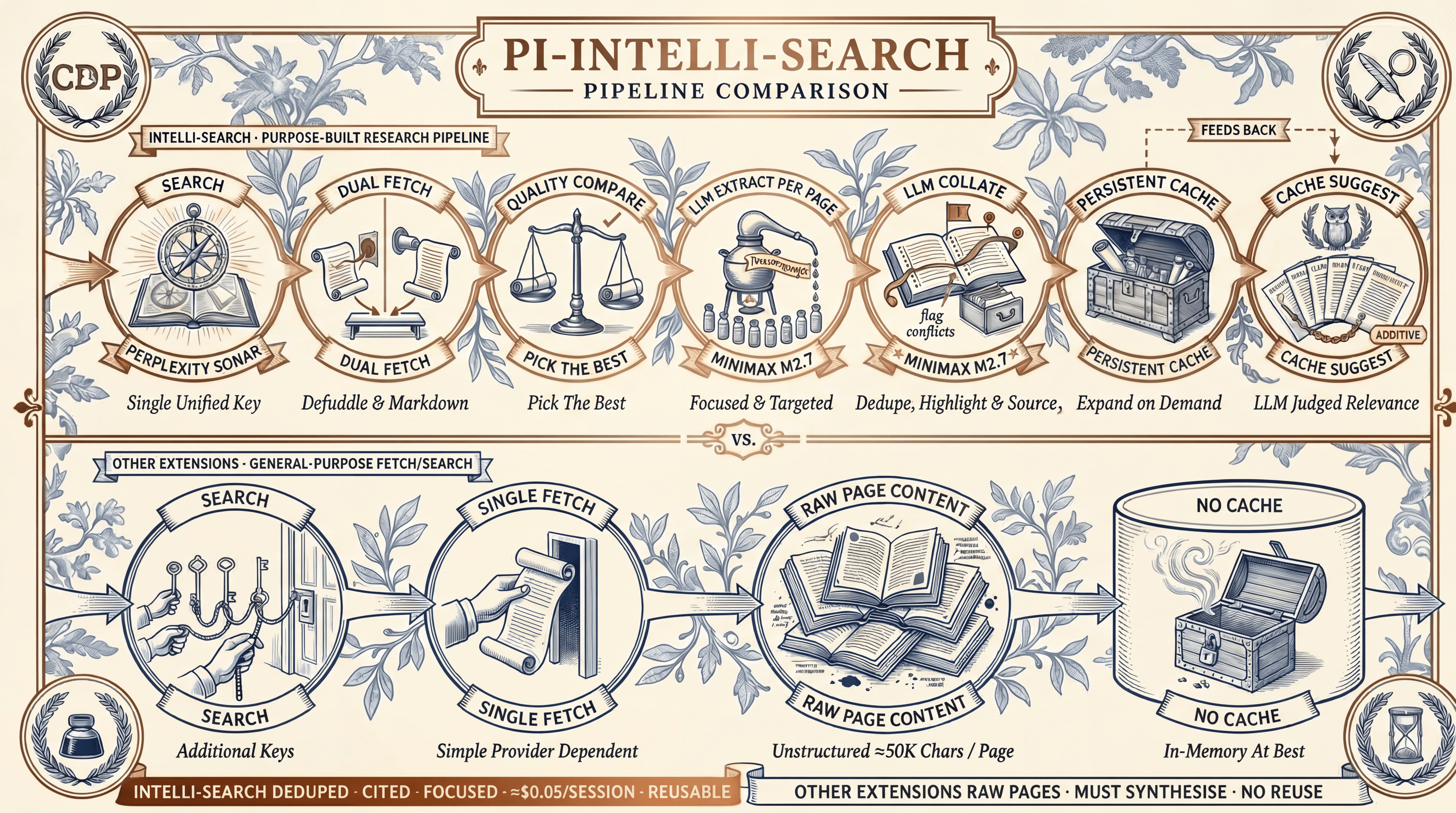
The comparison illustration shows the default configuration and cost at its creation; search is configurable (see Model Configuration).
Four capabilities together separate intelli-search from every other extension in the Pi ecosystem:
- Dual-fetch quality comparison. Every page is fetched twice in parallel (Defuddle versus Markdown endpoint), scored, and the better version wins. Server-rendered Markdown is not guaranteed to be cleaner than HTML; the comparison catches this automatically.
- Per-page LLM extraction guided by
focusPrompt. Each page is compressed to ≈3-5K chars of query-relevant content before entering the agent's context. Extraction quality scales with the chosen model. - LLM collation with deduplication. A collation model synthesises across sources, flags conflicting claims, and preserves source attribution. The agent does not spend reasoning tokens on mechanical synthesis.
- Persistent cache with cache suggest. Full pages and extractions are kept in
.search/and indexed. An LLM judge surfaces related previous searches on each query, so follow-up research is faster and cheaper.
The agent receives a concise ≈5K summary by default. The full page content stays in the cache, accessible via native Pi tools like read or grep for deeper inspection. No other Pi search extension offers both.
For the detailed feature-by-feature comparison against six other Pi search extensions, see docs/COMPARISON.md.
Install
Prerequisites
You need at minimum an OpenRouter account: one key covers the default search model (Perplexity Sonar) plus extraction and collation with the default models, and every alternative search configuration uses the same account. For the extract and collate stages, any model or provider Pi supports can be used. See Model Configuration for how to swap them.
- Sign in with OAuth (recommended): run
/login openrouterinPi. OnPi0.82.0 and later this performs OpenRouter OAuth PKCE sign-in and stores a user-controlled key automatically. No manual key paste is required. - Or add a key manually: create one at openrouter.ai/keys, then edit
~/.pi/agent/auth.json:
{
  "openrouter": {
    "type": "api_key",
    "key": "sk-or-v1-..."
  }
}
Install the Extension
From npm (recommended):
pi install npm:@curio-data/pi-intelli-search
From GitHub:
pi install git:github.com/Curio-Data/pi-intelli-search
Local development:
pi install /path/to/pi-intelli-search
On first load, Pi will show Added models: followed by whatever was missing: on a fresh install that is perplexity/sonar, perplexity/sonar-pro, and perplexity/sonar-pro-search; an upgrade from an earlier version lists only the models you did not already have. If your OpenRouter key is missing, you will see a warning notification.
Verify Installation
Start Pi and type /model. You should see perplexity/sonar, perplexity/sonar-pro, and perplexity/sonar-pro-search in the model list. If they are missing after a manual edit, reopen /model: since Pi 0.82.0 the picker reloads models.json on open. Restart Pi only if they are still absent. Registration does not select a pipeline model; searchModel in settings does that.
Customise (Optional)
No configuration is needed to get started. The defaults use OpenRouter for all stages. If you want to change models, add a pi-intelli-search block to ~/.pi/agent/settings.json or, for a trusted project, <project>/.pi/settings.json:
Defaults (what you get without any config):
Copying this block pins every value explicitly, which also opts you out of future default migrations. You do not need to write any of this: the table in Settings Reference is the complete list of keys.
{
  "pi-intelli-search": {
    "searchModel": {
      "provider": "openrouter",
      "model": "perplexity/sonar"
    },
    "searchWebSearch": {
      "enabled": false,
      "engine": "auto",
      "maxResults": 8,
      "reasoning": "minimal"
    },
    "extractModel": {
      "provider": "openrouter",
      "model": "minimax/minimax-m2.7"
    },
    "collateModel": {
      "provider": "openrouter",
      "model": "minimax/minimax-m2.7"
    },

    "defaultUrls": 10,
    "maxUrls": 20,
    "cacheDir": ".search",
    "extractMaxChars": 150000,
    "extractionConcurrency": 4,
    "extractionMaxTokens": 3000,
    "collationMaxTokens": 4000,
    "fetchTimeoutMs": 20000,
    "fetchConcurrency": 4,
    "browserFingerprint": "chrome_145"
  }
}
Customised example (different provider, tuned pipeline):
{
  "pi-intelli-search": {
    "searchModel": {
      "provider": "openrouter",
      "model": "perplexity/sonar"
    },
    "extractModel": {
      "provider": "openai",
      "model": "gpt-4o-mini"
    },
    "collateModel": {
      "provider": "openai",
      "model": "gpt-4o-mini"
    },

    "defaultUrls": 6,
    "maxUrls": 6,
    "cacheDir": ".my-research-cache",
    "extractMaxChars": 80000,
    "extractionMaxTokens": 8000,
    "collationMaxTokens": 16000,
    "fetchTimeoutMs": 30000,
    "fetchConcurrency": 2,
    "browserFingerprint": "chrome_145"
  }
}
See Model Configuration for all options, Configuration Recipes for complete copy-paste examples, and Settings for the full reference.
Configuration Recipes
Each recipe is a complete ~/.pi/agent/settings.json. Copy it whole, or lift the pi-intelli-search block into your existing file. Project-level overrides go in <project>/.pi/settings.json (applies only after Pi approves the project; the global file always applies).
Two loader rules to keep in mind:
- An object you set replaces its default wholesale. The
searchWebSearchblock and the model blocks have no per-key merge: set every key you care about. - Nested
pi-intelli-searchkeys always win over the deprecated flatintelli*keys.
| You want | Recipe |
|---|---|
| Works immediately, nothing to write | Zero Configuration |
| Off Sonar before 2026-09-27, cheapest | Web Search Tool + Nano |
| Off Sonar, strongest search quality | Sonar Pro Search |
| The pre-0.13 page count and spend | Pin Eight Pages |
| Cheaper extraction and collation | Economy Extract and Collate |
| Better final summaries | Stronger Collation |
| A free-tier or shared OpenRouter key | Free-Tier Resilience |
| A different search model for one repo only | Per-Project Override |
Every recipe is exercised end-to-end in its own isolated environment by test/e2e/10_config_recipes.sh; recipes 2 and 3 by 08_websearch_tool.sh and 09_sonar_pro_search.sh.
Recipe 1: Zero Configuration
Write nothing. You get Sonar search with citation harvesting, MiniMax M2.7 extraction and collation, 10 pages per session, and the .search/ cache. Every other recipe below changes exactly one concern from this baseline.
Recipe 2: Web Search Tool + Nano
Any OpenRouter chat model gains live search through the openrouter:web_search server tool, so nothing depends on a search-native model family. This is the cheapest post-sunset migration (≈$0.008 per search). The reasoning: "minimal" pin matters: GPT-5 family models burn their completion budget on reasoning when left unconstrained.
{
  "pi-intelli-search": {
    "searchModel": {
      "provider": "openrouter",
      "model": "openai/gpt-5-nano"
    },
    "searchWebSearch": {
      "enabled": true,
      "engine": "exa",
      "maxResults": 8,
      "reasoning": "minimal"
    },
    "extractModel": {
      "provider": "openrouter",
      "model": "minimax/minimax-m2.7"
    },
    "collateModel": {
      "provider": "openrouter",
      "model": "minimax/minimax-m2.7"
    }
  }
}
Recipe 3: Sonar Pro Search
Agentic multi-step search on the Perplexity stack, reached through a settings-only model swap. Best raw search quality of the options, at ≈$0.05 per search ($18 per 1,000 requests plus tokens). searchWebSearch is disabled explicitly so this recipe stays correct even if you previously enabled the tool.
{
  "pi-intelli-search": {
    "searchModel": {
      "provider": "openrouter",
      "model": "perplexity/sonar-pro-search"
    },
    "searchWebSearch": {
      "enabled": false
    },
    "extractModel": {
      "provider": "openrouter",
      "model": "minimax/minimax-m2.7"
    },
    "collateModel": {
      "provider": "openrouter",
      "model": "minimax/minimax-m2.7"
    }
  }
}
Recipe 4: Pin Eight Pages
v0.13.0 raised defaultUrls to 10 and maxUrls to 20 because citation harvesting fills the URL list. If you prefer the earlier page count and spend, pin both values (each extra page costs ≈$0.004 to extract).
{
  "pi-intelli-search": {
    "defaultUrls": 8,
    "maxUrls": 16
  }
}
Recipe 5: Economy Extract and Collate
Extraction and collation run 10+1 times per session, so token rates dominate cost. Swap both stages to a cheaper OpenRouter model; search is untouched. Any model Pi supports works for these stages.
{
  "pi-intelli-search": {
    "extractModel": {
      "provider": "openrouter",
      "model": "google/gemini-3.7-flash"
    },
    "collateModel": {
      "provider": "openrouter",
      "model": "google/gemini-3.7-flash"
    }
  }
}
Check the model's context window against extractMaxChars (150K chars is roughly 37K tokens); lower extractMaxChars for smaller-window models.
Recipe 6: Stronger Collation
Keep extraction cheap and spend on the final synthesis, where cross-source reasoning and contradiction-flagging live. Only collateModel changes.
{
  "pi-intelli-search": {
    "collateModel": {
      "provider": "openrouter",
      "model": "openai/gpt-5-mini"
    }
  }
}
Recipe 7: Free-Tier Resilience
Free-tier OpenRouter keys share a ≈0.33 requests/second bucket. The extract stage fires up to 4 concurrent calls, which trips it. Space the calls, lengthen the retries, and shrink the page count.
{
  "pi-intelli-search": {
    "defaultUrls": 5,
    "minRequestIntervalMs": 3000,
    "extractionConcurrency": 2,
    "llmRetryAttempts": 4,
    "llmTimeoutMs": 120000
  }
}
Paid keys can ignore every key in this recipe; the defaults assume no hard rate limit.
Recipe 8: Per-Project Override
A trusted project can override individual keys for one repository only. Put the override in <project>/.pi/settings.json; everything not listed keeps its global value.
{
  "pi-intelli-search": {
    "searchModel": {
      "provider": "openrouter",
      "model": "perplexity/sonar-pro-search"
    },
    "cacheDir": ".search-client-x"
  }
}
Use this to give a client project a dedicated cache directory and a stronger search model while every other project stays on the global defaults.
Tools
| Tool | Description |
|---|---|
intelli_search |
Search the web and return a concise answer with a source list (top defaultUrls). |
intelli_extract |
Extract query-relevant content from a web page, preserving code and technical detail verbatim. |
intelli_collate |
Deduplicate and synthesise multiple extractions into a summary. Writes cache. |
intelli_research |
Search, fetch, extract, collate, cache. The primary research tool. One call. |
Quick Start
Quick Search
intelli_search(query="TypeScript 5.8 release date")
Deep Research
Always provide a focusPrompt. The extraction LLM works best with specific guidance.
intelli_research(
  query="Svelte 5 runes tutorial examples",
  focusPrompt="Extract the core rune concepts ($state, $derived, $effect), their syntax, and how they replace the old reactive declarations. Include migration patterns from Svelte 4."
)
Targeted Research With Domain Guidance
intelli_research(
  query="Cloudflare Workers KV write timeout limits",
  focusPrompt="Extract KV write limits, timeout thresholds, storage limits, and any workarounds for bulk writes. Focus on hard numbers and error messages.",
  maxUrls=3,
  domains=["developers.cloudflare.com"]
)
domains guides source selection, it is not a security boundary: the query gains a site: expression, and with the web search tool enabled the same domains are also combined with searchWebSearch.allowedDomains and sent as an engine filter. The lists are combined, not intersected, and returned URLs are not checked against a local hostname allowlist before fetching. Engine support for allow and exclude lists differs (see searchWebSearch Keys).
Comparing Options
intelli_research(
  query="Tailwind CSS vs Vanilla Extract comparison 2026",
  focusPrompt="Extract pros/cons, bundle size benchmarks, DX tradeoffs, and migration costs. Note which claims come from official sources vs blog opinions."
)
Model Configuration
All three pipeline stages use independently configurable models. Defaults are chosen for cost-efficiency, but any model Pi can access works. This includes built-in providers, OpenRouter models, or models from other extensions.
| Stage | Default | Config key |
|---|---|---|
| Search | openrouter/perplexity/sonar |
searchModel |
| Extract | openrouter/minimax/minimax-m2.7 |
extractModel |
| Collate | openrouter/minimax/minimax-m2.7 |
collateModel |
Why OpenRouter for Sonar?
Perplexity Sonar is an excellent search-grounded model, but it is not in Pi's built-in model list. Rather than requiring a separate Perplexity API account (which requires a $50 minimum credit top-up), the extension routes Sonar through OpenRouter. OpenRouter is a unified pay-as-you-go API with a lower minimum spend. One API key gives you Sonar alongside thousands of other models. On first load, the extension patches ~/.pi/agent/models.json to add Sonar under the openrouter provider so Pi can discover it. This approach has several benefits:
Avoids the Perplexity API $50 minimum. Routing through
OpenRouterconsolidates spend on a single account already used across the open-source coding-agent ecosystem, includingPi. No separate Perplexity subscription is required.One account, many models. The same OpenRouter key covers Sonar and any other models you might want for extract or collate.
Is non-destructive. The patch merges new models by ID. It never replaces existing OpenRouter models.
Is idempotent. It is safe across extension reloads and updates.
Is idempotent. It is safe across extension reloads and updates.
The same single-key argument covers the post-sunset alternatives: the web search server tool and perplexity/sonar-pro-search both route through the same OpenRouter account.
Source Harvesting from Citations
Search-grounded models return machine-readable url_citation annotations naming the sources they consulted, a larger set than the links they write into the prose (probe: 20 annotations against 3 prose links from Sonar). Pi's chat-completions adapter reassembles only text, thinking, and tool-call blocks, so those annotations never reach extension code on their own. The pipeline reads a tee of the raw response body, parses the citations out, and merges them with the text-scraped links before pages are selected for fetching.
This runs on every search call regardless of model, needs no configuration, and never blocks or fails the pipeline. Text links come first; annotation-only links follow; exact URL duplicates are removed. intelli_research applies its URL limit after merging, so not every discovered source is fetched. Harvesting is best-effort: a model that emits no annotations, or annotations the parser does not recognise, leaves the text-link path intact. intelli_search caps its rendered source list at defaultUrls (top 10 by default). The count is recorded in meta.json as stages.search.annotationsHarvested.
OpenRouter Web Search Server Tool
The search stage normally relies on a search-native model (default: Sonar). The searchWebSearch setting decouples it: OpenRouter's openrouter:web_search server tool gives the configured chat model access to live web search, so the pipeline is not tied to any search-native model family. The tool is beta upstream; the model decides whether and how many times to search, and search charges depend on the engine, the number of server-side searches, and token usage. maxResults limits results per search and maxUrls limits pages fetched; neither caps total search spend.
searchWebSearch requires searchModel.provider to be openrouter. The tool id is OpenRouter-specific; on any other provider the setting is ignored without warning.
A probe-validated pairing (2026-09): openai/gpt-5-nano with engine exa and reasoning: "minimal", at ≈$0.008 per search with 5-17 cited sources:
{
  "pi-intelli-search": {
    "searchModel": {
      "provider": "openrouter",
      "model": "openai/gpt-5-nano"
    },
    "searchWebSearch": {
      "enabled": true,
      "engine": "exa",
      "maxResults": 8,
      "reasoning": "minimal"
    }
  }
}
searchWebSearch Keys
A supplied object replaces the entire default object; there is no per-key merge. A trusted project's object also replaces the global one. Omitting reasoning gives low, not minimal; omitting maxResults sends no result-count override and OpenRouter applies its own default (5).
| Key | Values | Notes |
|---|---|---|
enabled |
true, false |
Off by default. Requires searchModel.provider to be openrouter. |
engine |
auto, native, exa, parallel, perplexity, firecrawl |
auto (and unrecognised values) are omitted from the payload, leaving OpenRouter's default. |
maxResults |
1-25 (1-20 on perplexity) |
Rounded and clamped by the extension. Per engine search, not per session. |
searchContextSize |
low (≈5K chars), medium (≈15K), high (≈30K) |
Engine-specific budgets; some engines ignore it. |
allowedDomains |
array of domains | Combined (not intersected) with the per-call domains tool parameter. Cannot be combined with excludedDomains except on exa. |
excludedDomains |
array of domains | As above. |
reasoning |
minimal, low, medium, high |
Falls back to low when omitted. Use minimal explicitly with GPT-5 family models, which otherwise burn reasoning budget when paired with the tool. |
The extension exposes a subset of the server tool's parameters. Upstream mode, max_uses, max_total_results, max_characters, and user_location are not settable through this block. The firecrawl engine additionally requires your own Firecrawl account configured with OpenRouter (BYOK); the other engines bill through OpenRouter credits.
Choosing an Alternative Search Configuration
Perplexity states that its Sonar API is supported until September 27, 2026 (see its migration guide). This release does not change the default search model. It adds two configurable alternatives. Check OpenRouter for current availability: the direct API sunset notice does not by itself establish the retirement date of each OpenRouter model.
| Option | Model | Setting | Cost per search |
|---|---|---|---|
| Server tool | openai/gpt-5-nano + engine: "exa" |
searchWebSearch.enabled: true |
≈$0.008 |
| Model swap | perplexity/sonar-pro-search |
searchModel only |
≈$0.05 |
| Current default | perplexity/sonar |
none | ≈$0.007, direct API retires 2026-09-27 |
The model swap is settings-only:
{
  "pi-intelli-search": {
    "searchModel": {
      "provider": "openrouter",
      "model": "perplexity/sonar-pro-search"
    },
    "searchWebSearch": {
      "enabled": false
    }
  }
}
perplexity/sonar-pro-search bills $18 per 1,000 requests on top of $3/$15 per 1M tokens (model card). It buys agentic multi-step search; it is not the cheap migration. Explicitly disabling searchWebSearch in the example makes it safe to apply after previously enabling the server tool: changing searchModel alone does not clear that separate setting.
Swapping the Extract and Collate Model
MiniMax M2.7 (via OpenRouter) is the default because it is cheap and effective for extraction and collation. However, you can use any model Pi supports. Override in ~/.pi/agent/settings.json or .pi/settings.json:
Option A: Use a Pi Built-In Provider (auth via /login):
{
  "pi-intelli-search": {
    "extractModel": {
      "provider": "openai",
      "model": "gpt-4o-mini"
    },
    "collateModel": {
      "provider": "openai",
      "model": "gpt-4o-mini"
    }
  }
}
Option B: Use Another OpenRouter Model (same key, no extra setup):
{
  "pi-intelli-search": {
    "extractModel": {
      "provider": "openrouter",
      "model": "google/gemini-2.0-flash-001"
    },
    "collateModel": {
      "provider": "openrouter",
      "model": "google/gemini-2.0-flash-001"
    }
  }
}
Option C: Use a Model Provided by Another Extension (for example, Z.Ai or local models):
{
  "pi-intelli-search": {
    "extractModel": {
      "provider": "zai",
      "model": "glm-5.1"
    },
    "collateModel": {
      "provider": "zai",
      "model": "glm-5.1"
    }
  }
}
The only requirement is that the model is registered in Pi's model registry and has auth configured. Run /login to set up built-in providers, or follow the extension's own setup for extension-provided models.
Model Selection Guidance
For extraction and collation, the ideal model has:
- Low cost per token: 8 extractions, 1 collation, and 1 cache suggest per default session.
- Good instruction following: Must adhere to extraction prompts precisely.
- Sufficient context: Cleaned pages can be ≈50K chars (truncated to
extractMaxChars).
Models known to work well for extraction and collation: MiniMax M2.7 (default, via OpenRouter), Qwen 3.5-Flash (≈1M context, ≈$0.26/M output), DeepSeek V4 Flash (≈1M context, ≈$0.28/M output), Gemini 2.0 Flash Lite (≈1M context, ≈$0.30/M output), GPT-4.1 Nano (≈1M context, ≈$0.40/M output).
Required API Keys
With default settings, you need one key in ~/.pi/agent/auth.json:
{
  "openrouter": {
    "type": "api_key",
    "key": "sk-or-v1-..."
  }
}
A single OpenRouter key is the minimum required. It covers the default search model (Sonar) plus MiniMax M2.7 for extraction and collation with the default models. The extract and collate stages can use any model Pi supports. Override extractModel or collateModel in settings to switch providers.
Run /login openrouter in Pi to authorise via OAuth (Pi 0.82.0 and later), or edit the file directly with a key from openrouter.ai/keys.
Pipeline
All model assignments are configurable. See Model Configuration. The illustration above shows the default configuration; alternative search configurations use the same five-stage pipeline.
The search stage merges text links with harvested citation annotations before selecting pages (see Source Harvesting from Citations). Each page is dual-fetched (HTML via Defuddle versus Markdown endpoint) and scored for quality. Per-page extraction (guided by focusPrompt) compresses ≈50K chars to ≈3-5K of query-relevant content before collation, keeping the total context manageable (≈30-50K for 10 pages).
At the end of each run the pipeline writes a local-only meta.json telemetry sidecar into the cache directory (see Cache Structure). Set disableTelemetry: true to suppress it.
See docs/ARCHITECTURE.md for detailed design decisions.
Cost
Per research session with the default 10 pages: ≈$0.06
| Step | Calls | Cost |
|---|---|---|
| Search (Sonar) | 1 | ≈$0.007 |
| Fetch (Defuddle + Markdown) | 10 (≤4 concurrent) pairs | $0.00 |
| Extract (M2.7 via OpenRouter) | 10 (≤4 concurrent) | ≈$0.04 |
| Collate (M2.7 via OpenRouter) | 1 | ≈$0.005 |
| Cache suggest (M2.7 via OpenRouter) | 1 | ≈$0.0002 |
Since v0.13.0 the search stage contributes every source the model cited, not only the ones it wrote into the prose, so sessions reach the defaultUrls page count more often than before. The ≈$0.06 figure is the typical cost of a full 10-page session; lower defaultUrls to hold earlier spend. Changing the search model or engine also changes the search step's cost (see Choosing an Alternative Search Configuration); the extract and collate rows scale with your chosen models.
Settings
Override defaults in ~/.pi/agent/settings.json or, for a trusted project, <project>/.pi/settings.json under the pi-intelli-search namespace. Pi ignores project-local settings until you approve the project; the global file always applies:
{
  "pi-intelli-search": {
    // Model assignments (see Model Configuration above)
    "searchModel": {
      "provider": "openrouter",
      "model": "perplexity/sonar"
    },
    "extractModel": {
      "provider": "openrouter",
      "model": "minimax/minimax-m2.7"
    },
    "collateModel": {
      "provider": "openrouter",
      "model": "minimax/minimax-m2.7"
    },

    // Pipeline tuning
    "defaultUrls": 10,
    "maxUrls": 20,
    "cacheDir": ".search",
    "extractMaxChars": 150000,
    "extractionMaxTokens": 3000,
    "collationMaxTokens": 4000,

    // Fetch behavior
    "fetchTimeoutMs": 20000,
    "fetchConcurrency": 4,
    "browserFingerprint": "chrome_145"
  }
}
Settings Reference
| Setting | Stage | Default | What It Does |
|---|---|---|---|
searchModel |
1. Search | openrouter/perplexity/sonar |
Model for the initial web search. Swap to a stronger model for deeper search results, or to a cheaper one to reduce the ≈$0.007 search cost. See Model Configuration. |
searchWebSearch |
1. Search | see reference | Attach OpenRouter's openrouter:web_search server tool to the search-stage call so a plain OpenRouter chat model gains access to live search. Off by default; requires searchModel.provider to be openrouter. Full key reference in OpenRouter Web Search Server Tool. |
extractModel |
3. Extract | openrouter/minimax/minimax-m2.7 |
Model for per-page content extraction. Runs 10 times per session so low cost per token matters. Ensure the model's context window exceeds extractMaxChars plus the system prompt. For a model with a smaller window (e.g. 256K), lower extractMaxChars to match. See Model Configuration. |
collateModel |
4. Collate | openrouter/minimax/minimax-m2.7 |
Model for cross-source synthesis and deduplication. Sees all extractions at once so it needs enough context and instruction-following to flag contradictions. A model with ≥128K context handles 8 full extractions comfortably. See Model Configuration. |
defaultUrls |
1 → 2 | 10 |
Fallback when the agent does not pass maxUrls per call; also caps intelli_search's rendered source list. Lower values reduce cost and latency but give less thorough results. The agent's skill guide recommends 3 (targeted), 10 (broad), or 16 (exhaustive). Raised from 8 in v0.13.0: citation harvesting fills the URL list, so the pipeline can use more sources than prose links alone provided. |
maxUrls |
1 → 2 | 20 |
Hard cap on URLs fetched. Lower caps mean faster responses and lower cost; higher caps allow more thorough research. Each extra URL adds roughly $0.004 in extract cost with the default model. Requests above the cap are silently clamped. Raised from 16 in v0.13.0. |
cacheDir |
4, 5 | .search |
Directory where research sessions are cached. Change this to keep project-specific research separate. Example: ".my-research-cache". |
extractMaxChars |
3. Extract | 150000 |
Maximum characters of raw page content fed to the extract LLM per page. Lower this when using an extract model with a small context window (e.g. 256K) to prevent context overflow. Raise it if pages are truncated and your model has ample headroom. Each 50K chars consumes roughly 12K input tokens. |
extractionConcurrency |
3. Extract | 4 |
Number of per-page extractions sent to the extract model simultaneously. Bounded so a wide result set does not fire many concurrent LLM calls and trigger rate limiting. Raise it (6-8) on generous rate limits for faster extraction; lower it (1-2) on tight limits. |
extractionMaxTokens |
3. Extract | 3000 |
Maximum output tokens for each per-page extraction. Higher values preserve more detail at higher cost. Lower this when using a model with a small context window so the output does not crowd out the input. The extract prompt targets 3,000-5,000 characters; 3,000 tokens covers this comfortably. |
collationMaxTokens |
4. Collate | 4000 |
Maximum output tokens for the final synthesis. Lower values force tighter deduplication. Lower this when using a collation model with a small context window (the output must fit alongside all extraction inputs). The summary you see in the agent context is bounded by this setting. |
fetchTimeoutMs |
2. Fetch | 20000 |
Per-page fetch timeout in milliseconds. Increase if you research sites known to be slow. Fetches run in parallel so this does not multiply by page count. |
fetchConcurrency |
2. Fetch | 4 |
Number of pages fetched simultaneously. Higher values (6-8) complete the fetch stage faster but may trigger rate limiting. Lower values (2) are gentler on target servers. |
browserFingerprint |
2. Fetch | chrome_145 |
TLS fingerprint used by wreq-js to impersonate a browser. Determines which HTTP client signature site sees. Available profiles include chrome_*, firefox_*, safari_*, edge_*, and opera_* across many versions. Change this if a site blocks the default fingerprint. |
llmTimeoutMs |
All LLM | 90000 |
Hard per-call timeout in milliseconds for every LLM request. Bounds a stalled provider connection (common under rate limiting) so it becomes a retryable timeout instead of hanging on the SDK's long default. Raise it for slow reasoning models on large inputs; lower it to fail faster. |
llmRetryAttempts |
All LLM | 3 |
Total attempts per LLM call including the first. Transient failures (HTTP 429, 5xx, timeouts) are retried with full-jitter exponential backoff that honours any Retry-After hint. Set to 1 to disable retry. |
retryBaseDelayMs |
All LLM | 1500 |
Base delay for retry backoff. Attempt N waits a random duration up to min(retryMaxDelayMs, retryBaseDelayMs * 2^(N-1)). |
retryMaxDelayMs |
All LLM | 20000 |
Upper bound on any single retry backoff, and the clamp applied to a Retry-After hint so a large hint cannot stall the pipeline. |
searchRetryAttempts |
1. Search | 2 |
Total attempts for the search stage when it returns a valid response with zero usable links (a degraded result), including the first. Independent of llmRetryAttempts, which covers transport errors. |
minRequestIntervalMs |
3. Extract | 0 |
Minimum gap in milliseconds between concurrent extract LLM calls. 0 disables the throttle. Free-tier OpenRouter keys (approximately 0.33 requests per second) should set this to approximately 3000 to avoid tripping rate limits; paid keys can leave it off. |
disableTelemetry |
All | false |
When false, each intelli_research run writes a local-only meta.json sidecar into its .search/<slug>/ cache directory recording per-stage outcomes (pages fetched/failed, fetch-variant winners, links and harvested annotations, search-retry, cache-suggest hits, latency). Strictly local: no network call, no data leaves the host. Set true to suppress the sidecar. |
Automatic llms-full.txt Discovery
Sites that follow the llms-full.txt convention publish a single Markdown file containing their complete documentation. During the fetch stage, every domain in the search results is probed at https://domain/llms-full.txt. If the file exists (HTTP 200), it is downloaded raw to sources/llms-full-*.md for offline search with grep or read.
These probes are supplementary and never gate the research result. Each runs under a tight timeout and honours cancellation, so a slow or unresponsive documentation host cannot stall the summary, and pressing Esc cancels them along with the rest of the pipeline. Set disableLlmsFullDiscovery: true to skip the probes entirely.
A small built-in list handles sites with non-standard paths:
| Site | Path Pattern |
|---|---|
| Cloudflare Docs | /product/llms-full.txt |
| Next.js | /docs/llms-full.txt |
| Vite | /llms-full.txt (root) |
No configuration is needed. The probe and download are automatic.
Cache Structure
.search/
├── 2026-04-19-d1-worker-api-3f7a2c/
│   ├── report.md               # Collated summary + source index
│   ├── query.txt               # Original search query
│   ├── meta.json               # Local-only telemetry sidecar (v0.11.0+)
│   ├── extractions/            # Per-page LLM extractions (≈3-5K each)
│   │   ├── 01-developers-cloudflare-com.md
│   │   └── 02-developers-cloudflare-com.md
│   └── sources/                # Full page content
│       ├── 01-developers-cloudflare-com.md
│       ├── 02-developers-cloudflare-com.md
│       └── llms-full-developers-cloudflare-com.md
└── .index.json                 # Index of all cached searches
Each cached session lives in a directory named <date>-<slug>-<hash>. The <hash> is a short SHA-1 of the full query, appended so that distinct queries issued on the same day do not collide and overwrite each other. Concurrent runs stage their output before a short cache commit, so source files and the shared index remain intact.
meta.json (local-only telemetry). Each intelli_research run writes a meta.json sidecar recording per-stage outcomes: pages fetched and failed, fetch-variant winners (Defuddle versus Markdown), whether search-retry fired, cache-suggest hits, and per-stage latency. stages.search.annotationsHarvested counts url_citation entries recovered from the response body; it is absent on runs against models that emit none, and it is not a subset of linksReturned: harvested citations are merged with prose links before the maxUrls clamp, so a run can harvest twenty and report ten links. It is strictly local: no network call is added, no data leaves the host, and no account or identity is recorded. Set disableTelemetry: true in Settings to suppress it. The bundled scripts/analyze-sessions.sh can aggregate these sidecars to report per-stage success rates.
Compatibility
Pi>= 0.81.1: Core functionality, trusted project settings, the configurableCONFIG_DIR_NAME, provider-basedpi-aicalls, and sequential cache-writing tools. Compatibility audited and verified throughPi0.84.4; thefetch/onPayloadrequest hooks used by citation harvesting and the web search tool are verified against pi-ai 0.84.4.- UI notifications and status indicators are guarded with
ctx.hasUI, so the tools behave cleanly in non-interactive modes (pi -p,--mode json, RPC). - Page fetching honours the global
httpProxysetting. The LLM stages already route throughPi's managed HTTP clients, which applyhttpProxyautomatically. - Retry and timeout are owned by the extension (
callLlm()), independent ofPi'sretry.provider.maxRetries. The extension forcesmaxRetries: 0and runs its own full-jitter backoff, so changingPi's provider-retry setting has no effect on these tools.
Development
npm install
npm run build        # TypeScript -> dist/
npm test             # Unit tests
npm run test:smoke   # Smoke test

# Test in pi
pi -e ./dist/index.js

# Install as package
pi install /path/to/pi-intelli-search
Documentation
- Comparison: How
intelli-searchcompares to otherPisearch extensions. - Changelog: Release history.
- Architecture: Detailed design decisions and pipeline internals.
- Components: Third-party dependencies and license attribution.
- Skill guide: Agent-facing usage instructions.
- Contributor guide: Coding conventions and project structure.
Downloads
Weekly npm downloads across all published versions, refreshed every Monday by a scheduled GitHub Action. The chart is rendered with rough.js from an append-only daily cache in data/downloads.json (see scripts/plot-downloads.mts).
Provenance
Git history was rewritten in v0.9.0 to normalise commit author and committer metadata on the path to a stable v1 release. The gitHead SHAs recorded in npm SLSA provenance attestations for versions 0.3.1 through 0.8.0 reference pre-rewrite commits that no longer resolve in this repository. Published tarballs and their tree-level contents are unchanged; only commit metadata was altered. From v0.9.0 onwards, attestations track the rewritten history. See the Changelog entry for v0.9.0 for the full account.
Sponsor
Curio Data Pro Ltd sponsors this project. Curio Data Pro is a data consultancy serving Rail, Naval Design, Aviation, and Offshore Energy, combining 20+ years of Chartered Engineer experience with Data Science and DevOps capabilities.
License
Copyright 2026 Ashraf Miah, Curio Data Pro Ltd.
Licensed under the Apache License, Version 2.0.
Use of Large Language Models
Large Language Models were used extensively during the development of this project:
Piagent (primary development environment).- GLM 5.1/5.2/5.3: Primary model family for code generation and architecture, across successive releases.
- Kimi K3: Code generation, review, and vision-dependent verification.
- MiniMax M3: Adversarial review and analysis.
- Qwen 3.8 Max: Review and deep research.
- DeepSeek V4 Pro: Research and data analysis.
- Qwen 3.6 Plus: Secondary model for review and documentation.