@d3ara1n/pi-peek-agent
Cross-instance peek for pi — UDS mesh + peer discovery + LLM tools (peek, peek_list) for agent-to-agent coordination
Package details
Install @d3ara1n/pi-peek-agent from npm and Pi will load the resources declared by the package manifest.
$ pi install npm:@d3ara1n/pi-peek-agent- Package
@d3ara1n/pi-peek-agent- Version
0.4.0- Published
- Jul 22, 2026
- Downloads
- 1,330/mo · 204/wk
- Author
- d3ara1n
- License
- MIT
- Types
- extension
- Size
- 454.2 KB
- Dependencies
- 1 dependency · 2 peers
Pi manifest JSON
{
  "extensions": [
    "./src/index.ts"
  ],
  "image": "https://raw.githubusercontent.com/d3ara1n/pi-extensions/main/packages/pi-peek-agent/preview.png"
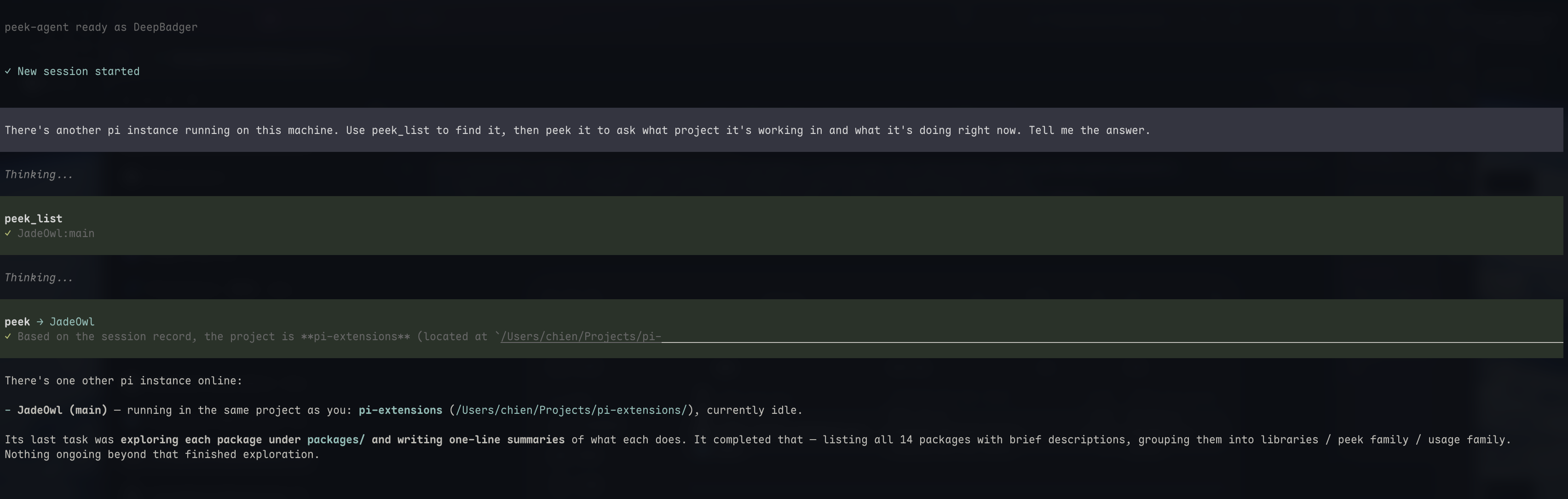
}
Security note
Pi packages can execute code and influence agent behavior. Review the source before installing third-party packages.
README
@d3ara1n/pi-peek-agent
Cross-instance peek for pi — let one pi instance glance at, or ask a question to, another instance without disturbing it.
Adds two tools for the main agent (peek_list, peek) and runs a lightweight Unix domain socket mesh so instances can discover and consult each other.
How it works
- Discovery: each instance writes a tiny PID-file marker to
~/.pi/peek/registry/. Liveness is verified bykill(pid, 0)+ a socket connect probe — no heartbeat drift, no stale leftovers (the kernel reclaims the socket fd on exit, including SIGKILL/crash). - Transport: Unix domain sockets via
node:net(zero runtime dependencies). The connection is bidirectional, so the answer streams token-by-token. - Read-after-burn: the peeked instance's main agent is never touched. The answer comes from its side
utilitymodel via the sharedpi-peekconsult core.
Tools
peek_list
List other pi instances online, grouped by project. Peers appear only if they have pi-peek-agent loaded.
peek
Ask another instance a question without disturbing its main conversation.
| Parameter | Required | Description |
|---|---|---|
question |
yes | The question to ask. |
at |
no | Target instance name (e.g. "Fox"). Omit to auto-pick the other same-project instance. |
sessionId |
no | Pin a specific instance by sessionId (use when names collide). |
Installation
pi install npm:@d3ara1n/pi-model-roles
pi install npm:@d3ara1n/pi-peek
pi install npm:@d3ara1n/pi-peek-agent
Or add to ~/.pi/agent/settings.json:
{
  "extensions": [
    "/absolute/path/to/pi-extensions/packages/pi-model-roles",
    "/absolute/path/to/pi-extensions/packages/pi-peek",
    "/absolute/path/to/pi-extensions/packages/pi-peek-agent"
  ]
}
Dependencies
@d3ara1n/pi-peek— consult core (serialize + investigate + tracker)
Configuration
Optional, in ~/.pi/agent/settings.json under peek:
{
  "peek": {
    "registryDir": "~/.pi/peek/registry",
    "heartbeatMs": 15000,
    "askTimeoutMs": 120000,
    "role": "utility"
  }
}
registryDir accepts a leading ~. heartbeatMs and askTimeoutMs must be positive finite numbers; invalid values fall back to their defaults.
Naming
Each instance gets a stable display name shown in peek_list. The name is
derived deterministically from the session id (a hash into an
adjective+noun pool) — so the same session always gets the same name across
/reload, restarts, even across machines. Switching sessions (resume / fork /
new) yields a different name.
Set it explicitly to override:
PI_PEEK_NAME=Fox pi
Otherwise the derived name (e.g. QuietBrook) is used. Name collisions across
sessions are disambiguated by peek({sessionId}).
License
MIT