@d3ara1n/pi-subagent
Role-based subagent orchestration for pi — delegates tasks to specialized pi child processes with configurable model roles
Package details
Install @d3ara1n/pi-subagent from npm and Pi will load the resources declared by the package manifest.
$ pi install npm:@d3ara1n/pi-subagent- Package
@d3ara1n/pi-subagent- Version
0.10.0- Published
- Jul 10, 2026
- Downloads
- 1,410/mo · 551/wk
- Author
- d3ara1n
- License
- MIT
- Types
- extension
- Size
- 704.9 KB
- Dependencies
- 1 dependency · 4 peers
Pi manifest JSON
{
  "extensions": [
    "./src/index.ts"
  ],
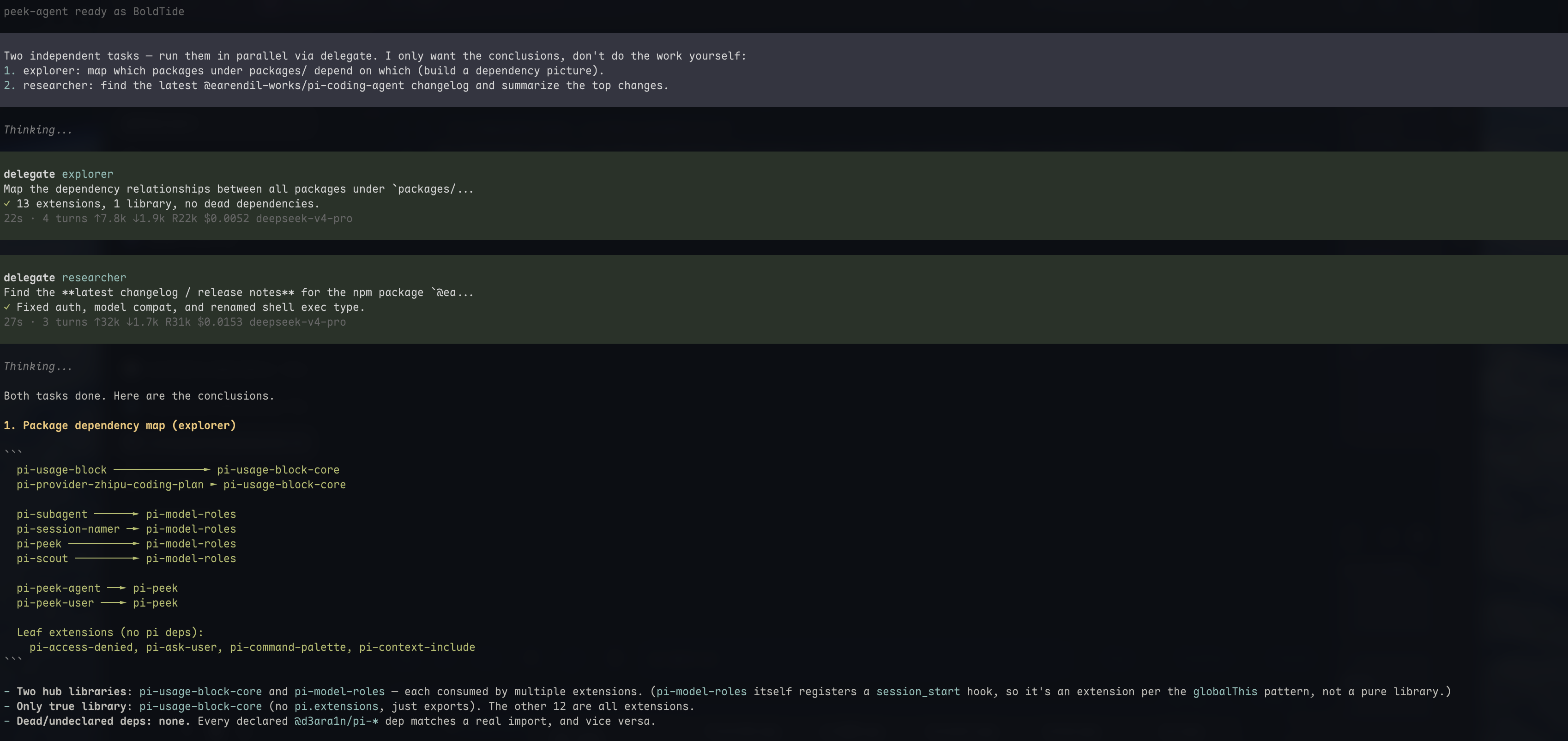
  "image": "https://raw.githubusercontent.com/d3ara1n/pi-extensions/main/packages/pi-subagent/preview.png"
}
Security note
Pi packages can execute code and influence agent behavior. Review the source before installing third-party packages.
README
@d3ara1n/pi-subagent
Role-based subagent orchestration for pi.
Provides a delegate tool that lets the main model offload tasks to specialized pi child processes with configurable model roles, real-time TUI progress, and AI-generated summaries.
Design Philosophy
The main model is the decision maker; subagents are executors.
Your primary AI has the most complete context — it knows the full conversation history, project structure, and task at hand. Subagents are spawned with clean, isolated contexts to handle specific, well-defined tasks without polluting the main model's context window.
This means:
- Subagents don't plan — the main model decides what needs to be done and provides a clear task description
- Subagents don't orchestrate — if a task requires multiple steps, the main model examines each result and decides the next move
- Subagents don't inherit history — they don't need the full conversation; just a precise task description
- Multiple subagents can run in parallel — emit multiple
delegatecalls in one turn; pi executes them concurrently - Subagents can nest subagents — a
workercan delegate exploration toexplorerwithout returning to the main model
This design currently focuses on single-task delegation rather than chain pipelines or context-forking — those patterns fit better when subagents act as advisors (planner, oracle) rather than executors.
How it works
- Main model calls the
delegatetool with a role and task description - The extension resolves the role to a model via pi-model-roles
- Spawns an isolated pi child process with the configured model, tools, and system prompt
- Real-time TUI progress shows tool calls, turns, and elapsed time as the subagent runs
- After completion, an AI-generated one-line summary is produced for compact display
- Returns the result to the main model with usage statistics (turns, tokens, cost)
Built-in Roles
| Role | Model Role | Tools | Can Delegate To | Description |
|---|---|---|---|---|
explorer |
fast | read, find, grep, glob | — | Fast code search (read-only, no bash) |
reviewer |
heavy | read, bash, grep, glob | — | Deep code review (read-only, bash for git/log) |
worker |
default | read, bash, edit, write, grep, glob, delegate | explorer, researcher | Implementation — the only role that can modify files |
researcher |
fast | web_search, fetch_content, read, bash, delegate | explorer | Web research + GitHub repo analysis |
Nested delegation: worker and researcher can spawn their own subagents. This keeps the main model's context clean — a worker can explore unfamiliar code via an explorer subagent without returning intermediate results to the main model.
Parallel execution: To run multiple subagents concurrently, emit multiple delegate calls in a single turn. Pi's framework executes them in parallel automatically, with each subagent getting its own TUI progress display.
TUI Display
- During execution: Shows role, elapsed time, turn count, and live tool calls
- Collapsed result:
✓ explorer · Found login, registration, and token logic+ recent tool calls + usage stats - Expanded result (Ctrl+O): Full task text, all tool calls, final output as rendered Markdown, and usage details
Dependencies
@d3ara1n/pi-model-roles— model role resolution
Installation
pi install npm:@d3ara1n/pi-model-roles
pi install npm:@d3ara1n/pi-subagent
Or add to ~/.pi/agent/settings.json:
{
  "extensions": [
    "/absolute/path/to/pi-extensions/packages/pi-model-roles",
    "/absolute/path/to/pi-extensions/packages/pi-subagent"
  ]
}
Configuration
Edit ~/.pi/agent/settings.json:
{
  "subagent": {
    "timeout": 1500,
    "maxConcurrency": 4,
    "maxDepth": 3,
    "maxTurns": 0,
    "maxCost": 0,
    "history": {
      "enabled": true
    },
    "summary": {
      "role": "utility",
      "enabled": true
    }
  }
}
All fields are optional. Defaults: timeout: 1500 (seconds; 25 min; active time — the clock pauses while the child is inside a nested delegate call, so delegate-capable roles need no extra headroom), maxConcurrency: 4, maxDepth: 3, maxTurns: 0 (unlimited), maxCost: 0 (unlimited), history.enabled: true, summary.role: "utility", summary.enabled: true.
Agent Overrides
Override, disable, or add subagent roles via agentOverrides. Built-in and custom roles are treated equally — all descriptions, examples, and decision triggers feed into the LLM's prompt dynamically.
{
  "subagent": {
    "agentOverrides": {
      "worker": {
        "role": "heavy",
        "timeout": 1500,
        "maxTurns": 50,
        "maxCost": 1.0
      },
      "reviewer": {
        "disabled": true
      },
      "tester": {
        "role": "default",
        "description": "Test automation & QA — write and run tests, validate fixes. Tools: read, bash, edit, write, grep. Can delegate to explorer.",
        "examples": [
          "Write unit tests for the auth module",
          "Run the test suite and fix failing tests"
        ],
        "decisionTrigger": "Task writes or runs tests?",
        "tools": ["read", "bash", "edit", "write", "grep"],
        "systemPrompt": "QA engineer. Write tests, run them, fix failures. After each change, re-run affected tests."
      }
    }
  }
}
Required fields for custom roles: role, description, examples, decisionTrigger, tools, systemPrompt.
Optional fields: subagentRoles (roles this role can spawn via delegate), timeout (per-role timeout override in seconds of active time; the clock pauses while the child delegates), maxTurns / maxCost (per-role budget overrides; 0 = unlimited), fallbackRole (backup pi-model-roles role on provider errors).
Invalid custom roles (missing required fields) are silently skipped with an error notification at session start.
Usage (by the main model)
Delegate tasks that would generate many tool calls or verbose output to keep your own context clean:
{
  "role": "explorer",
  "task": "Find all files that import the ModelRegistry and trace how they use it"
}
Role-specific examples:
| Role | Example task | Why delegate? |
|---|---|---|
explorer |
"Map the routing structure of src/api/" |
You only need the conclusion, not every grep result |
reviewer |
"Review error handling in auth.ts for security issues" |
Review output is longform; keep it isolated |
worker |
"Rename all snake_case fields to camelCase in src/models/" |
Your context stays focused on high-level intent |
researcher |
"Find the React 19 migration guide and summarize breaking changes" |
Search results are noisy; get a clean summary |
Parallel usage: emit multiple delegate calls in a single turn:
[
  { "role": "explorer", "task": "Map the repository structure" },
  { "role": "researcher", "task": "Find latest docs on the library used here" }
]
Passing context and reference files
pi-subagent delivers context to the child as independent channels, never fused into the task string. This keeps the task an unambiguous directive and lets each channel be sized independently.
context (inline text)
Hand the subagent precise context — selected code, a prior delegate's result, a file list, a git diff — without inflating the task string. It's delivered as a separate channel:
{
  "role": "worker",
  "task": "Add input validation to the login function",
  "context": "Current implementation (src/auth.ts:42-70):\n```ts\nasync function login(email, pw) { ... }\n```\nValidation must reject empty/invalid emails and enforce a min 8-char password."
}
The stored/displayed task stays as the original task. When small, context inlines as a <context> block; when large (over 8,000 chars) it spills to a temp file injected via @file, so a large context never drags a short task into a spill.
files (reference paths)
{
  "role": "explorer",
  "task": "Report the public API of the auth module",
  "files": ["src/auth.ts", "src/auth.types.ts"]
}
Each path is injected as an independent @file attachment the subagent reads directly. File contents stay out of your context window — you pass only the paths. Prefer this over pasting file contents into context, since the child receives the content on its first turn without spending a tool call to read it.
Budget enforcement
maxTurns / maxCost cap a run. When exceeded, the child is killed and the last completed output is returned with stopReason: "budget_exceeded" (shown in the expanded TUI). Defaults are unlimited (0); set global defaults in config or per-role via agentOverrides.
Oversized outputs
When a run's output exceeds the size limit (50,000 chars), pi-subagent first tries to compress it with the summary model (same role configured under summary.role) into a compact form that preserves conclusions, code, file paths, and errors. If compression fails or doesn't shrink enough, it falls back to mechanical head+tail truncation. The prepared text is what the main model receives and what the expanded TUI renders; a hint line notes which method was used. The full raw output is always kept in the history file for auditing.
Run history
Every completed delegate run is written (best-effort) to ~/.pi/subagent/history/{sessionId}/{toolCallId}.json, recording role, task, usage, activity log, and the full raw output (even when the main model saw a compressed/truncated version). Useful for auditing what subagents did and how much they cost. Disable with history.enabled: false.
License
MIT