@eamode/pi-commit
pi extension for automatic changelog-friendly Conventional Commits with submodule support.
Package details
Install @eamode/pi-commit from npm and Pi will load the resources declared by the package manifest.
$ pi install npm:@eamode/pi-commit- Package
@eamode/pi-commit- Version
1.1.4- Published
- May 21, 2026
- Downloads
- 628/mo · 628/wk
- Author
- skropp
- License
- MIT
- Types
- extension
- Size
- 56.6 KB
- Dependencies
- 1 dependency · 1 peer
Pi manifest JSON
{
  "extensions": [
    "extensions/index.ts"
  ],
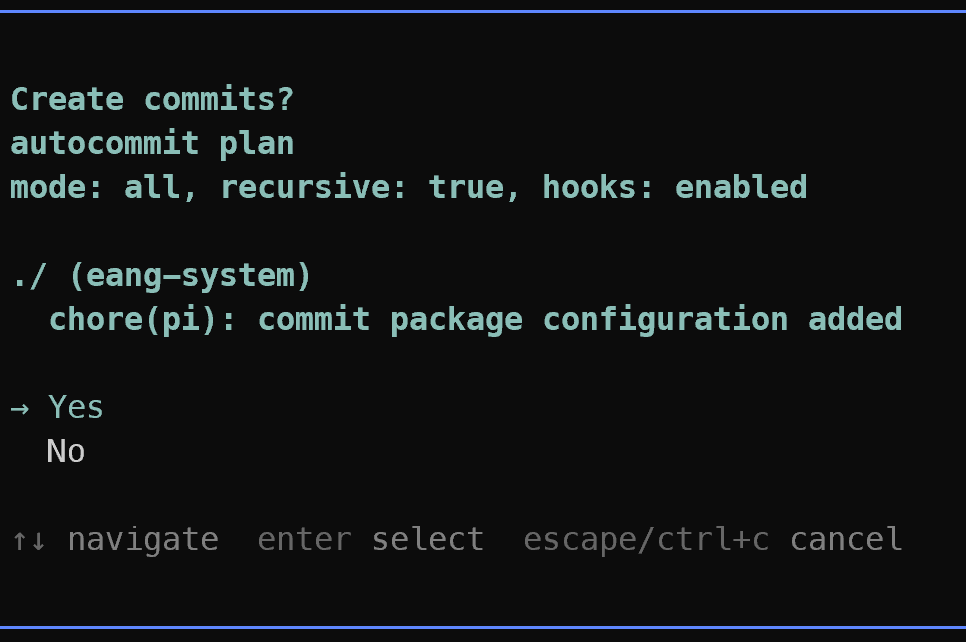
  "image": "https://raw.githubusercontent.com/EAmode/pi-commit/main/assets/screenshot.png"
}
Security note
Pi packages can execute code and influence agent behavior. Review the source before installing third-party packages.
README
pi-commit
A pi extension for automatic, changelog-friendly Conventional Commits.
/autocommit inspects git changes, commits dirty submodules deepest-first, generates a Conventional Commit message with an isolated model, previews/confirms in interactive mode, and runs git commit with hooks enabled by default.
Installation
pi install npm:@eamode/pi-commit
# or, for a project-local install committed in .pi/settings.json:
pi install -l npm:@eamode/pi-commit
Reload pi if it is already running:
/reload
Usage
/autocommit
Default behavior: /autocommit --all --recursive --context recent
/autocommit --staged              # commit only staged changes
/autocommit --all                 # stage all changes before committing
/autocommit --recursive           # include nested submodules
/autocommit --no-recursive        # only commit the current/root repo
/autocommit --dry-run             # preview without staging or committing
/autocommit --no-verify           # bypass git hooks intentionally
/autocommit --model <provider/model>
/autocommit --model=<provider/model>
/autocommit --context none|recent|session
/autocommit --yes                 # skip confirmation prompts
If hooks fail, /autocommit stops and shows their output. Use --no-verify only when you intentionally want to bypass hooks.
Configuration
Optional .pi-commit.json in the working directory. It is parsed as JSONC, so // comments and trailing commas are allowed. Command flags override config values for one run.
Start from the included example if desired:
cp .pi-commit.example.json .pi-commit.json
{
  // Model used to generate commit messages. Omit to inherit the current pi model.
  "model": "openai-codex/gpt-5.4-mini",
  // "staged" commits only staged changes; "all" stages all changes first.
  "defaultMode": "all",
  // Commit dirty nested submodules before the parent repository.
  "recursive": true,
  // Conversation context for message generation: "none", "recent", or "session".
  "contextMode": "recent",
  // Number of latest user prompts included when contextMode is "recent".
  "recentPromptCount": 5,
  // Maximum conversation context size passed to the message generator.
  "maxContextBytes": 8000,
  // Maximum staged diff size passed to the message generator for each repository.
  "maxDiffBytes": 30000,
  // Ask before creating commits in interactive UI mode. false behaves like --yes.
  "confirmBeforeCommit": true,
}
| Key | Values | Default | Description |
|---|---|---|---|
model |
pi model id, e.g. openai-codex/gpt-5.4-mini |
current pi model | Model for commit-message generation. Use openai-codex/... for ChatGPT Plus/Pro login, or openai/... with an OpenAI API key. If unset, generation uses the current parent pi model; if unavailable or failed, a deterministic fallback message is used. |
defaultMode |
"staged" or "all" |
"all" |
"staged" commits already staged changes; "all" stages tracked and untracked changes before committing. |
recursive |
boolean | true |
Commit dirty nested submodules before the parent repo. |
contextMode |
"none", "recent", or "session" |
"recent" |
Prompt context included in generation; "session" uses all available user prompts up to maxContextBytes. |
recentPromptCount |
number | 5 |
Latest user prompts included when contextMode is "recent". |
maxContextBytes |
number | 8000 |
Maximum conversation context passed to the generator. |
maxDiffBytes |
number | 30000 |
Maximum staged diff passed to the generator per repo. |
confirmBeforeCommit |
boolean | true |
Ask before committing in interactive UI mode; false behaves like --yes. |
Commit messages and submodules
Messages use Conventional Commits for future changelog generation: accurate types (feat, fix, refactor, docs, chore, etc.), meaningful scopes, subjects usually under 90 chars and capped around 120, non-imperative descriptions of what changed, and optional bodies for motivation/impact.
Example:
feat(autocommit): nested submodule commits generated deepest-first

Recursive dirty-repo discovery was added so submodules are committed before
the superproject and parent gitlink updates are captured correctly.
Nested repositories are committed deepest-first:
nested submodule -> submodule -> parent repository
Development and release
TypeScript extension files are loaded directly by pi; no compile or bundle step is required.
npm install
npm run typecheck
npm run pack:dry-run
Releases use semantic-release from Conventional Commits on main and publish to npmjs. Before releasing locally, log in to npmjs for @eamode or export NPM_TOKEN, ensure main is clean/up to date, then run:
git checkout main
git pull --ff-only
npm ci
npm run typecheck
npm run release:dry-run
npm run release
npm run release runs semantic-release --no-ci, computes the next version, creates the git tag, and publishes @eamode/pi-commit.