@eddiewang/pi-predict
Predicts your next reply when a Pi run ends, with the session model and its cached prefix.
Package details
Install @eddiewang/pi-predict from npm and Pi will load the resources declared by the package manifest.
$ pi install npm:@eddiewang/pi-predict- Package
@eddiewang/pi-predict- Version
0.1.1- Published
- Oct 12, 2026
- Downloads
- 531/mo · 531/wk
- Author
- eddiewang
- License
- MIT
- Types
- extension
- Size
- 93.4 KB
- Dependencies
- 0 dependencies · 3 peers
Pi manifest JSON
{
  "image": "https://raw.githubusercontent.com/eddiewang/pi-predict/main/docs/demo.svg",
  "extensions": [
    "./src/index.ts"
  ]
}Security note
Pi packages can execute code and influence agent behavior. Review the source before installing third-party packages.
README
pi-predict
Your next message, one Tab away.
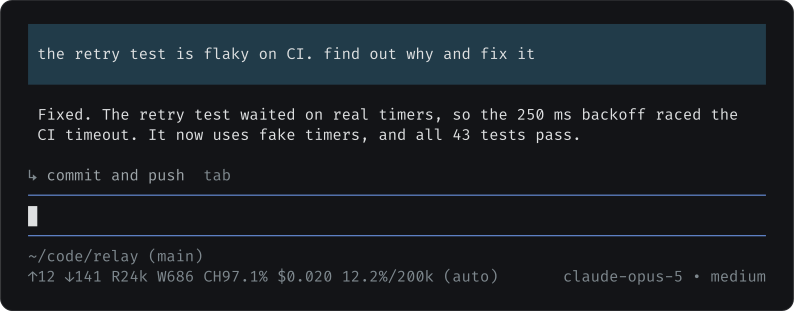
When the agent finishes, this Pi extension asks the session's own model for the message that you will most likely send next. The prediction shows above the editor. Tab puts it in the editor, and Enter sends it. When the model is not sure, nothing shows. pi-predict never sends a message itself.
The request continues the session's cached prompt, so the provider reads almost all of it from the cache. A prediction on a 114k-token Claude Opus prompt costs about $0.09. Your earlier replies in the same project show the model how you write.
Install
pi install npm:@eddiewang/pi-predict
# or from a git tag
pi install git:github.com/eddiewang/pi-predict@v0.1.0
# or for one run only
pi -e npm:@eddiewang/pi-predict
pi-predict needs Pi 0.87.1 or later. CI tests it with Pi 0.87.1 and with the latest Pi release, on each change and each week.
pi-predict is experimental (0.x). Each prediction is one more model request, so read the next two sections before you install it.
Cost
Each prediction is one more request to the session's model. With a cache hit, it pays a cache read of the prompt, a cache write of the new tail, and its output, which is short. A cache miss writes the whole prompt again. At Claude Opus prices ($5 input, $25 output, $0.50 cache read, and $6.25 cache write per million tokens), a prompt of 114k tokens costs about $0.09 with a hit and about $0.71 with a miss.
In the author's first 10 predictions (prompts of 44k to 413k tokens), 94.6% to 99.3% of each prompt came from the cache. Each prediction cost $0.04 to $0.22, and the median latency was 2.2 s.
Four guards limit the cost. The "Guards" reference below gives the details.
| Guard | Default | Effect |
|---|---|---|
| Prefix guard | always on | Sends nothing when the request does not continue the cached prompt. |
maxCostPerPrediction |
$0.40 | Skips a prediction whose estimated price is higher. |
dailyBudget |
$10 | Stops for the day when the day's predictions, from all Pi processes, cost this much. |
minCacheReadRatio |
80% | Pauses the session when two predictions in a row read less of their prompt from the cache. |
What it sends
The request goes to the session's own provider, with the session id. It holds the same context as your last request, the agent's final reply, and one instruction. The instruction can hold examples of your earlier replies to similar messages: by default, up to 6 from sessions in the same working directory. pi-predict starts no process and opens no other connection.
Commands
/predict shows the status. The subcommands are on, off, now (predict
even when the editor has a draft), stats (today and the last 7 days), and
resume (after a cache pause).
Reference
- pi-predict keeps a copy of the session's last request as Pi sent it to the
provider: the messages from
context_with_systemand the payload frombefore_provider_request. - When the run settles (
agent_settled), pi-predict checks the skip rules (see "Skips" below). Then it sends one request to the session's model: the copied messages, the run's final reply, and one instruction message. - Before the request leaves, the prefix guard compares its payload with the copied payload. All request settings must be equal, and the copied messages must be a prefix of the new messages. If they are not, pi-predict sends nothing. So the provider's prompt cache serves the request.
- The prediction shows while the branch still ends at the same message. A new message, a tree move, a compaction, a new context window, a model change, or the end of the session drops it.
- Your next message gives the outcome:
accepted(Tab, then sent without a change),edited(Tab, then changed),typed(the same text, typed), ormissed./predict statsshows the counts.
- Prefix guard. pi-predict sends nothing when the request does not continue the cached prefix.
- Price cap. pi-predict skips a prediction when its estimated price is
above
maxCostPerPrediction($0.40). The estimate counts a cache hit, at the price tier of the request's size, and the full output cap. A model without a cache price pays the input price for the whole prompt. Just before the request leaves, pi-predict checks again with the output cap of the payload itself. A payload without an output cap counts the model's largest output, so a priced model then gets no prediction. - Daily budget. Predictions stop for the day when the predictions of all
Pi processes cost
dailyBudget($10). Each process checks the budget before it sends, so the total can pass the budget by one prediction for each Pi process. A request that stops before the provider reports its usage (for example, because you sent a message first) counts its estimate. If pi-predict cannot read its log, it sends nothing; if it cannot write the log, it stops until/predict resume. - Cache pause. If two predictions in a row read less than
minCacheReadRatio(80%) of their prompt from the cache, the session pauses until/predict resume. Prompts smaller than 8,192 tokens are not checked.
The request keeps the cache key of the session:
- A model with
compat.supportsMidConvoEffortgets "low" effort in the transcript, after the cached prefix. The request keeps its thinking settings. The output cap is 2,048 tokens. - Other models keep the session's thinking level, with an output cap of 8,192 tokens. When thinking is off, the cap is 2,048 tokens.
- Anthropic models with budget-based thinking get no predictions, because a lower output cap changes the cache key.
The prefix guard knows the payloads of these APIs: anthropic-messages,
openai-responses, openai-codex-responses, azure-openai-responses, and
openai-completions. Models of other APIs get no predictions.
The instruction can hold up to examples of your earlier replies to similar
messages of the agent. pi-predict ranks them with BM25 on the end of the
agent's message. A reply from the same project gets a 1.5x weight. An older
reply loses up to half of its weight, with a half-life of 30 days.
history: "project"(the default) uses replies from sessions in the same working directory only."project+short"also uses replies of 60 characters or less from all projects. These replies then go to the provider of the current session."all"uses replies from all projects."off"uses none.
After a run that ends in an error or an abort, pi-predict makes no model call. It offers the reply that most often followed such a stop in your history, if that reply occurred 3 times or more (for example, "continue").
The index is <agentDir>/pi-predict/history-v2.json. Its sources are the
top-level session files in <agentDir>/sessions, so subagent transcripts in
subfolders are not read. These are left out:
- sessions in temporary directories
- the live session
- replies that start with
< - replies longer than 2,000 characters
The first build starts 5 s after a session starts and reads every session file once. Later builds read only the lines that each file gained. One builder runs at a time, by a lock file. On 4.7 GB of session files, the first build took about 11 s and peaked at about 440 MB RSS. A later refresh took 0.15 s.
pi-predict makes no request in these cases:
- predictions are off or paused
- the mode is print or JSON
- pi-subagents reports the session as a child
(
Symbol.for("pi-subagents:session-status.v1")) - Pi is busy or has queued messages
- the editor has a draft
- the run did not end with a normal reply
- the model's API has no prefix check
- the estimated price is above
maxCostPerPrediction - the predictions of the day (from all Pi processes) used up
dailyBudget
<agentDir>/pi-predict.json. Every key is optional:
| Key | Default | Meaning |
|---|---|---|
enabled |
true |
/predict on and /predict off write it. |
display |
"auto" |
"auto", "ghost", or "line". Ghost text needs an editor suggestion API that stock Pi does not have yet, so "auto" shows the line. |
history |
"project" |
Which earlier replies can be examples: "project", "project+short", "all", or "off". |
examples |
6 |
The maximum number of examples (0-12). |
maxCostPerPrediction |
0.40 |
Dollars. |
dailyBudget |
10 |
Dollars per local day. |
minCacheReadRatio |
0.8 |
The minimum share of the prompt read from the cache. |
Other extensions in the same Pi process can read the predictions:
const api = globalThis[Symbol.for("pi-predict:api.v1")];
// { version: 1, current(sessionId), subscribe(listener) => unsubscribe }
Each state is { sessionId, sourceEntryId, state, text, at }. state is
running, completed, failed, or cleared. sourceEntryId is the message
entry that the prediction continues. Pi also emits each change on pi.events
as predict:updated.v1.
pi-predict writes these files:
<agentDir>/pi-predict.json(only/predict on|offwrites it)<agentDir>/pi-predict/history-v2.jsonandhistory.lock<agentDir>/pi-predict/log/YYYY-MM.jsonl: one line for each prediction (its text, usage, cost, and cache-read share) and one line for each outcome. Logs older than three months are deleted.
The prefix guard compares with the payload that pi-predict's own
before_provider_requesthandler sees, and the prediction request does not go through thebefore_provider_requesthandlers of other extensions. An extension that changes provider payloads has this effect:- If it loads before pi-predict, the guard sees the changed payload. The predictions then fail the guard, and pi-predict sends nothing.
- If it loads after pi-predict, the guard sees the payload before the change. A prediction can then pass the guard and still miss the cache. The cache pause stops the predictions after two such misses.
So load such an extension before pi-predict, or turn pi-predict off.
Some Pi builds have features that stock Pi does not have. pi-predict uses them when they are present:
- pi-ai's
fitImagesToInputLimits: the prediction leaves out the same images as the agent loop. - the
session_context_windowevent: a new context window drops the prediction. - an editor suggestion API (
ctx.ui.editorSuggestionVersion === 1): ghost text in the editor. This is not built yet.
- pi-ai's
Uninstall
pi remove npm:@eddiewang/pi-predictThen delete <agentDir>/pi-predict.json and <agentDir>/pi-predict/.
Design
docs/design.md gives the decisions and the reasons for
them. The idea comes from the composer predictions of OpenAI's Codex; this is
an independent implementation, with no Codex code.
Development
npm ci
npm run check   # Biome and tsc
npm test        # Vitest, against the Pi SDK in package-lock.json
npm run smoke   # pack the package, load the tarball in Pi, and find /predict
npm run test:sdk -- <directory with pi-ai.tgz, pi-coding-agent.tgz, pi-tui.tgz>
test:sdk runs the tests against other Pi SDK builds, for example a fork. The
tests that need a feature of such a build run only there.
RELEASING.md gives the release steps.
License
MIT