@fractaal/pi-claude-bridge
Pi provider bridge that runs Claude Code through the Claude Agent SDK.
Package details
Install @fractaal/pi-claude-bridge from npm and Pi will load the resources declared by the package manifest.
$ pi install npm:@fractaal/pi-claude-bridge- Package
@fractaal/pi-claude-bridge- Version
1.6.2-fractal.1- Published
- Jul 17, 2026
- Downloads
- 484/mo · 293/wk
- Author
- fractaal
- License
- MIT
- Types
- extension
- Size
- 3.7 MB
- Dependencies
- 4 dependencies · 2 peers
Pi manifest JSON
{
  "image": "https://raw.githubusercontent.com/fractaal/pi-extensions/main/packages/claude-bridge/assets/bridge-demo.png",
  "extensions": [
    "./bundle/index.js"
  ]
}Security note
Pi packages can execute code and influence agent behavior. Review the source before installing third-party packages.
README
@fractaal/pi-claude-bridge
Run Claude Code as a Pi provider using your Claude subscription. Adds claude-bridge/* models to /model while keeping Pi's tools and TUI.
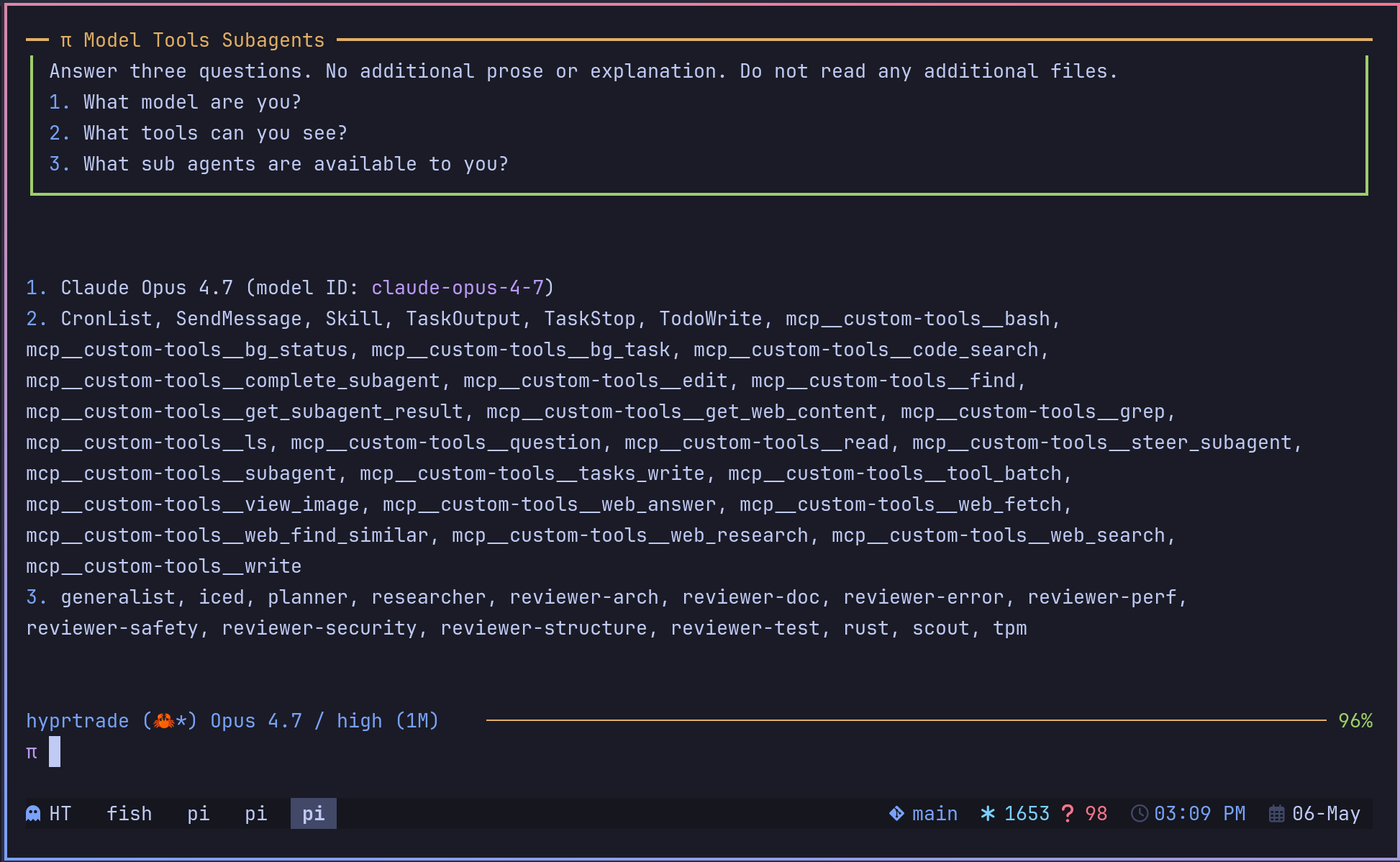
Maintained from @vanillagreen/pi-claude-bridge, itself forked from elidickinson/pi-claude-bridge. The fractaal fork tracks current Pi APIs and can use Pi's complete system prompt without embedding host-specific policy.
Highlights
claude-bridge/claude-fable-5, Sonnet 5, Opus 4.8, Opus 4.7, Sonnet 4.6, and Haiku in/model.- Pi tool calls run on Pi; Claude Code handles reasoning.
- Tool-use turns block until Pi-delivered tool results reach Claude Code, including persistent subagent panes.
- Session continuity across normal turns,
/compact, tree navigation, and abort recovery. - Thinking-level forwarding with summarized Opus thinking display.
- Optional Claude effort overrides (
xhigh→maxfor Opus 4.8). - MCP isolation and Claude cloud-MCP suppression to keep tokens lean.
- Opt-in forwarding of
APPEND_SYSTEM.mdand recognized Pi prompt hooks.
Install
Via npm:
pi install npm:@fractaal/pi-claude-bridge
Restart Pi after installation.
Prompt context
systemPromptMode has two modes:
claude-code(default): use Claude Code's preset prompt and optionally append selected Pi context.pi: pass Pi's complete system prompt through unchanged and disable Claude filesystem setting sources, avoiding duplicate instructions and MCP discovery.
The bridge only provides this mechanism. Pi installations and embedding hosts choose the mode through normal package settings.
Embedding hosts that run multiple sibling Pi runtimes in one process should use @fractaal/pi-claude-bridge/isolated. Every factory invocation owns independent session, tool, UI, and query state. The default package entry preserves personal Pi's nested-agent behavior, where reloaded extension instances share one model registry.
Settings
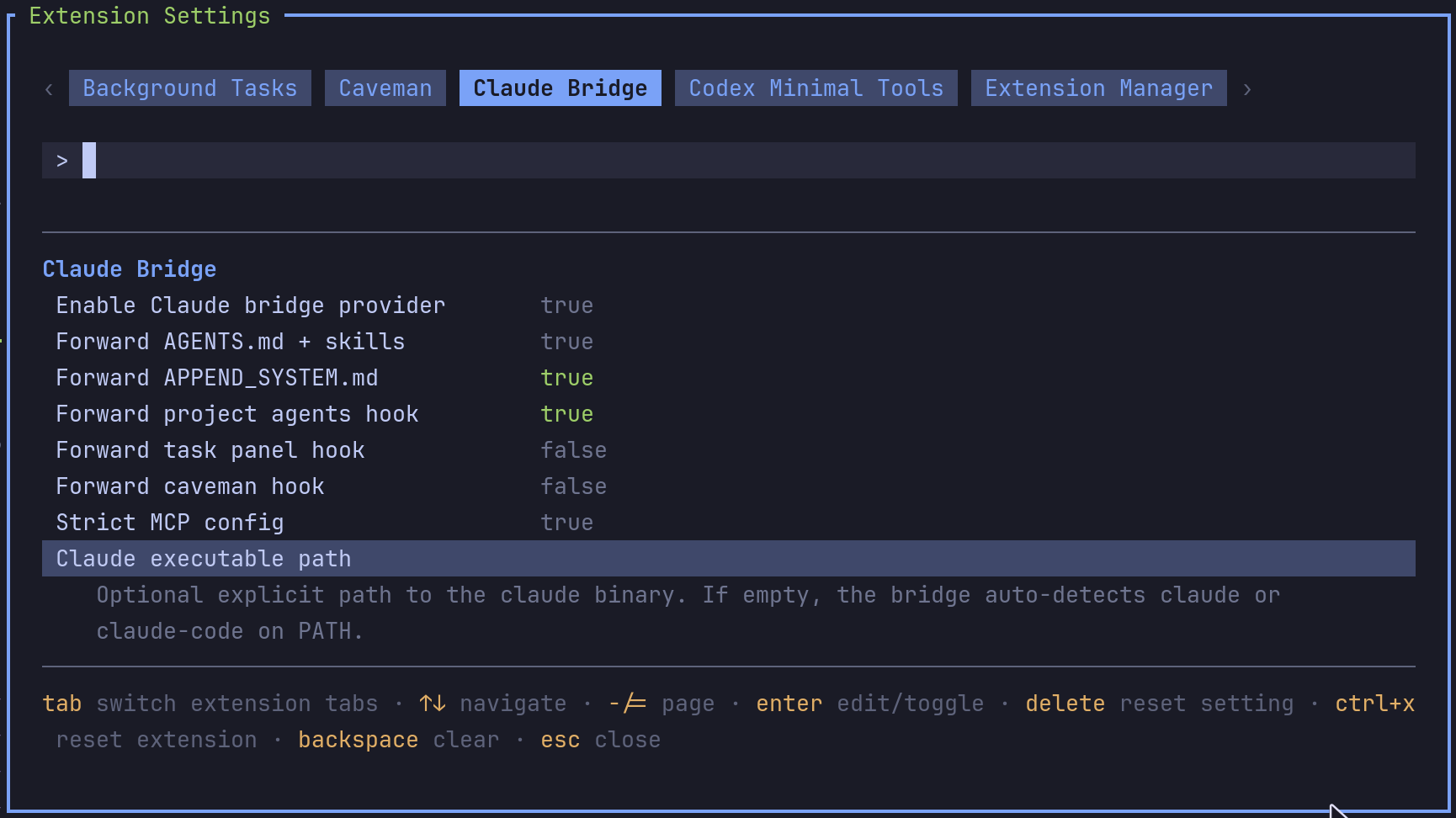
Open /extensions:settings; settings appear under the Claude Bridge tab.
Project settings in .pi/settings.json apply only after Pi marks the workspace trusted; before trust, vstack Pi extensions read user/global settings only.
General
| Setting | What it does |
|---|---|
| Enable Claude bridge provider | Register claude-bridge/* models. Reload required. |
Base prompt
| Setting | What it does |
|---|---|
| System prompt | Choose Claude Code's preset prompt or Pi's complete system prompt. |
| Forward AGENTS.md + skills | In Claude Code mode, append AGENTS.md and Pi's skills block. |
Pi prompt context
| Setting | What it does |
|---|---|
| Forward APPEND_SYSTEM.md | Forward project/global APPEND_SYSTEM.md content. |
Pi prompt hooks
| Setting | What it does |
|---|---|
| Forward project agents hook | Forward pi-agents-tmux Project Agents/Subagents list. |
| Forward task panel hook | Forward pi-task-panel workflow reminders. |
| Forward caveman hook | Forward pi-caveman response-style directives. |
Claude Code
| Setting | What it does |
|---|---|
| Strict MCP config | Block filesystem MCP auto-loads; Pi owns tools. |
| Allow extra usage helper | Let the bridge launch Claude Code's /extra-usage flow when extra usage is required. Billing/admin approval still happens in Claude's browser page. |
| Fast mode | Enable Claude Code fast mode for bridge requests when the selected model supports it. |
| Force Claude effort | Override Pi's thinking-level mapping for every claude-bridge request. none keeps Pi's selected level; max sends Claude Code --effort max. |
| Model effort overrides | JSON object mapping model IDs to Claude Code efforts, e.g. {"claude-opus-4-8":"max"}. Per-model entries beat the global force setting. |
| Claude executable path | Explicit claude binary path; empty auto-detects. |
Pi 0.80.6 and newer expose native max thinking. Fable 5 bridge metadata forwards both xhigh and max; Force Claude effort and Model effort overrides remain available when one bridge model needs a different fixed effort. For example, to force only Opus 4.8 to max:
{"claude-opus-4-8":"max"}
Keys may be bare model IDs (claude-opus-4-8), claude-bridge/<id>, or * for all bridge models. Values are low, medium, high, xhigh, or max.
Fable 5 caveat
The bridge registers claude-bridge/claude-fable-5, claude-bridge/claude-sonnet-5, and claude-bridge/claude-opus-4-8 even when Pi's Anthropic model registry has not shipped those entries yet. For Fable 5, the bridge asks Claude Code to use Opus 4.8 as the availability fallback and preserves Claude Code's content-safety fallback events so Pi labels rerouted turns as Opus 4.8. Content-safety fallback still depends on Claude Code's own Fable 5 support; use Claude Code 2.1.170 or newer, and set ANTHROPIC_DEFAULT_FABLE_MODEL / ANTHROPIC_DEFAULT_OPUS_MODEL yourself when routing provider-specific model IDs through Bedrock, Vertex, or Foundry.
Extra usage and rate limits
Claude Code's /extra-usage local command works through the Claude Agent SDK. In Pi, use /claude-bridge:extra to run that flow from claude-bridge. Persist automatic launch on extra-usage errors with Allow extra usage helper in /extensions:settings.
When Claude Code reports a rate-limit reset time, the bridge shows one clear [rate-limit] warning with timezone context and avoids repeating the same error line. If pi-qol is installed, it can use the reset time to resume later.
Allowed-warning rate-limit events are filtered before user notification. The bridge normalizes unambiguous numeric utilization (0 < value < 1 as fractional, 1 < value <= 100 as percent), suppresses low or unit-ambiguous values such as exact 1, and only shows a neutral warning at 80%+ instead of claiming an unverified % used value. Check Claude Code /usage for exact allowed-warning utilization.
If Claude Code accepts a turn but produces no visible output, the bridge returns a retryable assistant error with a backoff hint instead of leaving Pi stuck waiting. Tune the first-output timeout with CLAUDE_BRIDGE_STREAM_IDLE_TIMEOUT (bare numbers are seconds; suffixes ms, s, and m are accepted). Default: 90s; set 0 to disable.
Debugging
Set CLAUDE_BRIDGE_DEBUG=1 to write bridge logs to ~/.pi/agent/claude-bridge.log and per-query Claude Code CLI logs under ~/.pi/agent/cc-cli-logs/.
Tool-result integrity problems are surfaced even when debug logging is off. Pi shows an error notification and writes a diagnostic file to ~/.pi/agent/claude-bridge-diag.log so lost or mismatched tool output is visible.
Startup failures include the resolved Claude executable and working directory, which makes missing binaries and wrong launch directories easier to fix.
Contributor-facing stream, tool-result, and startup diagnostics are documented in DEVELOPMENT.md.