@geohar/pi-mcp-combiner
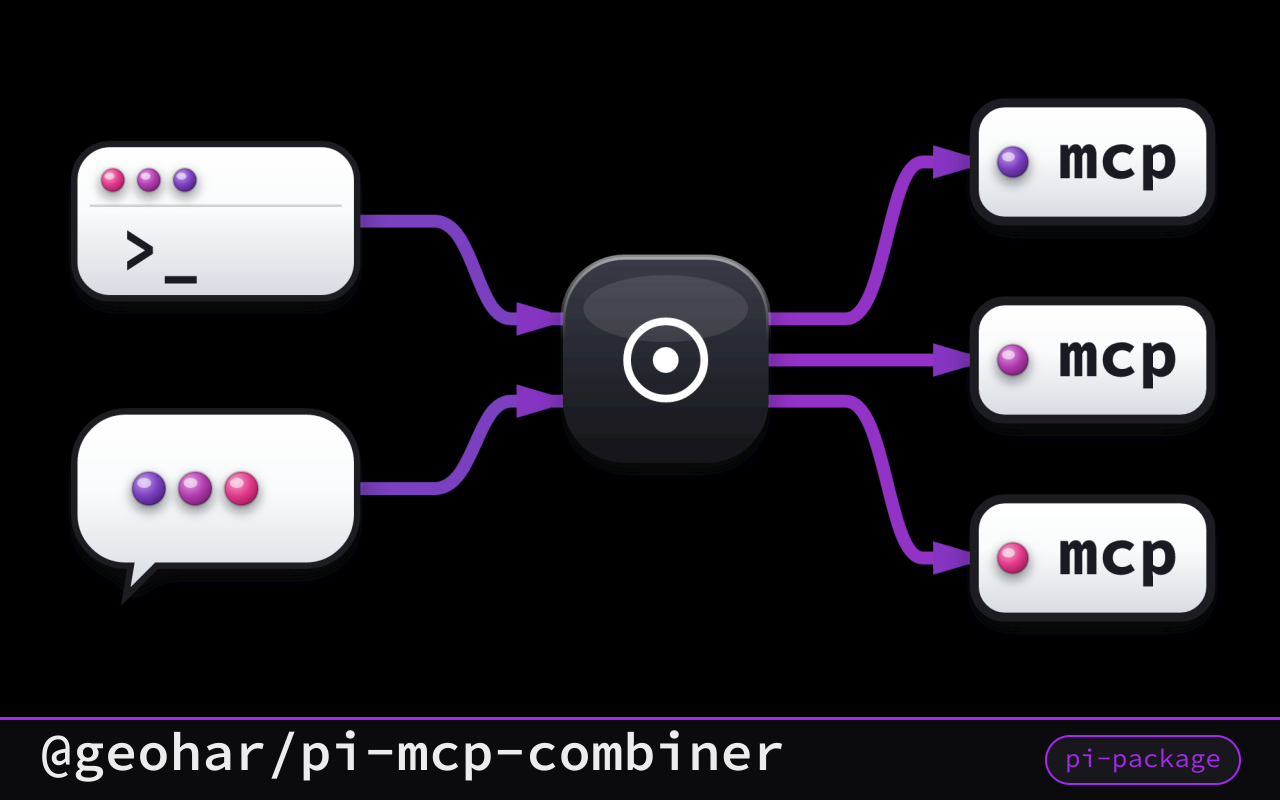
Pi extension: run the mcp-combiner MCP aggregator via sharedserver and inject its tool-discovery directive. Pairs with pi-mcp-adapter, which makes the combiner's tools reachable from Pi.
Package details
Install @geohar/pi-mcp-combiner from npm and Pi will load the resources declared by the package manifest.
$ pi install npm:@geohar/pi-mcp-combiner- Package
@geohar/pi-mcp-combiner- Version
0.16.0- Published
- Oct 7, 2026
- Downloads
- 1,016/mo · 126/wk
- Author
- georgeharker
- License
- MIT
- Types
- extension
- Size
- 792.8 KB
- Dependencies
- 1 dependency · 2 peers
Pi manifest JSON
{
  "image": "https://raw.githubusercontent.com/georgeharker/mcp-companion/main/plugins/pi/assets/preview.png",
  "extensions": [
    "./src/index.ts"
  ]
}
Security note
Pi packages can execute code and influence agent behavior. Review the source before installing third-party packages.
README
@geohar/pi-mcp-combiner
A Pi extension + one shared MCP aggregator: a single refcounted combiner process fronts all your MCP servers, and every client you use talks to that one process.
It reuses Pi's MCP stack rather than replacing it. The transport is
@earendil-works/pi-mcp — Pi's own MCP client library (peer dependency, ^1.0.2) —
and Pi's built-in MCP support keeps its role (/mcp, codemode, tool_search). The
extension is additive; it adds the pieces Pi's built-in can't do:
- Elicitation — upstream servers can ask you: consent ladders, deploy confirmations, structured forms. Pi's built-in MCP can't forward those; this extension bridges them to Pi's dialogs — and to your paired app over un-bien.
- Interactive resources (mcp-app widgets) — Pi's
read_mcp_resourceskipsui://resources entirely; we registerread_*tools, host the widget, hold the call while you interact, and fold your actions back into the result. - A discovery router —
mcp({search})/({describe})/({tool, args}): ranked discovery over the whole aggregated surface, under the tool namemcpthat tool_call gates already recognize.
The sharing is the point. One combiner process, supervised by
sharedserver, is shared across Pi,
Claude Code, OpenCode, and Neovim — upstream connections, sessions, and OAuth live
once, not once per client. One servers.json permission policy (deny / elicit /
allow, per server) is enforced at the combiner for every client alike, keyed by
per-chat tokens that survive restarts: consent grants, parked sessions, and filters
carry across combiner restarts by handover, and combiner__status reports what a
boot restored.
It is the Pi counterpart of the
Claude Code
and OpenCode
plugins, and shares the same combiner and the same sharedserver instance.
How it fits together
Three halves, all in this one package:
Process — on
session_startit drivessharedserver use <name> --pid <pi-pid> --grace-period <g> \ -- <combiner> --mcp --config <servers.json> --port <port>sharedserverrefcounts by PID with a grace period, so the combiner is shared across clients and outlives any single one. The refcount releases onsession_shutdownonly whenreason === "quit"— reload/resume/fork keep the same Pi process and a freshsession_startre-attaches.Client — the pi-mcp transport on an owned connection (per-Pi-session custody token, elicitation capability advertised and bridged to Pi's UI) that registers the agent-facing surface: every combiner tool first-class under its bare name (
github_search_code) with pi-1.0 exposure/namespace/annotations, themcp()discovery router on the same connection,read_*resource tools (interactiveui://widgets included), prompt slash commands, a status footer, and an interactive panel.Instructions — on
before_agent_startit appends the combiner's<server>_-prefix / "discover before assuming" directive to the system prompt.
sharedserver itself is fetched automatically if not installed (pinned release via
the cargo-dist installer), and the combiner is resolved from PATH / a checkout /
a pinned PyPI release — same resolvers as the sibling plugins.
Running it
Install only this extension. Nothing else needed — the client half connects to the combiner and registers everything:
pi install /path/to/mcp-companion/plugins/pi     # local checkout
# or the published package under settings.json "packages"
On startup you get: every combiner tool first-class under its bare name (your
directTools matches declared direct, the rest on codemode), the mcp discovery
router, read_<resource> tools, /<server>__<prompt> slash commands, a footer line
(14 servers enabled (13 ready) · 671 tools), and /mcp-combiner panel.
*Via another mechanism — pi-mcp-adapter. The target is Pi's native MCP support (Pi ≥ 1.0). If you already run
pi-mcp-adapterfor other servers, this extension can stand down its client half:"adapter": false(or the default"auto", which detects the adapter and yields automatically) leaves the process half + instructions to us and MCP to the adapter./mcp-combiner install-configstill writes the shared-mcp.jsonentry for the adapter to read.
Requirements
mcp-combineravailable as a command (uv tool install mcp-combiner), or justuvon PATH — a pinned release is fetched from PyPI on demand. Requires combiner ≥ 0.8.0 (version-gated automatically).- A combiner
servers.json(auto-probe locations below). - pi-mcp-adapter not required.
- Pi ≥ 1.0 with its bundled
@earendil-works/pi-mcp(peer dependency,^1.0.2) — the transport is Pi's own MCP client library.
Configuration — three layers
1. Pi settings file — $PI_CODING_AGENT_DIR/extensions/mcp-combiner.json
Pi-side knobs (see settings.example.json):
| Key | Default | Effect |
|---|---|---|
toolName |
"mcp" |
Name of the proxy tool. Rename (e.g. "combiner") to coexist with pi-mcp-adapter's own mcp. |
adapter |
"auto" |
Client-half gate — see above. |
lazy |
"lazy" |
"eager" connects at session start; "lazy" on first use. Prompts/resources/directTools imply eager. |
exposeResources |
true |
Register read_<resource> tools. |
prompts |
true |
Register prompt slash commands. |
uiAutoOpen |
true |
Auto-open interactive widget URLs in the browser (Stage 2 holds + resource reads). |
warnLargeDirectExposure |
true |
Warn when >50 tools end up direct-exposed (every schema rides in every request); set false to silence. Native mode. |
mcpFooterStatus |
"full" |
Footer text: "full" = N servers enabled (M ready) · T tools, "compact" = MCP M/N, "off" = none. |
mcpFooterKey |
"mcp" |
The ctx.ui.setStatus key the footer publishes under (the slot oh-my-posh-style footers aggregate). |
url |
— | Explicit combiner URL. Env wins. |
notify |
true |
Surface lifecycle messages via the Pi UI. |
2. Shared MCP config ladder — read-only
The extension reads the standard MCP files (same ladder and precedence as
pi-mcp-adapter, later wins): ~/.config/mcp/mcp.json → ~/.agents/mcp.json →
~/.agents/mcp/mcp.json → <agent dir>/mcp.json → .mcp.json → .pi/mcp.json
(project). It never writes them.
The recognized mcp-combiner entry carries connection + per-project exposure:
{
  "mcpServers": {
    "mcp-combiner": {
      "url": "http://127.0.0.1:9741/mcp",
      "auth": "bearer",
      "bearerTokenEnv": "MCP_COMBINER_AUTH_TOKEN",
      "combiner": {
        // extension-specific, ignored by other readers
        "servers": { "allow": ["github", "svg-mcp"] }, // or "deny": [...]
        "exposeResources": true,
        "prompts": true,
        "directTools": ["combiner__status", "github_search_*"], // or "search"
      },
    },
  },
}servers.allow/deny— per-project exposure, enforced at the combiner for this chat's token (sees through scripting too) and mirrored client-side.directTools— an allowlist (globs) of tools to declaredirect(verbatim, in every request) instead ofcodemode(reachable from scripts and pi'stool_search)."search"degrades to all-codemode — pi's own discovery replaces the old search-promote. A >50-entry allowlist warns;trueis deliberately not offered (context cost: every direct schema rides in every request).- Codemode activation (pi 1.0.x quirk) — pi does NOT auto-activate the codemode
tool for extension-registered tools (only for its own connected MCP servers), so
codemode-exposed combiner tools are unreachable from scripts until you add"defaultTools": ["+codemode"]to your pi settings.json. That setting applies at a fresh session's creation (resumed sessions keep their recorded tool set). If you don't use codemode, combiner tools outsidedirectToolsstay callable via themcpdiscovery/router tool. - Project layers are read against the session cwd — worktree subagents and
project switches get their own
.pi/mcp.json. Commit thecombinerblock if you want worktree agents to honour it. - URL precedence:
MCP_COMPANION_COMBINER_URL(host-owned) →PI_MCP_COMBINER_URL→ settingsurl→ ladder entryurl→host:port/mcp.
3. Environment — PI_MCP_COMBINER_*
| Variable | Default | Effect |
|---|---|---|
PI_MCP_COMBINER_ADAPTER |
(settings) | off / on / auto — client-half gate. |
PI_MCP_COMBINER_TOOL_NAME |
(settings) | Proxy tool name override. |
PI_MCP_COMBINER_URL |
— | Explicit combiner URL. |
PI_MCP_COMBINER_PORT |
9741 |
HTTP port the combiner serves on. |
PI_MCP_COMBINER_HOST |
127.0.0.1 |
HTTP host the combiner binds. |
PI_MCP_COMBINER_CONFIG |
(auto-probed) | Path to the combiner's servers.json. |
PI_MCP_COMBINER_COMMAND / _ARGS |
(auto-resolved) | Override the combiner invocation. |
PI_MCP_COMBINER_CHECKOUT |
— | Checkout for uv run --project <checkout> python -m mcp_combiner. |
PI_MCP_COMBINER_NAME |
mcp-combiner |
sharedserver instance name. |
PI_MCP_COMBINER_GRACE |
30m |
sharedserver grace period. |
PI_MCP_COMBINER_LOG / _PYLOG / _LOG_LEVEL |
(state dir) | Combiner logging; "none" disables. |
PI_MCP_COMBINER_MANAGE |
true |
false → don't launch (combiner runs elsewhere). |
PI_MCP_COMBINER_INSTRUCTIONS |
true |
false → skip the system-prompt directive. |
PI_MCP_COMBINER_NOTIFY |
true |
false → don't surface messages via the Pi UI. |
SHAREDSERVER_BIN / SHAREDSERVER_LOCKDIR |
(auto) | sharedserver binary / lock dir. |
servers.json auto-probe: $PI_MCP_COMBINER_CONFIG →
~/.cache/secrets/<user>.mcpservers.json → ~/.config/mcp-combiner/servers.json →
~/.config/mcp/servers.json.
The UX
The proxy tool (mcp, or your toolName) — one tool instead of hundreds:
mcp({search: "github search code"})     → ranked hits + describe-next hint
mcp({describe: "github_search_code"})   → full schema (TS-shaped) + description
mcp({tool: "github_search_code", args: {...}})  → the call
mcp({})                                 → status
Per-tool registration — the combiner's tools are also declared first-class under
their own bare names (github_search_code): directTools matches verbatim, the rest
reachable from codemode scripts and pi's tool_search — while the mcp router above
keeps registering on the same connection (tool_call gates that match the mcp tool
name keep working). See docs/call-chain.md for the full
layer map of a call.
read_<resource> tools — one zero-parameter tool per MCP resource; interactive
mcp-app resources are flagged and their read_* results append the combiner UI-host URL (/ui/<token>/?resource=…), auto-opened in the browser — the interactive widget runs combiner-side.
Interactive widgets (mcp-app) — when a widget-bound tool result arrives (e.g.
todoist_find-tasks-by-date), the combiner holds the call in flight: the
extension auto-opens the widget in your browser, the tool's data streams to it
over SSE, and you interact while the call waits. Hit Done in the widget and
the call resolves with a summary of what you did. Every widget action runs
through the combiner's permission pipeline, and the full interaction stays
retrievable: ask for combiner__ui_messages afterwards (the hold budget is 50s
by default — MCP_COMBINER_UI_HOLD_TIMEOUT combiner-side; the widget URL stays
valid after a timeout, you just lose the fold-into-result for that call).
Widgets that self-fetch (svg-mcp's preview) work the same way.
Prompt slash commands — mcp__<server>__<name> (e.g. mcp__todoist__productivity_analysis),
positional + name=value args with bash quoting.
Footer — 14 servers enabled (13 ready) · 671 tools under the mcp status key;
refreshed on connect/changes and every 30s; honest degradation when unreachable.
/mcp-combiner command:
| Verb | Effect |
|---|---|
(none) / status |
Connection state, per-server glyph table, session view |
panel |
Interactive panel (below) |
enable / disable / restart-server <srv> |
Drive the combiner's meta-tools |
system-prompt |
Show the injected directive |
install-config [path] |
Legacy: write the shared-mcp.json entry for pi-mcp-adapter |
The panel — /mcp-combiner panel: connection + port + session token, exposure
filter, fuzzy search (/), per-server rows with state glyphs (● ○ ⊘ ✗ ◌) and the
tools/resources/prompts counts trio, expandable tool lists with token estimates,
[session off] labels for project-filtered servers, the combiner's own ⬢ meta-tools
group. Keys: ↑↓/jk move · enter expand/copy · e enable/disable · c copy ·
/ filter · r refresh · q close.
Chat identity
Each Pi session mints its own grouping token (pi-<sessionId>) into the combiner URL
path, so per-chat isolation (isolate: true servers), parked upstream sessions, and
restart handover all key on the chat — subagents automatically get their own tokens
(each child session binds fresh). A resumed chat continues its identity; a fork
deliberately starts fresh. An explicit token in the configured URL always wins.
Because identity lives at the client, a combiner restart degrades gracefully: the
sanctioned-restart handover carries consent grants, per-token filters and parked
sessions to the successor boot, every connection method retries a stale session once
(withStaleRetry), and combiner__status / /health report what this boot restored
(_handover) — the post-restart re-orientation receipt.
Permissions
Tool-call policy is enforced at the combiner (permissions in servers.json:
deny/elicit/allow per server, with interactive elicitation bridged to Pi's UI —
subagents decline securely by default). "Allow for session" grants are keyed by the
chat token and carried across sanctioned combiner restarts. In native mode the
combiner's tool annotations (readOnly/destructive hints) ride pi's registration for
classification-aware gates. If you also run
pi-permission-system, keep toolName: "mcp" for its mcp-surface rules (tool-glob patterns like github_* match out of
the box).
Acknowledgments
The client half began as a substantial reduction of
pi-mcp-adapter (MIT, © Nico Bailon) —
the proxy-tool calling convention, search semantics, result-guard behavior, prompt
command format, resource naming, the schema-signature renderer, and the HTML/JS
widget contract derive from it, and the conformance cases in test/ are ported from
its suite. Everything OAuth, multi-server, and transport-related is deliberately
not here — the combiner owns that. This package would be a much worse tool
without Nico's design work; go star it.
Host-owned mode
If $MCP_COMPANION_COMBINER_URL is set, an editor/host (e.g. Neovim) already owns
and refcounts the combiner — this extension never launches it (the client still
connects). Equivalent to PI_MCP_COMBINER_MANAGE=false for the process half.
Development
npm install
npm run typecheck
npm run build      # emits dist/ (not committed; built on publish)
npm run smoke      # live suite against the running combiner on :9741
Design notes: docs/adapter-design.md. The
src/sharedserver-resolve.ts file is vendored byte-identical from
georgeharker/sharedserver (via
scripts/sync-vendored.sh). Edit upstream; re-sync here.
License
MIT © George Harker