@giladbarnea/pi-simple-team
A flat, live team of Pi agents.
Package details
Install @giladbarnea/pi-simple-team from npm and Pi will load the resources declared by the package manifest.
$ pi install npm:@giladbarnea/pi-simple-team- Package
@giladbarnea/pi-simple-team- Version
2.0.0- Published
- Sep 14, 2026
- Downloads
- 4,120/mo · 308/wk
- Author
- giladbarnea
- License
- MIT
- Types
- extension
- Size
- 4.6 MB
- Dependencies
- 0 dependencies · 4 peers
Pi manifest JSON
{
  "extensions": [
    "./index.ts"
  ],
  "image": "https://raw.githubusercontent.com/giladbarnea/pi-simple-team/main/screenshots/abstract-tool-output-preview-640.png"
}
Security note
Pi packages can execute code and influence agent behavior. Review the source before installing third-party packages.
README
pi-simple-team
The team extension with no features.






No roles. No org chart. No mailboxes. No routing rules.
pi-simple-team spawns a small team of Pi agents that can all talk to each other, like the responsible adults they are, and then stays out of the way.
Why
I did my best work in a small room, together with a bunch of very capable people.
[shouts] Has anyone figured out how to set up auth yet?
Not filing a "request for assistance".
[taps shoulder] Dude can you grill me on this plan?
Not scheduling a meeting.
That's the whole design. Not a swarm, not a company. A room.
Install
pi install npm:@giladbarnea/pi-simple-team
Using pi-simple-team
Tell your main agent:
Spawn a team.
That's it. The team takes the shape of the mission:
You:
Create an implementer-reviewer team to complete
PLAN.md.
Main agent:
Pair created. They'll loop through it together. They'll let me know when they're done.
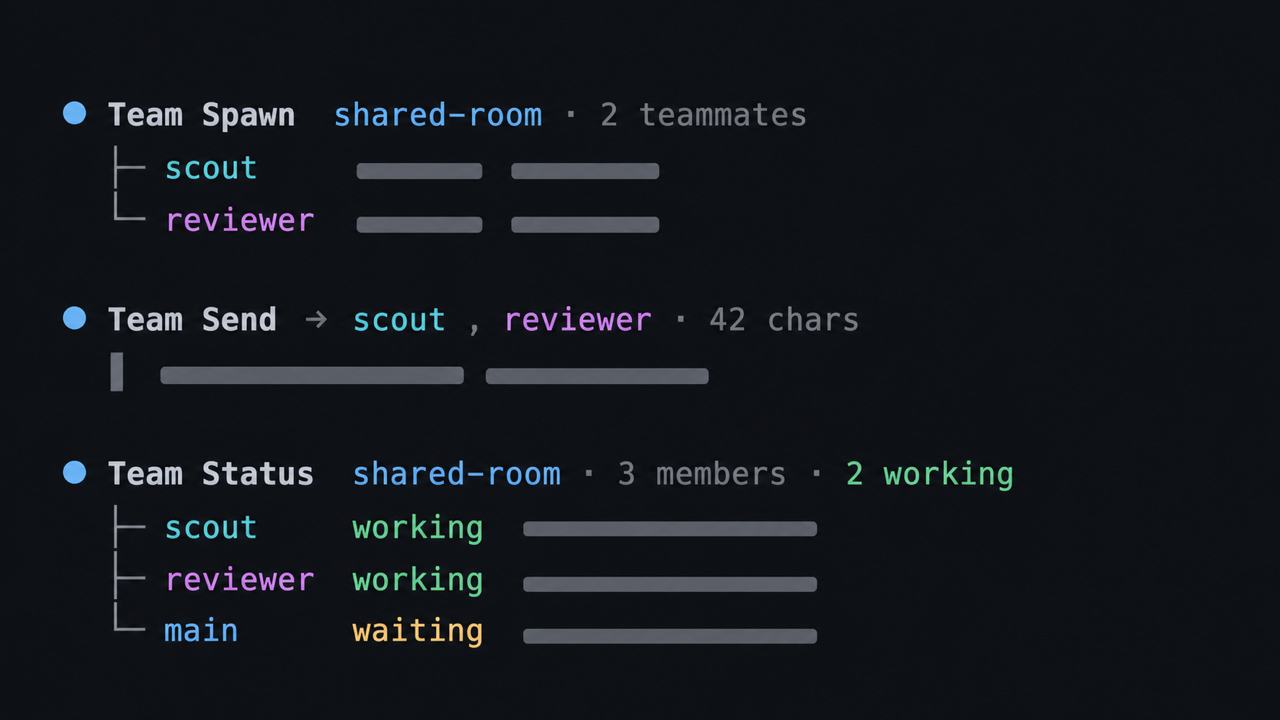
Watch a live team with /team.
/team is for you, not another agent tool. It gives you a live view of the room without turning the main agent into a status relay.
The command opens an overlay rolling recent statuses, messages, and a separate event log.
Up/Down select the messages or log widget. Enter zooms it to the full overlay. Esc goes back.
The mechanics
🏋️ Woken up when needed. Works freely otherwise.
Tokens, intelligence and time are never wasted on busy-polling for messages.
Instead, pi-simple-team pushes messages to the recipients.
This is both efficient and effective:
- ✔ No inbox to forget.
- ✔ Context window stays lean.
- ✔ Unlocks arbitrary workflows.
⚡ Messages arrive fast.
- Sub-second, when the recipient is idle.
- The moment the current bout of work ends, when busy.
🟢 Statuses everyone can see.
For free, at any time. Like setting a Slack status.
Teammates publish a one-liner:
implementer Done, 89 tests green, awaiting review.
reviewer Reading implementation, will finalize review in a few minutes.
Your main agent calls team_status and understands exactly what is going on. Main does not ask teammates for updates or clutter their context.
🌡️ Context window self-awareness
The team manages its own context:
Teammates know how much free context they have left.
Main agent knows its own and everyone else's too.
They will hand off work autonomously when it's time to say goodbye.
You can stop babysitting context windows.
📣 Interrupts, when justified.
Situation: Late afternoon. Team finished production hotfix and started wrap up. There is one problem though.
- 17:32:00:
security-guardspots a private SSH key not covered by.gitignore. - 17:32:01:
release-ownersets status: Rangit add ., preparing commit and push. - 17:32:02:
security-guardimmediately interruptsrelease-owner. Key never leaves the machine. Developer keeps their job another day 👍
📡 Live, zero-cost observability
Your main uses team_log when it needs to understand the chain of events in high granularity.
Provides main a timestamped, filterable, append-only record of the team’s messages, tool calls, and lifecycle events.
🌅 Herdr Support
pi-simple-team can open a teammate direct Pi session in a dedicated Herdr pane. Just ask your main agent to do that.
Live view of the room.
Talk directly with teammates.
I recommend starting with “Captain here”. Feels good and the surprise on their faces is priceless.
🧱 Teammates are durable Pi sessions.
A teammate is just a Pi session with a team attachment.
This means teammates (and thus, teams) survive shutdown.
Have a teammate do work, exit Pi entirely, come back tomorrow in a brand-new session, and ask main to get you that teammate by its Pi session id. Everything it learned stays intact.
You can even /resume a teammate session directly if you ever want a cozy one-on-one.
It’s teams all the way down (optionally)
Tell main you want to have a teammate manage its own team(s).
This is a powerful technique to create a separate layer of context.
That teammate will spawn, steer and observe its own team(s) without costing tokens to its siblings or parent.
The tradeoff, like any higher-order delegation, is reduced control: you are moved one level further away from the trenches.
This is opt-in: teammates by default can't create teams.
This technique plays even nicer if your main assumes the captain rank^1.
🧬 Graphs engineer themselves
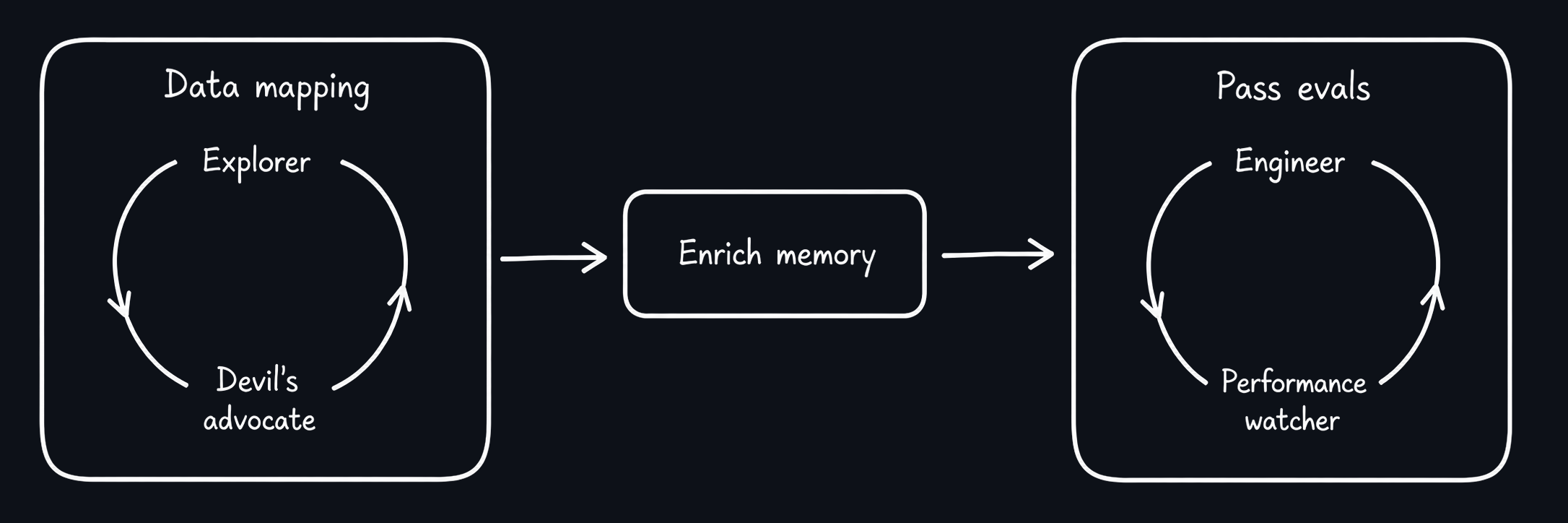
Because it does nothing special, pi-simple-team can construct any agentic graph you need:
You tell main:
Team goal:
- Map the database for all customer ⟷ purchases money streams.
- Feed the new knowledge into the memory layer.
- Make the data analysis agent pass the new purchases evals.
Note:
- #1 is a saturation loop. Stop only when you can't find anything new.
- #3 is a hill-climbing loop. Stop only the evals are green.
- Teammates #1 and #3 create their own teams to loop until task is complete.
That prompt creates this graph:
Tools
Kept minimal:
| Role | For | Tools |
|---|---|---|
| Main agent | Team lifecycle | team_spawn, team_list, team_resume, team_add_teammates, team_shutdown |
| With team | team_send_message |
|
| On team | team_status, team_log |
|
| On everyone | get_context_window_usage |
|
| On self | schedule_reminder |
|
| Managing teammate | On self and own teams | Same tools as the main agent |
| With parent team | team_send_message, team_status, send_main_message |
|
| Teammates | With team | team_send_message |
| With main | send_main_message |
|
| On self | get_context_window_usage |
|
| Everyone | For everyone | team_status |
team_spawn, team_resume, and team_add_teammates start work automatically once every affected teammate is ready. Set startIdle: true to leave those teammates idle instead.
On resume, resumptionPrompt adds instructions to the conversation without changing saved system prompts. With startIdle: true, those instructions wait in context for the next turn.
Existing teammates can be selected by name or Pi session ID in the same input field. Messages, logs, and context usage share a targets list. Select a team for all its teammates, or select individual teammates across your teams. Ambiguous names return IDs you can use instead.
Spawn, resume, and add return the complete roster. Results distinguish a live runtime from active work, including work that was already underway before the call.
Set showOnHerdrPane: true on individual teammates to open their panes. An explicit showOnHerdrPanes value on spawn overrides all individual settings.
Message tools return published: true when the extension accepts a message for delivery. If delivery later fails, the sender receives the error automatically.
Roadmap
User involvement track:
- Herdr panes for teammates.
-
/team: live, read-only team dashboard. - Teammate drill-down and transcripts.
- Joining and steering teams from slash commands.
- Adding teammates to existing teams directly from slash commands.
- Spawning teams directly from slash commands.
Functional:
- Resume all or selected teammates from a dormant team.
- Add teammates after a team has spawned.
- Let opted-in teammates create and manage teams of their own.
- Remove teammates from a team.
- Main triggers
/compacton select teammate. - Teammates auto-reminded to hand off on low context.