@gonrocca/skillautoforge-pi
skillautoforge-pi — an installable pi (pi.dev) package that adds the skill auto-learning loop pi is missing. pi already stores, surfaces (progressive disclosure), and loads skills; this package adds the behavioral loop: a skill_save tool plus prompt guide
Package details
Install @gonrocca/skillautoforge-pi from npm and Pi will load the resources declared by the package manifest.
$ pi install npm:@gonrocca/skillautoforge-pi- Package
@gonrocca/skillautoforge-pi- Version
0.1.2- Published
- May 20, 2026
- Downloads
- not available
- Author
- gonrocca
- License
- MIT
- Types
- extension
- Size
- 49.9 KB
- Dependencies
- 0 dependencies · 0 peers
Pi manifest JSON
{
  "extensions": [
    "./extensions/skillautoforge.ts"
  ],
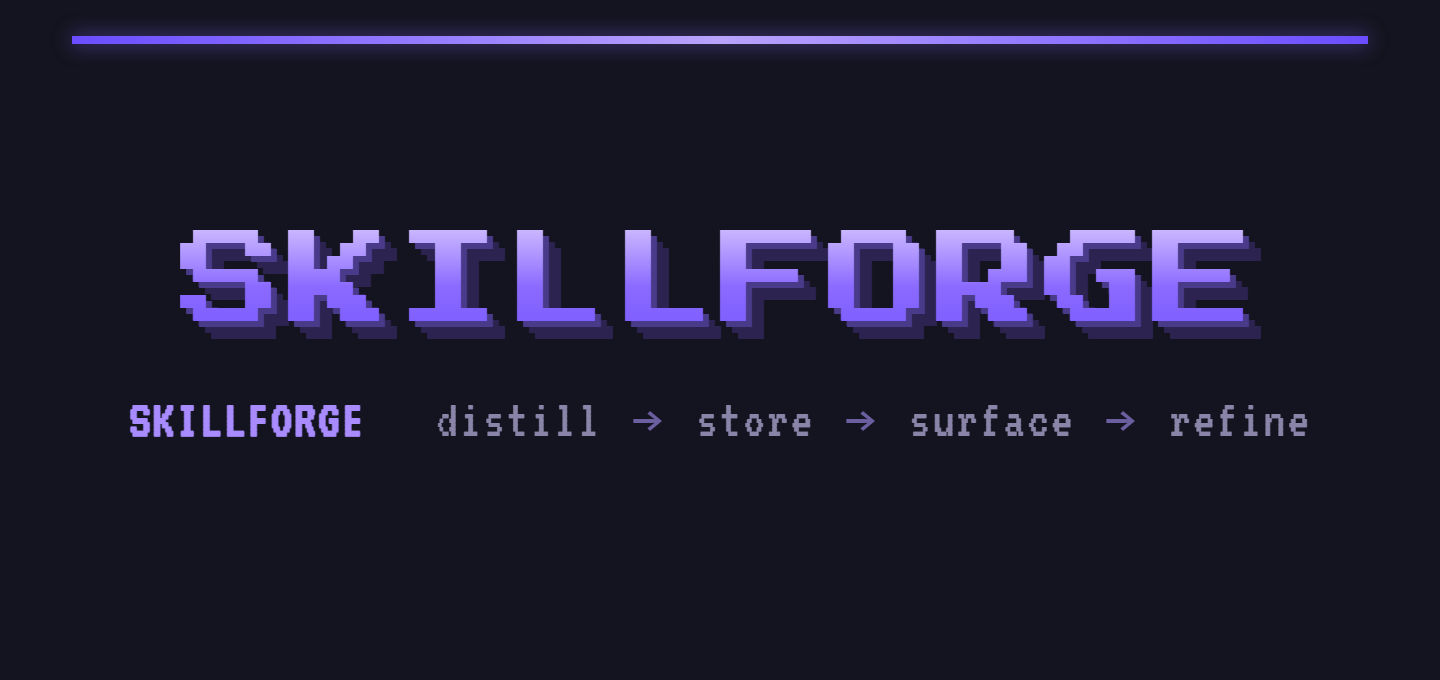
  "image": "https://raw.githubusercontent.com/gonzalonicolasr/skillautoforge-pi/main/assets/preview.png"
}
Security note
Pi packages can execute code and influence agent behavior. Review the source before installing third-party packages.
README
@gonrocca/skillautoforge-pi
The skill auto-learning loop pi is missing. pi already stores, surfaces, and loads skills — this adds the behavioral loop: distill a reusable skill after a hard task, refine one that proved wrong.


💬 Join the community
Questions, ideas, or want to debate skills & agent design? Come hang out:

skillautoforge-pi is a pi (pi.dev) package. It does not reimplement pi's skill system — pi already does the hard parts:
- Storage: scans
~/.pi/agent/skills/,~/.agents/skills/, and project skill dirs. - Surfacing (progressive disclosure): only skill descriptions sit in the system prompt; the full
SKILL.mdloads on demand. - Invocation:
/skill:nameloads and runs a skill.
What pi lacks is the behavioral loop — the nudge to create a skill after a hard task and to refine one when it was wrong. This package adds exactly that, and nothing else. Inspired by Hermes Agent's "after difficult/iterative tasks, offer to save as a skill" pattern.
📦 Install
pi install npm:@gonrocca/skillautoforge-pi
Needs Node ≥ 20.6.0. Restart pi after install.
🛠 What it adds
skill_save tool (LLM-callable)
A deterministic writer. The model supplies a kebab-case name, a specific
description (what it does + when to use it), and a Markdown body (pattern,
ordered steps, exact commands, gotchas). The extension validates the name,
builds valid frontmatter, and writes ~/.pi/agent/skills/<name>/SKILL.md —
the library pi already scans. The model never hand-serializes frontmatter or
guesses the path.
- Invalid names are normalized (slugified) rather than rejected outright.
- Missing description/body are rejected (pi won't load a description-less skill).
- Saving over an existing name without
overwrite:trueis refused with guidance to read-then-merge — so refinement never blind-clobbers a skill.
Prompt guidelines (the loop)
While skill_save is active, pi surfaces these guidelines:
- After a difficult, multi-step, or iterative task with a reusable pattern, call
skill_save. Routine one-off work is skipped. - If a skill you loaded was missing steps or had a wrong command, read it and call
skill_savewithoverwrite:trueand the merged content — refine, don't duplicate.
These ride pi's promptGuidelines mechanism, so they appear only when the tool
is active — no manual system-prompt surgery, no always-on token tax beyond the
guideline bullets.
/skill-save command (manual)
Force distillation of the current session:
/skill-save                       # distill whatever is reusable here
/skill-save focus on the deploy   # optional hint
🔄 How the loop closes
- Distill — after a hard task, the model calls
skill_save. - Store — the extension writes
SKILL.mdinto pi's user skill library. - Surface — pi indexes the new skill's description into the system prompt (next session, or now after
/reload). - Refine — when the model re-applies a skill and finds it lacking, it reads and re-saves the merged version with
overwrite:true.
🔗 Composition with zero-pi / devteam-pi
No code coupling. Because skill_save writes into pi's shared skill library,
any agent pi runs — a plain session, a /forge run, a /devteam role — that
has skills enabled will see distilled skills surface automatically. To let the
loop run inside zero's SDD phases, enable skills on the relevant phase agents
(they ship with inheritSkills: false).
🧪 Development
npm test # node --test --experimental-strip-types
The deterministic core (extensions/skill-write.ts) is pure and unit-tested.
Dependency-free, no build step — pi loads the TypeScript directly via jiti.
License
MIT © Gonzalo Rocca