@gotgenes/pi-subagents
A focused, in-process sub-agent core for pi — autonomous agents plus a typed API and lifecycle events other extensions build on. Friendly fork of @tintinweb/pi-subagents.
Package details
Install @gotgenes/pi-subagents from npm and Pi will load the resources declared by the package manifest.
$ pi install npm:@gotgenes/pi-subagents- Package
@gotgenes/pi-subagents- Version
23.4.0- Published
- Oct 9, 2026
- Downloads
- 14.5K/mo · 4,845/wk
- Author
- gotgenes
- License
- MIT
- Types
- extension
- Size
- 1.3 MB
- Dependencies
- 0 dependencies · 4 peers
Pi manifest JSON
{
  "image": "https://raw.githubusercontent.com/gotgenes/pi-packages/main/packages/pi-subagents/docs/assets/demo.webp",
  "extensions": [
    "./src/index.ts"
  ]
}Security note
Pi packages can execute code and influence agent behavior. Review the source before installing third-party packages.
README
@gotgenes/pi-subagents






A pi extension that gives pi a focused, in-process sub-agent core — autonomous agents that run inside the same pi runtime (no spawned subprocesses), plus a typed API and lifecycle events other extensions build on. Spawn specialized agents that run in isolated sessions — each with its own tools, system prompt, model, and thinking level. Run them in foreground or background, steer them mid-run, resume completed sessions, and define your own custom agent types.
Originally forked from
tintinweb/pi-subagentsby @tintinweb, now an independently maintained hard fork. See Comparison with upstream for a feature-by-feature comparison and guidance on which to choose.
Features
- In-process & native — agents run inside the same pi runtime (no spawned subprocesses), sharing tool names, calling conventions, and UI patterns (
subagent,get_subagent_result,steer_subagent) — feels native - Parallel background agents — spawn multiple agents that run concurrently with automatic queuing (configurable concurrency limit, default 4) and individual completion notifications
- Live widget UI — persistent above-editor widget with animated spinners, live tool activity, token counts, and colored status icons
- Session transcripts — open any subagent's full session transcript (running or with its session released) in pi's native read-only viewer via
/subagents:sessions - Custom agent types — define agents in
.pi/agents/<name>.mdwith YAML frontmatter: custom system prompts, model selection, thinking levels, tool restrictions - Mid-run steering — inject messages into running agents to redirect their work without restarting
- Session resume — pick up where an agent left off, preserving full conversation context.
An agent given an isolated workspace by a
WorkspaceProvideris resumable while that workspace is live — which, for an agent that ended its turn with a question, lasts until you answer it - Ask-back — an agent that needs information only you have calls
ask_parentand ends its turn, and every result surfaces the question with the exactresumecall that answers it; once that agent can no longer be resumed, the result says so and why instead of naming a call that would be refused - Mid-run updates — an agent that finds something material calls
notify_parentand keeps working; the message arrives on its own while you are idle and that agent is still running, and otherwise rides that agent's own result, so you hear it exactly once and never as a stale prompt to steer an agent that has finished - Turn budgets —
max_turnsis a hard ceiling, and an agent is told how many turns it has left while it still has room to wrap up, so it answers instead of being cut off - Case-insensitive agent types —
"explore","Explore","EXPLORE"all work. Unknown types fall back to general-purpose with a note - Fuzzy model selection — specify models by name (
"haiku","sonnet") instead of full IDs, with automatic filtering to only available/configured models - Context inheritance — optionally fork the parent conversation into a sub-agent so it knows what's been discussed
- Styled completion notifications — background agent results render as themed, compact notification boxes (icon, stats, result preview) instead of raw XML. Expandable to show full output
- Event bus — lifecycle events (
subagents:created,started,completed,failed,resuming,resumed,steered,compacted) emitted viapi.events, enabling other extensions to react to sub-agent activity
Install
pi install npm:@gotgenes/pi-subagentsOr load directly for development:
pi -e ./src/index.tsQuick Start
The parent agent spawns sub-agents using the subagent tool:
subagent({
  subagent_type: "Explore",
  prompt: "Find all files that handle authentication",
  description: "Find auth files",
  run_in_background: true,
})
Foreground agents block until complete and return results inline. Background agents return an ID immediately and notify you on completion.
UI
The extension renders a persistent widget above the editor showing active background agents (foreground runs are rendered inline by the subagent tool's progress stream):
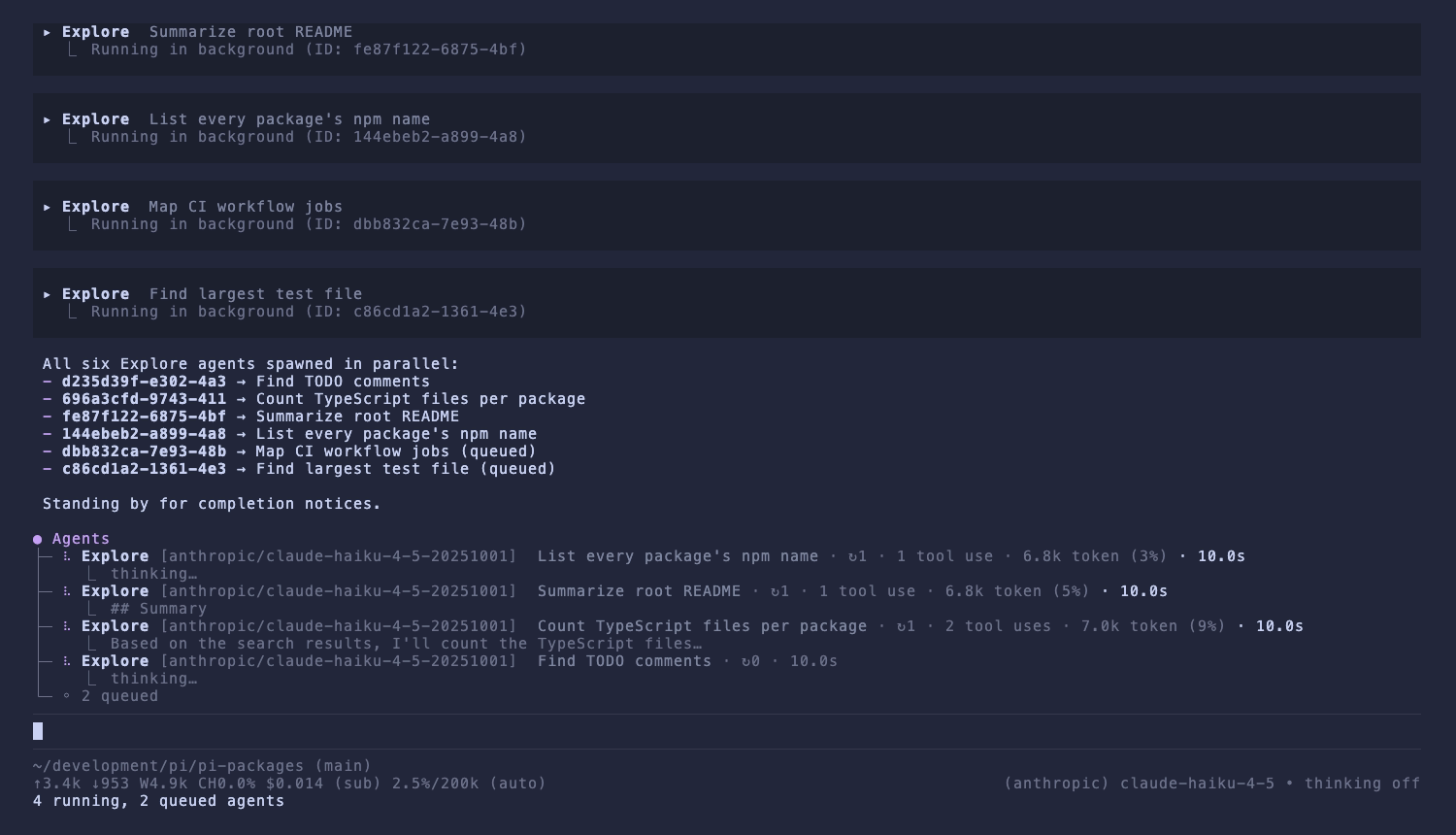
● Agents
├─ ⠹ Agent [anthropic/claude-sonnet-5]  Refactor auth module · ↻5≤30 · 5 tool uses · 33.8k token (62%) · 12.3s
│    ⎿  editing 2 files…
├─ ⠹ Explore [anthropic/claude-haiku-5]  Find auth files · ↻3 · 3 tool uses · 12.4k token (8%) · 4.1s
│    ⎿  searching…
├─ ⠹ Agent [openai/gpt-6]  Long-running task · ↻42 · 38 tool uses · 91.0k token (84% · ⇊2) · 2m17s
│    ⎿  reading…
└─ 2 queued
Each agent line names the provider and model the agent is running, read from its live session, so a model switched mid-run shows as the one actually in use. The tag is omitted until the model is known.
The token field is annotated with two optional signals inside parens:
NN%— context-window utilization (color-coded: <70% dim, 70–85% warning, ≥85% error). Omitted when the model has no declaredcontextWindow, or briefly right after compaction.⇊N— number of times the session has compacted, when > 0. Stays dim; the percent's color carries urgency.
Individual agent results render inline in the conversation:
| State | Example |
|---|---|
| Running | ⠹ ↻3≤30 · 3 tool uses · 12.4k token (8%) / ⎿ searching, reading 3 files… |
| Completed | ✓ ↻8 · 5 tool uses · 33.8k token (62%) · 12.3s / ⎿ Done |
| Wrapped up | ✓ ↻49≤50 · 49 tool uses · 89.1k token (84% · ⇊2) · 45.2s / ⎿ Wrapped up (budget warning) |
| Stopped | ■ ↻3 · 3 tool uses · 12.4k token (8%) / ⎿ Stopped |
| Error | ✗ ↻3 · 3 tool uses · 12.4k token (8%) / ⎿ Error: timeout |
| Aborted | ✗ ↻50≤50 · 50 tool uses · 102.3k token (95% · ⇊3) / ⎿ Aborted (turn limit reached) |
Completed results can be expanded (ctrl+o in pi) to show the full agent output inline.
Background agent completion notifications render as styled boxes:
✓ Find auth files completed
  ↻3 · 3 tool uses · 12.4k token · 4.1s
  ⎿  Found 5 files related to authentication...
  transcript: .pi/output/agent-abc123.jsonl
The LLM receives structured <task-notification> XML for parsing, while the user sees the themed visual.
Tools
subagent
Launch a sub-agent.
| Parameter | Type | Required | Description |
|---|---|---|---|
prompt |
string | yes | The task for the agent |
description |
string | yes | Short 3-5 word summary (shown in UI) |
subagent_type |
string | yes | Agent type (built-in or custom) |
model |
string | no | Model — provider/modelId or fuzzy name ("haiku", "sonnet") |
thinking |
string | no | Thinking level: off, minimal, low, medium, high, xhigh, max |
max_turns |
number | no | Turn ceiling (minimum 2). Omit for the agent's own limit |
run_in_background |
boolean | no | Run without blocking |
resume |
string | no | Agent ID to resume a previous session |
inherit_context |
boolean | no | Fork parent conversation into agent |
These five parameters win over the agent file's own values, which fill whichever the call leaves unset.
An agent file can withhold one with locked; the result then names the agent and the parameters it ignored.
A call with resume and run_in_background: true resumes the agent without waiting: it returns the agent ID at once, and you are notified when the resumed run finishes.
Only the call's own flag does this; an agent file's run_in_background default does not apply to a resume.
get_subagent_result
Check status and retrieve results from a background agent.
| Parameter | Type | Required | Description |
|---|---|---|---|
agent_id |
string | yes | Agent ID to check |
wait |
boolean | no | Wait for completion |
verbose |
boolean | no | Include full conversation log |
timeout |
number | no | Seconds to bound a wait |
Without timeout, a wait lasts until the agent finishes.
With one, the wait ends at the bound and returns the current report; the agent is not stopped, and its outcome is still delivered when it finishes.
A report on a running agent names what it is doing, the turns it has used, and how long since it last made progress, so a parent can tell a stalled agent from a long one.
The result renders as a compact three-line summary — status, stats, description, and a one-line preview.
Press Ctrl+O to expand it to the full report, bounded so a long result cannot fill the terminal; the expanded view names the transcript path when it withholds anything.
The complete report, including the conversation verbose requests, always reaches the model regardless of what the terminal shows.
steer_subagent
Send a steering message to a running agent. The message interrupts after the current tool execution.
| Parameter | Type | Required | Description |
|---|---|---|---|
agent_id |
string | yes | Agent ID to steer |
message |
string | yes | Message to inject into agent conversation |
Commands
| Command | Description |
|---|---|
/subagents:settings |
Configure subagent settings (concurrency, turn limits, retention, interrupt policy) |
/subagents:sessions |
View a subagent's session transcript (read-only) |
/subagents:settings
Interactive list to tune runtime settings — max concurrency, default max turns, wrap-up turns, the two session-retention windows, and whether ESC aborts every subagent. The numeric settings open an input prompt; the abort-on-ESC entry is a direct flip. Changes persist across pi restarts (see Persistent Settings).
/subagents:sessions
Pick any subagent — running, or completed with its live session already released — and read its full session transcript in pi's native per-entry viewer.
Read-only: no steering, no session takeover (steering lives in the steer_subagent tool and the background widget).
Runs that finished earlier in the session stay listed after a /reload, and a resumed session lists the runs it recorded; both open from their saved transcript.
The viewer is framed by two rules in the style of pi's editor border, coloured for the agent's thinking level:
── Agent (twin)  Refactor auth module · anthropic/claude-sonnet-5 • high ───────
… transcript …
── 142 lines · 87% ──────── ↑↓ scroll · PageUp/PageDown · Home/End · Esc close ──
The top rule names the agent, its task, model, and thinking level; the bottom carries the scroll position and key hints.
Paging and jumping to the top or bottom follow Pi's viewport keybindings (tui.altScreen.pageUp, pageDown, top, bottom), so a remap applies here too, and the footer names the keys you bound; the mouse wheel scrolls the transcript as well.
In fullscreen mode the viewer floats over the bottom of the screen, above Pi's footer, so those keys reach it instead of scrolling the conversation behind it.
On a narrow terminal the footer drops the key hints, and the header drops the task and then the model before it shortens the agent's name.
Creating and editing agent definitions is not a command — write an agent .md file in your editor, or ask a pi session to generate one (see Custom Agents).
Turn Budget
max_turns is the ceiling on a run: no turn after turn max_turns runs.
An agent is told its remaining budget while it still has room to finish:
- Once
wrapUpTurnsturns remain (a/subagents:settingsvalue, default 2), the agent gets a context message stating how many turns it has left and that the harness stops it after that. It reads that message on its next turn, and the message never forces an extra turn. When every turn is a wrap-up turn, the budget is stated before the first one. - If the agent is still calling tools on turn
max_turns, the harness stops it and the run endsaborted. An agent that gives its final answer on that turn finishes normally.
Only successful turns count: a response that errored and was retried does not spend budget.
The minimum max_turns is 2, one turn to work and one to answer; a smaller value runs with 2, and the spawn result says so.
A resumed agent gets a fresh budget with its original ceiling.
| Status | Meaning | Icon |
|---|---|---|
completed |
Finished naturally | ✓ green |
completed |
Finished after the turn-budget warning | ✓ yellow |
aborted |
Still working at the ceiling; stopped | ✗ red |
stopped |
User-initiated abort | ■ dim |
The budget itself is the turnBudget field ({ used, maxTurns, phase }) on the subagent record, tool-result details, notifications, and the terminal events.
It is live while the agent runs: used counts the run's successful turns, maxTurns is absent for an unlimited run, and phase is within, then warned once the warning was sent, then exhausted when the harness stopped the run (always paired with aborted).
The widget shows a warned agent's turn count in the warning color.
Concurrency
Background agents are subject to a configurable concurrency limit (default: 4).
Excess agents are automatically queued and start as running agents complete.
The widget shows queued agents as a collapsed count.
It also bounds its own height to the terminal's, collapsing the agents that do not fit into a +N more summary, so a short pane keeps its conversation visible.
Foreground agents bypass the queue — they block the parent anyway.
Stopping a still-queued agent produces the same completion notification a running agent's stop does. Because that agent never started, the notification says so and offers no result to collect.
Child session lifecycle
A child session runs in the parent's process but is a full Pi session with its own extension set. It receives the standard pair of session lifecycle events:
| Event | When | Reason |
|---|---|---|
session_start |
Extensions are bound, before the child's first turn | "startup" |
session_shutdown |
The child session is disposed | "quit" |
Disposal happens when the retention window for a finished agent expires, when completed records are cleared at session start or switch, when the parent session shuts down, or when child extension binding fails partway.
It does not happen the moment an agent finishes: the session is retained so the agent can be resumed, per the consumedSessionRetentionMinutes and unconsumedSessionRetentionMinutes settings above.
The shutdown event is dispatched and awaited before the child's AgentSession is disposed, so a handler still has a live context and can close what it opened — stdio subprocesses, sockets, timers, file handles.
Each child's shutdown is bounded: a handler that never resolves is abandoned after a few seconds and disposal proceeds, so one misbehaving extension cannot stall the parent's teardown or Pi's exit.
If you author an extension that runs in children, note that its session_shutdown handler now fires once per child session in addition to once for the parent.
A handler that flushes a log, writes a summary, or closes a shared resource should be safe to run repeatedly within one process.
Before this behavior existed, children fired session_start with no matching shutdown, so extension-owned resources accumulated for the life of the parent process.
Events
Agent lifecycle events are emitted via pi.events.emit() so other extensions can react:
| Event | When | Key fields |
|---|---|---|
subagents:created |
Background agent registered | id, type, description, isBackground |
subagents:started |
Agent transitions to running (including queued→running) | id, type, description |
subagents:completed |
Agent finished successfully | id, type, status, turnBudget, durationMs, tokens (lifetime { input, output, total }), toolUses, result |
subagents:failed |
Agent errored, stopped, or aborted | same as completed + error, status |
subagents:resuming |
Resume started, from either front door | id, type, description |
subagents:resumed |
Resumed run reached a terminal state (completed/error) | same as completed + error, status (buildEventData shape) — status/error discriminate |
subagents:steered |
Steering message sent | id, message |
subagents:compacted |
Agent's session successfully compacted | id, type, description, reason ("manual" / "threshold" / "overflow"), tokensBefore, compactionCount |
subagents:settings_loaded |
Persisted settings applied at extension init | settings (merged global + project) |
subagents:settings_changed |
/subagents:settings mutation was applied |
settings, persisted (boolean — false on write failure) |
tokens.total = input + output + cacheWrite.
cacheRead is excluded — each turn's cacheRead is the cumulative cached prefix re-read on that one API call, so summing per-message would over-count it.
Use contextUsage.percent (surfaced as (NN%) in the widget) for current context size.
Worktree Isolation
Worktree isolation lives in a companion package, not this core.
Install @gotgenes/pi-subagents-worktrees and list the agent types you want isolated in its worktreeAgents config — opted-in agents run in a temporary git worktree, and their changes are saved to a branch on completion.
The earlier isolation: "worktree" spawn flag and isolation: frontmatter key were removed from the core.
Removed: agent memory and skill preloading
Persistent agent memory (the memory: frontmatter key) and skill preloading (the skills: frontmatter key) were removed when the core was slimmed down.
Children inherit the parent's skills and extensions by default, so the isolated, extensions, and skills frontmatter keys no longer exist.
Package-level extension opt-outs live in the excludedExtensionPackages setting rather than agent frontmatter.
Migrating from disallowed_tools
The disallowed_tools frontmatter field has been removed.
Use @gotgenes/pi-permission-system's permission: frontmatter instead — it provides richer semantics (allow/ask/deny vs. binary hide):
# Before (no longer supported)
disallowed_tools: bash

# After
permission:
  bash: deny
Permission System Integration
When @gotgenes/pi-permission-system is installed, this extension integrates automatically:
- Per-agent permission policies — define
permission:in agent YAML frontmatter to set allow/ask/deny rules per agent type. The permission system resolves the agent name from the<active_agent>tag in the child system prompt. - Tool filtering — the permission system's
before_agent_starthandler removes denied tools from the child session before the agent starts. ask-state forwarding — when a child session triggers anaskpermission, the prompt forwards to the parent session's UI. The parent approves or denies, and the child resumes.- Deterministic child detection — this extension publishes
subagents:child:session-createdbeforebindExtensions()fires; the permission system subscribes and registers the child session synchronously, so detection does not rely on env vars or filesystem heuristics. - Unguarded children are announced — this extension also publishes
subagents:child:boundonce a child's extensions have bound; the permission system uses it to notice a child that loaded no permission node of its own — the caseexcludedExtensionPackagescan create — and warns rather than letting it run ungated in silence.
No configuration is required.
When @gotgenes/pi-permission-system is not installed, the lifecycle events have no subscriber — a harmless no-op.
For Extension Authors
This package exposes two public subpath exports for companion extensions to import from the published tarball.
@gotgenes/pi-subagents — cross-extension service contract
Access the subagent service from another extension at runtime:
const { getSubagentsService } = await import("@gotgenes/pi-subagents");
const svc = getSubagentsService();
svc?.spawn("Explore", "Check for stale TODOs");
Declare this package as an optional peer dependency.
See src/service/service.ts for the full SubagentsService interface and the WorkspaceProvider seam.
spawn contract
spawn returns the new agent's id immediately — it never waits for the run.
Use getRecord(id) to poll, steer to send a message, and the subagents:completed event to learn when it finished.
The agent type is canonicalized, so "explore" and "Explore" reach the same agent.
An unrecognized type falls back to general-purpose rather than throwing, matching the subagent tool's behavior.
It throws in four cases:
- there is no active session, so there is no parent to spawn from;
- a
modelstring does not resolve against the session's model registry; - a
thinkingLevelis not one ofoff,minimal,low,medium,high,xhigh,max; - the named agent type exists but is disabled (
enabled: false).
Agent frontmatter never overrides an option you pass.
It fills model, thinkingLevel, and maxTurns when you omit them; inheritContext is the exception, and defaults to false whatever the agent file declares.
An agent file's locked frontmatter does not apply here — it guards against a model guessing harness settings, and an SDK caller is not that.
Background mode follows the caller's degree of commitment.
Omit foreground and the agent's own run_in_background frontmatter decides, defaulting to background when the agent declares nothing.
Pass foreground explicitly and it wins outright, whatever the frontmatter says.
A spawned agent is a first-class citizen of the runtime: it appears in the background widget, carries its parent's session identity so permission prompts route correctly, and nests its session file under the parent's.
getRecord / listAgents contract
Both return SubagentRecord, a by-value snapshot: nothing in it changes after you receive it, and writing to it cannot reach the agent.
Poll again for fresh data.
The snapshot carries identity (id, type, description), lifecycle status (status, startedAt, completedAt, result, error, pendingQuestion), the resolved spawn fact isBackground, the current run's turnBudget, cumulative metrics (toolUses, compactionCount, lifetimeUsage), and outputFile — the path to the agent's session JSONL, which you can read with Pi's own parseSessionEntries.
It also carries resumeRefusal: absent when resume would start a run, otherwise the reason it would refuse with (the resume contract lists them).
Render a Resume affordance from it without calling resume first.
still-running clears when the run settles, and a queued agent's no-session clears once it starts; the other reasons are final.
It deliberately withholds momentary activity (the tools running right now, the partial response text) and this package's internal bookkeeping. A pulled snapshot of momentary state would be stale on arrival; decision 0005 records the full policy and what would reopen it.
SubagentRecord and SubagentsService are types this package produces and you read — not contracts to implement.
A new field is therefore a minor release; use a cast or a Partial<> for a test double rather than implementing either type.
resume contract
resume(id, prompt, options?) continues a settled agent's session, and is the one service call that waits: it resolves when the resumed run reaches a terminal state, carrying the terminal snapshot.
A caller that does not need the outcome can ignore the promise.
It never throws and never rejects.
A resume that could not start resolves to { kind: "refused", reason } instead, promptly — the checks are synchronous and no turn loop runs:
reason |
Meaning |
|---|---|
unknown-agent |
No record answers to that id (records are cleared per session) |
still-running |
The agent has not settled; wait, or steer it while it runs |
no-session |
The agent never had a session to continue |
session-released |
Its session was released after the retention window |
workspace-disposed |
Its isolated workspace is gone, so a resume cannot re-enter it |
Every record's resumeRefusal field predicts this answer before the call, minus unknown-agent, which no record can carry.
A resumed run that fails is still { kind: "resumed" }; the snapshot carries status: "error" and the message.
Refused means nothing started.
By default the resumed outcome is announced to the parent like any other background completion.
Pass claimOutcome: true to declare that your extension is delivering it, which suppresses that announcement — do this only if you will actually carry the result to the parent, or it reaches nobody.
Pass signal to cancel the resumed turn loop.
It is wired through the record's own lever, so it ends the resume exactly as abort(id) does — either cancel reaches the same run, and the record reads stopped.
@gotgenes/pi-subagents/settings — layered config loader
Extensions that store configuration in JSON files can use the shared layered loader, which reads a global file (<agentDir>/<filename>) and a project file (<cwd>/.pi/<filename>) and merges them — project wins on conflicts, missing files are silent, malformed files warn and fall back:
import { loadLayeredSettings, type LayeredSettingsSource } from "@gotgenes/pi-subagents/settings";

interface MyConfig { enabled?: boolean; limit?: number }

function sanitize(raw: unknown): Partial<MyConfig> {
  if (!raw || typeof raw !== "object") return {};
  const r = raw as Record<string, unknown>;
  const out: Partial<MyConfig> = {};
  if (typeof r.enabled === "boolean") out.enabled = r.enabled;
  if (typeof r.limit === "number") out.limit = r.limit;
  return out;
}

const config = loadLayeredSettings<MyConfig>({
  agentDir,          // Pi runtime agent home directory
  cwd,               // project root — project file lives at <cwd>/.pi/<filename>
  filename: "my-extension.json",
  sanitize,
  warnLabel: "my-extension",  // prefix for the malformed-file stderr warning
});
loadLayeredSettings returns Partial<T> (all fields optional); apply your defaults after the call.
It never throws — all error conditions produce a console.warn and return {}.
Extensions that append to the system prompt
If your extension appends to the system prompt from a before_agent_start handler, your parent-session block does not ride into child sessions.
A child inherits only the stable part of the parent's prompt — everything Pi assembled ahead of the skills catalogue, and ahead of <project_context> too for a child running in its own workspace — so anything appended after that is dropped.
See What a child inherits from the parent's prompt for the full layer breakdown.
This is usually invisible to you, because your handler runs in the child too: a child binds the parent's extension set, and its turn loop fires before_agent_start the same way the parent's does.
An unconditional appender therefore writes a fresh block built for the child's own session — which is what you want, since the parent's copy named the parent's directory, model, and session.
Two cases need care:
- A handler gated on something a child lacks — an interactive UI, a terminal, or state your extension cached at
session_start— appends nothing in the child. That child now carries no block at all, where previously it inherited one built for the parent. If your guidance applies to children, make the handler unconditional or derive its inputs from the event context rather than from cached session state. - An extension excluded from children through
excludedExtensionPackagescontributes nothing to a child by design, and no longer leaks its parent-session block in either.
Extensions that shape the prompt at the provider boundary rather than appending to it are unaffected — the region they rewrite is the identity a child inherits verbatim.
An extension that states something per session — which tools this session may call, which skills it loaded — should append it rather than edit the inherited identity, even when Pi wrote its own copy up there.
Editing that region rewrites bytes the child inherited from its parent, which ends the prefix the two share (#890).
Pi's own <tools> and <rules> sections are the exception: they describe one session's tools, so a child drops its parent's copies, and a per-session tool statement belongs after <cwd> (ADR 0011).
Scope and non-goals
Purpose. A minimal, in-process sub-agent core. It spawns a child session derived from the parent, runs the turn loop, streams and collects the result, gates concurrency, supports resume, and publishes its lifecycle. Everything else is a consumer.
In scope. Defects in the surfaces the core already owns, completeness of the public lifecycle-event contract, and internal work toward the minimal-core target. Anything attaching to the core either subscribes to a lifecycle event, or registers a provider if it must return a value the core consumes — see ADR-0002.
Non-goals.
- Capability the fork deliberately left behind. Scheduling, cross-extension RPC, model-scope enforcement, and a built-in tool denylist belong to upstream — see Relationship to upstream.
- Policy about what a child may do.
Tool restriction is allow/ask/deny in a permission layer, not a binary hide in a spawner — see Migrating from
disallowed_tools. - Widening a child's tool allowlist with capability tools on the agent's behalf.
An agent's
tools:frontmatter is the only thing that admits a capability tool, and no settings key may name one, because a settings-level list would hand a read-onlyExploreagent write-capable tools from a file its author never saw. The core does install its own protocol in every child — the<active_agent>tag, the parent-context prefix, and theask_parent/notify_parenttools — none of which reaches the filesystem, the shell, or the network. - A global run-mode default. Foreground or background is a per-invocation argument and a per-agent frontmatter key; a global flip changes every existing agent file at once.
- Provider seams with no consumer. A seam nobody supplies is a speculative abstraction that taxes every reader; the architecture may admit one without shipping it until a real consumer exists.
The architecture doc carries the full inventory, including the removed UI surfaces and the reasoning behind each.
Where adjacent requests belong.
Tool restriction and per-agent permission policy → @gotgenes/pi-permission-system.
Worktree isolation → @gotgenes/pi-subagents-worktrees.
Timed dispatch, telemetry, and alternate UIs → a consumer over the lifecycle events and the typed service.
A batteries-included alternative → upstream tintinweb/pi-subagents.
Documentation
| Document | Contents |
|---|---|
| Configuration | Default agent types, custom agent files and their frontmatter fields, and the subagents.json settings file |
| Architecture | Design principles, domain decomposition, module dependency flow, Mermaid diagrams, and the improvement roadmap |
| Comparison with upstream | Feature-by-feature comparison against the current upstream release |
Architecture
This extension is a minimal, composable core: it owns agent spawning, execution, and result retrieval, and exposes a typed SubagentsService plus lifecycle events that other extensions build on.
Relationship to upstream
This package is an independently maintained hard fork of tintinweb/pi-subagents by @tintinweb.
It has diverged substantially in scope and architecture: a minimal core with a typed service API and lifecycle events, with tool-restriction policy and worktree isolation delegated to companion packages.
Upstream remains the batteries-included option, keeping scheduling, cross-extension RPC, model-scope enforcement, and a built-in tool denylist in a single package.
See Comparison with upstream for a full feature-by-feature comparison against the current upstream release and guidance on which to choose.
License
MIT — tintinweb (upstream) and Chris Lasher (fork)