@hypercarrier/pi-team-bright
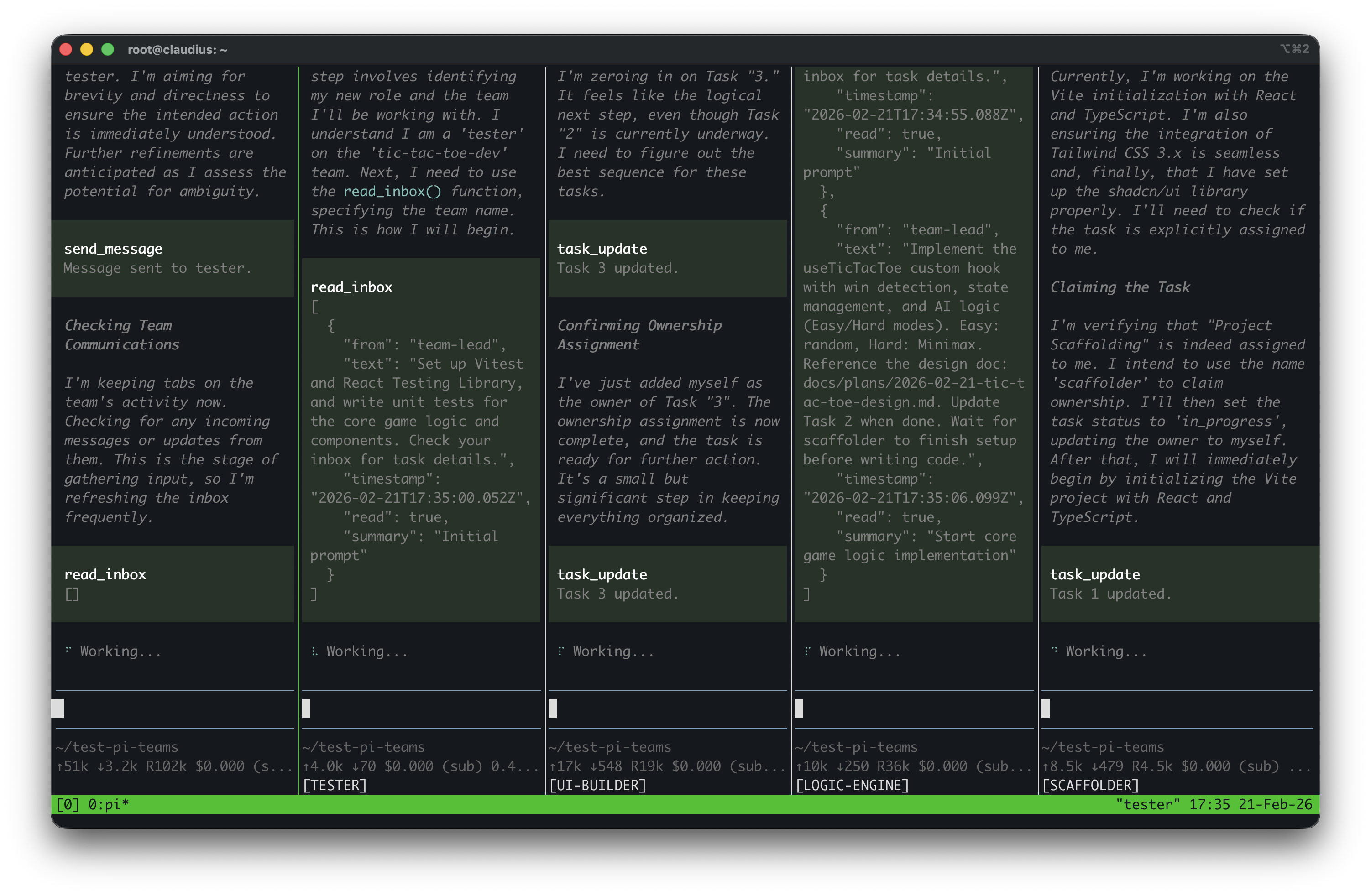
Task-first Pi teams, visible in terminal panes.
Package details
Install @hypercarrier/pi-team-bright from npm and Pi will load the resources declared by the package manifest.
$ pi install npm:@hypercarrier/pi-team-bright- Package
@hypercarrier/pi-team-bright- Version
0.17.1- Published
- Aug 16, 2026
- Downloads
- 1,865/mo · 371/wk
- Author
- silverbreenz
- License
- MIT
- Types
- extension, skill
- Size
- 1.4 MB
- Dependencies
- 4 dependencies · 4 peers
Pi manifest JSON
{
  "image": "https://raw.githubusercontent.com/deephbz/pi-team-bright/v0.17.0-rc.14/pi-team-in-action.png",
  "extensions": [
    "extensions/index.ts"
  ],
  "skills": [
    "skills"
  ]
}
Security note
Pi packages can execute code and influence agent behavior. Review the source before installing third-party packages.
README
Pi Team Bright
Delegate work to a visible Pi team without turning terminal activity into your source of truth.
Pi Team Bright lets one Pi lead assign durable Tasks to stable, named Workers. Workers remain visible through terminal adapters, but the work lives in the Task: who owns it, what done means, and the evidence that achieved, failed, or blocked its goal. The lead can wait for changes instead of watching panes.
From terminal juggling to accountable delegation
Suppose a release needs two things at once: an API-contract audit and a rollback checklist update.
Before: the operator opens extra terminals, pastes two prompts, and watches scrolling output. One process exits and another looks busy, but there is no reliable answer to “Who owns which result?”, “What is still blocked?”, or “What proved completion?”
With Pi Team Bright: the lead ensures an auditor and a writer, then
creates one assigned Task for each outcome with explicit acceptance criteria.
The auditor reports goal_achieved with file-and-command evidence. The writer
blocks with the missing decision, blocker evidence, and a next action. The lead observes those
state changes through team_sync, resolves the blocker, and reviews the Task
evidence before stopping either Worker.
A pane, process, launch receipt, or startup observation may show that a carrier exists. None of them proves that a Worker is ready, making progress, or done. The Task plus its assignee is the only executable work contract.
The normal flow
The normal sequence is:
team_create → ensure_worker → task_graph_apply → snapshot and updates
through team_sync → inspect goal evidence → resolve Tasks → worker_stop or
team_shutdown.
A minimal agent-led run looks like this:
team_create({ name: "review", purpose: "Audit the recovery contract." })

ensure_worker({
  name: "auditor",
  scope: "Contract reviewer who reports reproducible evidence."
})

task_graph_apply({
  operation_id: "audit-recovery-contract-1",
  tasks: [
    {
      key: "audit",
      title: "Audit the recovery contract",
      goal: "Compare implementation with the documented recovery path and report exact evidence.",
      assignee: "auditor"
    },
    {
      key: "repair",
      title: "Repair a failed contract",
      goal: "Apply the smallest coherent repair and report focused verification evidence.",
      assignee: "writer",
      needs: ["audit"]
    },
    {
      key: "verify",
      title: "Verify the repaired contract",
      goal: "Independently verify the repair and report the acceptance result.",
      assignee: "auditor",
      needs: ["repair"],
      on_goal_failed: { target: "repair", max_traversals: 2 }
    }
  ]
})

team_sync({ view: "snapshot" })
team_sync({ view: "updates" })
Use the initial team_sync snapshot to reconcile the Team, then use updates
for event-driven supervision. Inspect the authoritative Task and its evidence
after a change. A Worker reports goal_achieved or goal_failed with evidence,
or blocks with a next action. A blocked Task requires an explicit resolution, not an inference
from terminal output.
Reuse Workers across Tasks. Before worker_stop, resolve every nonterminal Task
assigned to that Worker. Reconcile once more before team_shutdown.
Alerts are only for exceptional clarification, attention, or announcements. They never assign, advance, block, or complete work, and they are not a chat- based substitute for Tasks.
Mission graph semantics
task_graph_apply atomically applies the complete assigned Task graph. On the
first revision, omit expected_graph_version. Later revisions must supply the
exact current graph version. Success edges in needs remain acyclic. An
explicit on_goal_failed edge may return to earlier repair work, but its
traversal limit must be from 1 through 8.
Only goal_achieved satisfies a prerequisite. goal_failed, cancelled, and
blocked never release a success edge. dependency_waiting and ready are
derived states and cannot be authored. Every claim starts an immutable Attempt,
and joins bind the accepted Attempt lineage of all prerequisites.
Task authority presents at most one ready Task to each stable Worker. Different
Workers can execute the ready front in parallel. Several unordered ready Tasks
for one Worker remain queued; add needs edges when their order matters.
In Herdr, /pi-team-graph toggles a read-only graph pane in the exact current
tab. An optional limit is 25, 50, 100, 200, or all. The pane supports
TB and LR layouts, disconnected islands, pan and selection modes, bounded Task
details, and terminal-owned semantic colors. It never schedules or changes a
Task.
Candid limits
- This is Team-scoped coordination. It is not a general agent directory, cross-Team router, universal chat bus, or freeform work-by-message system.
- Terminal capabilities vary. Herdr and tmux enforce the Team pane-placement
invariant: the first Worker splits the exact leader pane right with a measured
ratio that keeps the leader at least at its configured share. Linear placement
splits an exact current Worker pane down; Herdr grid placement creates a deterministic Worker
grid. Every target is checked against the leader tab and Worker region. They never use terminal
focus, select a whole-window layout, or close another pane during
Worker stop. iTerm2, Zellij, cmux, WezTerm, and Windows preserve their existing
placement behavior but do not guarantee this exact target-and-ratio invariant.
Herdr owns the
piexecutable used byagent start; a real Herdr Team must configure that executable to a supported Pi release (0.83.x or later). Pi 0.83 or later is required for exact Worker run-state evidence. Launching a supported local Pi only for the leader does not change Worker Pi. Workers load the exact Pi Team Bright extension and retain Pi's normal unrelated extension and Skill discovery. A distinct discovered Pi Team Bright copy violates the one-version-epoch rule and remains a documented installation risk. Herdr forwards the established Pi launch environment allowlist into Worker launches. Placement remains Team-wide policy, never a per-Worker override; an unsupported policy is refused. - Package version is not Team storage compatibility. Existing Team records
remain usable across compatible upgrades and rollbacks. Historical
implementationVersionvalues are accepted as provenance, not used as a capability gate. - Visibility is not progress. Launch, delivery, process, runtime, pane, and
window evidence is bounded evidence about those things only. Likewise,
/pi-team-bright statusand/pi-team-bright helpprovide bounded local diagnosis; they are not Worker health, readiness, or progress checks. - Beads list contention is unresolved. While live Workers settle Tasks,
ordinary
team_synccan intermittently time out in the underlying Beadslistcommand. Do not interpret that timeout as an empty Task set, Worker failure, or lack of progress; preserve the last valid cursor and reconcile from authoritative state when the read is available. - The packaged operating skill is named
pi-team-bright. Its discovery name now matches the product, command, and npm package.
Install and upgrade
Install the stable release by exact version:
pi install npm:@hypercarrier/pi-team-bright@0.17.1
Version 0.17.0 replaces the leader tool task_create with
task_graph_apply. It also replaces authored Task status changes with explicit
transitions such as claim, block, resume, goal_achieved, and
goal_failed. Update saved prompts or scripts that call the old contract.
Version 0.17.1 is backward compatible with 0.17.0 Team state. It only
resolves the live Herdr graph-pane origin. It does not change Team storage, Task
graph, model-tool, or Worker protocol contracts. Do not recreate a Team for this
update.
The package owns its local Task backend through the exact runtime dependency
@beads/bd@1.1.0; a separate global bd installation is not required.
For an upgrade or rollback, restart each Pi process that must load the chosen extension. Do not recreate the Team only because the package version changed. Stop or migrate a Team only when release notes identify a real persistence contract change, or when a Team policy requires a new epoch.
Team pane layout settings
Set the optional Team policy under pi_team_bright.team in global
settings.json or a trusted project's .pi/settings.json. Pane layout values
use Pi's normal trusted-project precedence. Sync liveness values are read from
global settings only. This complete example also shows the related Worker settings:
{
  "pi_team_bright": {
    "team": {
      "pane_layout": {
        "leader_share": 0.6,
        "worker_tiling": "grid"
      },
      "wait_seconds": 120,
      "nudge_enabled": true,
      "nudge_delay_seconds": 1200
    },
    "worker": {
      "default_model": "openai-codex/gpt-5.6-luna",
      "agents": {
        "append_global": "/absolute/path/to/worker-AGENTS.md"
      },
      "tools": {
        "enable": ["tool-name"],
        "disable": ["tool-name"]
      }
    }
  }
}
leader_share is the fraction kept by the leader after the first Worker split.
It must be greater than 0.1 and less than 1.0; the default is 0.6.
team_create.pane_layout takes precedence over trusted project settings, then
global settings, then { "leader_share": 0.6, "worker_tiling": "linear" }.
Herdr supports linear and grid; other pane backends support linear only.
The resolved policy is stored in TeamConfig, so later settings changes do not
move a live Team. wait_seconds defaults to 120. Nudge settings default to
enabled with a 1200 second delay. Malformed nudge values use these defaults and
emit diagnostics; set nudge_enabled to false to disable nudges.
Stop and recreate the Team to apply a new policy.
Worker resource settings
Worker-only prompt, tool, and default-model projection uses Pi settings. Put it under
pi_team_bright.worker in the active Pi agent directory's settings.json
(PI_CODING_AGENT_DIR, normally ~/.pi/agent), or in a trusted project's
.pi/settings.json. Pi applies its normal global/project merge, so the trusted
project's nested Worker values take precedence. No Pi Team Bright settings file exists.
Replace the example's model, absolute prompt path, and tool names with values
available in the Worker environment.
default_model is optional and applies only to new Workers. Its first slash
separates a provider from a nonempty model ID; the model ID can contain later
slashes, for example openrouter/openai/gpt-5.1. Pi Team Bright requires the
exact available identifier and never selects a provider for this setting. Explicit Worker or template models and the durable Team default_model
take precedence. Then trusted-project and global Worker settings apply. If none
apply, Pi receives no --model and uses its native default. Pi Team Bright stores
the selected exact model on Membership before launch, so recovery cannot drift.
A malformed, bare, or unavailable setting refuses the launch before carrier
creation. The refusal identifies the global or trusted-project scope; edit it and
retry. An untrusted or unknown Worker ignores project settings and can use only
the global Worker setting.
Both agents paths are optional and must be absolute. The four cases are:
- Neither: native global plus ancestor/project context stays unchanged.
append_global: native global plus ancestor/project context, then the append file.replace_global: the replacement file, then native ancestor/project context.- Both: the replacement file, native ancestor/project context, then the append file.
An unreadable replace_global warns and restores the native global contribution.
An unreadable append_global warns and skips only the append file. Pi Team Bright
serializes an active aggregate in a private temporary file and launches Workers
with --no-context-files --append-system-prompt; Pi reports appended content and
getAgentsFiles is empty.
Tool-list precedence
Tool projection starts with the Worker's inherited active tool list. It then
adds registered tools named in enable and removes registered tools named in
disable. Thus, [A, B, C] with enable: [E] and disable: [C] becomes
[A, B, E], not [E]. If both lists name the same tool, disable wins.
Unknown names are ignored with a Worker diagnostic. Settings cannot restore
leader-only tools to a Worker.
Tool projection changes only the model-visible active set. It never grants authorization: core services, including Alert authorization, still reject forged or prohibited calls.
A saved Pi trust decision controls project settings. A trusted Worker gets
--approve. An untrusted or unknown Worker gets --no-approve; an unknown cwd
uses global settings only and warns. Save trust then restart.
The aggregate covers normal and Task-delivery trigger turns. On Worker reload,
Pi Team Bright atomically refreshes the fixed aggregate path. If both paths then
disappear, it restores serialized native global plus ancestor/project context.
A final Worker shutdown removes its aggregate on a best-effort basis. A failed
launch removes it only when no carrier exists or terminal stop is confirmed. If
a carrier can remain live, Pi Team Bright retains its aggregate lease. Restart
without an aggregate restores Pi's native getAgentsFiles metadata. The lead is
unchanged.
Architecture and authority boundaries
Pi Team Bright keeps coordination concepts separate so that convenient observations do not become accidental authority:
| Concern | What it means |
|---|---|
| Team and Membership | The durable roster, lifecycle, current Membership generation, and Team-wide placement policy. |
| Pi Session identity | The exact conversational Session bound to a current Membership; a matching name, process, pane, or environment variable is not identity proof. |
| Task authority | Durable graph revisions, Task goals, assignments, Attempts, versions, outcomes, and evidence. The graph-native path uses a Team-scoped snapshot; Beads remains a legacy pre-graph fallback. |
| Delivery | Presentation of a Task change or Alert to one exact Session. A delivery receipt never changes Task state. |
| Runtime observation | Bounded evidence that an exact Membership process generation was observed. It does not prove readiness or progress. |
| Terminal surface | An adapter-owned pane or window carrying a Worker process. It is replaceable and is neither Worker identity nor work state. |
Events and team_sync |
The projection, cursor, and wait boundary that wakes the lead. Events report changes; Team and Task authorities still own current state. |
Terminal surfaces may be replaced while the stable Worker and its assigned Task remain the coordination concepts the operator reasons about. Exact schemas, guards, and lifecycle behavior live in executable contracts rather than this README.
Security and local data
Pi packages run with full system access as the user running Pi. Pi Team Bright is not a sandbox: review the package and release before installing it, and only run Workers in directories they should be allowed to access.
Team/Membership configuration, event and delivery records, runtime observations, and the Team-owned Beads Task data are local machine state. Terminal adapters also control processes and surfaces in their host applications. Treat those files, processes, prompts, and Task evidence according to the sensitivity of the project.
Report suspected vulnerabilities privately as described in SECURITY.md; do not open a public vulnerability issue.
Verification and exact contracts
From a source checkout, use the verification lane appropriate to the change:
npm run typecheck
npm test
npm run test:full
npm run verify:package
npm test is the fast deterministic lane; npm run test:full includes the
broader suite, and npm run verify:package probes the packed public artifact.
For current stage, constraints, and open work, read the maintained context. For one-hop links to tool schemas, authority implementations, types, event semantics, adapters, and focused tests, use the contract source map.
Credits
Pi Team Bright is maintained by the HyperCarrier project. It derives from
pi-teams by Mark Burggraf, a Pi port of
claude-code-teams-mcp
by Victor (cs50victor). The original MIT copyright notice is retained in
LICENSE.
TODO
- Isolate Task projection availability from valid Team and Worker carrier state when the underlying Beads list read is contended.