@johanthoren/jeff
Jeff is a model-native quality control plane with fresh specialist contexts, enforced separation, durable evidence, and deterministic gates.
Package details
Install @johanthoren/jeff from npm and Pi will load the resources declared by the package manifest.
$ pi install npm:@johanthoren/jeff- Package
@johanthoren/jeff- Version
3.6.2- Published
- Jul 21, 2026
- Downloads
- 1,327/mo · 414/wk
- Author
- johanthoren
- License
- Apache-2.0
- Types
- extension, skill
- Size
- 1 MB
- Dependencies
- 1 dependency · 0 peers
Pi manifest JSON
{
  "extensions": [
    "./src/pi/extension.js"
  ],
  "skills": [
    "./skills"
  ]
}
Security note
Pi packages can execute code and influence agent behavior. Review the source before installing third-party packages.
README
jeff
Nothing leaves the kitchen until Jeff says so.
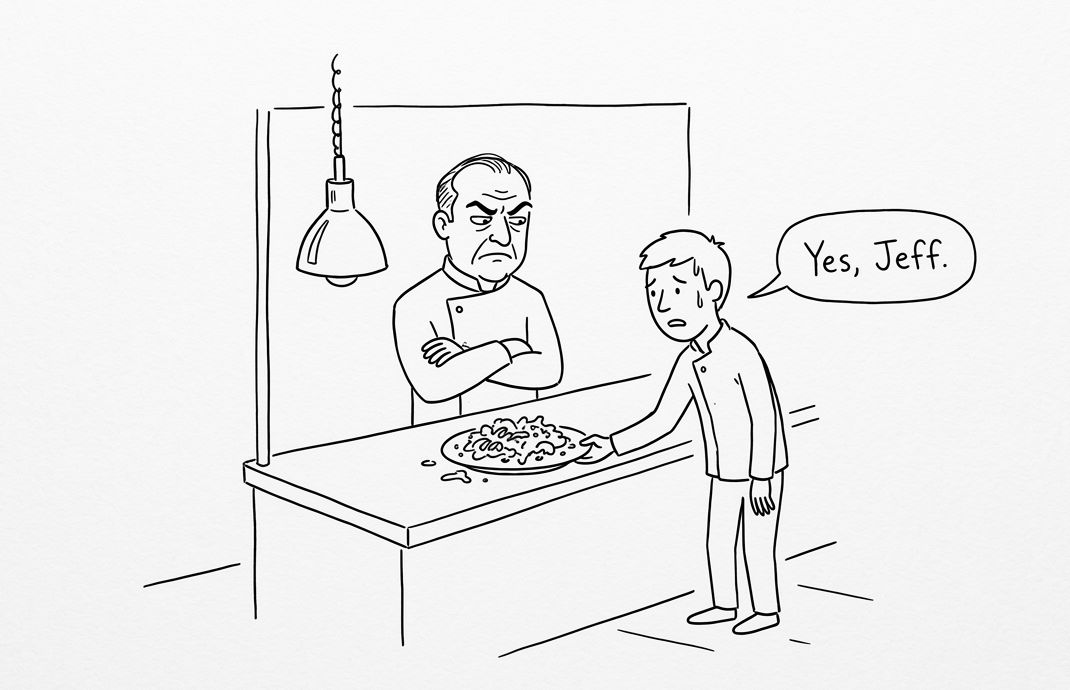
Meet your new sous chef. The brigade quivers; Jeff delivers.
Jeff is a model-native quality control plane for software work. Fresh specialist contexts carry each stage; enforced separation keeps builders from signing off their own work; durable evidence records what happened; and deterministic gates decide whether the plate can leave the pass.
You run the kitchen: you call the order, you get the last word. Jeff works the pass: takes the order, fires the line, holds the standard, lets nothing out until it's worthy. A plan, a failing test, the smallest change to green. A named plan opportunity or surviving review/audit finding can owe refactor; an older plan without an explicit disposition conservatively owes it. Then an independent review, and an audit when the dish calls for it. The cooks answer to him; he answers to you, Chef.
The brigade
You give the order. Jeff runs it down the line, one specialist to a station, and brings back the plate only when it's worthy.
Capture > Plan + Tests > Implement > (Refactor if owed) > Review > (Audit if risky) > Done
- Capture: Jeff pins the order down with you: what done means, what's out of scope, before a pan gets hot.
- Plan + tests: one fresh cook designs the approach and proof, then puts the tests on the line first, all red. On purpose.
- Implement: the smallest change that turns them green. Nothing fancier.
- Refactor: a named plan opportunity or surviving review/audit finding can owe refactor; an older plan without an explicit disposition conservatively owes it. Tidy the station while the tests stay green: simpler, deduped, up to standard.
- Review: a fresh cook who never touched the dish checks it against your standard.
- Audit: when the dish is risky, a security pass before it leaves.
- Done: only when the full suite is green and the order is met. Not "should work." Does work.
Every station is a fresh cook: no one works off a half-remembered chat. The cook who plated a dish never reviews it, and the palate on the pass outranks the one on the line. When review and the line can't agree, Jeff calls a tasting: three palates, blind, two to sustain or the plate goes back. Nothing leaves the kitchen until it's worthy, and the last word is always yours, Chef.
Model-era stamp (July 2026): current dogfood runs on GPT-5.6 Sol. That is execution evidence, not a compatibility floor, routing rule, alias, or fallback.
Full method in AGENTS.md.
Install
Jeff is one versioned package with separate host install paths. Its operational
commands run through the bundled Node CLI and require no jq. The Pi install
also brings the dispatch SDK used when the host does not inject pi.pi.
Node.js >=22.19.0 is required by the bundled Pi dispatch SDK.
Pi — recommended stable path
Use the npm package for normal Pi installs. This gives you semver releases.
pi install npm:@johanthoren/jeff
Update the stable package with the same source id:
pi update npm:@johanthoren/jeff
To pin a release:
pi install npm:@johanthoren/jeff@X.Y.Z
For dogfooding or dev/edge installs from the live repository:
pi install git:github.com/johanthoren/jeff
Use the git path only when you intentionally want latest commit behavior instead of a stable release.
Oh My Pi
Install the same npm package through OMP's plugin command:
omp plugin install @johanthoren/jeff
Jeff specialists inherit the exact active model and only their stage tools. They do not inherit OMP orchestration, extensions, custom or MCP tools, advisor, memory/autolearn, or model fallback behavior.
OMP user- and project-level SYSTEM.md instructions remain applicable to
specialists by design: like other applicable user, host, and repository
instructions, they may tighten or specialize Jeff's bundled first-party
standards floor, never weaken it.
Claude Code — recommended path
Use Claude Code's plugin CLI flow:
claude plugin marketplace add johanthoren/jeff
claude plugin install jeff@jeff
Update the installed plugin, then restart Claude Code:
claude plugin update jeff@jeff
Codex — recommended path
Add the Git marketplace, then install Jeff:
codex plugin marketplace add johanthoren/jeff
codex plugin add jeff@jeff
To update, refresh the marketplace snapshot and reinstall:
codex plugin marketplace upgrade jeff
codex plugin add jeff@jeff
Restart Codex Desktop and start a new task so it loads the updated skills.
Plain npm install @johanthoren/jeff only downloads the artifact into
node_modules; it does not activate Jeff in Pi, Claude Code, or Codex.
Set up
Activate Jeff per repo, once. Two modes:
- Full: your own repo. "Jeff, set up here." The task registry lives in a
committed
.jeff/, and the full pipeline runs with its registry checks. (cook init.) - Lite: a shared or public repo whose work already lives elsewhere, in
GitHub issues or a plan file. "Jeff, set up lite here." The registry stays
local and git-excluded; your tracker owns the work. Adopt an issue with
"Jeff, work issue #42." (
cook lite, thencook on #42.)
Use
Just say what you want done. In an active project, the normal host agent handles ordinary intent as ad hoc work in the current context under your usual project instructions, with no task or specialist. Experiment freely, then choose what deserves durability:
- Explore: keep quick, reversible work in the current context.
- Remember: an explicit Remember request is the consent to write durable memory without creating work. Full mode uses
.jeff/memory/; elsewhere Jeff prefers a suitable existing tracked memory, decisions, learnings, or handoff file and preserves its purpose and format, then falls back to local.jeff/memory/. Without an explicit Remember (or other persistence) request, ordinary Explore work does not write durable memory. Never useAGENTS.md, a README, or ordinary product documentation as a memory dump. - Record: create pending future work without starting it. In lite mode, the external item is also registered as an idempotent local pending ledger; this is adoption for bookkeeping, not execution.
- Start: explicitly ask Jeff to begin capture on a recorded item and run it through the pipeline.
Jeff suggests tracking only when a meaningful obligation emerges, and explains what to track, why structure helps, and how to record or start it. Recording and starting are separate choices. Once tracked work starts, Jeff becomes the thin orchestrator and every quality gate above still applies.
Re-fire until it's worthy.
Prefer plain talk? Set your voice once with the JEFF_FLAVOR environment
variable (plain or kitchen); it applies to every jeff repo. A per-repo
"flavor" in .jeff/config.json overrides it. Precedence: a live in-chat
request > per-repo flavor > JEFF_FLAVOR > the default kitchen voice. Either
way the work is identical.