@jstxn/agentdir-pi
Pi package for AgentDir local-first coding-agent memory and evidence capture.
Package details
Install @jstxn/agentdir-pi from npm and Pi will load the resources declared by the package manifest.
$ pi install npm:@jstxn/agentdir-pi- Package
@jstxn/agentdir-pi- Version
0.7.3- Published
- May 25, 2026
- Downloads
- not available
- Author
- justen-p
- License
- MIT
- Types
- skill
- Size
- 18.1 KB
- Dependencies
- 0 dependencies · 0 peers
Pi manifest JSON
{
  "skills": [
    "./skills"
  ],
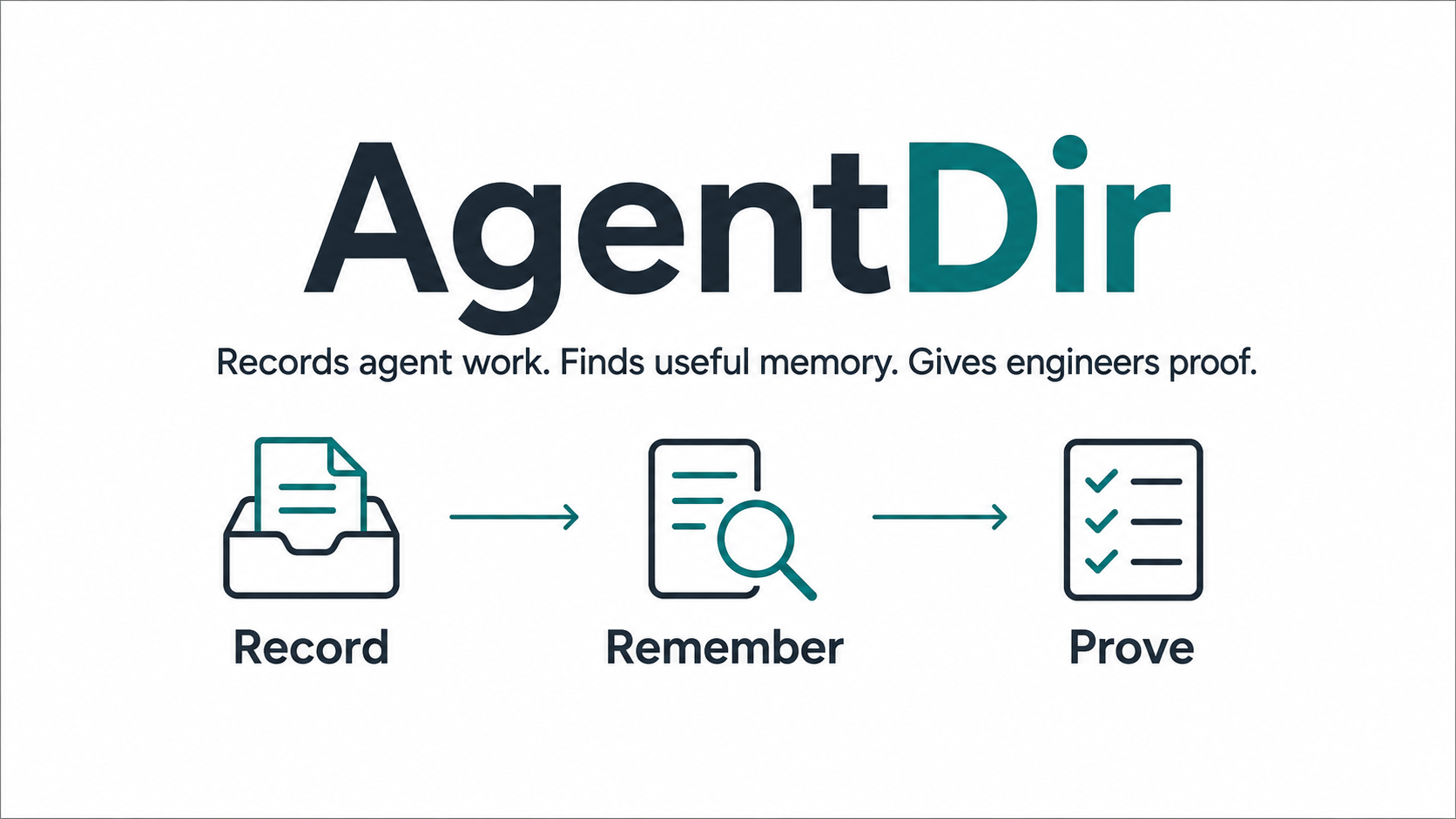
  "image": "https://raw.githubusercontent.com/jstxn/agentdir/v0.7.3/docs/assets/agentdir-overview.png"
}
Security note
Pi packages can execute code and influence agent behavior. Review the source before installing third-party packages.
README
AgentDir
AgentDir is a flight recorder for coding agents. It lets agents record what happened during a software task, then gives engineers a clean way to inspect, replay, search, and audit that work later.
The goal is simple: AgentDir should be nearly invisible while you work.
Engineers should not have to manually start sessions, wrap commands, collect evidence, or maintain agent memory by hand. Once a repository is adopted, the agent operates AgentDir in the background and leaves behind a useful trail.
Why AgentDir Exists
Agentic engineering has a trust gap.
Agents can edit code, run tools, and summarize results, but their work often ends up scattered across chat history, terminal scrollback, temporary files, and unverified final claims. That makes it hard to answer basic questions:
- What did the agent actually do?
- Which commands support the final answer?
- Were tests, builds, lint, or release checks really run?
- What context did the agent retrieve and rely on?
- Can a future agent learn from this session?
- Can the index or memory layer be rebuilt if it breaks?
AgentDir gives those answers a local, durable home.
What You Get
| Capability | What it means |
|---|---|
| Invisible agent workflow | Agents run AgentDir commands during normal work, so engineers keep using their coding assistant normally. |
| Evidence-backed claims | Test, build, lint, typecheck, doctor, and release claims can be checked against recorded tool results. |
| Replayable sessions | Inspect the task, decisions, commands, outputs, blockers, summaries, and handoffs after the fact. |
| Local-first storage | Records live in the repo-local .agentdir directory by default. No hosted service is required. |
| Rebuildable memory | Raw event files are the source of truth. SQLite search and memory indexes can be rebuilt. |
| Context lineage | Agents can emit context packs, then record which retrieved sources were consumed or cited. |
| Cross-repo memory | Explicitly registered AgentDir roots can be searched together without moving canonical records. |
| Secret-aware persistence | Common secret-like patterns are redacted before storage, with scan and cleanup commands for older records. |
The Invisible Workflow
AgentDir is designed around a small separation of responsibility.
| Human does | Agent does |
|---|---|
| Install AgentDir once. | Start and finish AgentDir sessions. |
Run agentdir adopt once per repo. |
Capture evidence-bearing commands with agentdir run. |
| Ask the coding agent to do work. | Record decisions, blockers, context, and handoffs. |
| Inspect evidence only when needed. | Audit session quality and final claims before reporting. |
In day-to-day use, the human workflow stays the same:
Ask the agent to do the task.
Review the result.
Use AgentDir only when you want the trail.
The agent handles the recording surface:
agentdir work start "fix checkout failure" --emit-context
agentdir run -- pytest -q
agentdir audit session
agentdir work finish --json
Install
AgentDir is distributed through GitHub Releases. For the private
jstxn/agentdir repo, authenticate GitHub CLI first:
gh auth login
Install the latest release:
gh api -H "Accept: application/vnd.github.raw" \
  'repos/jstxn/agentdir/contents/scripts/install.sh?ref=v0.7.3' | bash
The installer uses pipx when available. Otherwise it creates a self-contained
virtual environment under ~/.local/share/agentdir and links the CLI into
~/.local/bin.
Verify:
agentdir --version
agentdir --help
Pi Package
Pi users can install this repository as a Pi package so the AgentDir skill is available automatically during coding tasks:
pi install npm:@jstxn/agentdir-pi@0.7.3
# or install directly from a local checkout / release tag:
pi install /absolute/path/to/agentdir
pi install git:github.com/jstxn/agentdir@<tag-or-commit>
The package exposes skills/agentdir/SKILL.md; it teaches Pi to start AgentDir
sessions, wrap evidence-bearing commands, use local memory/context packs, and
produce evidence-aware handoffs. See AgentDir Pi Package
for details.
Adopt A Repository
Run once from a git repository:
agentdir adopt
This is intentionally boring setup. It prepares the repository once, then agents operate AgentDir during normal coding work:
- creates the repo-local
.agentdirstore - installs AgentDir-managed git hook shims
- installs the Codex skill into the user skill directory
- writes managed project guidance for common agent tools
- asks interactive users whether
.agentdir/should be added to the project or user-level Git ignore file - runs
doctorto confirm the store is healthy
After that, agents have the guidance they need to use AgentDir without the engineer manually operating it during normal work.
Preview setup without writing anything:
agentdir adopt --dry-run --json
If you want generated integration files to stay inside the AgentDir store instead of project instruction files:
agentdir adopt --install-skill store --install-generic store --integration-target store
For non-interactive installs, choose the ignore destination explicitly:
agentdir adopt --gitignore project  # write <repo>/.gitignore
agentdir adopt --gitignore user     # write the user-level Git excludes file
agentdir adopt --gitignore none     # leave ignore files unchanged
Undo managed setup while keeping the .agentdir evidence store:
agentdir unadopt          # dry-run
agentdir unadopt --apply  # remove managed hooks and guidance
What Gets Written
Default adoption writes only local files:
<repo>/.agentdir/                         # evidence, artifacts, indexes, state
<repo>/.git/hooks/*                       # managed hook shims with backups
<repo>/AGENTS.md                          # generic / Codex-readable guidance
<repo>/CLAUDE.md                          # Claude Code guidance
<repo>/.github/copilot-instructions.md    # Copilot guidance
<repo>/.cursor/rules/agentdir.mdc         # Cursor guidance
<repo>/.windsurf/rules/agentdir.md        # Windsurf guidance
~/.codex/skills/agentdir/SKILL.md         # Codex skill, by default
Managed guidance is wrapped in AgentDir markers. Existing unmanaged content is preserved where the target format supports managed blocks.
Inspect A Session
Most users will not need these commands every day, but they are the reason AgentDir exists.
agentdir status
agentdir evidence --brief
agentdir timeline
agentdir report final --format json
agentdir replay
agentdir memory search "checkout failure"
For final-answer support:
agentdir audit session
agentdir audit claims --text final-response.md
Audits are advisory by default. Use --strict when unsupported or contradicted
claims should fail a check.
How AgentDir Works
AgentDir has one source of truth and several rebuildable views:
raw envelopes -> SQLite index -> memory/search/audit/report
                    ^
                    |
             rebuilt from envelopes
- Raw envelopes Each meaningful event is stored as an immutable file in a Maildir-inspired directory layout. These files are the source of truth.
- Derived indexes SQLite indexes, search tables, memory passages, context packs, and audit views are derived from the raw event files and can be rebuilt.
Default project layout:
<repo>/.agentdir/
  sessions/
  actors/
  artifacts/
  archives/
  indexes/agentdir.sqlite3
  state/
  integrations/
The important property is recoverability: deleting the derived index does not destroy the session. AgentDir can rebuild from the envelope store.
The agent-facing report surface is JSON. agentdir report final --format json
and agentdir work finish --json include an agent_handoff object with
verification evidence, failed evidence, claim support, context lineage, known
gaps, and recommended next agent actions.
Unique Capabilities
Claims-To-Evidence Checks
AgentDir can compare final-response claims such as "tests passed" or "build passed" against the latest recorded tool results. It does this with deterministic heuristics, not an LLM.
Supported claim families:
- test
- lint
- typecheck
- build
- doctor
- release
Context Packs
Agents can package retrieved context into auditable source manifests:
agentdir context build "checkout failure" --emit
agentdir context consume --pack <pack-id> --source <source-id> --purpose plan
agentdir context cite --pack <pack-id>
agentdir audit context --pack <pack-id>
This does not prove a model paid attention, but it does make cooperative agent behavior visible.
Local Agent Memory
AgentDir builds searchable local memory from prior sessions. Agents can search similar work, explain why a memory hit matched, and include relevant history in new context packs.
agentdir memory search "release evidence"
agentdir memory explain "release evidence"
agentdir context build "release evidence" --emit
Optional semantic extras exist, but the default path does not require a vector database or external embedding service.
Federated Memory
For multi-repo work, AgentDir can search explicitly registered roots:
agentdir roots register ../other-repo --name other-repo
agentdir memory search --federated "release evidence"
Each repository remains the canonical owner of its own .agentdir store.
Safety Model
AgentDir is local-first and advisory by design.
- It records what agents choose to record.
- It does not replace code review or CI.
- It does not send data to a hosted AgentDir service.
- It treats raw envelopes as the source of truth.
- It redacts common secret-like patterns before persistence.
- It provides
secrets scanandsecrets redact --applyfor cleanup.
Useful commands:
agentdir doctor
agentdir secrets scan
agentdir secrets redact
agentdir secrets redact --apply
Upgrade And Rollback
Upgrade an existing install and refresh current repo adoption:
agentdir --upgrade
Rollback to the previous stable release:
gh api -H "Accept: application/vnd.github.raw" \
  'repos/jstxn/agentdir/contents/scripts/rollback.sh?ref=v0.7.3' | bash
Learn More
Project Status
AgentDir is beta software for local-first agentic engineering workflows. The core model is stable: agents operate the recorder, engineers get the evidence, and raw local envelopes remain the recoverable source of truth.