@juicesharp/rpiv-advisor
Pi extension. A second opinion the model can request from a stronger reviewer model before it acts.
Package details
Install @juicesharp/rpiv-advisor from npm and Pi will load the resources declared by the package manifest.
$ pi install npm:@juicesharp/rpiv-advisor- Package
@juicesharp/rpiv-advisor- Version
2.4.0- Published
- Aug 3, 2026
- Downloads
- 6,555/mo · 2,580/wk
- Author
- juicesharp
- License
- MIT
- Types
- extension
- Size
- 78.1 KB
- Dependencies
- 2 dependencies · 3 peers
Pi manifest JSON
{
  "extensions": [
    "./index.ts"
  ]
}
Security note
Pi packages can execute code and influence agent behavior. Review the source before installing third-party packages.
README
@juicesharp/rpiv-advisor


Let the model you're working with hand its whole conversation to a second, stronger model and get back a plan, a correction, or a stop signal — then keep going. rpiv-advisor adds the zero-parameter advisor tool and the /advisor picker to Pi Agent, so you can drive a session with a fast model and keep a stronger reviewer one call away.
Install
pi install npm:@juicesharp/rpiv-advisor
Restart your Pi session.
Quick start
Nothing happens until you pick a reviewer. Run:
/advisor
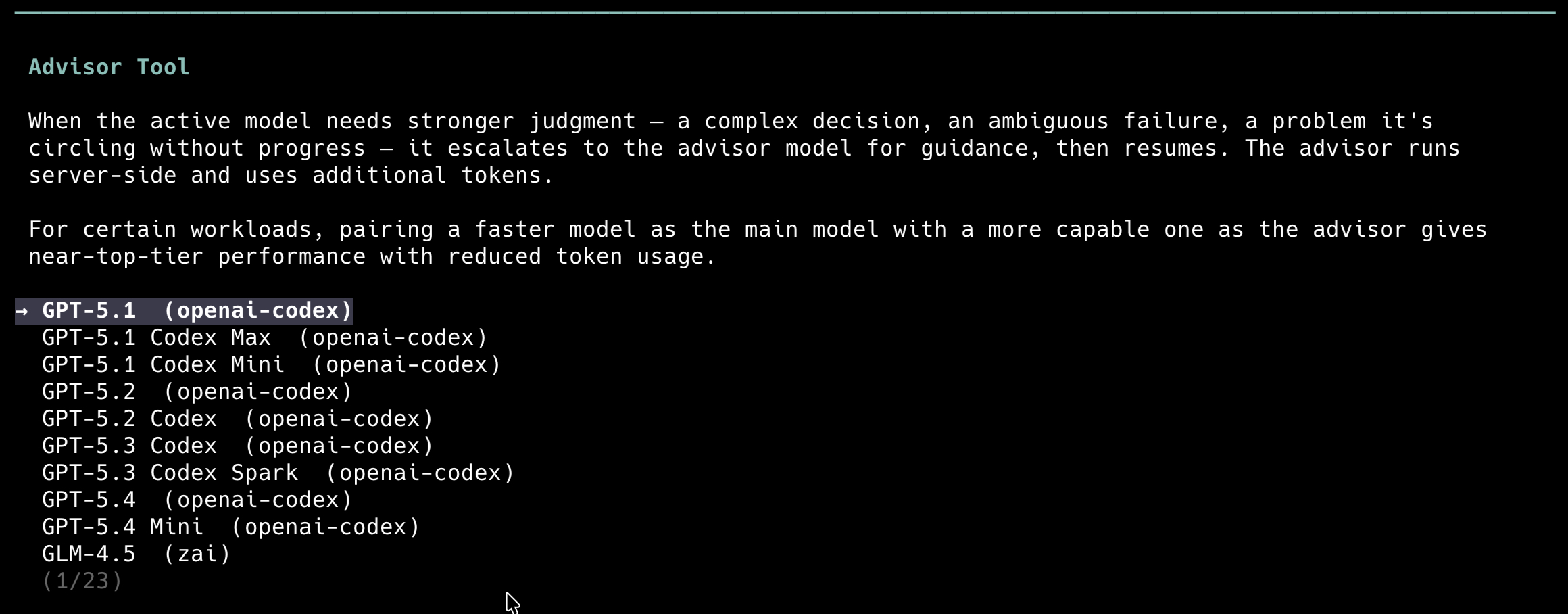
You get a picker over every model Pi already has credentials for — start typing
to filter it by model name, provider, or provider/id. Pick one, and if it
supports reasoning you get a second picker for its effort level (high is
recommended). Pi confirms with Advisor: <model>, <effort>, and the advisor
tool goes live for this and every future session.
If the model you want isn't in the list, its provider isn't authenticated yet —
run Pi's /login for that provider, then re-run /advisor.
From there the executor model calls advisor() on its own when it needs stronger
judgment. To turn it back off, run /advisor and choose No advisor.
What you get
- A second opinion without leaving the session — the executor calls
advisor()mid-turn, reads the reviewer's answer as the tool result, and resumes. Nothing is injected into your transcript, and the default prompt guidelines tell the executor to restate the advisor's key guidance in its next visible reply, so you are not left with only a collapsed tool card. - Nothing to type or paste — the tool takes zero parameters. The whole conversation branch is serialised and forwarded automatically: the task, every tool call made, every result seen. That whole branch is billed against the reviewer model on every call, so escalations are not free.
- The reviewer sees what survived compaction — the branch is built from Pi's resolved LLM context, so compaction and branch summaries are forwarded instead of a stale raw replay.
- Any model can be the reviewer — every model you're authenticated for is in
the
/advisorpicker, found by fuzzy-typing. No provider is privileged. - Pick once, it stays picked — model and effort persist to
advisor.jsonand are re-applied at every session start. - Skip it when you're already on a strong model — list executor models in
disabledForModelsto strip the tool for them, optionally only at or above a reasoning-effort threshold. It strips and re-adds live as you switch model or effort mid-session. - Off costs nothing — with no model selected the tool is stripped from the active set, so its prompt text never enters the system prompt at all.
Configuration
Settings live in ~/.config/rpiv-advisor/advisor.json (or
$XDG_CONFIG_HOME/rpiv-advisor/advisor.json when that variable is set to an
absolute path). /advisor creates the file and chmods it to 0600; a failed
write leaves your previous selection untouched and tells you so.
| Key | What it does | Default |
|---|---|---|
modelKey |
The reviewer model, as "provider/modelId". Written by /advisor. |
absent — advisor off |
effort |
Reasoning effort for the reviewer: minimal, low, medium, high, xhigh. Written by /advisor. |
absent — no reasoning sent |
disabledForModels |
Executor models the advisor is stripped for. Plain strings block at any effort; { "model": "…", "minEffort": "…" } blocks only at or above that effort. |
[] |
{
  "modelKey": "anthropic/claude-opus-4-5",
  "effort": "high",
  "disabledForModels": [
    "anthropic/claude-opus-4-5",
    { "model": "openai/gpt-5.2", "minEffort": "high" }
  ]
}
/advisor only rewrites modelKey and effort, so hand-edited keys —
disabledForModels and the guidance overrides — survive every save.
Reference
- Configuration — config file resolution, every key, blocklist matching rules, guidance overrides, and the full notification catalogue.
advisortool reference — schema, result envelope, failure paths, what gets sent to the reviewer, lifecycle hooks, and picker keys.
Requirements
- A Pi Agent host — the extension loads through Pi's extension manifest. No native dependencies.
- An authenticated provider for the reviewer model, resolved through Pi's model registry.
- An interactive terminal for
/advisor.
Troubleshooting
| Symptom | Cause | Fix |
|---|---|---|
The /advisor picker offers only No advisor |
No provider is authenticated in Pi | Run Pi's /login for a provider, then re-run /advisor |
Advisor (<model>) has no API key available. comes back as the tool result |
Credentials for the reviewer's provider no longer resolve | Re-authenticate that provider with /login |
/advisor requires interactive mode |
Running under pi --print … or RPC |
Run Pi interactively |
Related
@juicesharp/rpiv-pi— the umbrella package; itscode-reviewskill callsadvisor()when this package is installed.
License
MIT — see LICENSE.