@juicesharp/rpiv-pi
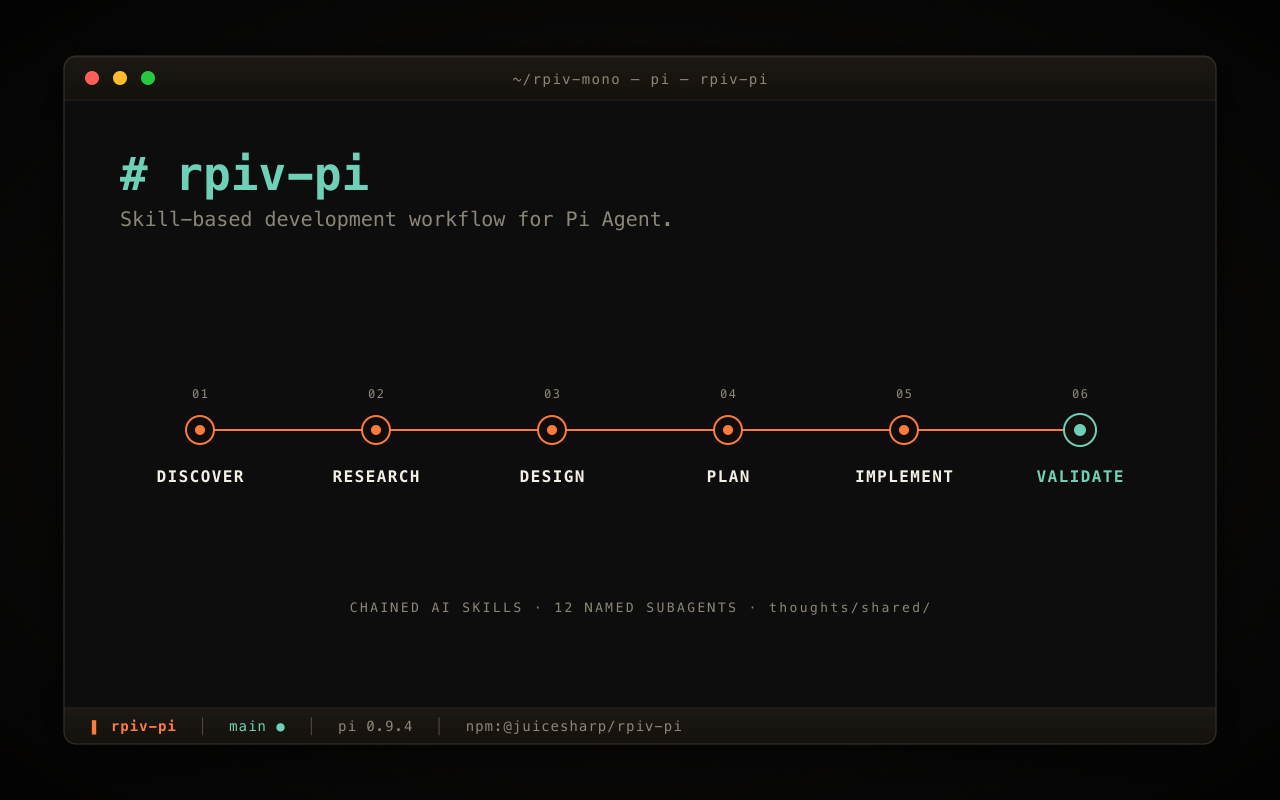
A skill-based development workflow for Pi Agent. Six skills (discover, research, design, plan, implement, validate) and the shared subagents that compose its ship-loop.
Package details
Install @juicesharp/rpiv-pi from npm and Pi will load the resources declared by the package manifest.
$ pi install npm:@juicesharp/rpiv-pi- Package
@juicesharp/rpiv-pi- Version
1.1.5- Published
- May 5, 2026
- Downloads
- 7,926/mo · 3,810/wk
- Author
- juicesharp
- License
- MIT
- Types
- extension, skill
- Size
- 526.3 KB
- Dependencies
- 0 dependencies · 10 peers
Pi manifest JSON
{
  "extensions": [
    "./extensions"
  ],
  "skills": [
    "./skills"
  ]
}
Security note
Pi packages can execute code and influence agent behavior. Review the source before installing third-party packages.
README
rpiv-pi


Pi compatibility -
rpiv-pi0.14.xtracks@mariozechner/pi-coding-agent0.70.xand@tintinweb/pi-subagents0.6.x. If you see peer-dep resolution issues after a Pi upgrade, open an issue.
⚠️ Upgrading from
0.13.x-1.0.0swaps the subagent provider fromnpm:pi-subagents(nicobailon fork) back tonpm:@tintinweb/pi-subagents(resumed maintenance). On first launch after upgrade you'll see "rpiv-pi requires 1 sibling extension(s): @tintinweb/pi-subagents" - run/rpiv-setuponce and restart Pi. The setup dialog previews both changes (install@tintinweb/pi-subagents, removenpm:pi-subagentsfrom~/.pi/agent/settings.json) and applies them only after you confirm. After restart, run/rpiv-update-agentsto refresh the 12 bundled specialist frontmatters. Customised<cwd>/.pi/agents/*.mdfiles are not touched. The tool name reverts fromsubagent→Agent(paramsubagent_type/description/prompt) - only your own custom skills/agents need editing; the bundled rpiv-pi specialists are migrated in this release.
Skill-based development workflow for Pi Agent - discover, research, design, plan, implement, and validate. rpiv-pi extends Pi Agent with a pipeline of chained AI skills, named subagents for parallel analysis, and session lifecycle hooks for automatic context injection.
What you get
- A pipeline of chained AI skills - discover → research → design → plan → implement → validate, each producing a reviewable artifact under
thoughts/shared/. - Named subagents for parallel analysis -
codebase-analyzer,codebase-locator,codebase-pattern-finder,claim-verifier, and 8 more, dispatched automatically by skills. - Session lifecycle hooks - agent profiles, guidance files, and pipeline directories scaffold themselves on first launch.
Prerequisites
Node.js - required by Pi Agent
Pi Agent - install globally so the
picommand is available:npm install -g @mariozechner/pi-coding-agentModel provider (first-time Pi Agent users only - skip if
/loginalready works or~/.pi/agent/models.jsonis configured). Pick one:Subscription login - start Pi Agent and run
/loginto authenticate with Anthropic Claude Pro/Max, ChatGPT Plus/Pro, GitHub Copilot, or Gemini.BYOK (API key) - edit
~/.pi/agent/models.jsonand add a provider entry withbaseUrl,api,apiKey, andmodels[]. Example (z.ai GLM coding plan):{ "providers": { "zai": { "baseUrl": "https://api.z.ai/api/coding/paas/v4", "api": "openai-completions", "apiKey": "XXXXXXXXX", "compat": { "supportsDeveloperRole": false, "thinkingFormat": "zai" }, "models": [ { "id": "glm-5.1", "name": "glm-5.1 [coding plan]", "reasoning": true, "input": ["text"], "cost": { "input": 0, "output": 0, "cacheRead": 0, "cacheWrite": 0 }, "contextWindow": 204800, "maxTokens": 131072 } ] } } }
git (recommended) - rpiv-pi works without it, but branch and commit context won't be available to skills.
Quick Start
- Install rpiv-pi:
pi install npm:@juicesharp/rpiv-pi
- Start a Pi Agent session and install sibling plugins:
/rpiv-setup
Restart your Pi Agent session.
(Optional) Configure web search:
/web-search-config
First Session
On first Pi Agent session start, rpiv-pi automatically:
- Copies agent profiles to
<cwd>/.pi/agents/ - Detects outdated or removed agents on subsequent starts
- Scaffolds
thoughts/shared/directories for pipeline artifacts - Shows a warning if any sibling plugins are missing
Usage
Typical Workflow
/skill:discover "how does X work"
/skill:research thoughts/shared/questions/<latest>.md
/skill:design thoughts/shared/research/<latest>.md
/skill:plan thoughts/shared/designs/<latest>.md
/skill:implement thoughts/shared/plans/<latest>.md Phase <N>
Each skill produces an artifact consumed by the next. Run them in order, or jump in at any stage if you already have the input artifact.
Recipes
Skills compose. Pick the entry point that matches your intent:
- Form context before a task -
/skill:discover "[topic]"→/skill:research <questions artifact>. Produces a high-signal subspace of the codebase relevant to your topic, ready to feed directly into the next prompt. - Compare approaches before designing -
/skill:explore "[problem]"→/skill:design <solutions artifact>. Use when multiple valid solutions exist; the solutions artifact is a first-class input todesignalongside aresearchartifact. - One-shot plan from research -
/skill:research <questions>→/skill:blueprint <research artifact>→/skill:implement. Fusesdesign+planinto a single pass with the same slice-by-slice rigor, but spawns onlycodebase-pattern-finderupfront (vsdesign's 4-agent fan-out) by trusting the research artifact's integration/precedent sections. Use for solo work or when no one else needs to review the design before implementation; pickdesign→planwhen the design is itself a deliverable or when research is thin and you want the fuller verification sweep. - Full feature build -
/skill:discover→research→design→plan→implement→validate→ (code-review↔commit). The default pipeline; jump in at any stage if you already have the input artifact. Review and commit are interchangeable in order - reviewstaged/workingbefore committing, or commit first and review the resulting branch (empty scope, first-parent vs default). - Investigate a bug -
/skill:discover "why does X fail"→/skill:research <questions artifact>. Fix from the research output without writing a plan when the change is small. - Adjust mid-implementation -
/skill:revise <plan artifact>→ resume/skill:implement. Use when new constraints land after the plan is drafted. - Review before shipping -
/skill:code-review↔/skill:commit. Order is your call: reviewstaged/workingbefore committing to catch issues at the smallest blast radius, or commit first and review the resulting branch (empty scope defaults to feature-branch-vs-default-branch, first-parent). Produces a Quality/Security/Dependencies artifact underthoughts/shared/reviews/with claim-verifier-grounded findings andstatus: approved | needs_changes. - Audit a specific scope -
/skill:code-review <commit|staged|working|hash|A..B|branch>. Targeted lenses over a commit, range, staged/working tree, or PR branch; advisor adjudication applies when configured (/advisor). - Review-driven plan revision -
/skill:code-review→/skill:revise <plan artifact>→ resume/skill:implement. When a mid-stream review surfaces structural findings that the existing plan can't absorb as spot fixes. - Scaffold manual UI test specs -
/skill:outline-test-cases→/skill:write-test-cases <feature>. Outline first via Frontend-First Discovery to map project scope and avoid duplicate coverage, then generate flow-based manual test cases (with a regression suite) under.rpiv/test-cases/<feature>/. - Hand off across sessions -
/skill:create-handoff→ (new session)/skill:resume-handoff <doc>. Preserves context when stopping mid-task. - Onboard a fresh repo -
/skill:annotate-guidanceonce, then use the rest of the pipeline normally. Useannotate-inlineinstead if the project follows theCLAUDE.mdconvention.
Skills
Invoke via /skill:<name> from inside a Pi Agent session.
Research & Design
| Skill | Input | Output | Description |
|---|---|---|---|
discover |
- | thoughts/shared/questions/ |
Generate research questions from codebase discovery |
research |
Questions artifact | thoughts/shared/research/ |
Answer questions via parallel analysis agents |
explore |
- | thoughts/shared/solutions/ |
Compare solution approaches with pros/cons |
design |
Research or solutions artifact | thoughts/shared/designs/ |
Design features via vertical-slice decomposition |
Implementation
| Skill | Input | Output | Description |
|---|---|---|---|
plan |
Design artifact | thoughts/shared/plans/ |
Create phased implementation plans |
blueprint |
Research or solutions artifact | thoughts/shared/plans/ |
Fused design + plan: vertical-slice decomposition with micro-checkpoints, emits implement-ready phased plan in one pass. Lighter on subagent fan-out than design - trusts the research artifact's integration/precedent sections instead of re-dispatching. Use when a separate design artifact isn't needed for review or handoff |
implement |
Plan artifact | Code changes | Execute plans phase by phase |
revise |
Plan artifact | Updated plan | Revise plans based on feedback |
validate |
Plan artifact | Validation report | Verify plan execution |
Testing
| Skill | Input | Output | Description |
|---|---|---|---|
outline-test-cases |
- | .rpiv/test-cases/ |
Discover testable features with per-feature metadata |
write-test-cases |
Outline metadata | Test case specs | Generate manual test specifications |
Annotation
| Skill | Input | Output | Description |
|---|---|---|---|
annotate-guidance |
- | .rpiv/guidance/*.md |
Generate architecture guidance files |
annotate-inline |
- | CLAUDE.md files |
Generate inline documentation |
migrate-to-guidance |
CLAUDE.md files | .rpiv/guidance/ |
Convert inline docs to guidance format |
Utilities
| Skill | Description |
|---|---|
code-review |
Comprehensive code reviews using specialist row-only agents (diff-auditor, peer-comparator, claim-verifier) at narrativisation-prone dispatch sites |
commit |
Structured git commits grouped by logical change |
create-handoff |
Context-preserving handoff documents for session transitions |
resume-handoff |
Resume work from a handoff document |
Commands
| Command | Description |
|---|---|
/rpiv-setup |
Install all sibling plugins in one go |
/rpiv-update-agents |
Sync rpiv agent profiles: add new, update changed, remove stale |
/advisor |
Configure advisor model and reasoning effort |
/btw |
Ask a side question without polluting the main conversation |
/languages |
Pick the UI language for rpiv-* TUI strings (Deutsch / English / Español / Français / Português / Português (Brasil) / Русский / Українська) |
/todos |
Show current todo list |
/web-search-config |
Set Brave Search API key |
Agents
Agents are dispatched automatically by skills via the Agent tool - you don't invoke them directly.
| Agent | Purpose |
|---|---|
claim-verifier |
Grounds each supplied code-review claim against repository state and tags it Verified / Weakened / Falsified |
codebase-analyzer |
Analyzes implementation details for specific components |
codebase-locator |
Locates files, directories, and components relevant to a feature or task |
codebase-pattern-finder |
Finds similar implementations and usage examples with concrete code snippets |
diff-auditor |
Walks a patch against a caller-supplied surface-list and emits file:line | verbatim | surface-id | note rows |
integration-scanner |
Maps inbound references, outbound dependencies, config registrations, and event subscriptions for a component |
peer-comparator |
Compares a new file against a peer sibling and tags each invariant Mirrored / Missing / Diverged / Intentionally-absent |
precedent-locator |
Finds similar past changes in git history - commits, blast radius, and follow-up fixes |
test-case-locator |
Catalogs existing manual test cases under .rpiv/test-cases/ and reports coverage stats |
thoughts-analyzer |
Performs deep-dive analysis on a research topic in thoughts/ |
thoughts-locator |
Discovers relevant documents in the thoughts/ directory |
web-search-researcher |
Researches modern web-only information via deep search and fetch |
Architecture
rpiv-pi/
├── extensions/rpiv-core/   - runtime extension: hooks, commands, guidance injection
├── skills/                 - AI workflow skills (research → design → plan → implement)
├── agents/                 - named subagent profiles dispatched by skills
└── thoughts/shared/        - pipeline artifact store
Pi Agent discovers extensions via "extensions": ["./extensions"] and skills via "skills": ["./skills"] in package.json.
Configuration
- Web search - run
/web-search-configto set the Brave Search API key, or set theBRAVE_SEARCH_API_KEYenvironment variable - Advisor - run
/advisorto select a reviewer model and reasoning effort - Side questions - type
/btw <question>anytime (even mid-stream) to ask the primary model a one-off question; answer appears in a borderless bottom overlay and never enters the main conversation - UI language - run
/languagesto pick the locale for rpiv-* TUI strings, or passpi --locale <code>at startup. Detection priority: flag →~/.config/rpiv-i18n/locale.json→LANG/LC_ALL→ English. LLM-facing copy stays English by design - Agent concurrency - open the
/agentsoverlay and tuneSettings → Max concurrencyto match your provider's rate limits.@tintinweb/pi-subagentsowns this setting; rpiv-pi does not seed it. - Agent profiles - editable at
<cwd>/.pi/agents/; sync from bundled defaults with/rpiv-update-agents(overwrites rpiv-managed files, preserves your custom agents)
Uninstall
- Remove rpiv-pi from Pi:
pi uninstall npm:@juicesharp/rpiv-pi - Optional - uninstall the subagent runtime if no other plugin needs it:
pi uninstall npm:@tintinweb/pi-subagents - Restart Pi.
Troubleshooting
| Symptom | Cause | Fix |
|---|---|---|
| Warning about missing siblings on session start | Sibling plugins not installed | Run /rpiv-setup |
/rpiv-setup fails on a package |
Network or registry issue | Check connection, retry with pi install npm:<pkg>, re-run /rpiv-setup |
/rpiv-setup says "requires interactive mode" |
Running in headless mode | Install manually: pi install npm:<pkg> for each sibling |
web_search or web_fetch errors |
Brave API key not configured | Run /web-search-config or set BRAVE_SEARCH_API_KEY |
advisor tool not available after upgrade |
Advisor model selection lost | Run /advisor to re-select a model |
| Skills hang or serialize agent calls | Agent concurrency too low | Open /agents, raise Settings → Max concurrency |
License
MIT