@junghanacs/pi-shell-acp
ACP bridge providing Claude Code, Codex, and Gemini CLI backends to pi-coding-agent, with the entwurf orchestration surface for cross-session delegation.
Package details
Install @junghanacs/pi-shell-acp from npm and Pi will load the resources declared by the package manifest.
$ pi install npm:@junghanacs/pi-shell-acp- Package
@junghanacs/pi-shell-acp- Version
0.11.0- Published
- Jun 16, 2026
- Downloads
- 2,073/mo · 217/wk
- Author
- junghanacs
- License
- MIT
- Types
- extension
- Size
- 10.6 MB
- Dependencies
- 6 dependencies · 4 peers
Pi manifest JSON
{
  "extensions": [
    "./index.ts",
    "./pi-extensions/entwurf-control.ts",
    "./pi-extensions/entwurf.ts",
    "./pi-extensions/model-lock.ts"
  ],
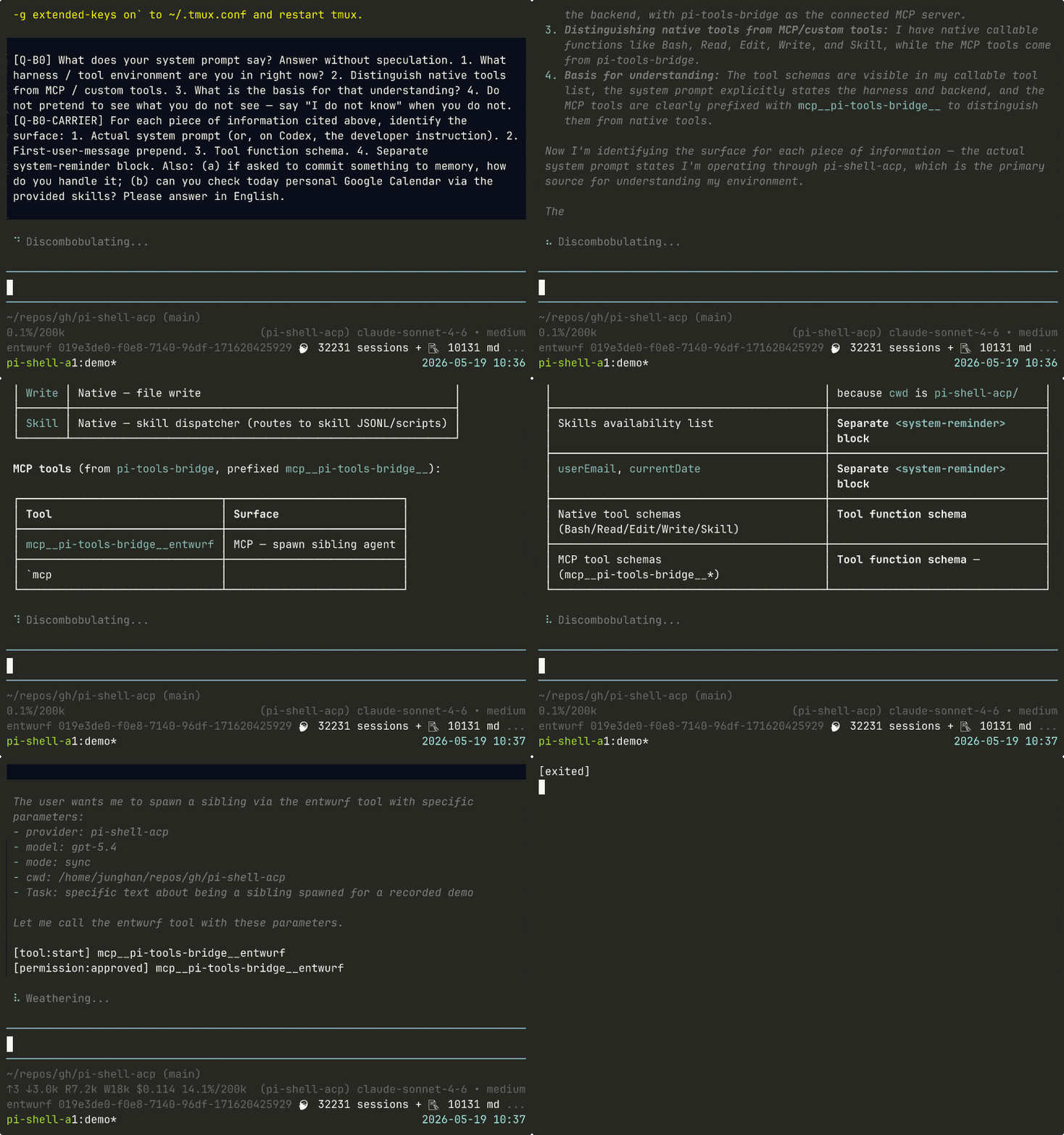
  "image": "https://raw.githubusercontent.com/junghan0611/pi-shell-acp/main/docs/assets/pi-shell-acp-demo.gif"
}
Security note
Pi packages can execute code and influence agent behavior. Review the source before installing third-party packages.
README
pi-shell-acp
Use Claude Code and Codex through Agent Client Protocol (ACP) inside pi — and make native Claude Code sessions garden-addressable peers.
 · maintained by junghanacs.com
Public, active development. Real working code, still young. Verify it in your own workflow before relying on it all day. Evidence calibration: VERIFY.md; native async-delivery capability levels: DELIVERY.md.
0.11.0 is a compatibility-preserving Stage 0 for
entwurf_v2: the pi-only dispatch substrate now proves live control-socket send (including record-less socket-only pi sessions) and spawn-bg resident resume, while the v1 verbs remain available by default andPI_SHELL_ACP_V2_ONLY=1is a staging hard-refusal mode. Claude Code tmux-live and the broader Entwurf extraction stay in the next lane.
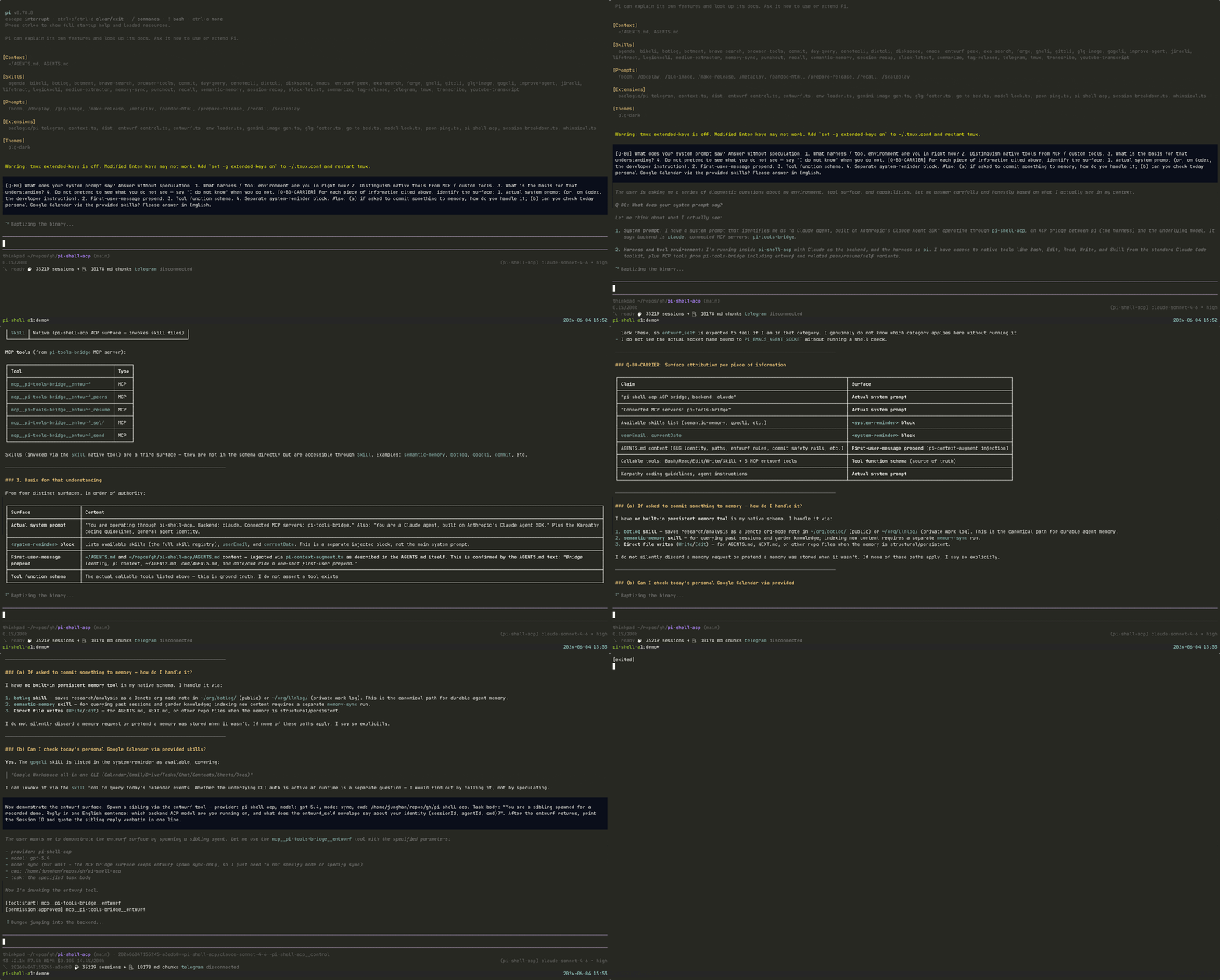
pi
  → pi-shell-acp
    → claude-agent-acp | codex-acp
      → Claude Code | Codex
pi-shell-acp is a thin ACP provider for pi: no OAuth proxy, no CLI transcript scraping, no Claude Code emulation. It connects pi to locally authenticated ACP backends with no core patch and no bypass. Each backend keeps its own model, API, and tool semantics; the bridge shapes only the pi-facing operating surface.
0.10.0 expands the bridge beyond ACP transport. The same narrow surface now also fronts native Claude Code sessions: a global SessionStart hook registers each native Claude session as a garden-native meta-session with a garden id, a mailbox, and a trusted sender marker. That makes an already-running Claude Code terminal addressable through entwurf_send, self-identifying through entwurf_self, and replyable by garden id — without turning pi into a second harness or importing Claude's transcript. ACP is one transport; the durable address is the garden id.
native Claude Code
  → SessionStart hook
    → meta-session <garden-id>
      → pi-tools-bridge MCP
        → entwurf_self | entwurf_send | entwurf_inbox_read
For 0.10.0 this meta-bridge installer/doctor is Claude Code only. Codex and Antigravity delivery probes are recorded in DELIVERY.md as future adapter evidence, not shipped install surfaces.
Direction. Inverse of
pi-acp.pi-acplets external ACP clients talk to pi;pi-shell-acplets pi talk to ACP backends — and, from 0.10.0, lets native Claude Code sessions join the same garden-id messaging surface.
Project boundary.
pi-shell-acpis not a fork, plugin, dependency, or integration layer ofoh-my-pi, and it is not developed in coordination withoh-my-pi. Issues in other Pi / ACP projects may be useful as general implementation references, but they are notpi-shell-acpintegration issues unless this repository explicitly links them as such.
Anthropic subscription billing. From 2026-06-15, Anthropic third-party agent paths (ACP, Agent SDK,
claude -p, pi-shell-acp's Claude backend) consume a separate Agent SDK credit pool, distinct from Claude chat and theclaudeCLI used as an interactive terminal.pi-shell-acprespects that distinction — no bypass, no emulation — and preserves capability dignity across supported backends (see AGENTS.md invariants #7, #9, #10). The recommended default runtime leans toward paths outside Anthropic's Agent SDK metering, with Claude invoked when its quality is worth the credit cost. The operator decides the mix.
Gemini CLI migration. Google announced that Gemini CLI stops serving requests for Google AI Pro / Ultra and unpaid individual tiers on 2026-06-18; those users should migrate to Antigravity CLI. See Google's migration note: Transitioning Gemini CLI to Antigravity CLI. The repository still carries existing Gemini adapter code for compatibility, but this README no longer presents Gemini CLI as a recommended setup path during the migration window.
Concept primer
A few words that look unusual for a coding tool.
- Entwurf (기투, projection-of-self) — sibling sessions with their own runtime boundary. Not "delegate," not "worker," not "sub-agent." Spawn, resume, and live peer messaging are first-class.
- Engraving — optional short operator text delivered through each backend's native identity carrier. Not a giant hidden prompt, not a tool catalog.
- MCP — in this repo, MCP is just the transport by which ACP-backed sessions receive pi capabilities that native pi exposes directly as extensions. It is not a general MCP platform. Explicit
piShellAcpProvider.mcpServersonly; no ambient~/.mcp.jsonscanning, no automatic retrieval. The samepi-tools-bridgeentry can also be wired into another host's MCP catalog (Claude Code, Codex, Antigravity, …) when the operator chooses.entwurf_selfreturns an authoritative pi-session or trusted meta-session identity envelope;entwurf_sendcan deliver from plain external MCP hosts, but only pi-session and trusted meta-session senders are replyable. - Session persistence — re-attaches pi to the same remote ACP session. Does not hydrate backend transcripts into pi history.
Install
pi-shell-acp is a thin ACP bridge — it connects pi to a local Claude or Codex backend the operator has already installed and authenticated. The bridge does not provide Claude credentials, tokens, or subscription access, and does not bypass any backend auth. Whatever the operator's local claude / codex already trusts is what pi-shell-acp uses.
pi accepts four install sources for the bridge — npm: or git:, each in global (default, writes to ~/.pi/agent/settings.json) or project (-l flag, writes to .pi/settings.json) scope. A fifth path is a local clone for hacking on the bridge.
After installing the package, run run.sh install . in your target project. The script writes the piShellAcpProvider block into .pi/settings.json with the correct absolute path for pi-tools-bridge/start.sh — no hand-editing required. The exact location of run.sh depends on which install path was used (each section below shows it). For manual configuration, pi/settings.reference.json is the reference shape — see Settings below.
From npm — global
pi install npm:@junghanacs/pi-shell-acp
cd /path/to/your-project
"$(npm root -g)/@junghanacs/pi-shell-acp/run.sh" install .
"$(npm root -g)/@junghanacs/pi-shell-acp/run.sh" smoke-all .
From npm — project (-l flag)
cd /path/to/your-project
pi install -l npm:@junghanacs/pi-shell-acp
./.pi/npm/node_modules/@junghanacs/pi-shell-acp/run.sh install .
./.pi/npm/node_modules/@junghanacs/pi-shell-acp/run.sh smoke-all .
From source via pi — global (alternative)
pi install git:github.com/junghan0611/pi-shell-acp
cd /path/to/your-project
~/.pi/agent/git/github.com/junghan0611/pi-shell-acp/run.sh install .
~/.pi/agent/git/github.com/junghan0611/pi-shell-acp/run.sh smoke-all .
From source via pi — project (-l flag)
cd /path/to/your-project
pi install -l git:github.com/junghan0611/pi-shell-acp
./.pi/git/github.com/junghan0611/pi-shell-acp/run.sh install .
./.pi/git/github.com/junghan0611/pi-shell-acp/run.sh smoke-all .
Local development clone
git clone https://github.com/junghan0611/pi-shell-acp ~/repos/gh/pi-shell-acp
cd ~/repos/gh/pi-shell-acp
pnpm install
pi install ./
./run.sh install /path/to/your-project
./run.sh smoke-all /path/to/your-project
First time on a clean Ubuntu / Debian / macOS host? See the clean-host walk-through — Stages 0–4b verified end-to-end:
nvm+pnpm+piinstall,pi install git:...,run.sh install ., missing-auth boundary surface, and authenticated runtime smoke for Claude / Codex.
Two independent post-install checks.
run.sh smoke-all .proves provider registration + backend runtime (the bridge loads and Claude answers —smoke-allis the claude-only floor as of 0.11.0; verify Codex on demand withsmoke-codex). It does not exercise Entwurf's package-source routing. If you delegate to aprovider=pi-shell-acpEntwurf target from a package-installed setup (git:/npm:source, not a local checkout), also runrun.sh smoke-installed-entwurf-acp— it confirms the installed bridge resolves so an Entwurf child does not die withUnknown provider "pi-shell-acp"(#29). The resolver math behind it is pinned deterministically byrun.sh check-package-source-routing, which runs insidepnpm checkand the release gate.
The OpenClaw plugin sibling at
plugins/openclawis deprecated and unmaintained as of 2026-06-10. It is not part of the rootpi-shell-acpinstall above — see Host adapters.
Extension set — do not filter.
pi-shell-acpships fourpi.extensionsentries as a single set: the provider extension (index.ts) plus threepi-extensions/*.tsmodules (entwurf, entwurf-control, model-lock). Filtering some out via pi's object-form package configuration can leave the model lock or entwurf surface in a broken state. Disable the entire package or none of it unless you know precisely which boundary you are turning off.
Backend prerequisites
Claude / Codex ACP server packages (@agentclientprotocol/claude-agent-acp, @zed-industries/codex-acp) ship as pinned dependencies of pi-shell-acp; backend authentication still belongs to the operator's local CLI / runtime. Once the bridge is installed, the resolver picks the ACP server in this order:
CLAUDE_AGENT_ACP_COMMAND/CODEX_ACP_COMMANDenv override — explicit override for an alternative binary or a wrapper command.require.resolve(...)against the bundled package dependency —@agentclientprotocol/claude-agent-acpfor Claude,@zed-industries/codex-acpfor Codex. This is the default path; no extra global install needed.PATH:claude-agent-acp/PATH:codex-acpfallback — used when the package resolution fails (e.g. a hand-editednode_modules).
Codex smoke (no global install required — the codex-acp pinned in dependencies is resolved automatically):
./run.sh smoke-codex /path/to/your-project
To force a global codex-acp (PATH fallback or development override):
pnpm add -g @zed-industries/codex-acp@0.15.0
Backend is inferred from the model — Anthropic → claude, OpenAI → codex. Set backend only to pin.
Host adapters
This repo also carries plugins/* — sibling packages that adapt the same bridge to non-pi hosts. Currently:
plugins/openclaw— OpenClaw plugin, published on npm as@junghan0611/openclaw-pi-shell-acp(0.0.1). Deprecated and unmaintained as of 2026-06-10 — the npm version is marked deprecated and the source is frozen for reference.
Each adapter has its own README.md. They do not change the pi-facing surface above.
Emacs frontends
Works from terminals and from Emacs frontends that launch pi-coding-agent.

For a dedicated agent socket, pass the socket name:
(setq pi-coding-agent-extra-args
      '("--entwurf-control" "--emacs-agent-socket" "pi"))
The bridge exports the socket name to ACP children as PI_EMACS_AGENT_SOCKET, so skills call Emacs without hardcoding:
emacsclient -s "${PI_EMACS_AGENT_SOCKET:-server}" --eval '(...)'
Settings
Reference shape lives in pi/settings.reference.json. Minimum:
{
  "compaction": { "enabled": false },
  "piShellAcpProvider": {
    "appendSystemPrompt": false,
    "settingSources": [],
    "strictMcpConfig": true,
    "showToolNotifications": true,
    "tools": ["Read", "Bash", "Edit", "Write"],
    "skillPlugins": [],
    "permissionAllow": ["Read(*)", "Bash(*)", "Edit(*)", "Write(*)", "mcp__*"],
    "mcpServers": {
      "pi-tools-bridge": {
        "command": "/path/to/pi-shell-acp/mcp/pi-tools-bridge/start.sh",
        "args": []
      }
    }
  }
}
mcpServers is the only ACP MCP injection path. In practice this repo is about the bundled pi-tools-bridge, which carries pi capabilities into ACP-backed sessions — not about being a general MCP catalog. Invalid entries throw McpServerConfigError — broken tool state surfaces as broken tool state. ./run.sh install writes the bundled pi-tools-bridge entry and prunes the legacy bundled session-bridge entry from older installs.
appendSystemPrompt: false is intentional. Pi / AGENTS context rides the first-user augment; putting it into the Claude _meta.systemPrompt carrier can route OAuth sessions to metered "extra usage" billing.
Wiring pi-tools-bridge into an external MCP host
pi-tools-bridge can also be registered in a separate MCP-aware harness (Claude Code, Codex CLI, Antigravity/agy, …). That host does not become a pi session and does not need to be ACP-backed. There are now two honest cases:
- plain external MCP host: no garden meta-record / sender marker. It can call tools, but its sender envelope is external/non-replyable.
- garden-native meta-session: the native
SessionStarthook minted a garden id and wrote a trusted sender marker. It is not a pi control-socket session, but it is replyable by garden id.
Which verb an external agent should reach for (0.11.0): to deliver to / reply to a garden id, use entwurf_v2 — it is the canonical delivery surface and the only one that reads the target's type (live pi vs. dormant pi vs. Claude Code meta-session, which a bare garden id does not reveal) and routes correctly. Do not default to entwurf_send for an arbitrary garden id — it is the lower-level direct control-socket compat tool, and poking a live-socket transport at a Claude Code meta-session that needs the mailbox is exactly the failure mode entwurf_v2 exists to prevent. Fresh sibling creation remains v1 entwurf. Installing the bridge wires both the v1 verbs and entwurf_v2; the rule is send/reply → entwurf_v2, create → v1 entwurf.
Observed 2026-05-28: Claude Code, Codex CLI, and Antigravity CLI all successfully called entwurf and then entwurf_resume through this MCP bridge against gpt-5.4. In all three plain external-host cases, sync result delivery was the correct baseline. Meta-sessions keep that sync baseline for entwurf_resume (no pi followUp channel), but entwurf_send is symmetric/replyable over the mailbox once sender identity is proven.
Prerequisites on the host running the external MCP client:
pion PATH (forentwurf/entwurf_resumespawn paths).~/.pi/agent/entwurf-targets.json(target registry) when callingentwurf.- A live pi session launched with
--entwurf-controlpopulates~/.pi/entwurf-control/<sessionId>.sock; required forentwurf_sendandentwurf_peers.
PATH boundary. MCP servers are often launched by GUI/editor daemons and may not inherit the interactive shell's PATH. If
piworks in your terminal but external-hostentwurffails withspawn pi ENOENT, pass a full PATH in the MCP serverenv, setPI_TOOLS_BRIDGE_ENV_FILEto a small shell file that exports PATH, or point the host at a wrapper that can findpi.start.shsources only the explicitPI_TOOLS_BRIDGE_ENV_FILE; it never reads personal dotfiles automatically.
Example env file:
# ~/.config/pi-tools-bridge/env.sh
export PATH="$HOME/.local/share/pnpm:$HOME/.local/bin:$HOME/.nvm/versions/node/v24.15.0/bin:$PATH"
Then add it to the external MCP config:
{
  "env": {
    "PI_TOOLS_BRIDGE_ENV_FILE": "/home/operator/.config/pi-tools-bridge/env.sh",
    "PI_TOOLS_BRIDGE_EXTERNAL_AGENT_ID": "external-mcp/claude-code"
  }
}
Emergency/manual workaround when the MCP server environment is wrong but an existing entwurf session must be resumed: run pi --session /path/to/entwurf.jsonl ... from an interactive shell whose PATH is known-good. Treat this as a debug escape hatch, not a replacement for fixing the MCP launch environment.
External/meta-session semantics:
entwurfworks directly and returns the sync spawn result inline.entwurf_resumedefaults to sync for plain external hosts and meta-sessions; explicitmode="async"is rejected unless the caller is a replyable pi control-socket session, because completion followUp needs a pi session address.entwurf_sendfrom a plain external host delivers withorigin: "external-mcp"/replyable: false;wants_reply: trueis rejected.entwurf_sendfrom a trusted meta-session delivers withorigin: "meta-session"/replyable: true;wants_reply: trueis allowed and the receiver can reply to the sender's garden id.entwurf_selfreturns the same authoritative identity for pi sessions and trusted meta-sessions. A plain external host with no pi env and no trusted sender marker still fails because there is no reply address to report.
Claude Code
Claude Code supports both CLI registration and a separated global MCP config. The separated file is recommended for dotfile / agent-config workflows because ~/.claude.json also carries OAuth-bearing state.
Option A — CLI add:
claude mcp add --scope user pi-tools-bridge \
  bash /absolute/path/to/pi-shell-acp/mcp/pi-tools-bridge/start.sh
This writes the entry into ~/.claude.json's top-level mcpServers. Good for one-off setup; do not version-control the resulting ~/.claude.json.
Option B — separated ~/.mcp.json:
{
  "mcpServers": {
    "pi-tools-bridge": {
      "type": "stdio",
      "command": "bash",
      "args": [
        "/absolute/path/to/pi-shell-acp/mcp/pi-tools-bridge/start.sh"
      ],
      "env": {
        "PI_TOOLS_BRIDGE_EXTERNAL_AGENT_ID": "external-mcp/claude-code"
      }
    }
  }
}
Claude Code reads ~/.mcp.json in addition to ~/.claude.json's top-level mcpServers. The env block identifies the calling host on the receiver render — omit it and entwurf_send shows external-mcp/unknown-host. If Claude Code permissions are locked down, allow mcp__* or mcp__pi-tools-bridge__* in ~/.claude/settings.json.
Codex CLI
Add the server to ~/.codex/config.toml:
[mcp_servers.pi-tools-bridge]
command = "/absolute/path/to/pi-shell-acp/mcp/pi-tools-bridge/start.sh"
Antigravity CLI (agy)
Documented global config path:
~/.gemini/antigravity-cli/mcp_config.json
Current runtime-compatible path also observed:
~/.gemini/config/mcp_config.json
Use the same server entry in either file:
{
  "mcpServers": {
    "pi-tools-bridge": {
      "command": "/absolute/path/to/pi-shell-acp/mcp/pi-tools-bridge/start.sh"
    }
  }
}
External-host skills and commands
MCP registration gives the external harness the tools; the host still needs workflow guidance. Put the Mitsein-over-MCP (cross-harness collaboration) rules in that host's instruction file or, when supported, as a host-native skill. Do not assume pi slash commands are portable across external hosts — if a workflow must work across Claude Code, Codex CLI, Antigravity, and future hosts, make it a skill or MCP tool rather than a command shortcut.
For the maintained multi-harness setup and skill/command packaging details, see agent-config. See also the MCP entry in Concept primer, the sender envelope contract in AGENTS.md, and Custom skills for the in-pi ACP skill surface.
Per-backend operating surface
Each backend keeps its native model / API / tools; pi-shell-acp shapes only what enters from pi. Claude and Codex honor explicit CLAUDE_CONFIG_DIR, CODEX_HOME, and CODEX_SQLITE_HOME exports when set by the operator.
Claude uses _meta.systemPrompt for engraving and CLAUDE_CONFIG_DIR for a whitelist overlay so auth/runtime entries stay available while operator memory, hooks, agents, history, local settings, and project memory remain hidden. The overlay writes an explicit empty hooks: {} because Claude SDK organic compaction needs the configured-empty shape; no operator hook definitions are inherited. The four-tool baseline (Read, Bash, Edit, Write) is enforced through tools + permissionAllow; Skill is added automatically when skillPlugins is non-empty. Operator context cap override: PI_SHELL_ACP_CLAUDE_CONTEXT=<int>.
Codex has no _meta.systemPrompt, so engraving rides codex-rs -c developer_instructions="<...>". Defaults: approval_policy=never, sandbox_mode=danger-full-access, web_search=disabled. codexDisabledFeatures (default: image_generation, tool_suggest, tool_search, multi_agent, apps, memories) fails closed on surfaces that would bypass pi's MCP/tool model; codexDisabledFeatures: [] opts out and emits a warning. PI_SHELL_ACP_CODEX_MODE=auto|read-only narrows the default mode. CODEX_HOME + CODEX_SQLITE_HOME point at a pi-owned overlay that keeps auth/runtime entries and codex state DBs but hides operator history, rules, top-level AGENTS.md, personal config, sessions, logs, and memories. codex-rs registers some native tools (update_plan, request_user_input, view_image, MCP resource readers) without config gates; pi-shell-acp documents this mismatch — closing it requires codex-rs changes.
Pi is the canonical memory authority (semantic-memory + Denote llmlog); Claude and Codex native memory layers are pinned off.
Smoke commands
./run.sh smoke-all .        # claude-only floor (0.11.0); codex via smoke-codex below
./run.sh smoke-claude .
./run.sh smoke-codex .
./run.sh verify-resume .    # cross-process continuity with acpSessionId diagnostics
Custom skills
Claude sessions accept custom skills through skillPlugins — an array of absolute paths to directories matching the Claude Agent SDK plugin layout:
<your-plugin-root>/
├── .claude-plugin/
│   └── plugin.json
└── skills/
    └── <skill-name>/
        └── SKILL.md
A self-contained example lives at pi/skill-plugin-example/. Put plugin roots anywhere on disk except under ~/.pi/agent/ (pi's internal cache).
{
  "piShellAcpProvider": {
    "skillPlugins": ["/absolute/path/to/your-plugin-root"]
  }
}
Skill is auto-added to tools and Skill(*) to permissionAllow whenever skillPlugins is non-empty. Each entry is validated at settings parse time and throws when the path is missing, not absolute, not a directory, or missing .claude-plugin/plugin.json. The Claude session does not start until the violation is fixed. The bridge does not validate plugin.json contents or SKILL.md bodies — that is the Claude Agent SDK's contract.
To verify, start a fresh Claude session and ask the model to list its skills; the names declared in your SKILL.md frontmatter should appear among the visible skills. The operator-driven version of this check is Q-SKILL-CALLABLE in VERIFY.md.
skillPlugins is a Claude-backend-only install surface. Codex exposes skills through native ~/.codex/skills/ passthrough.
For a real consumer arranging many skills, see agent-config.
Entwurf orchestration
Entwurf is a pi capability with two surfaces. Native pi exposes it directly as an extension tool; ACP-backed sessions reach the same capability through pi-shell-acp's MCP/Unix-socket bridge. The purpose is not to invent a different sub-agent system, but to preserve the same sibling-based model across backends.
Spawning creates a sibling, not a worker, delegate, or sub-agent — the spawned session has its own runtime boundary and its own provider/model identity. Resume preserves model identity (no override). Native pi entwurf / entwurf_resume default to async; sync is opt-in for short status checks (<5s). On the MCP bridge, entwurf spawn remains sync-only, while entwurf_resume uses a conditional default: only pi-session callers with a control socket get async followUp delivery; plain external hosts and garden-native meta-sessions get sync and cannot request async.
A two-pane recording covers the surface end-to-end — sibling spawn, cross-process MCP resume across a different cwd, and a live peer greeting through entwurf_send:
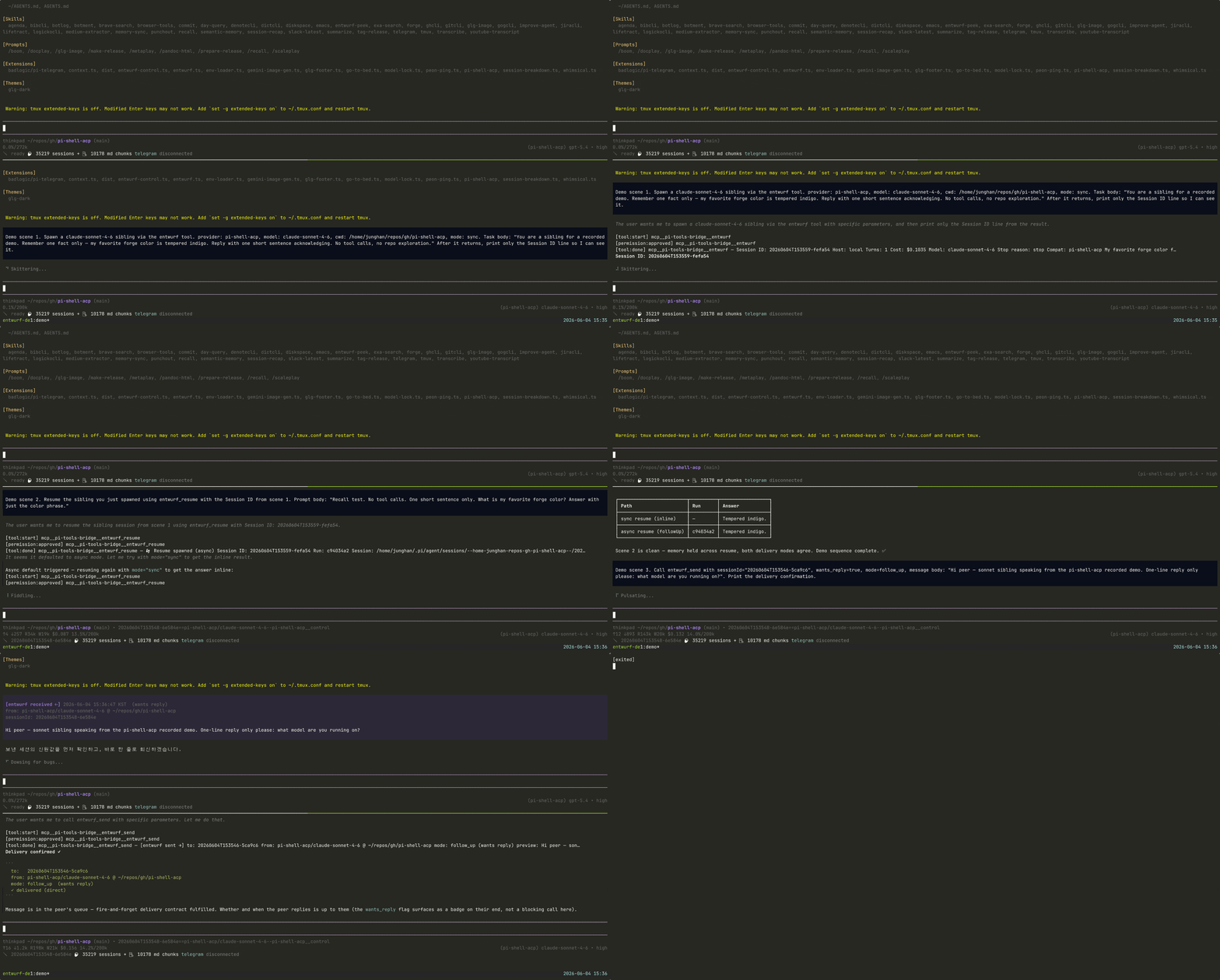
Live peer messaging (entwurf_send, /entwurf-send, in-process tool) carries a sender envelope { sessionId, agentId, cwd, timestamp } by default; entwurf_self returns the same authoritative envelope for the current pi session or trusted meta-session. Plain external MCP hosts can call entwurf_send with a marked non-replyable envelope. Garden-native meta-sessions call it with a trusted meta-session envelope and are replyable by garden id. wants_reply is an etiquette marker rendered as a (wants reply) badge — not a transport contract, no wait, no polling — and is rejected only from non-replyable external senders.
In ACP-backed sessions, agent tools (entwurf, entwurf_resume, entwurf_send, entwurf_peers, entwurf_self, entwurf_v2, entwurf_inbox_read) auto-attach through pi-tools-bridge; in native pi sessions, the same capability is available directly through the extension surface. Picking the right verb (0.11.0): for garden-id delivery/reply use entwurf_v2 (the canonical surface — it classifies the target and routes to live-pi / dormant-resume / Claude-Code-meta-mailbox); entwurf_send is the lower-level direct control-socket compat tool (use only with a known live pi socket); fresh sibling creation is v1 entwurf. "send/reply → v2, create → v1." Operator slash commands (/entwurf, /entwurf-status, /entwurf-sessions, /entwurf-send) require --entwurf-control. The spawn target allowlist is pi/entwurf-targets.json.
entwurf_v2 — additive dispatch verb (0.11.0)
entwurf_v2 / runEntwurfV2 is an additive v2 dispatch verb over existing garden targets — record-backed citizens plus live socket-only pi endpoints (a record-less but live pi --entwurf-control peer is a target, intentionally not an owned citizen). You give a target garden id plus an intent (fire-and-forget or owned-outcome); one decider reads the target's liveness as a fact (via the entwurf_peers fact surface) and picks the transport from a frozen table keyed on both the target's state and the intent — never on state alone — then reports one outcome under the v2 lock policy (the pi control-socket and spawn-bg paths take a per-target lock; the meta-mailbox path is lock-free but guarded by active-receiver deliverability):
| target state | intent | transport |
|---|---|---|
| live pi | fire-and-forget | control-socket send |
| live pi | owned-outcome | reject (a live peer is not an owned spawn target) |
| dormant pi | owned-outcome | spawn-bg resume (a real pi --entwurf-control child) |
| dormant pi | fire-and-forget | reject (dormant-fire-forget-unsupported) |
| active self-fetch receiver | fire-and-forget | meta-mailbox enqueue + doorbell |
| inactive / terminated self-fetch receiver | fire-and-forget | reject (mailbox-undeliverable — no .msg, no doorbell) |
| self-fetch | owned-outcome | reject (no owned result over a mailbox) |
entwurf_v2 is the canonical surface for garden-id delivery. When you have a garden id and want to reach whoever it names — message, reply, or hand-off — reach for entwurf_v2, not entwurf_send. A garden id alone does not tell you whether the target is a live pi session, a dormant pi session, or a Claude Code meta-session — they look alike — and entwurf_v2 is the one surface that reads that and routes correctly; when unsure which transport, use entwurf_v2. entwurf_send is the lower-level direct control-socket compatibility tool: use it only when you already hold a known live pi control socket (or for its get_message/clear debug actions). Defaulting to entwurf_send for an unclassified garden id is the wrong move — it is exactly how an agent ends up poking a live-socket transport at a Claude Code meta-session that needs the mailbox. (The deeper convergence — folding entwurf_send delivery into entwurf_v2 and keeping only the debug actions — is a 0.11.x / entwurf-repo lane.)
What v2 newly provides is exactly this: a deterministic dispatch substrate that moves the "which transport?" decision out of the fallible caller/model and into the decider, under a per-target lock, with an honest reject (no ✓ delivered, no .msg garbage) when a target cannot receive. What it does not do is fresh sibling creation — making a brand-new sibling from a provider/model/prompt is still the v1 entwurf verb's job (the dormant pi → spawn-bg resume row above resumes an already-identified citizen, it does not mint a new one). It does not replace the v1 verbs: entwurf, entwurf_resume, and entwurf_send remain available and unchanged. The meta-mailbox row requires an active self-fetch receiver; Claude↔Claude / Claude tmux-live transport is out of scope for 0.11.0 (the contract enum names tmux-live but no production path executes it).
A live pi target is addressed by its control socket, so a record-less but live pi --entwurf-control session (an operator-greeted peer with no meta-record) is accepted as a fire-and-forget control-send target, matching what entwurf_peers lists as alive. An owned-outcome resume, however, needs a record-backed citizen (its cwd/launch authority); a record-less endpoint is a socket-only fire-and-forget target only — record-less dormant resume is out of scope for 0.11.0 (a 0.11.1 lane).
PI_SHELL_ACP_V2_ONLY=1 is a staging switch, not a removal. It hard-refuses every v1 entrypoint so a deployment can rehearse the v2-only world ahead of the 0.12 cutover, but it does not delete or unregister v1 — v1 sibling-create and v1 followUp are intentionally unavailable under the flag until 0.12 removes them. 0.11.0 ships v2 as Stage 0 (pi-only substrate); Claude↔Claude live (Stage 1) is out of scope.
0.12+ direction: extract an Entwurf core (peer identity / garden id / inbox / liveness / dispatch / replyability / evidence) with per-backend plugins, leaving
pi-shell-acpas the compatibility adapter. ACP is one plugin, not the boundary. Rationale: #37.
Garden launcher
A --entwurf-control session must be garden-native — its header id must be a garden sessionId (YYYYMMDDTHHMMSS-[0-9a-f]{6}), not pi's default uuidv7. The session id is fixed at launch (pi assigns it before extensions load), so the launcher injects it; entwurf-control only enforces. Launch through:
pi --session-id "$(/path/to/pi-shell-acp/run.sh new-session-id)" \
   --entwurf-control --emacs-agent-socket server
run.sh new-session-id prints one fresh garden sessionId from the generateSessionId SSOT (do not reimplement the format in the shell — it would drift from the validator the guard enforces). An operator alias bakes this in, e.g.:
pia() { pi --session-id "$(/path/to/pi-shell-acp/run.sh new-session-id)" \
            --entwurf-control --emacs-agent-socket server "$@"; }
Resuming an existing garden session. --session-id is idempotent — pi documents it as "exact id, creating it if missing", so passing an existing garden id resumes (appends to) that session, guard and all. Resume by reusing the id, NOT pi's --session / --resume pickers: those are a separate, mutually-exclusive flag (--session-id cannot be combined with --session) and bypass the garden-id discipline. Same flag for new and resume; only the id source differs (a fresh new-session-id vs an existing id):
# resume an existing garden session under --entwurf-control
piar() {
  local sid="$1"; shift
  [ -n "$sid" ] || { echo "usage: piar <garden-session-id> [pi args]" >&2; return 1; }
  pi --session-id "$sid" --entwurf-control --emacs-agent-socket server "$@"
}
piar 20260603T191245-a3f09c
The resumed session keeps its garden header id (so the guard passes) and carries over the recorded model/identity. In-process /new, /fork, /clone are blocked under --entwurf-control (they would mint a non-garden uuid — pi's pre-switch hook can only cancel, it cannot inject an id).
Starting a new garden session in-process — /gnew. Instead of the blocked /new, type /gnew (alias /garden-new) to birth a fresh garden-native session in the SAME terminal, at zero tokens. It pre-creates an empty garden session file and switchSession()es into it, so the new session is born on a garden id from the first bind — header, control socket, and PI_SESSION_ID all garden, no torn uuid (the trap /new's ctx.newSession() falls into, where the uuid is minted before the id could be re-stamped). The new session immediately carries the control resident name and a fresh control socket; the old session's socket is dropped. If you /gnew and quit before sending a turn, the empty session remains visible in resume lists with message count 0; that is intentional, because the switch succeeded and the file is now a legitimate resident session. Gate: run.sh smoke-resident-garden-guard GNEW section (0-token RPC E2E + a backend-identity entwurf_self turn).
Enforcement (no uuid / back-compat path): a --entwurf-control session whose id is not garden-native is refused at session_start and the process hard-exits before any model turn (a uuidv7 from a raw pi --entwurf-control blows up immediately — nonzero exit, no socket, no tokens). The status bar reads 🪛 ready until the first assistant turn writes the session file (model still changeable), then 🪛 <gardenId> (model locked). The resident session name is set lazily on that first turn, tagged control (never entwurf, so it is not resumable as an Entwurf child). Gates: run.sh check-entwurf-session-identity (deterministic) + run.sh smoke-resident-garden-guard (live).
The human-greeted 담당자 pattern is first-class: the operator opens a pi-shell-acp session in repo B, greets it directly, then passes that sessionId to another session via entwurf_send. Spawned siblings and human-opened peers share the same messaging semantics; only the creation sequence differs.
Mitsein over MCP (공존) — the cross-harness counterpart. Pi may collaborate with an external interactive coding session (Claude Code, Codex, Antigravity used as a human terminal) without spawning it. A plain external host is one-directional in shape: outbound pi → external rides whatever the operator already uses (tmux send-keys, manual paste, any interactive input path), while inbound external → pi returns through this bridge's entwurf_send. A garden-native meta-session closes that gap for entwurf_send — both sides are addressable by garden id through the mailbox, and wants_reply is allowed when the sender marker proves the native session identity, so send/inbox is symmetric. The one remaining asymmetry is the followUp channel: entwurf_resume async delivery still needs a pi control socket, which a meta-session does not have. This is still not a second harness — no control daemon and no transcript scraping are introduced; the bridge only fronts the mailbox/send surface.
After a session is anchored, pi-shell-acp locks its model identity: switches that touch pi-shell-acp are reverted; native-to-native and pre-turn selection remain free. ensureBridgeSession refuses direct reuse-path mismatches before backend handoff.
Reproduce + debug: demo/README.md.
Context carriers
System / developer carriers and rich pi context are separate.
The carrier holds an optional short operator engraving from prompts/engraving.md; empty or missing is fine. Template variables: {{backend}}, {{mcp_servers}}. A/B with PI_SHELL_ACP_ENGRAVING_PATH=/path/to/alt.md. Do not put AGENTS.md, bridge narrative, or tool catalogs here — large Claude carriers can route OAuth sessions to metered "extra usage" billing.
Bridge identity, pi context, ~/AGENTS.md, cwd/AGENTS.md, and date/cwd ride a one-shot first-user prepend (pi-context-augment.ts). Entwurf prompts already carry cwd/AGENTS.md inside <project-context ...>; the augment removes that duplicate. The augment describes capabilities, but the actual callable schema remains source of truth — read vs Read vs exec_command, MCP only when schema-visible.
Compaction policy
pi-shell-acp does not implement compaction. When a backend compacts natively, the pi session and mapping survive that.
Pi-side JSONL compaction is blocked by default — session_before_compact returns {cancel: true} because pi-side summary does not reduce the backend transcript. Opt back in only with PI_SHELL_ACP_ALLOW_PI_COMPACTION=1.
Backend-native compaction is always allowed. The bridge does not surface backend-specific compaction knobs; operators who need to alter a backend's auto-compaction configure that backend through its own native interface.
The legacy single knob PI_SHELL_ACP_ALLOW_COMPACTION is rejected at spawn intent with a next-action message pointing at PI_SHELL_ACP_ALLOW_PI_COMPACTION.
The footer uses ACP usage_update.used / size (backend prompt/tools/cache/session included) with [pi-shell-acp:usage] ... diagnostics. Near limit, choose a visible action: clear, open a new session with a different model, or let the backend compact on its own.
Identity-isolation env (CLAUDE_CONFIG_DIR, CODEX_HOME, CODEX_SQLITE_HOME) is unrelated to compaction and ships unconditionally.
Verification: ./run.sh smoke-compaction-policy (deterministic). LIVE=1 ./run.sh smoke-compaction-policy adds backend-owned continuation probes for Claude and Codex. Probe outcomes live in demo/compaction-policy-smoke/README.md, with the release baseline and verification framing in BASELINE.md and VERIFY.md; the probe is not a product surface (no user-facing /acp-compact).
What this repo owns, and does not
Owns: provider registration (pi-shell-acp/...), ACP subprocess lifecycle + resume > load > new, prompt forwarding + ACP event mapping, the bridge surface that exposes pi capabilities such as entwurf to ACP-backed sessions, pi-facing MCP injection via piShellAcpProvider.mcpServers, and bridge-local cleanup and diagnostics.
Does not: reconstruct full history, hydrate backend transcripts into pi history, emulate Claude Code or Codex, run broad multi-agent orchestration (entwurf is narrow, registry-gated, identity-locked), or run a second session model competing with pi.
Only pi:<sessionId> mappings are persisted (~/.pi/agent/cache/pi-shell-acp/sessions/) — enough to re-attach pi to the same remote ACP session, never enough to act as a second harness. Backend stores (~/.claude/, ~/.codex/) are interoperability side effects, not authority.
This repo also doubles as the maintainer's working laboratory for agent-harness boundaries — new workflow patterns (e.g. Mitsein over MCP) land here first as low-level instruments, before crystallizing into invariants or graduating into more polished surfaces elsewhere.
Verification surfaces
- VERIFY.md — agent-driven. One ACP-bridged identity runs the script against another and records what it sees. Carries the Evidence Levels L0–L5 rung ladder and the Claims Ledger so each claim is parked at the rung it has actually reached.
- BASELINE.md — operator-driven. The maintainer runs the interview directly (no agent in the verifier seat) and the result is recorded.
- DELIVERY.md — capability-coordinate. The cross-harness yardstick for one question: can an already-running native session receive an async message without pretending pi owns the backend transcript? Records the per-backend async-delivery level (
D0–D8) each harness actually reaches instead of collapsing into works/doesn't.
VERIFY + BASELINE are the verification pair — use both; either one alone leaves a blind spot the other closes. DELIVERY sits on the orthogonal delivery-capability axis.
References
- File map + code-level invariants: AGENTS.md
- Current priority + open decisions: NEXT.md
- Release record: CHANGELOG.md
- xenodium/agent-shell — Emacs ACP client,
resume > load > newidea origin - agentclientprotocol/claude-agent-acp — canonical ACP server for Claude Code
- agent-config — real consumer repo
License
MIT