@lincoln504/pi-research
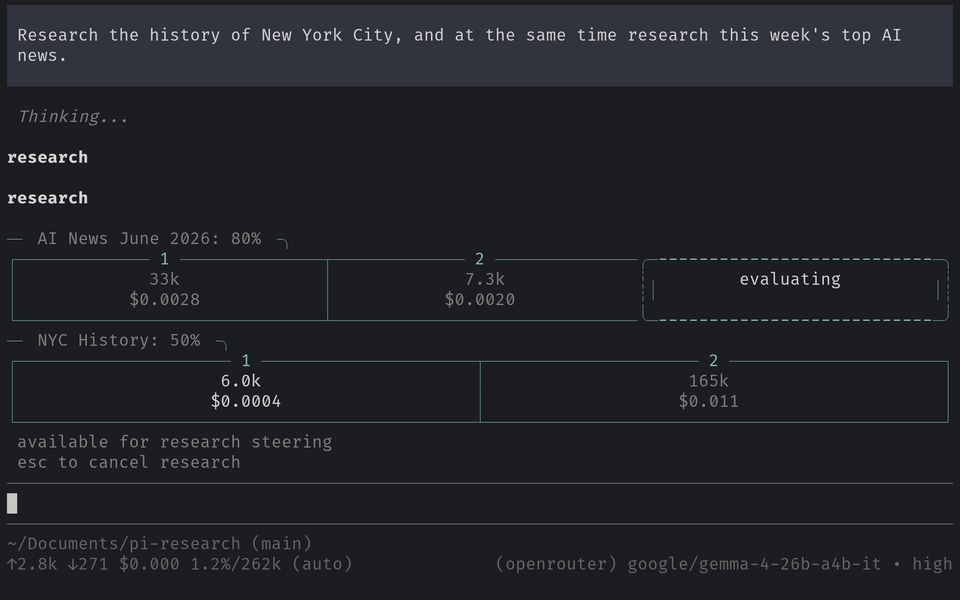
A set of web research tools (search, scrape, and others) and research agent system that uses them safely and efficiently.
Package details
Install @lincoln504/pi-research from npm and Pi will load the resources declared by the package manifest.
$ pi install npm:@lincoln504/pi-research- Package
@lincoln504/pi-research- Version
1.0.6- Published
- Jul 4, 2026
- Downloads
- 153/mo · 55/wk
- Author
- ldeen
- License
- MIT
- Types
- extension
- Size
- 3 MB
- Dependencies
- 19 dependencies · 0 peers
Pi manifest JSON
{
  "extensions": [
    "./src/index.ts"
  ],
  "image": "https://raw.githubusercontent.com/Lincoln504/pi-research/main/docs/media/hero.png"
}
Security note
Pi packages can execute code and influence agent behavior. Review the source before installing third-party packages.
README
Research is broken into subtasks automatically, with each sub-researcher given a high volume of sources to investigate. Then, evaluator decides whether the answer is complete or an additional round of research is needed. The final result is a synthesized cited report.
Ask in natural language — the tool understands the depth needed:

Use cases
- Plug-and-play (no API key needed) research tool for your pi.
- Research from Claude Code, Codex, or another coding agent, with a cheaper lightweight or local model driving the research so it doesn't spend your main agent's budget.
- Populating a dataset or building an index of knowledge sources from the web.
- Holding research in the knowledge store with a configurable scope — project-specific or globally user-scoped, set per directory from the
/research-configTUI. - Using the pi-research agent skill as OpenClaw's web access.
- Building agent systems that identify and examine web sources.
Advantages
- Unlimited search and scrape, for free — you only pay for LLM tokens.
- Context-efficient — it returns a synthesized, cited report to the chat instead of dumping raw web content into the conversation.
- Safe by design — web access runs inside a specialized, limited research agent with no filesystem or shell access.
- Search a little or a lot — three depth levels in the pi tool (four via the SDK and standalone CLI, which add the quick depth-0 path). Levels 1 and 2 are recommended for everyday workflow use; level 3 is for larger-scale investigations.
Requirements / limitations
- Node.js >= 22.19.0
- An LLM with a 100k+ context window (bring your own key)
- Internet access
- A residential IP address — search, scraping, and YouTube transcripts all rely on a residential connection. A datacenter/VPS/cloud IP gets bot-blocked by the providers these features depend on.
- The pi runtime the engine builds on —
@earendil-works/pi-ai,@earendil-works/pi-coding-agent, and@earendil-works/pi-tui. The pi extension uses the host's copies; the standalone CLI / agent skill install them as dependencies. - Cloudflare and similar anti-automation systems block scraping on some sites, so runs will identify sources they cannot reach. pi-research compensates with volume: the search tool rapidly pulls a large set of results off free DuckDuckGo, giving the model a wide selection of reachable content to cite.
Install
pi install npm:@lincoln504/pi-research
See Agent skill or SDK for standalone (no pi extension) installation.
The pi extension works out of the box — it runs on your pi session's model and pi's own configuration. Standalone use (agent skill / CLI) requires a configured model: set PI_RESEARCH_MODEL (e.g. openai/gpt-4o) as an environment variable or in ~/.pi/research/config.env (the CLI also accepts a per-run --model), plus PI_RESEARCH_API_KEY if you don't use pi; the SDK takes a model option. See Configuration.
The first install pulls the stealth browser engine, which takes a few minutes.
Stability (v1.x.x)
v0.1.13 (April 2026) was the last release before a rebuild against current pi APIs and the stealth-browser stack. v1.0.0 is the first stable release since. Channels:
- npm (
npm:@lincoln504/pi-research) is the stable channel, kept current with breaking pi changes. - A git install is the development channel: latest commits, first to break.
License
MIT. Bundled third-party licenses are listed in docs/THIRD-PARTY-NOTICES.md.