@llblab/pi-claude-usage
Minimal Pi extension that shows Anthropic Claude subscription usage limits using Pi OAuth auth
Package details
Install @llblab/pi-claude-usage from npm and Pi will load the resources declared by the package manifest.
$ pi install npm:@llblab/pi-claude-usage- Package
@llblab/pi-claude-usage- Version
0.2.1- Published
- Oct 3, 2026
- Downloads
- 236/mo · 236/wk
- Author
- llblab
- License
- MIT
- Types
- extension
- Size
- 116.9 KB
- Dependencies
- 1 dependency · 4 peers
Pi manifest JSON
{
  "image": "https://github.com/llblab/pi-claude-usage/raw/main/banner.jpg",
  "extensions": [
    "./index.ts"
  ]
}
Security note
Pi packages can execute code and influence agent behavior. Review the source before installing third-party packages.
README
pi-claude-usage
Pi extension for Anthropic Claude subscription usage state and optional Fast mode
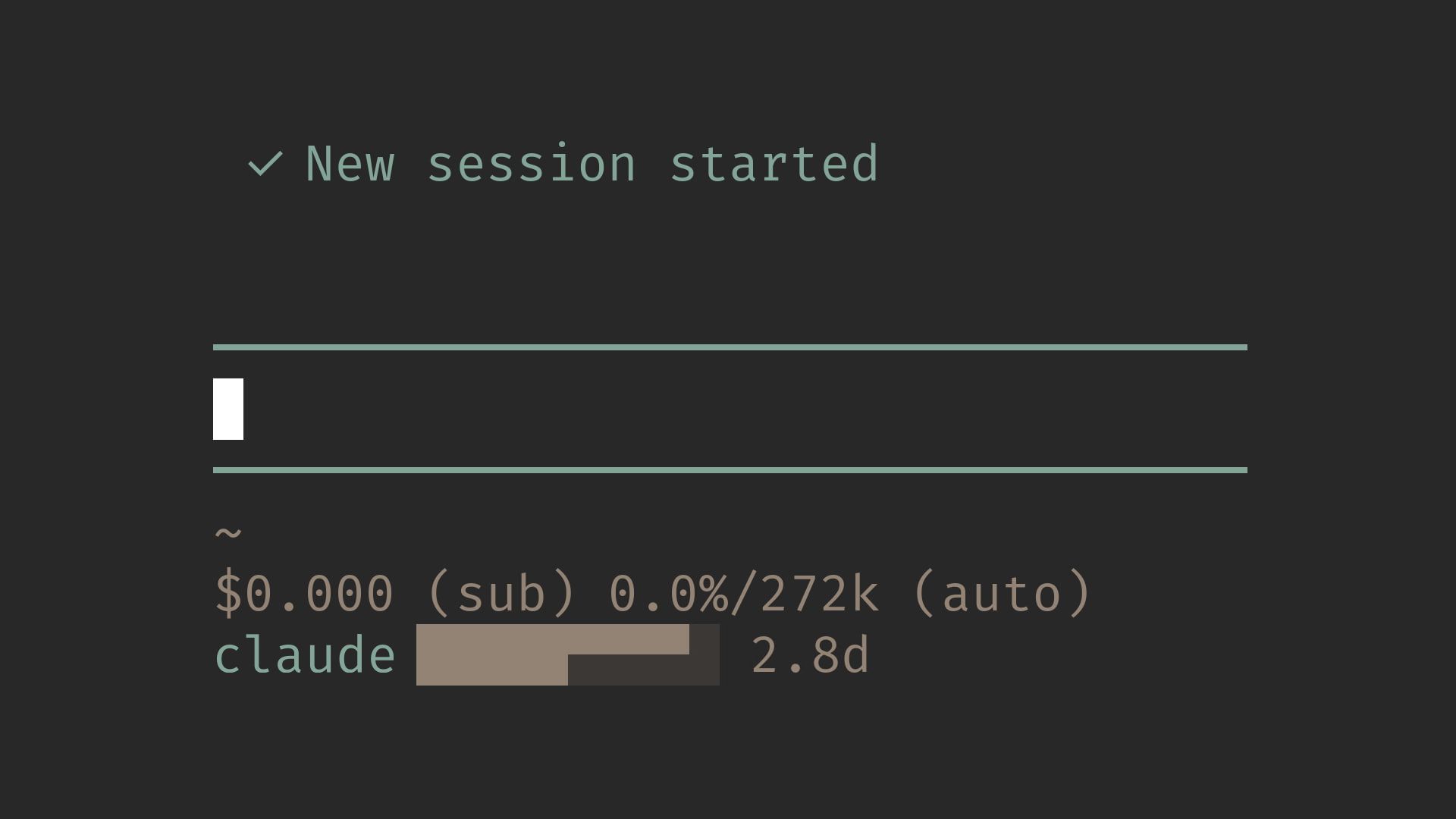
This extension owns usage state + usage mode: zero-configuration quota reporting and an optional per-model Fast preference. Shared command arbitration/JSONC editing belong to @llblab/pi-command-fast, a normal library dependency, not another Pi extension.
This repository is an adaptation of pi-codex-usage for Anthropic Claude Pro/Max subscriptions. It keeps the statusline design, but reads quota from the Anthropic OAuth usage endpoint using Pi's own Anthropic login.
Start Here
Features
- Shows two counter-moving half-height markers in the statusline bar while quota is loading, then keeps the bar fresh (the countdown ticks locally)
- Keeps the last usable bar visible during ordinary refreshes instead of replacing known quota with a loading state
- Dual bar: the top half shows the 5-hour session window and the bottom half shows the 7-day window, 20 steps (5% each) per window
- If only one window is returned, shows its remaining percentage and reset countdown instead of a bar
- Shown only while the active model uses the Pi
anthropicprovider - When
pi-telegramis available, the same compact value appears asclaude: <value>in the/startmenu status text - Missing OAuth auth, API-key-only auth, or missing quota windows are shown as
n/a, not as an error - Network/provider failures keep the last good bar, then show
errorafter repeated failures - Any number of Pi instances share one request stream, see Shared Refresh
- No commands or configuration are required for quota display; the optional shared
/fasttoggles native request speed
Install
Requires Pi ≥1.0.0 for the native beta-preserving Fast bridge. Older Pi (including 0.84.2) assembles Anthropic headers differently and is not supported by this release.
From npm:
pi install npm:@llblab/pi-claude-usageFrom git:
pi install git:github.com/llblab/pi-claude-usageDevelopment
The shared @llblab/pi-command-fast@^0.1.0 dependency now resolves from npm; no sibling library checkout is required.
npm ci
npm run validate
For explicitly local library experiments, a temporary folder link reads the library's built dist/, not TypeScript source directly. Rebuild after source edits and restore the registry dependency/lock before publishing; see Backlog.
Fast mode
/fast takes no arguments and dispatches by the current provider. This consumer permits Fast for the Opus family (claude-opus- model IDs), without pinning versions. Sonnet, Haiku, Fable, Mythos and other families receive Fast mode is supported only for Opus without config writes or quota requests. Family eligibility does not guarantee backend support: older or otherwise unsupported Opus versions can still receive an API rejection. For eligible models it persists only the following model override in Pi's canonical models.json (honoring PI_CODING_AGENT_DIR):
{
  "providers": {
    "anthropic": {
      "modelOverrides": {
        "your-current-model": { "speed": "fast" }
      }
    }
  }
}
OFF deletes only speed; there is no normal/default sentinel or separate Fast config. JSONC comments, unrelated fields and other providers/models survive. State follows the selected model and restart; manual edits are reread on lifecycle refresh and every request. Stale speed: "fast" overrides on unsupported models do not enable the suffix or this extension's request bridge; they are preserved, not silently deleted. Remove such a stale property manually if needed.
When Claude Usage and Codex Usage are loaded together, their shared library registers one /fast in either load order, across separate physical library copies. Its WeakMap is keyed by session manager; shutdown releases registrations because Pi reload reuses that identity. Unrelated providers receive a concise unsupported-provider message; invalid arguments show Usage: /fast. Successful toggles are silent and immediately redraw the existing terminal status without a quota request:
claude ██████▀▀▀▀ 6d fastExactly lowercase fast uses the existing dim/countdown role at the final terminal presentation boundary, including loading, single-window percentages, n/a and errors. Telegram also appends plain-text fast for the active eligible model; quota OAuth, polling, mutex, fencing and backoff are unchanged.
Native request adaptation adds speed: "fast" without overwriting an explicit speed. It adds fast-mode-2026-02-01 to Pi's already-assembled request betas, preserving automatic OAuth/thinking/streaming and configured betas; the Anthropic SDK converts that list to the final anthropic-beta HTTP header. Setting a replacement header earlier would suppress Pi's automatic betas, so no header replacement or custom provider/transport is used. See Anthropic Fast mode.
Pi 1.0.0 accepts the extra override but does not propagate speed to native request options, so the bridge is necessary. There is no public command unregister/conditional-visibility API: /fast stays listed and checks the provider and consumer model capability when invoked. A stored preference/suffix is intent, not evidence that the backend served Fast. Anthropic also requires Fast usage credits and organization-level permission; a supported model can still be rejected (for example, 429 credits_required with org_level_disabled). The extension never enables billing or buys credits.
Statusline
claude ██████▀▀▀▀ 6dThe ten-character bar encodes two twenty-step limits at once: the top quadrants show the remaining 5-hour limit and the bottom quadrants show the remaining weekly limit. If either window is exhausted, the bar keeps its shape but switches to the error background color.
When the weekly reset time is available, it follows the bar. More than a day remains is shown in 144-minute day-tenth steps such as 7d, 6.9d, 1.1d, rounded upward. At 24 hours and below it switches to upward-rounded hour-tenths such as 24h, 23.7h, 1.1h, 1h. Under an hour it shows floored minutes, then seconds. After the reset passes, 0s is held until the next successful refresh.
When the 5-hour window is exhausted and exposes its reset time, the statusline adds it before the weekly reset:
claude ▄▄▄▄▄⠀⠀⠀⠀⠀ 5h/7dIf only one window is returned, the exact remaining percentage is shown:
claude 67% 7dUnavailable (no Anthropic subscription auth):
claude n/aRuntime failure, such as a network or provider error (including rate limiting of the usage endpoint):
claude errorShared Refresh
The extension ships an export-only index.ts and a flat domain DAG under lib/, matching Codex Usage's layout. extension.ts composes lifecycle/Fast wiring; status.ts orchestrates refresh and redraw; usage-store.ts owns shared claims/fencing/mutex; query.ts owns OAuth/HTTP; usage.ts normalizes quotas; status-format.ts formats values; telegram.ts owns optional registration; fast.ts adapts native Fast requests. Domains never import the entrypoint, and tests are organized by domain in tests/.
To avoid independent polling, instances coordinate through ~/.pi/agent/tmp/pi-claude-usage/usage.json (percentages and timestamps only, no tokens):
- The instance that last updated the file is the leader and refreshes it every minute
- Every other instance only reads the file (re-checking every ≤30s) and redraws when it changes
- Leadership is never cached in memory: before each usage request, the instance re-reads the file and checks its
owner, uniqueclaimId, and 90s lease. Publication rechecks that claim under the lock; a superseded success or failure is discarded. Failed locks or unwritten claims never authorize a request - If the file is 90 seconds old (leader is closed, busy, or asleep), the first follower that obtains the mutex takes over: it re-reads the JSON, writes itself as the leader with a fresh timestamp, releases the mutex, then fetches from the server and publishes under the mutex after rechecking its claim. Its next refresh is one minute later; JSON writes remain atomic renames
- Claiming and publication use a non-waiting transaction in
mutex.sqlite, through Node's built-innode:sqlite(Node ≥22.19.0, the existing package minimum). It stores no quota or leadership records and needs no extra package or service. The OS releases the lock when the connection closes or the process dies; there is no timeout-based lock stealing - Failures are written to the file with an exponential backoff (1 to 5 minutes; 5 to 30 minutes for HTTP 429) that applies to all instances
- The last report stays visible for up to an hour; after that
erroris shown
Coordination assumes a local filesystem and cooperating instances on the same machine. Never delete or replace mutex.sqlite while instances are running. Network requests do not hold the mutex; a process paused inside a short critical section keeps it until it resumes or exits, so other writers retry later without blocking the TUI. This preserves exclusion instead of stealing a live lock.
Upgrade: Close all old instances before starting updated ones. The legacy lock files are ignored; old and new locking protocols must not run together. Cached usage.json data needs no migration.
Telegram Status Menu
If @llblab/pi-telegram is loaded with the public status-line provider API, this extension registers an optional /start menu status row while the active model uses the Anthropic provider:
claude: ██████▀▀▀▀ 6dWhen Fast is enabled for the active Opus model, the row appends plain-text fast; without a usable quota report it shows claude: fast. The preference is reread when the menu is rendered, so toggles and model changes do not depend on a quota refresh. Unsupported Claude families never show Fast, even with stale overrides.
If pi-telegram is absent or older, or the active model is not Anthropic, no Telegram row is added.
Auth
The extension uses the OAuth token of Pi's anthropic provider (/login → Anthropic Claude Pro/Max) and calls GET https://api.anthropic.com/api/oauth/usage with the anthropic-beta: oauth-2025-04-20 header. Pi refreshes the token as needed. Anthropic API keys are not subscription auth and do not expose these quotas.
License
MIT. See LICENSE.