@maxiaochao/pi-codex-edit
Pi extension that exposes Codex-style apply_patch for GPT/Codex models with model-aware edit fallback.
Package details
Install @maxiaochao/pi-codex-edit from npm and Pi will load the resources declared by the package manifest.
$ pi install npm:@maxiaochao/pi-codex-edit- Package
@maxiaochao/pi-codex-edit- Version
0.1.7- Published
- Sep 30, 2026
- Downloads
- 875/mo · 44/wk
- Author
- maxiaochao
- License
- unknown
- Types
- extension
- Size
- 737.6 KB
- Dependencies
- 0 dependencies · 4 peers
Pi manifest JSON
{
  "extensions": [
    "./extensions/codex-edit.ts"
  ]
}
Security note
Pi packages can execute code and influence agent behavior. Review the source before installing third-party packages.
README
Codex Edit (apply_patch)
A Pi extension that gives selected GPT models the same apply_patch editing protocol used by the Codex harness, while every model outside the routing rules keeps Pi's native edit tool.
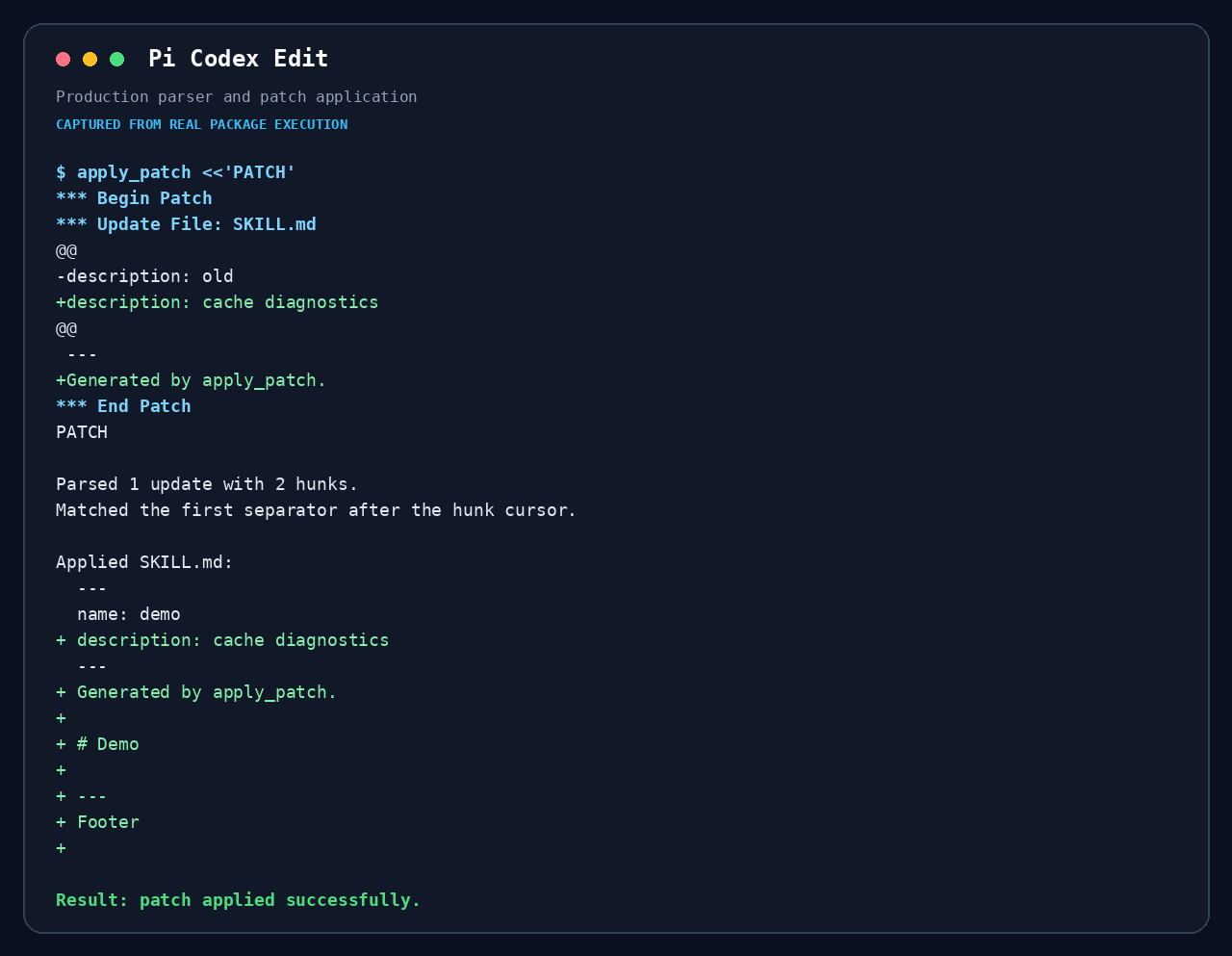
Why this package exists
GPT models used through the Codex harness are trained to edit with OpenAI's apply_patch protocol, while Pi's native editor uses a different oldText/newText contract. This package exposes the Codex-harness editing interface inside Pi for explicitly allowed models. Models that do not match the rules continue to see Pi's native edit; the extension never replaces the editor universally.
The implementation follows Codex's ordered hunk matching semantics and supports the same Add/Delete/Update/Move patch shape, then adds workspace, symlink, overwrite, preflight, and mutation-queue safeguards required by Pi.
Demo
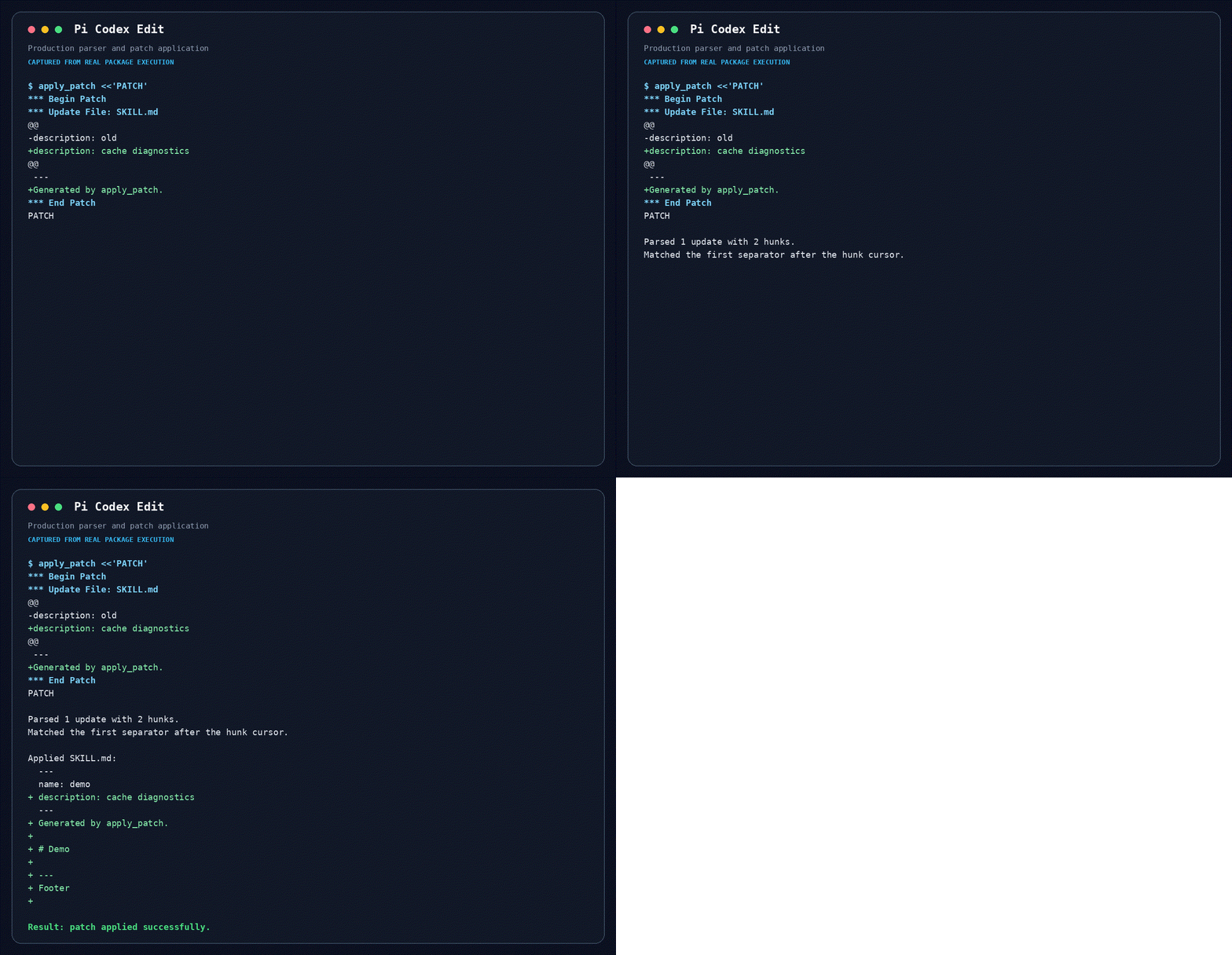
*** Begin Patch
*** Update File: src/app.ts
@@
-const enabled = false;
+const enabled = true;
*** End Patch
The complete patch is parsed and preflighted before any file is mutated; the result reports per-file diffs and committed paths.
Install
Install it as a separate package:
pi install npm:@maxiaochao/pi-codex-editThis is the standalone child package of @maxiaochao/pi-toolkit. The full toolkit already bundles the same implementation, so install this package only when you do not want the rest of the toolkit. Installing both is unnecessary and may register apply_patch twice.
Update whichever distribution you installed:
pi update npm:@maxiaochao/pi-toolkit     # full toolkit, including bundled Codex Edit
pi update npm:@maxiaochao/pi-codex-edit  # standalone child package
The two npm packages have independent versions. An implementation or configuration change reaches toolkit users only after a new @maxiaochao/pi-toolkit version is published, and reaches standalone users only after a new @maxiaochao/pi-codex-edit version is published.
The extension registers apply_patch and selects the editing tool from the resolved model configuration:
- Allowed model ID on a supported Responses API: Codex-harness-compatible
apply_patch - Model ID outside the allowlist: Pi's native
edit - Model on another API, even if its ID matches: Pi's native
edit
The default allowlist enables all gpt-5.6-* models regardless of provider. Other model families can be added after separate validation by editing config.json.
The extension does not add a permanent AGENTS rule telling models not to use apply_patch. Only the selected editor tool is active, so the model receives one editing protocol.
What apply_patch does
The tool accepts raw Codex patch text between *** Begin Patch and *** End Patch. It supports:
Add FileDelete FileUpdate FileMove to- multiple update hunks with
@@context - EOF-oriented insertions
Before writing, it parses the complete patch, resolves paths, rejects workspace escapes and unsafe symlink/parent paths, reads all source files, and computes every update in memory. Only after preflight succeeds does it mutate files. It returns per-file diff details and reports committed paths if a later filesystem operation fails.
Configuration
The extension defaults to a model-ID allowlist in config.json: "gpt-5.6-*". Provider does not affect routing. Each entry is a * glob, so this matches every gpt-5.6- variant. The route additionally requires:
model.api = openai-responses or openai-codex-responsesThe effective routing rule is:
settings.enabled
and model.api in ["openai-responses", "openai-codex-responses"]
and model.id matches at least one settings.models pattern
Patterns are case-sensitive, match the complete model ID, and support * as the wildcard. Provider name is intentionally ignored.
Add model rules
Edit config.json and add validated model-ID patterns:
{
  "enabled": true,
  "models": [
    "gpt-5.6-*",
    "gpt-5.7-*",
    "my-codex-model"
  ]
}
Examples:
| Pattern | Matches | Does not match |
|---|---|---|
gpt-5.6-* |
gpt-5.6-sol, gpt-5.6-terra |
gpt-5.7-sol |
gpt-*-codex |
gpt-5.6-codex |
gpt-5.6-codex-mini |
my-codex-model |
exactly my-codex-model |
my-codex-model-v2 |
Adding a pattern only changes routing; it does not prove that a model handles the Codex protocol correctly. Validate the model before adding it to the default allowlist. A matching model on anthropic-messages, openai-completions, or another unsupported API still uses Pi's native edit.
Grammar support is not part of the route. When a provider does not emit Lark grammar tools, Pi falls back to a normal function tool, so apply_patch still runs there — only the grammar-enforced output shape is lost.
Edit config.json in the standalone installed package, or packages/codex-edit/config.json inside an installed full toolkit, only if you need to change the default allowlist. Package updates can replace local edits. Set "enabled": false to disable all apply_patch routing. The implementation keeps both tools registered for session replay and changes only the active tool set on session_start and model_select.
Documentation
summary.md: benchmark summary and decision record.codex-edit-explainer.html: self-contained interactive architecture and configuration explainer.TESTING.md: deterministic test flow, regression fixtures, and latest baseline.
The benchmark found equal final correctness in the fair 20-case comparison, with first editor-call success improving from 85% to 95%. Overall tool-call count and cache-inclusive token use were effectively unchanged, so the route stays limited to the GPT/Codex allowlist rather than replacing edit universally.