@mazurovn/mazzy-command-center
Mazzy Command Center — a full agent orchestrator and command center for the Pi coding agent: durable task tracker, attested orchestration, and a spec<->code<->backlog graph today; its own sub-agent engine, sub-agent creator, meta-agents, and tiered memory
Package details
Install @mazurovn/mazzy-command-center from npm and Pi will load the resources declared by the package manifest.
$ pi install npm:@mazurovn/mazzy-command-center- Package
@mazurovn/mazzy-command-center- Version
0.2.3- Published
- Aug 19, 2026
- Downloads
- 665/mo · 19/wk
- Author
- mazurovn
- License
- SEE LICENSE IN LICENSE
- Types
- extension, skill
- Size
- 1 MB
- Dependencies
- 0 dependencies · 4 peers
Pi manifest JSON
{
  "extensions": [
    "./src/index.ts"
  ],
  "skills": [
    "./skills"
  ],
  "image": "https://raw.githubusercontent.com/mazurovn/Mazzy-Command-Center/main/docs/screenshot.png"
}
Security note
Pi packages can execute code and influence agent behavior. Review the source before installing third-party packages.
README
Mazzy Command Center
English · Русский · Deutsch · 中文 · 日本語 · 한국어
A parent-attested, localhost agent orchestrator and command center for the Pi coding agent.
By Mazurov N.N. — https://github.com/mazurovn · Source-available under PolyForm Noncommercial 1.0.0: free for personal, research, and educational use; commercial use requires a separate license (see LICENSE).
Mazzy Command Center is a full agent orchestrator and command center built as a project-local Pi extension. It turns a Pi session into a durable, auditable center from which agent work is planned, delegated, executed, reviewed, and remembered — a task tracker + orchestrator + its own sub-agent engine + a sub-agent creator + meta-agents + tiered memory + a spec↔code↔backlog knowledge graph, all over one embedded SQLite kernel.
Status: authenticated local pilot, actively building toward the full command center. The pilot ships the durable kernel, the dashboard, the graph view, and parent-attested orchestration today. The own sub-agent engine, sub-agent creator, meta-agents, and tiered memory / DAG / RAG / vectors are the product direction and are landing incrementally. See Roadmap and Security & limits.
What it is
Mazzy is a command center that owns orchestration: it decides what runs next, with which agent, under which budget and capability ceiling, and it keeps the durable plan, evidence, memory, and knowledge graph. It is designed around a clean three-authority split so that owning a powerful engine never turns the web surface into a remote-execution oracle:
- Scheduling (the kernel) — a pure planner computes what should run next from durable, typed records.
- Dispatch (Mazzy's own executor) — a separate, network-less, parent-lifetime process is the only thing that actually launches work.
- Execution provider — a replaceable runtime behind that executor (today
pi-subagents; Mazzy owns the provider interface and is growing its own engine).
- Durable task tracker — epics / features / tasks / bugs with a revisioned
lifecycle (
DRAFT → BACKLOG → READY → CLAIMED → RUNNING → REVIEW → DONE, plusBLOCKED / FAILED / CANCELLED). Every update is optimistic-concurrency checked. - Orchestrator with attested dispatch — Mazzy plans and dispatches work, binds
the observed run to its task, and gates
DONEon independent PASS evidence. - Own sub-agent engine & creator (direction) — a first-party execution engine and a declarative sub-agent creator: define agents, capability ceilings, budgets, and prompt contracts, and spawn them through Mazzy's own executor.
- Meta-agents (direction) — agents whose output is proposals other agents act on, all under the same attested, capability-ceilinged dispatch path.
- Tiered memory + knowledge (direction) — hot / warm / cold memory with hybrid retrieval (RAG) and vector search, plus a plan DAG — as context, never as authority.
- Authenticated local dashboard — a self-contained web UI on
localhostwith a capability token, live SSE updates, a Kanban board, and a task discussion drawer. - SDD/ADR knowledge graph — an in-browser visualization that links specification clauses (ADR/INV/FR), code components, and backlog items into one filterable connectivity graph, assembled from pluggable sources (memory & vectors plug in as first-class sources — direction).
- Safe scaffolding —
mazzy-initwrites portable project templates with a dry-run default, guarded--force, and--rollback.
Architecture at a glance
Mazzy owns orchestration through a three-authority split so a powerful engine never turns the web surface into a remote-execution oracle:
Human / planner ── Pi commands / authenticated localhost browser ──┐
                                                                    v
Mazzy Command Center kernel (orchestration authority) ── SQLite kernel store
   • plan / evidence / memory & knowledge (direction)  │
   • issues single-use, integrity-checked dispatch      │
                                                        v
                        Mazzy executor  (separate, network-less process)
                                                        │
                                                        v
                        execution provider — pi-subagents today,
                        Mazzy's own engine (direction) — replaceable
Core principles (invariants):
- No HTTP-caused execution — no process that terminates an HTTP socket holds dispatch authority; only the separate executor launches work, and only against a single-use authorization.
- No free text drives execution — scheduling is a pure function of typed durable records; memory, vectors, and cache are context, never authority.
- Parent-only writes — kernel mutations require the interactive parent; inherited child processes are refused.
- No host paths cross the API — only opaque ids, enums, and relative refs leave the localhost HTTP boundary.
- Comments are never evidence — reviewer/verifier evidence is the authoritative PASS/FAIL channel.
- All
gitinvocations are hardened — repository-supplied config/hooks and inherited environment cannot influence execution.
A deeper conceptual overview lives in docs/ARCHITECTURE.md.
Tools and commands
Parent-only tools (the LLM-visible surface):
| Tool | Purpose |
|---|---|
mazzy_task |
Create / list / get / update durable tasks (revisioned; DONE needs PASS evidence). |
mazzy_route |
Read-only policy preflight for delegation (planning only; the executor dispatches). |
mazzy_assignment |
Parent-attested run binding, completion import, and reviewer evidence. |
mazzy_discussion |
Read/answer a durable task discussion. |
mazzy_control |
Claim/complete/fail dashboard GO / PAUSE / STOP requests. |
Slash commands: /mazzy (status + dashboard URL), /mazzy-url (access URL with
token), /mazzy-server (start/stop/status), /mazzy-menu (Ctrl+Alt+M),
/mazzy-init, /mazzy-doctor, /mazzy-registry, /mazzy-clean.
Screenshots
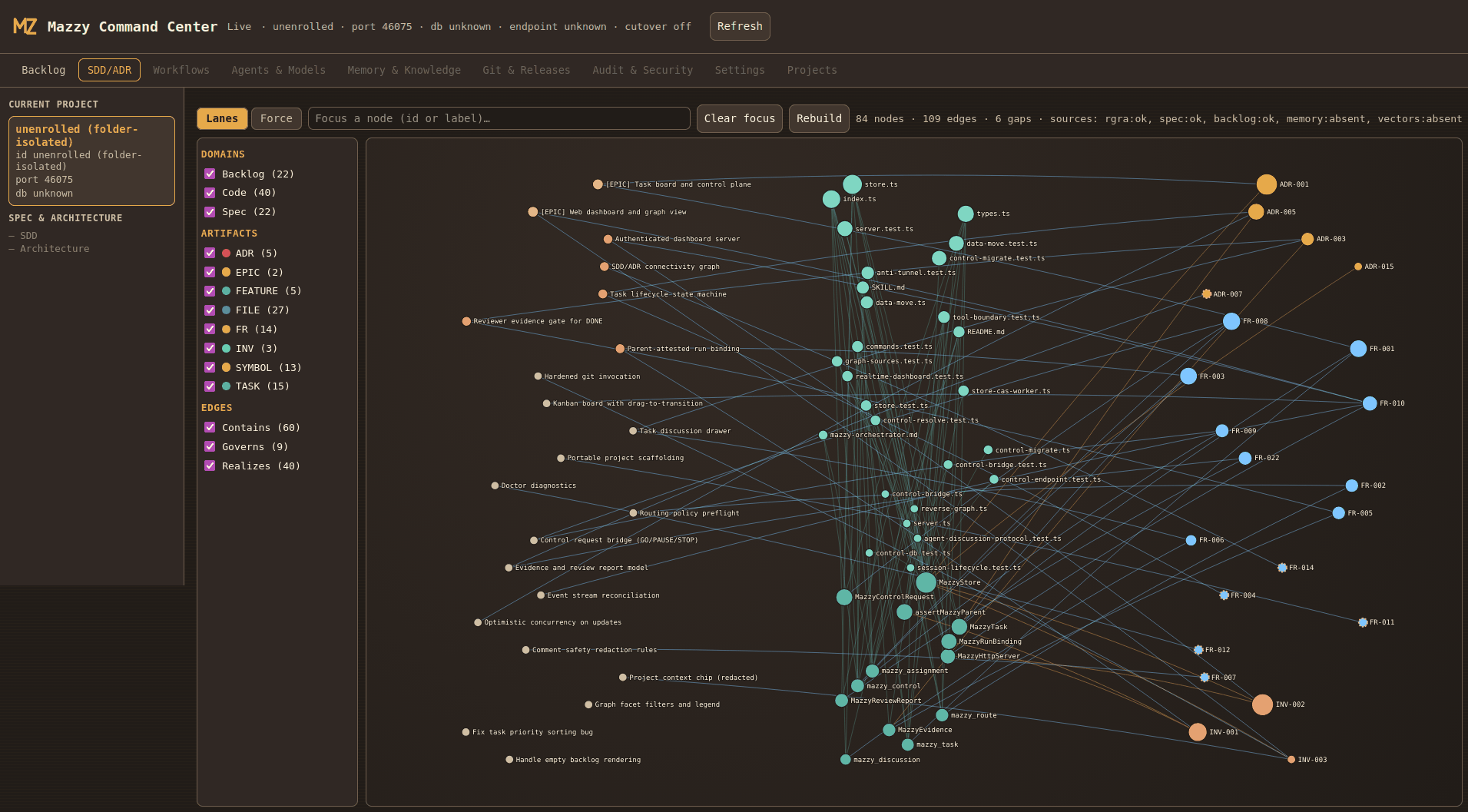
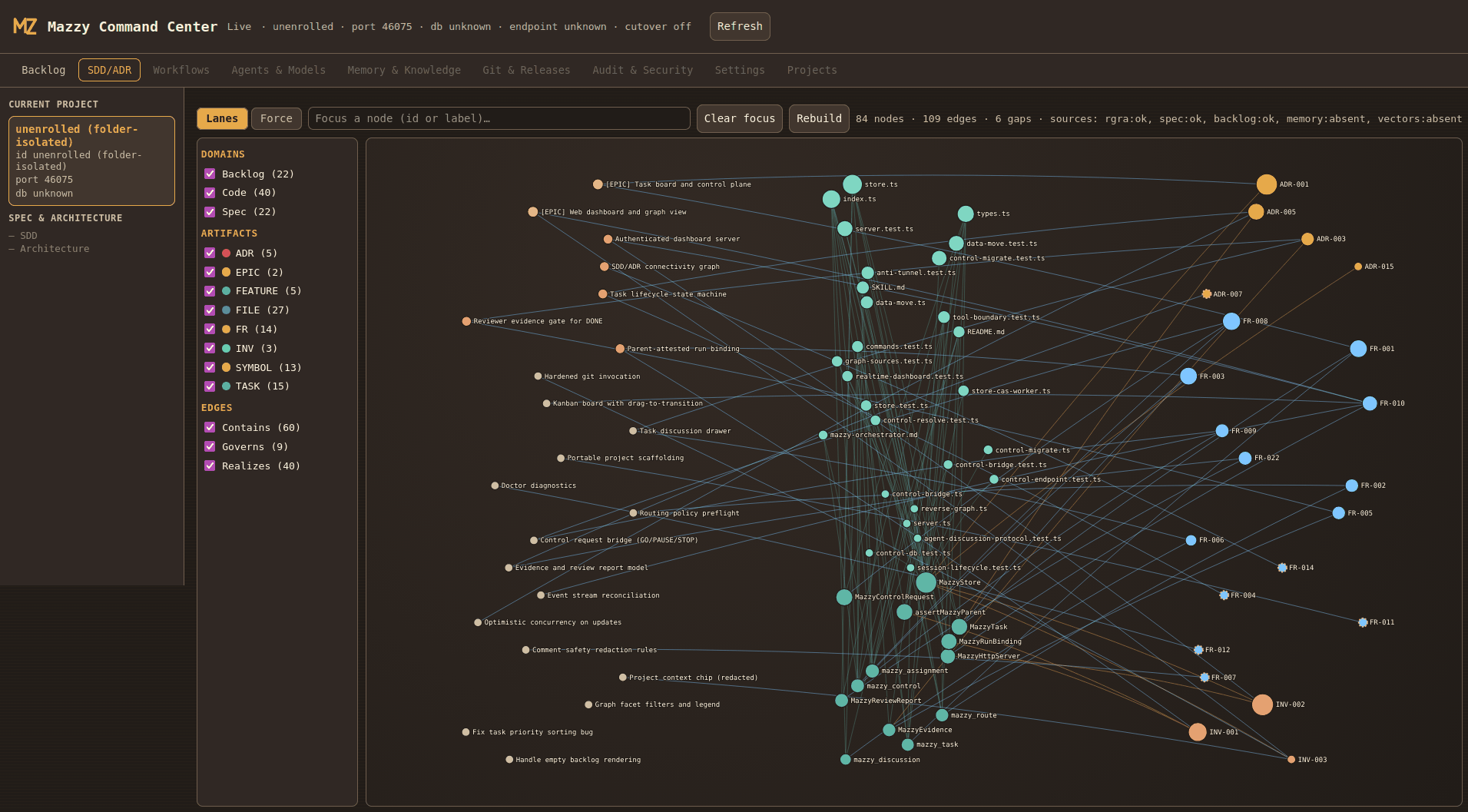
SDD/ADR connectivity graph — specification (ADR/INV/FR), code, and backlog in one filterable graph:
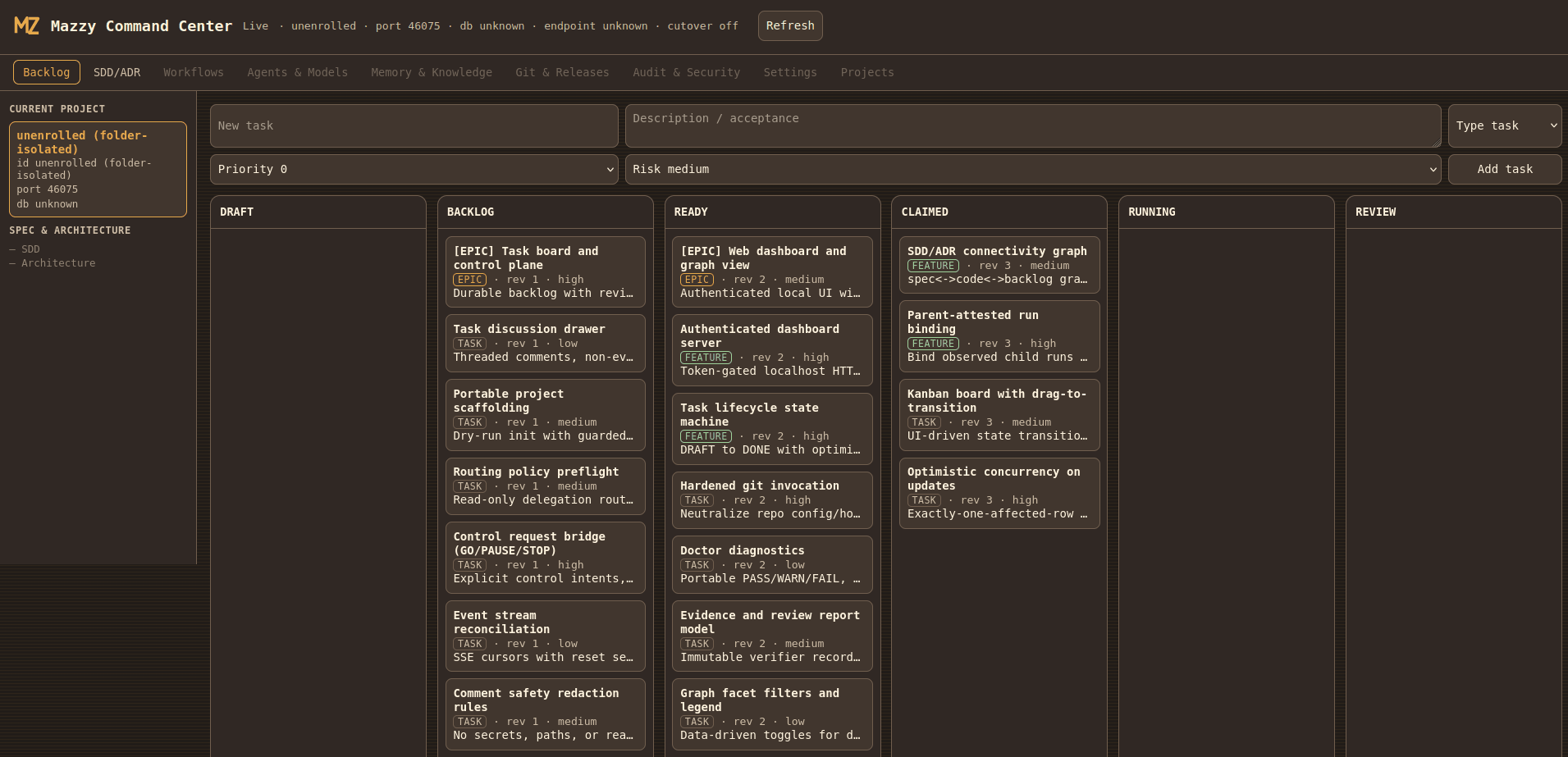
Backlog board — a Kanban board with a revisioned lifecycle:
Installation
Mazzy Command Center is a project-local Pi package, installed into a project's Pi configuration.
Requirements
| Component | Version |
|---|---|
| Node.js | >= 22.19.0 |
@earendil-works/pi-coding-agent |
0.84.2 (exact peer) |
@earendil-works/pi-ai |
0.84.2 (exact peer) |
@earendil-works/pi-tui |
0.84.2 (exact peer) |
Install from npm (recommended):
pi install npm:@mazurovn/mazzy-command-center
# then restart Pi so it discovers the extension.
Install from GitHub:
pi install git:github.com/mazurovn/Mazzy-Command-Center
Install from a local checkout (for development):
git clone https://github.com/mazurovn/Mazzy-Command-Center.git
cd Mazzy-Command-Center
npm install
pi install -l /path/to/Mazzy-Command-Center   # from your Pi project
Verify
npm run typecheck   # tsc, no emit
npm test            # node --test (requires a git-initialized working tree)
In a Pi session, run /mazzy to see status and the dashboard URL, or /mazzy-url
to reveal the authenticated access URL (the token is never written to logs).
The web dashboard
Start it from Pi with /mazzy-server start, then open the URL from /mazzy-url.
The dashboard is a single self-contained page under a strict Content-Security
Policy (no external scripts). It provides:
- a Backlog Kanban board with drag-to-transition and a task discussion drawer;
- an SDD/ADR graph tab with domain/artifact/edge filters and node focus;
- a redacted project context chip (project id, session prefix, bound port) — never a host path.
Access is gated by a per-session capability token; the API rejects any request without it and never embeds the token in the served HTML.
Roadmap
Mazzy Command Center is being built into a full agent orchestrator. Shipped today: the durable kernel, the task tracker, the authenticated dashboard, the SDD/ADR graph view, and parent-attested orchestration. The product direction, landing incrementally behind the three-authority model:
- Own sub-agent engine — a first-party execution engine behind Mazzy's own
network-less executor (the provider interface exists today;
pi-subagentsis the first provider). - Sub-agent creator — declaratively define agents, capability ceilings, budgets, and prompt contracts, then dispatch them through Mazzy.
- Meta-agents — agents whose output is proposals other agents act on, under the same attested, capability-ceilinged dispatch path.
- Tiered memory + RAG + vectors — hot / warm / cold memory and hybrid retrieval as first-class graph/retrieval sources (as context, never authority).
- Plan DAG — durable, declarative plan graphs the pure planner reads from.
Security & limits
This is an authenticated local pilot, and the README should not be read as a production security claim.
- One machine, one trusted user; process-level parent/child boundaries.
- Not multi-user authorization, not tenant isolation, not remote identity, not a distributed writer lease.
- Local dashboard authentication, parent-only writes, task revisions, bound runs, and reviewer evidence gating are pilot controls — a dashboard action, a comment, or a parent acknowledgement is not proof of execution or verification.
Report a security concern via a private channel rather than a public issue.
Development
npm run typecheck
npm test
- Source:
src/(TypeScript, run under Node's native type stripping — no build step). - Web UI:
static/(self-contained HTML + vendored assets). - Skills / templates:
skills/,resources/. - Tests:
test/(Node's built-in test runner).
See docs/ for the conceptual architecture and specification summary.
Author
Mazurov N.N. — https://github.com/mazurovn
License
Source-available under the PolyForm Noncommercial License 1.0.0. Copyright (c) 2025 Mazurov N.N.
- ✅ Free to use, study, modify, and share for any noncommercial purpose — personal use, research and science, and education.
- ⛔ No commercial use. Companies and commercial products/services need a separate commercial license. A Mazzy Command Center Enterprise edition and commercial licenses are planned / available on request.
- ⛔ You must keep all author/copyright/license notices, and may not rename the software, remove attribution, or present modified versions under the same name ("Mazzy Command Center" / "Mazzy") without written permission.
For a commercial license or any use beyond these terms, contact the author: https://github.com/mazurovn