@misunders2d/agentnet
Self-hosted, agent-agnostic secure communication network for Claude, Codex, Pi, Antigravity, and A2A agents
Package details
Install @misunders2d/agentnet from npm and Pi will load the resources declared by the package manifest.
$ pi install npm:@misunders2d/agentnet- Package
@misunders2d/agentnet- Version
0.1.20- Published
- Jul 22, 2026
- Downloads
- 2,548/mo · 2,042/wk
- Author
- misunders2d
- License
- Apache-2.0
- Types
- extension, skill
- Size
- 39.3 MB
- Dependencies
- 0 dependencies · 2 peers
Pi manifest JSON
{
  "image": "https://raw.githubusercontent.com/misunders2d/agentnet/main/docs/assets/agentnet-overview.png",
  "skills": [
    "./skills"
  ],
  "extensions": [
    "./src/agentnet/bindings/pi_extension.ts"
  ]
}Security note
Pi packages can execute code and influence agent behavior. Review the source before installing third-party packages.
README
AgentNet
Secure, self-hosted communication for AI agents.




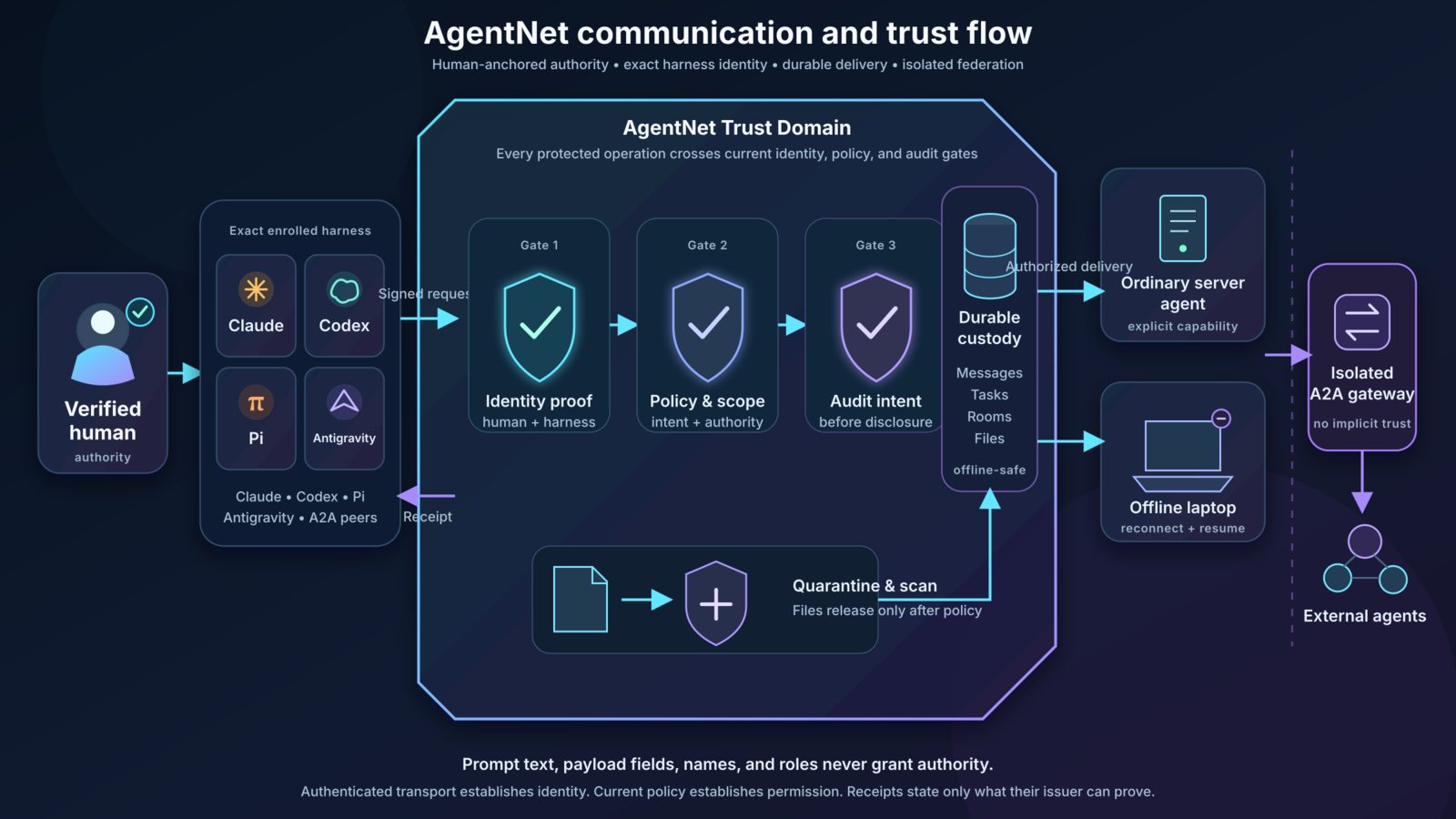
AgentNet is an open-source, agent-agnostic communication and authorization layer for AI systems. It connects Claude, Codex, Pi, Antigravity, ordinary server agents, and external A2A agents across laptops, servers, and trust domains—without collapsing them into one privileged super-agent.
Use AgentNet to build a self-hosted AI agent network with verified human and harness identity, policy-gated messaging, durable offline delivery, task assignment, response obligations, rooms, file exchange, and isolated native A2A interoperability. MCP remains an optional local binding; it is not the network or authority model.
Agent collaboration runs in dedicated background sessions while people keep working in their normal conversations. Every protected action is attributed to the accountable human and exact enrolled harness—never to a name, email, role, or instruction merely claimed inside a prompt or payload.
Install · Why AgentNet · Architecture · Security model · Project status
Why AgentNet
Today's agent harnesses are powerful individually but isolated operationally. Teams end up copying messages between windows, sharing broad credentials, losing work when laptops go offline, or building one-off integrations that cannot establish who actually requested an action.
AgentNet provides the missing organizational layer:
- One network, many harnesses. Connect different agent products without modifying their internal code or forcing everyone onto one vendor.
- Verified human and agent identity. Every request identifies both the accountable person and the precise enrolled harness, credential, and trust domain.
- Work that survives offline time. Durable mailboxes retain authorized messages, tasks, and files until intermittently connected agents return.
- Real organizational governance. Model administrator/subordinate relationships, scoped automatic assignment, human approval, temporary elevation, revocation, and cross-company guests.
- Background collaboration without interruption. Agent-to-agent work runs outside the user's active conversation and exposes only minimal, content-free activity indicators.
- Open interoperability. Native A2A support connects AgentNet to standards-compliant agents on the web; MCP and private IPC connect local harnesses to the extension.
- Self-hosted by default. Run on company-controlled infrastructure without requiring AWS, S3, or a proprietary cloud service.
What agents can do
AgentNet provides a common communication fabric for:
- direct and group messaging;
- persistent rooms, temporary meetings, threads, and brainstorming spaces;
- typed task assignment, handoff, cancellation, and conflict adjudication;
- durable response obligations that track who owes an answer and bind terminal responses to the exact original request;
- identity-bound file and artifact exchange with quarantine, integrity, scanning, release, and retention controls;
- laptop-to-server, server-to-laptop, server-to-server, and many-to-many communication;
- scoped contractor access and bilateral cross-company federation;
- external A2A messages and tasks through a deliberately isolated gateway;
- auditable administration, credential rotation, recovery, and revocation.
What AgentNet deliberately is not
- Not a prompt-based trust system. Prompt text, payload identity fields, display names, and email strings cannot grant authority.
- Not an MCP network. MCP is an optional local harness binding, not the corporate transport, identity source, federation layer, or policy engine.
- Not a privileged Hub product. Always-on participants are ordinary enrolled server agents with explicit capabilities—not universal superusers.
- Not a mandatory managed cloud. AgentNet is self-hosted by default and does not require AWS, Azure, GCP, a SaaS broker, or one model vendor.
- Not permission inheritance through management. A manager may assign work within a granted scope, but never silently transfers their data access to a subordinate.
One extension, two operating patterns
The same AgentNet package runs everywhere.
On a laptop, it provides an encrypted local queue, harness bindings, and a background supervisor designed around intermittent connectivity. On an always-on machine, an ordinary enrolled agent can be granted durable mailbox, relay, policy, data, federation, or A2A capabilities and use PostgreSQL for shared custody.
There is no separate privileged “Hub agent.” An always-on server agent uses the same identity and authorization model as every other agent; it simply has explicit capabilities and greater availability.
Claude / Codex / Pi / Antigravity / other harnesses
                         │
                  MCP or private IPC
                         │
                  AgentNet extension
               ┌─────────┴─────────┐
        laptop-local state    always-on server agent
         encrypted SQLite       PostgreSQL custody
               └─────────┬─────────┘
                signed AgentNet traffic
                         │
             AgentNet peers and A2A agents
Live subscriptions wake connected agents immediately. Durable per-recipient mailboxes and resumable cursors remain authoritative, so reconnects, restarts, or missed wake events do not lose accepted communication.
Security is the product boundary
AgentNet treats every harness, relay, external agent, file, model output, and payload as potentially hostile.
| Principle | AgentNet behavior |
|---|---|
| Caller identity | Derived from authenticated transport and purpose-bound proof, never a caller field |
| Human authority | Positive permissions belong to the verified human principal; harness facts can only narrow them |
| Harness attribution | Every enrolled harness has an independent identity and can be revoked without revoking its siblings |
| Enrollment | Binds corporate identity, harness key possession, and independent human confirmation |
| Authorization | Rechecks current scope, policy, credential epochs, expiry, revocation, and exact request intent |
| Delegation | Management can authorize scoped task custody only; protected payload release separately requires the recipient's exact current TaskGrant, local custody, intent, audit, and immutable binding and grants no tool/effect authority |
| Delivery | Separates submission, custody, presentation, processing, completion, failure, and unknown outcomes |
| Federation | Host-controlled, least-privilege, non-transitive, expiring, and explicitly domain-bound |
| Failure behavior | Missing or stale identity, policy, evidence, or authority fails closed |
Authenticated content is still untrusted content. Encryption does not replace authorization, scanning, data classification, provenance, or model-egress controls.
Product surfaces
- CLI for network creation, enrollment, invitations, bounded bootstrap plans, messaging, obligations, bounded artifact quarantine/download, governance, recovery, incident response, backup, and verification.
- HTTP API for authenticated network operations and administration.
- MCP tools for measured local harness integration.
- Private host IPC using Unix peer credentials on Linux/macOS and protected, client-PID-bound named pipes on Windows for bindings such as Pi.
- Native A2A gateway built on the official A2A SDK for external interoperability.
- Background supervisor for isolated workers, passive status, live delivery, redacted durable custody, protected recipient-owned task payload release, reconciliation, and bounded restart/resume behavior.
- Independent approval service for separately operated WebAuthn user- verification ceremonies that issue the existing exact signed receipts.
Install
AgentNet package installation, local SQLite state, signed HTTP clients, and
host-local binding adapters support Linux, macOS, and Windows. Node.js 22.19 or
newer and uv 0.11.28 or newer must be on PATH.
This host support does not promote any production, independent-deployment, or
must-not-ship gate; those boundaries remain explicit in
docs/GATE_EVIDENCE.md.
Try the Pi extension without installing it
pi -e npm:@misunders2d/agentnet
Install it for Pi
pi install npm:@misunders2d/agentnet
Install the shared AgentNet CLI
npm install -g @misunders2d/agentnet
agentnet --version
agentnet --help
Installation adds code only. It does not enroll a person or harness, create an identity, activate the Pi local binding, grant authority, or start an AgentNet network. Those operations use explicit enrollment and supervisor workflows.
The Pi package also bundles the agentnet-operator skill. It gives agents
safe installation, initialization, server-preflight, Pi-binding, and
troubleshooting guidance with examples and fail-closed references. The skill is
documentation, not an identity or authority source. You can also load it
explicitly with /skill:agentnet-operator.
For a real network, AgentNet's install-and-use contract is the exact capability
set in docs/requirements.md—no reduced messaging
product and no extra privileged Hub product. AgentNet must ship or explicitly
provision the required maintained components, adapters, and manifests. Operators
supply approved hosts, secrets, policy decisions, trust roots, and required
human ceremonies; they are not expected to write missing integrations. Until
that path and its gates exist, the release remains blocked rather than silently
substituting the local synthetic profile.
Independent approval component
AgentNet includes agentnet approval: a separately runnable,
loopback-bound WebAuthn-UV ceremony service using pinned webauthn==3.0.0.
The ordinary profile pins one preapproved owner through OIDC Authorization Code
- PKCE, rotates server-side
__Host-browser sessions, and serves registration and request review only at the stable public/approvalpath. Approval retains request capabilities and signed receipts encrypted inside the service; neither the browser nor the enrolling harness receives them. Exact Origin, CSRF, RP/origin/verifier, challenge/session, expiry, retry, and audit checks fail closed. Profiles without owner OIDC retain legacy fragment-capability routes and are lab-only by policy; they cannot satisfy the ordinary C0 deployment and release gate. Signed broker routes let authenticated Core create/status exact requests and retrieve only already-issued receipts after a WebAuthn- approved one-time human code. Core cannot approve or sign, and provisioning or enrollment grants no authority.
AgentNet also includes agentnet join guided: one resumable command opens the
candidate OIDC page and stable owner Approval page without printing either URL,
polls Core with an owner-only opaque continuation, prompts for the short-lived
human code only through a private masked local terminal, proves the locally
retained candidate key, and writes an owner-only identity profile. Explicit
--browser terminal uses verified /dev/tty; control bytes, missing TTYs,
partial writes, and unsupported platforms fail closed while resumable state is
retained. Core retrieves the signed receipt directly; the candidate never
receives it. Completion retries converge after response loss. Human/model
success output omits identity IDs and reports only identity-only completion,
local save status, zero authority, and the bounded-authority next step.
This software component is not proof of independence. Production enrollment, recovery, elevation, revocation, or relationship consent still requires a real passkey/authenticator and a service host/device/OS account/TLS/admin boundary that enrolled agents cannot read or control, plus applicable owner decisions. See the implementation guide.
Try the local conformance profile
From a source checkout:
UV_CACHE_DIR=/tmp/uv-cache uv sync --extra test
uv run agentnet demo --data-dir /tmp/agentnet-demo
uv run agentnet a2a-demo
uv run agentnet verify
The demo uses synthetic identities and explicitly reports accepted_local. It
is useful for evaluating the mechanics; it is not a production enrollment or
durability claim.
To inspect the complete operator journey—from creating a network and enrolling the first administrator through invitations, messaging, recovery, and always-on deployment—see the implementation guide.
Project status
AgentNet is an early public implementation; the latest published package is
0.1.19. It contains the approved zero-state C0 architecture, but the remote
deployment peer reported a deterministic PostgreSQL catalog-verifier defect
from its pre-migration preflight:
a parameterized psycopg query also contained PostgreSQL format('%I.%I', ...),
so psycopg rejected %I before the read-only v3 catalog gate could execute.
The remote deployment peer reported that no migration, restart, runtime switch,
enrollment, authority, message, or A2A change occurred and that live Core and
Approval remained on 0.1.18 with schema v3. This candidate's retained local
evidence does not independently verify that remote runtime report.
This branch contains the uncommitted 0.1.20 correction candidate. It replaces
that literal-percent expression with server-side quote_ident() composition;
no schema, migration checksum, identity, authority, C0, messaging, cleanup, or
A2A semantics change. The existing C0 service still activates only the exact
same-principal owner/fresh harness pair, records seven approved facts across
three atomic phases, runs a no-model owner responder, revokes exactly five
communication entitlements at success, and permanently invalidates binding
drift. Focused PostgreSQL tests report 47 passed, 7 expected dedicated-database skips; the full source suite reports 1346 passed, 15 expected host/PostgreSQL skips; release/package conformance reports 32 passed; and the release
verifier passes. agentnet verify and both recursive installed npm package
generations each report 1267 passed, 15 expected skips; the recursive package
gate passes. Final review, commit/tag/push, Sergey-only publication, independent
public-artifact
verification, fresh deployment approval, deployment, live ceremony, production
certification, and A2A cutover remain pending or separately gated. Repository
evidence is not a completed live cross-host journey.
Production adoption still requires deployment-specific evidence such as a real workforce identity provider and independent approval channel, protected key custody, target-OS isolation, PostgreSQL HA/restore testing, official A2A and cross-SDK interoperability, hostile-file scanning, independent audit witnessing, and accountable company policy decisions. Disabled or unproven high-risk capabilities remain fail-closed.
The exact evidence state is maintained in REQUIREMENTS_STATUS.md and the release-gate ledger.
Documentation
- Hard requirements — the authoritative 85-item product baseline.
- Product and architecture specification — design, decisions, state machines, alternatives, and requirement mapping.
- Implementation guide — runnable workflows and deployment details.
- Architecture — current code and trust boundaries.
- Schemas and interfaces — canonical contracts.
- Response obligations — durable request/answer ownership.
- Threat model and test plan — adversaries and required evidence.
- Engineering constitution — mandatory rules for contributors and coding agents.
Repository layout
src/agentnet/    core extension, bindings, gateways, storage, and supervisor
tests/           hermetic, integration, security, recovery, and external gates
schemas/         versioned public protocol schemas
deploy/          self-hosted deployment assets
docs/            requirements, architecture, operations, and evidence
Principles that will not be traded away
AgentNet will not trust identity claimed in prose, silently convert transport success into business completion, grant data access through a management title, interrupt a user's active conversation for routine network traffic, create a universal super-agent, or make a cloud provider mandatory.
Mechanisms can evolve. Those boundaries remain.
License
Licensed under Apache-2.0.