@mjasnikovs/pi-task
Deterministic spec-orchestration for local models, with a bundled real-time remote web view and web/docs/fetch/worker subagent tools.
Package details
Install @mjasnikovs/pi-task from npm and Pi will load the resources declared by the package manifest.
$ pi install npm:@mjasnikovs/pi-task- Package
@mjasnikovs/pi-task- Version
0.13.35- Published
- Jun 18, 2026
- Downloads
- 8,492/mo · 6,672/wk
- Author
- mjasnikovs
- License
- MIT
- Types
- extension
- Size
- 720.2 KB
- Dependencies
- 7 dependencies · 3 peers
Pi manifest JSON
{
  "extensions": [
    "dist/index.js"
  ],
  "image": "https://raw.githubusercontent.com/mjasnikovs/pi-task/main/assets/pipeline.png"
}
Security note
Pi packages can execute code and influence agent behavior. Review the source before installing third-party packages.
README
pi-task
Deterministic spec-orchestration for local models — with bundled web, docs, fetch, and worker sub-agent tools.





What it does
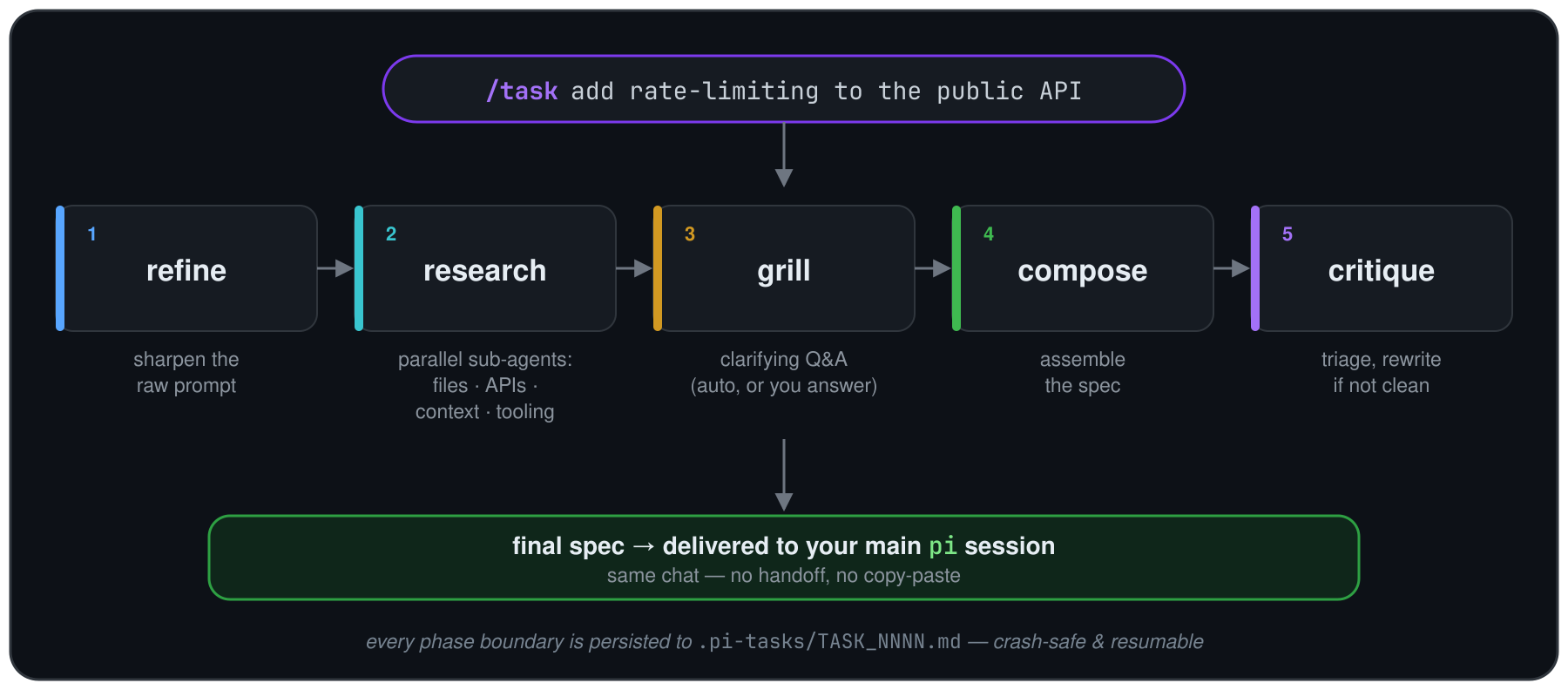
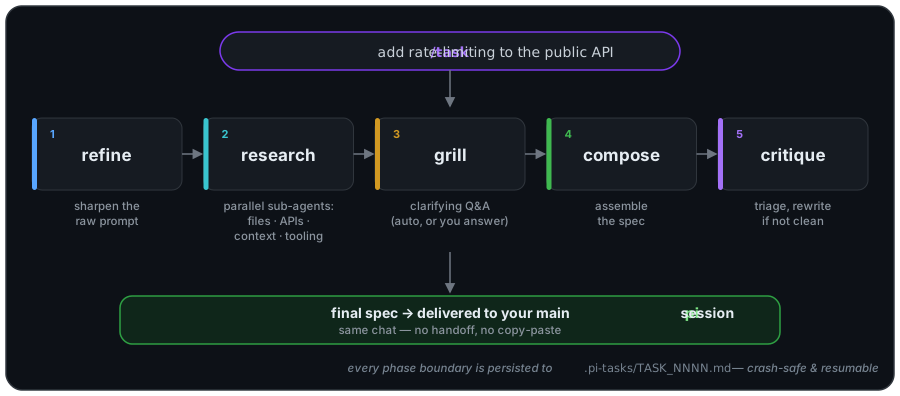
Local models drift. Ask one to plan a non-trivial change and it skips context, hallucinates APIs, and forgets what you actually asked. pi-task fixes this by not trusting a single prompt — it drives your request through a fixed, persisted pipeline of small, verifiable steps (shown above), then hands the main session a clean spec to execute.
Every phase boundary is written to .pi-tasks/TASK_NNNN.md, so a task survives a crash, a restart, or a /task-cancel — pick it back up with /task-resume.
Why it's different
- Deterministic by construction. The phase order is fixed code, not a model's free choice. The orchestrator loops over a config table; each phase has one job and one output section.
- Parallel research, focused output. The research phase fans out to isolated child agents — one indexing project files, others digging into APIs, context, and tooling — and verifies tooling claims before they reach the spec.
- Context stays clean. Noisy file/code spelunking, page fetches, and docs lookups run in throwaway child sessions. The parent only ever sees the distilled answer, never the raw page or the 4k-line file.
- Built for local LLMs. A loop detector and failure classifier catch the stalls, repetitions, and malformed output that smaller models produce, and retry with sharper emphasis instead of giving up.
- Crash-safe. State is a plain Markdown file you can read, diff, and edit by hand.
Install
pi install npm:@mjasnikovs/pi-task
Requires
pi(the Earendil coding agent) ≥ 0.78.
Slash commands
| Command | What it does |
|---|---|
/task <prompt> |
Start a new task and run it through the full pipeline. |
/task-list |
Open the task list in an editor dialog. |
/task-resume [id] |
Resume the most recent (or named) unfinished task. |
/task-cancel |
Cancel the running task (soft-terminal — still resumable). |
/task-auto <feature> |
Plan a feature into a task list and run each title through /task in order (resumable). |
/task-auto-resume |
Resume the active /task-auto run at the next unfinished task. |
/task-auto-cancel |
Stop the /task-auto loop after the current task (still resumable). |
/task-config |
Toggle pi-task settings in an editor dialog: remote server, compress reasoning, auto-commit, orientation, and enforce guidelines. |
/remote |
Show the QR code & URLs for the web view (/remote stop to stop). Answer grill questions, start tasks, and watch progress from your phone. |
The pipeline
| Phase | Output section | What happens |
|---|---|---|
| refine | refined prompt |
Sharpens your raw ask into an unambiguous, self-contained statement. |
| research | research |
Fans out to parallel sub-agents (project files · APIs · domain context · tooling), enriches any referenced packages/URLs/external services with fresh docs, then verifies tooling claims. |
| grill | grill Q&A |
Generates the clarifying questions the spec can't be written without — auto-answered from context where possible, surfaced to you where not. |
| compose | spec |
Assembles refined prompt + research + Q&A into a single implementation spec. |
| critique | spec |
Triages the draft; if it isn't already clean, rewrites it. The triage pass skips the expensive rewrite when the draft already holds up. |
The finished spec is delivered to your main pi conversation via sendUserMessage, so you keep working in the same chat — no context handoff, no copy-paste.
Orchestrating multiple tasks — /task-auto
A real feature is usually several tasks, not one. /task-auto is a thin planner on top of the single-task pipeline:
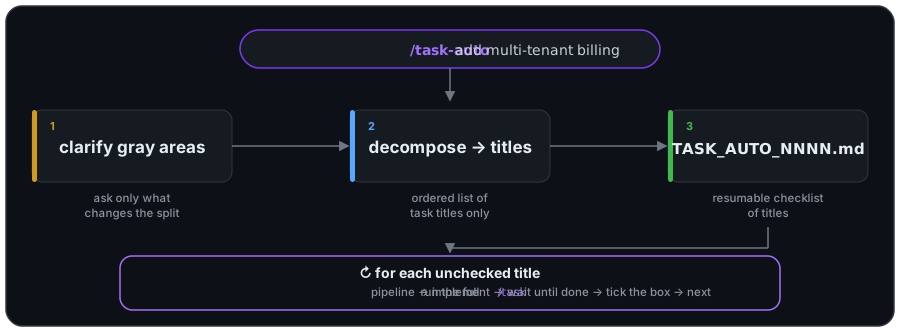
- It only produces titles. All the depth — refine, research, grill, compose, critique — is
/task's job, run fresh per title./task-autonever researches or specs anything itself. - Clarify first. It asks the few clarifying questions whose answers change how the feature splits, then decomposes the answers into an ordered list of task titles written to
.pi-tasks/TASK_AUTO_NNNN.md. - Sequential, blocking. Each title runs through
/taskto a spec, the spec is implemented, and the loop waits for that to finish before starting the next title. No overlap. - Crash- and cancel-safe. Progress is the markdown checkboxes in the AUTO file.
/task-auto-resume(no id) automatically picks up the active run at the first unchecked title. If a title's/taskrun fails, the loop stops and leaves the run resumable. - One commit per task. When auto-commit is on (the default) and you're in a git repo, the working tree is snapshotted into a single commit after each title passes, so the run produces a clean per-task history. It's best-effort: outside a repo, with nothing to commit, or on any git error, the loop reports the reason and keeps going. Toggle it in
/task-config.
Remote — drive a task from your phone
The remote server is on by default — it starts automatically with each session, with nothing taking up screen space (disable it in /task-config). Run /remote any time to pop a QR code and the connection URLs: a Tailscale line and a LAN line when both are available (the QR encodes the Tailscale-preferred one). Open the URL on any device that can reach the host and you get a live view of the session: streaming output, tool calls, and the /task status block (phase, elapsed, context). It's bidirectional — the browser can:
- Answer grill /
/task-autoclarify questions. Each question appears as a card with the recommended default pre-filled (Accept), a free-text box (Submit), Skip, or Cancel task. - Start and control tasks. Type
/task …,/task-auto …,/task-cancel,/task-resume, etc. — they run on the host. - Send plain messages to the agent.
Prompts use a first-answer-wins race: the same question shows in the local TUI and every connected browser, and whoever answers first wins — the other surfaces dismiss. With nobody connected, /task behaves exactly as before; the remote path is purely additive.
Push notifications
Tap the bell (◯ → ◉) in the remote header to get pushed a notification — even with the app backgrounded or the phone locked — when:
- a grill / clarify question needs answering ("pi needs your input"),
- a task finishes ("Task finished"), or
- the agent hits an error ("Agent error").
Delivery is server → push service → device over the Web Push standard (service worker + VAPID), so it reaches a suspended device. It works on desktop browsers and on iOS home-screen PWAs.
iOS setup (these are Apple's requirements, not ours):
- Open the HTTPS Tailscale URL (
/remotelists it). iOS only allows push from a secure context — the plainhttp://LAN URL won't work. - Share → Add to Home Screen, then open the app from that icon. iOS only permits notifications for installed PWAs.
- Launch the app, tap the bell, and Allow when prompted.
The subscription is kept in memory, so after restarting pi just reload the app (it re-subscribes automatically) or tap the bell again. Notifications are suppressed while the app is focused in the foreground — the in-page UI already shows the prompt there.
VAPID keys are generated once and persisted to ${XDG_DATA_HOME:-~/.local/share}/pi-task/vapid.json (deleting them invalidates existing subscriptions). The JWT contact (sub) defaults to the project URL; override it with PI_REMOTE_PUSH_SUBJECT (e.g. your own mailto:you@domain.com). To debug delivery, set PI_REMOTE_PUSH_DEBUG=1 and tail /tmp/pi-task-push.log — it records each push and the push-service HTTP status (201 delivered, 403/400 token/key problem, 410 stale subscription).
/remote stop shuts the server down for the rest of the session (it comes back on the next session start). There is no authentication — it's a personal LAN/Tailscale tool. Don't expose the port to untrusted networks.
Bundled tools
pi-task also registers four MCP-style worker tools (formerly @mjasnikovs/pi-worker). All are parallel-execution-capable, so the parent session can issue several calls in one turn.
pi-worker
Spawns an isolated child pi --print session with read + bash tools. Use it for noisy file/code work that would otherwise flood the main context.
pi-worker-search
Runs a Brave Search query and returns a compact markdown list (title · URL · snippet). Use it to discover candidate URLs before fetching.
Requires
BRAVE_SEARCH_API_KEY(also accepted asBRAVE_API_KEY). Grab a free key at api.search.brave.com/app/keys.
pi-worker-fetch
Fetches a URL, cleans HTML to markdown (Readability + Turndown), then hands it to an isolated child that extracts only the content answering your query. The parent never sees the raw page.
- HTML is cleaned; text formats (plain text, markdown, JSON, XML/feeds,
llms.txt, …) pass through verbatim. Binary responses — PDFs, images, octet-streams — return a clear error. - Bodies over 2 MB are rejected.
- The extraction child runs with
--no-toolsto mitigate visible-text prompt injection.
pi-worker-docs
Resolves an installed npm package, indexes its .d.ts files and README into a local SQLite cache, retrieves the most relevant chunks for your query, and passes them to an isolated child that extracts the focused answer. Version-pinned to whatever is in your node_modules.
- The package must be installed in the project's
node_modules; otherwise a one-time auto-install into a dedicated cache dir is attempted. - The first call for a
(package, version)pair pays a one-time ingestion cost; later calls are FTS-only. - Cache lives at
${XDG_CACHE_HOME:-~/.cache}/pi-worker/docs.sqlite— delete it to reset.
Settings — /task-config
Run /task-config to toggle pi-task's behavior in an editor dialog. Settings persist to ~/.config/pi-task/config.json. All default to on except enforce guidelines:
| Setting | What it does |
|---|---|
| remote | The remote UI server (QR code, phone access). Turn off to never start it. |
| compress reasoning | After each message, compresses the model's <think> blocks down to the decisions/constraints/facts that matter later — keeping long local-model runs from drowning their own context in self-talk. |
| auto-commit | Snapshots the working tree into one git commit per /task-auto sub-task (see above). |
| orientation | Pre-reads the project's core files (manifest, config, domain types, schema, entrypoints, API surface) once and hands the contents to the read-heavy research workers, so they skip re-discovering the same files cold. Bounded by a hard byte budget; applied only where it helps (FILES/APIS workers). |
| enforce guidelines (off by default) | Before each /task-auto commit, re-checks the sub-task's work against the project's AGENTS.md / CLAUDE.md (in the working directory). Local models drift and skip those rules, so a fresh pass of the same local model — with edit tools — reads the diff, fixes any violations in place, and returns a verdict. A violation it can't clear (or a pass that can't run) blocks the commit and stops the run so non-compliant work is never snapshotted; fix and /task-auto-resume. Adds one extra local-model pass per task, so it's opt-in. |
Configuration
| Variable | Used by | Notes |
|---|---|---|
BRAVE_SEARCH_API_KEY / BRAVE_API_KEY |
pi-worker-search, research enrichment |
Required for web search. |
XDG_CACHE_HOME |
pi-worker-docs |
Overrides the docs cache location (defaults to ~/.cache). |
XDG_DATA_HOME |
remote push | Where the VAPID keypair is stored (defaults to ~/.local/share). |
PI_REMOTE_PUSH_SUBJECT |
remote push | VAPID JWT sub contact. Defaults to the project URL; set your own mailto:you@domain.com or https://…. |
PI_REMOTE_PUSH_DEBUG |
remote push | When set (e.g. 1), logs push delivery and push-service HTTP status. Off by default. |
PI_REMOTE_PUSH_LOG |
remote push | Path for the debug log (defaults to /tmp/pi-task-push.log). |
Tasks are persisted to <cwd>/.pi-tasks/TASK_NNNN.md. Add .pi-tasks/ to your .gitignore if you don't want them checked in.
Development
bun install
bun test src/      # 731 tests across 57 files
bun run lint       # prettier + eslint + tsc --noEmit
bun run build      # tsc → dist/
Built with Bun, TypeScript (strict), and TypeBox for tool schemas. Design docs and plans live in docs/.
License
MIT © Edgars Mjasnikovs