@mobrienv/pi-tidy-subagents
Compact foreground and session-scoped background RPC subagents for Pi.
Package details
Install @mobrienv/pi-tidy-subagents from npm and Pi will load the resources declared by the package manifest.
$ pi install npm:@mobrienv/pi-tidy-subagents- Package
@mobrienv/pi-tidy-subagents- Version
0.3.1- Published
- Jul 19, 2026
- Downloads
- 287/mo · 287/wk
- Author
- mobrienv
- License
- MIT
- Types
- extension
- Size
- 1.6 MB
- Dependencies
- 2 dependencies · 2 peers
Pi manifest JSON
{
  "extensions": [
    "./index.ts"
  ]
}
Security note
Pi packages can execute code and influence agent behavior. Review the source before installing third-party packages.
README
pi-tidy-subagents

Fan work out to child Pi agents without losing the thread. Adds a
subagent tool for Pi that runs
independent child prompts concurrently — in the foreground or as session-scoped
background workers — and renders each child as one compact, scannable line. A
companion subagent_control tool steers, cancels, inspects, and collects them.
pi install npm:@mobrienv/pi-tidy-subagents
Usage
The model calls subagent with an ordered batch. Each child carries a short
transcript reason and a verbatim prompt:
{
  "agents": [
    {
      "label": "tests",
      "reason": "run the unit suite",
      "prompt": "Run npm test and summarize any failures.",
    },
    {
      "label": "review",
      "reason": "audit the diff",
      "prompt": "Review the working-tree diff for correctness bugs.",
      "thinking": "high",
    },
  ],
}
Children inherit the parent's model, thinking level, working directory,
extensions, skills, and active tools by default; each may optionally pick an
exact model or a different thinking level. The call waits for every
foreground child and preserves healthy sibling results when an individual
child fails. Settled children read:
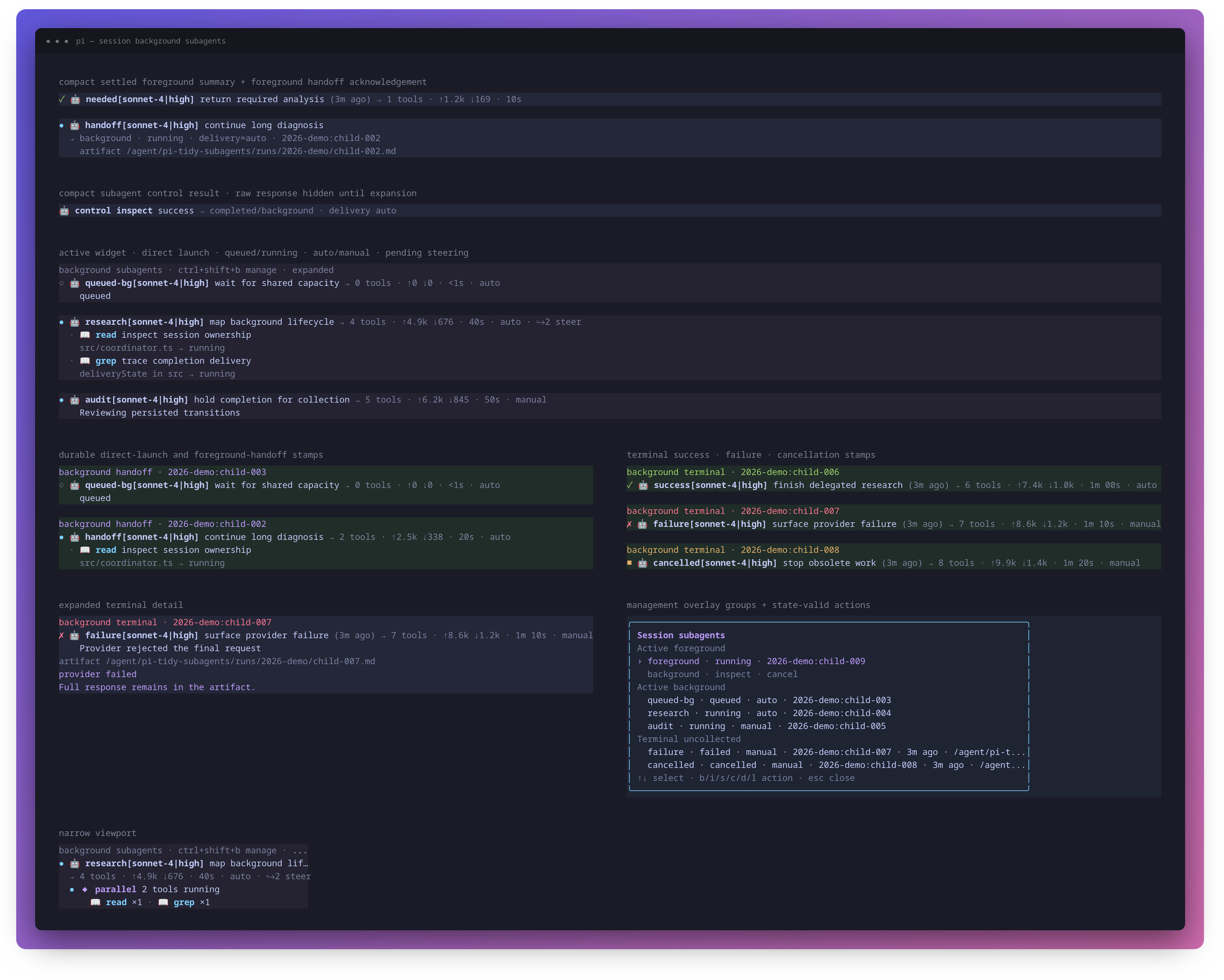
<agentName>[<model>|<thinking>] <reason> (<age> ago) → <metrics>
Active children keep their latest activity visible. Once settled, response prose
moves behind ctrl+o, leaving the child summary compact; interrupted tool state
remains visible because it is terminal truth. Metrics show tool calls, token
traffic (↑ input, ↓ output), and elapsed time. Cards start at the terminal's
left edge without a decorative rail or outer indent. Child glyphs remain because
a batch can contain mixed outcomes; settled control cards rely on Pi's native
success/error background instead of a redundant check or cross.
Background children
Add execution: "background" to any child and the call returns immediately
with an acknowledgement while the child keeps working:
- Active background work appears in a live widget above the editor; durable transcript stamps record launches and completions, and survive session resume.
- Manage children with the
/subagentsoverlay (ctrl+shift+b) or thesubagent_controltool:background,steer,cancel,inspect,status,set_delivery,collect. Control calls render as one compact, action-specific status line;ctrl+oreveals their bounded raw response. - Finished results arrive automatically as a follow-up turn when the parent is
idle, or on demand via
collect. - Workers live for the session: reload, exit, or session replacement cancels them cleanly.
Good to know
- Children share your working tree. This package does not lock files, create worktrees, or coordinate writes — give children non-overlapping mutation scopes or read-only work.
- Complete run manifests (prompts, responses, usage, model/thinking
provenance) persist under Pi's agent directory at
pi-tidy-subagents/runs/<run-id>/. - A batch fails preflight as a whole if any child requests an invalid model or an unsupported thinking level — no partial runs.
- An optional per-task routing map (
/tidy-subagents-routing) can suggest thinking levels and models per task class.
The full behavior contract — runtime selection and provenance, routing hierarchy, scheduling, rendering, run-artifact schema, and the background lifecycle — lives in docs/reference.md.
Out of scope
Installing this beside another extension that owns the subagent tool name is
unsupported. Cross-session/crash recovery, background-to-foreground handoff,
personas, automatic model selection, fuzzy matching, and project-level routing
rules are intentionally outside this package.
Development
npm test --workspace @mobrienv/pi-tidy-subagents
npm run check --workspace @mobrienv/pi-tidy-subagents
npm pack --workspace @mobrienv/pi-tidy-subagents --dry-run
| Script | Role |
|---|---|
npm test |
Release-blocking hermetic suite (fake RPC; no network) |
npm run smoke |
Opt-in real-provider smoke (PI_TIDY_REAL_SMOKE=1); hetero children when ≥2 auth'd models; skips with diagnostics otherwise |
npm run routing-eval |
Opt-in observational routing probes (PI_TIDY_ROUTING_EVAL=1); offline structural fixtures already run under npm test |
See docs/reference.md for routing-eval and
smoke details. Regenerate the renderer artifact with bash docs/visual.sh
(Chrome/Chromium and ImageMagick required).