@moonhalf383/pi-whoasked
Pi extension that detects unwanted phrasing in streamed replies and retries with configurable correction prompts. Includes Chinese and English rules.
Package details
Install @moonhalf383/pi-whoasked from npm and Pi will load the resources declared by the package manifest.
$ pi install npm:@moonhalf383/pi-whoasked- Package
@moonhalf383/pi-whoasked- Version
0.1.0- Published
- Oct 25, 2026
- Downloads
- 240/mo · 23/wk
- Author
- moonhalf383
- License
- MIT
- Types
- extension
- Size
- 987.3 KB
- Dependencies
- 0 dependencies · 1 peer
Pi manifest JSON
{
  "extensions": [
    "./src/index.ts"
  ]
}
Security note
Pi packages can execute code and influence agent behavior. Review the source before installing third-party packages.
README
@moonhalf383/pi-whoasked
English | 简体中文

A Pi extension that watches streaming assistant replies for configurable regex patterns. On a match, it interrupts generation and sends the rule's correction prompt, asking the model to answer again from the beginning.
The interrupted reply stays visible, is marked as superseded, and is followed by a new answer. Text already displayed is not retracted.
Installation
Requires Pi (@earendil-works/pi-coding-agent) 1.4.0+ and Node.js 22.19+. Node.js 24 is recommended for running tests.
Install from npm:
pi install npm:@moonhalf383/pi-whoaskedRestart Pi or run /reload. Bilingual rules are enabled out of the box.
Alternatively, install from GitHub:
pi install git:github.com/Moonhalf383/pi-whoaskedFor local development, clone the repository and load the extension temporarily:
git clone https://github.com/Moonhalf383/pi-whoasked.git
cd pi-whoasked
pi -e ./src/index.ts
Use pi install . from the repository directory for a persistent local installation.
Configuration
Chinese and English rules are enabled by default: all eight groups from the Chinese strict preset plus nine English groups. Notifications, status text, configuration errors, and correction-message framing use English. Default rule names and correction prompts are also in English; prompts ask the model to keep the user's requested reply language. Custom rule names and prompts are displayed as configured.
Configuration is merged in this order, with later values taking precedence:
- Built-in defaults.
<Pi agentDir>/whoasked.json, usually~/.pi/agent/whoasked.json.<cwd>/.pi/whoasked.json, only in a project trusted by Pi.
enabled and maxRetries override previous values. A rules array replaces the entire previous rule set; rules: [] disables all rules. Untrusted project configuration is not read.
You can also specify a standalone file. It is applied over the built-in defaults without loading personal or project configuration:
pi --whoasked-config /path/to/whoasked.jsonThe extension must already be installed. When loading directly from a checkout, add -e ./src/index.ts.
No configuration file is needed to use the bilingual defaults. To keep the defaults while adjusting the retry limit, use { "maxRetries": 4 }. A file containing rules replaces all built-in rules, including English rules; remove that field to inherit future defaults.
See whoasked.example.json for a smaller custom Chinese rule set. A minimal English-only override:
{
  "enabled": true,
  "maxRetries": 2,
  "rules": [
    {
      "name": "Unprompted defensive disclaimer",
      "pattern": "cannot claim",
      "flags": "iu",
      "correctionPrompt": "Answer the original question again. Remove unprompted defensive disclaimers. State the relevant facts and limitations directly, and do not mention this correction."
    }
  ]
}
Configuration fields:
enabled: enable detection; defaults totrue.maxRetries: maximum automatic corrections per user request; defaults to2. Set to0to report matches without interrupting.rules[].name: a unique, nonempty rule name.rules[].pattern: JavaScript regex source without/…/delimiters. Escape backslashes in JSON.rules[].flags: regex flags; defaults tou. An empty string omits the Unicode flag.rules[].correctionPrompt: a nonempty correction instruction sent to the model on a match.rules[].enabled: enable this rule; defaults totrue.
Rules are checked in configuration order; the first matching rule in a snapshot wins. Match state is reset for g; y retains its sticky semantics. Patterns that match empty input are rejected, and zero-width matches encountered at runtime are skipped. Unknown fields, invalid regexes, or invalid values produce an error and disable detection. Fix the configuration and run /whoasked reload.
For single-language overrides, use configs/zh-CN.strict.json (Chinese names and prompts) or configs/en.strict.json (English). These are subsets of the bilingual defaults, not additional detection modes. From a repository checkout:
pi -e ./src/index.ts --whoasked-config ./configs/zh-CN.strict.jsonBoth languages cover contrasts, repackaging accusations, evidence qualifiers, replacement disclaimers, exclusive causality, action exclusions, hypothetical implications, and broad negation. English adds formulaic caveats. Common English forms include negative-positive contrasts, implication disclaimers, replacement warnings, and stock cautionary introductions. Matching is case-insensitive for English and supports straight and curly apostrophes. See English pattern notes for examples and user reports that informed the rules.
The defaults are aggressive lexical filters. Ordinary negation, comparisons, quotations, and code examples can trigger corrections. Specific groups precede broad fallback rules, but a short streaming prefix can trigger the fallback before a more specific phrase arrives. Correction prompts preserve facts, important risks, and necessary limitations. Narrow or replace rules to reduce false positives.
After updating the extension, run /reload to load the new code. /whoasked reload only reloads configuration files.
Example
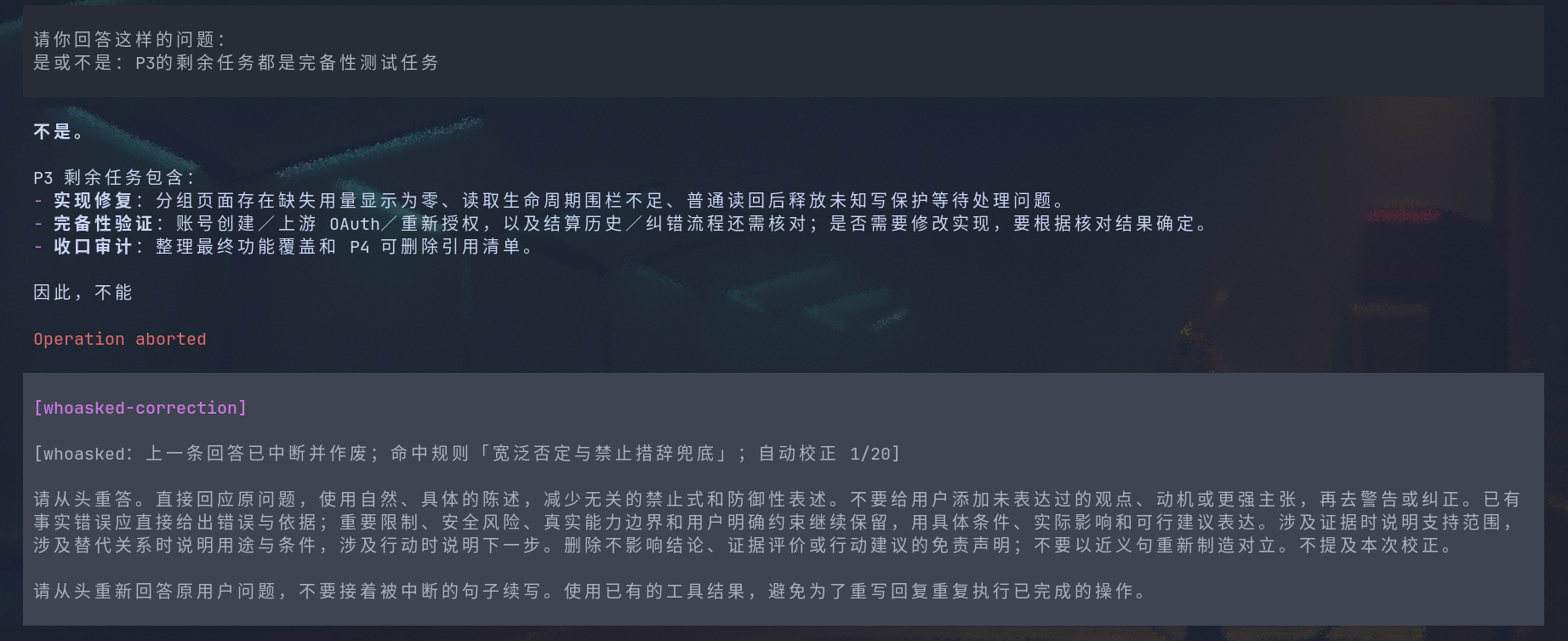
The screenshot shows an earlier Chinese UI with a personal retry limit of 20. The current default UI is English and the built-in retry limit is 2.
Corrections appear as custom messages in the conversation. The original question, existing tool results, and interrupted message history are retained; the session tree is not rolled back.
Commands
/whoasked           Show status, configuration sources, and enabled rules
/whoasked status    Same as above
/whoasked on        Reload configuration and enable detection for this session
/whoasked off       Disable detection and cancel any pending correction
/whoasked reload    Reload configuration
/whoasked cancel    Cancel further corrections for this request; resume on the next user input
Commands do not write configuration files. Configuration is reloaded on session start, session switch, or extension reload.
Streaming and cancellation
- Detection scans the full accumulated assistant text, so patterns can span streaming chunks. Separate text blocks are joined with newlines.
- Only assistant text is checked, not thinking, tool arguments, tool results, or user messages.
- A match interrupts generation. The extension waits for the run to settle before starting a new answer.
- If you press Escape after the extension has already requested an abort, Pi's public events cannot distinguish that additional stop during the same shutdown window. Use
/whoasked cancelor/whoasked offto explicitly cancel the pending correction. - New input and already queued input take priority over corrections.
- After
maxRetriesis reached, further matches produce a warning and the current answer continues without interruption. - Detection and retries also run in JSON/RPC/print modes. Stream consumers still receive previously emitted text and should use message boundaries to distinguish old replies from retries. Status and notification visibility depends on the host interface.
Development
npm ci --ignore-scripts
npm run check
check runs TypeScript checks, configuration and streaming unit tests, and real Pi SDK lifecycle tests. SDK tests use a local simulated model stream, make no online model calls, and do not read user credentials.
This package uses Pi's explicit pi.extensions manifest to load src/index.ts. An extensions/ directory and compiled JavaScript output are optional; Pi loads the TypeScript entry directly. The Pi host is declared as a peer dependency and is excluded from the archive. Pi 1.4.0+ is required by the extension API.
Prepare and verify a local release archive without publishing:
npm pack
npm run pack:check
npm pack runs check first through prepack. pack:check installs the archive in an isolated temporary directory, checks its contents, and verifies Pi package discovery and bilingual startup without calling a model. The resulting file is moonhalf383-pi-whoasked-0.1.0.tgz. Scoped npm packages are configured for public access; these commands only create and test a local archive.
Project files:
src/index.ts           Pi extension entry point
src/config.ts          Configuration loading and regex validation
src/defaults.ts        Bilingual default rule assembly
configs/               Chinese and English rule presets
src/extension.ts       Streaming detection, interruption, and retries
whoasked.example.json  Editable configuration example
tests/                 Unit and SDK integration tests