@mrclrchtr/supi-cache
Inspect prompt-cache history and investigate regressions
Package details
Install @mrclrchtr/supi-cache from npm and Pi will load the resources declared by the package manifest.
$ pi install npm:@mrclrchtr/supi-cache- Package
@mrclrchtr/supi-cache- Version
7.1.0- Published
- Sep 16, 2026
- Downloads
- 1,437/mo · 151/wk
- Author
- mrclrchtr
- License
- MIT
- Types
- extension
- Size
- 176.1 KB
- Dependencies
- 1 dependency · 4 peers
Pi manifest JSON
{
  "extensions": [
    "./src/extension.ts"
  ],
  "image": "https://raw.githubusercontent.com/mrclrchtr/supi/main/packages/supi-cache/assets/social-preview.png"
}
Security note
Pi packages can execute code and influence agent behavior. Review the source before installing third-party packages.
README
@mrclrchtr/supi-cache


Adds per-turn prompt-cache history and cross-session cache forensics to the pi coding agent.
PI provides live cache statistics and cache-miss notices. Enable its transcript notices with showCacheMissNotices in PI settings. This package does not add a second live monitor or a second notification path.
Install
pi install npm:@mrclrchtr/supi-cache
This is a beta package. Install it individually.
For local development:
pi install ./packages/supi-cache
What you get
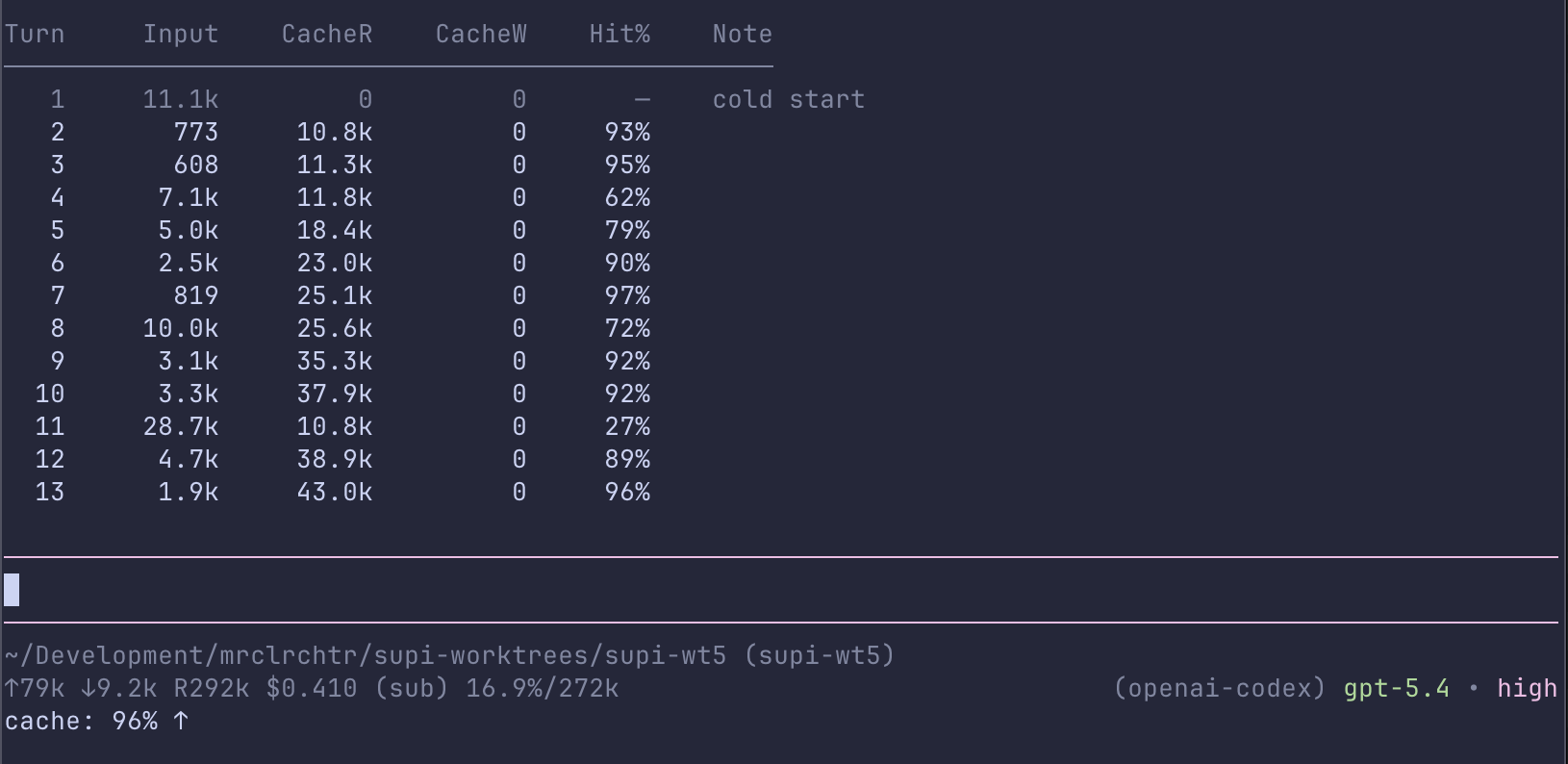
After install, the package provides two views:
Current-branch history
- reads usage from native PI assistant messages
- shows input, cache reads, cache writes, and hit rate for each request
- keeps old prompt-change notes and fingerprints when they exist
Historical forensics
- scans active branches across past sessions
- finds cache hotspots and idle-time drops
- groups model changes, compactions, branch summaries, prompt changes, and unknown causes
- correlates drops with redacted tool-call shapes
Commands and tool
/supi-cache-history
Shows per-turn cache usage for the current branch.
The report includes:
- input tokens
- cache-read tokens
- cache-write tokens
- cache hit rate
- known cause notes from current or old session records
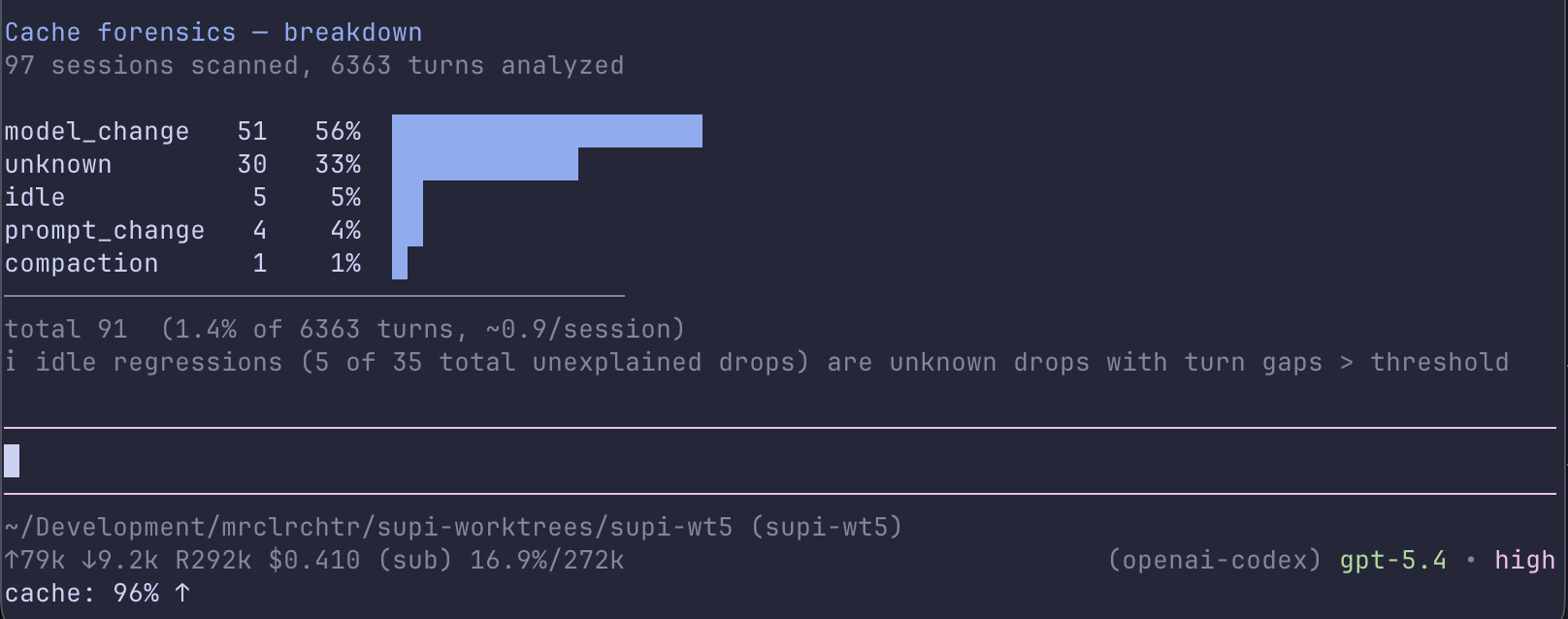
/supi-cache-forensics
Runs a cross-session investigation.
Supported patterns:
breakdown— count findings by causehotspots— show the largest hit-rate dropscorrelate— show preceding redacted tool shapes, ranked by hit-rate dropidle— show drops after long gaps between requests
Useful flags:
--since 7d--pattern breakdown--min-drop 20--limit 50(maximum findings returned; list patterns default to 50)
cache_forensics
Adds one model-callable tool with the same four patterns. The result uses structural tool fingerprints and removes raw command and path details before it reaches the model.
List patterns return at most 50 findings by default. Use the tool's limit parameter, or the command's --limit flag, to request up to 200 findings. Hotspots exclude structural events with no measurable drop. The result is also bounded to 2,000 lines or 51,200 bytes. Large results are written to a private temporary file and return a summary envelope.
Configuration
Forensics reads these optional values from the cache section. They are also available in /supi-settings under Cache Forensics:
{
  "cache": {
    "regressionThreshold": 25,
    "idleThresholdMinutes": 5
  }
}
The loader also reads these two values from the old cache-monitor section. Old enabled and notifications values are ignored. Configure live PI cache notices with PI's showCacheMissNotices setting.
Native session data
Native assistant-message usage is the source of truth. The package also reads old supi-cache-turn custom entries so old sessions keep their prompt-change details. New sessions do not create custom cache records.
Source
src/forensics/extension.ts— commands, renderers, and tool registrationsrc/forensics/extract.ts— native usage extraction and legacy migrationsrc/forensics/forensics.ts— cross-session scan pipelinesrc/report/history.ts— current-branch history reportsrc/report/forensics.ts— cross-session forensics reportsrc/tool/cache_forensics/— agent tool