@mrclrchtr/supi-debug
Capture and inspect SuPi debug events
Package details
Install @mrclrchtr/supi-debug from npm and Pi will load the resources declared by the package manifest.
$ pi install npm:@mrclrchtr/supi-debug- Package
@mrclrchtr/supi-debug- Version
6.3.0- Published
- Sep 3, 2026
- Downloads
- 2,508/mo · 380/wk
- Author
- mrclrchtr
- License
- MIT
- Types
- extension
- Size
- 167.1 KB
- Dependencies
- 1 dependency · 4 peers
Pi manifest JSON
{
  "image": "https://raw.githubusercontent.com/mrclrchtr/supi/main/packages/supi-debug/assets/social-preview.png",
  "extensions": [
    "./src/extension.ts"
  ]
}
Security note
Pi packages can execute code and influence agent behavior. Review the source before installing third-party packages.
README
@mrclrchtr/supi-debug


Adds shared debug-event capture and inspection for SuPi extensions in the pi coding agent.
Install
pi install npm:@mrclrchtr/supi-debug
For local development:
pi install ./packages/supi-debug
What you get
After install, this package wires the shared debug registry into three user-facing surfaces:
/supi-debug— show recent debug events in a readable TUI reportdebug— let the model query recent debug events during troubleshooting/supi-settingsintegration — configure whether events are captured and how much data is exposed
It also registers a Debug provider section for /supi-context, and ships a /supi-tooling-retro prompt template for post-task retrospective feedback on the SuPi tooling used in the completed task.
Event behavior
- events are session-local
- sanitized events are also persisted in the session JSONL for later inspection
- the event buffer is cleared on
session_start - if debug capture is disabled, no events are retained
- agent-facing access is blocked, sanitized, or raw depending on settings
Identity disclosure
Retained and persisted LSP debug events may identify local workspaces and files. Since the LSP telemetry expansion, LSP events can carry the absolute workspace root (cwd), the configured server name (server), workspace-relative file paths (file), exact LSP method names (method), and the server root (root). Identity strings are bounded to 512 UTF-16 code units and server lists to 16 entries.
Identity fields are not secret-redacted. The debug registry redacts secret keys and secret-looking values (tokens, passwords, API keys, authorization headers, URL credentials), but server names, file paths, method names, and workspace roots pass through unredacted by design, so local protocol failures stay diagnosable. Treat retained and persisted LSP events as potentially identifying your local machine, project layout, and file names.
Rendering
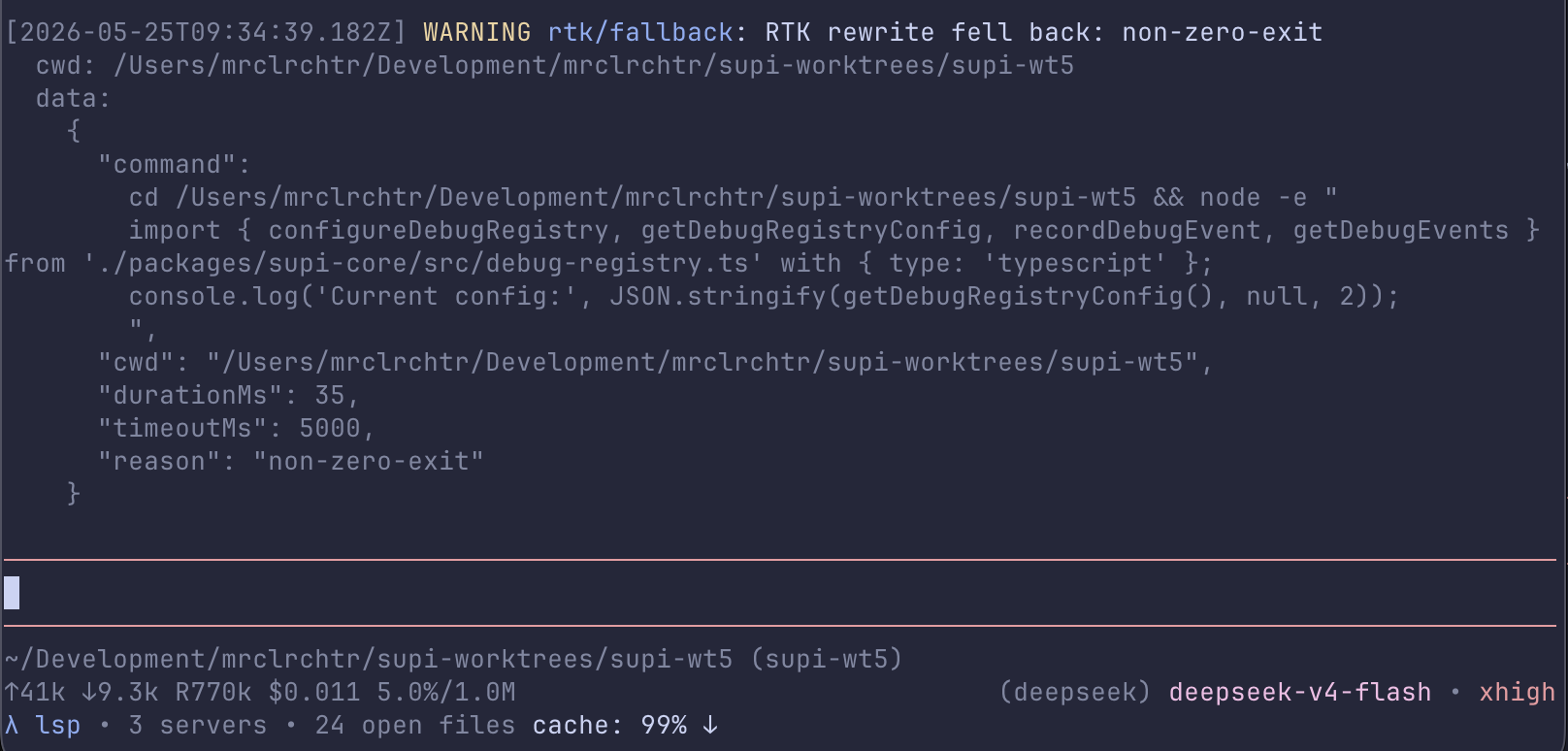
/supi-debug uses a custom TUI message renderer that shows two levels of detail:
Collapsed (default) — a one-line summary:
3 events — lsp/rewrite +2 moreExpanded — full details with timestamp, level, source/category, message, cwd, and data for each event. Click/expand the collapsed message in the TUI to reveal the full output.
Rendered fields per event:
- timestamp
- level
source/category- message
- optional
cwd - optional
data - optional
rawData - optional
operationIdfor events directly owned by one publiccode_*call
Why collapsed by default
Event payloads can be large (full command strings, structured data). Collapsing keeps the conversation focused; expand only when you need the details.
Seeing full details without expanding
The agent-facing debug tool returns the expanded plain-text
representation, subject to PI's standard tool-output truncation limits. This is
useful for automated troubleshooting flows while protecting the model context
from very large event payloads.
Filters
Both /supi-debug and debug support the same basic filters:
sourcelevelcategory- exact
operationId limit
For historical sessions, pass sessionFile to debug, or
sessionFile=<path> to /supi-debug. Historical sessions never retain raw data.
The tool also accepts includeRaw for live-session data when settings allow it. A Debug Operation ID groups direct request ownership only. It is not a security identity, distributed trace, raw Pi Tool-call identity, or time-window correlation.
Settings
This package registers a Debug section in /supi-settings.
Available settings:
enabled— turn session-local event capture on or offagentAccess—off,sanitized, orrawmaxEvents— maximum retained events in memory
Historical inspection works for events captured after this version is loaded. For example, an
agent can call debug with sessionFile set to a PI session JSONL path.
Defaults come from the shared debug registry:
{
  "debug": {
    "enabled": false,
    "agentAccess": "sanitized",
    "maxEvents": 100
  }
}
Extra status logging
If SUPI_LOG_STATUS is enabled in the environment, the package emits a versioned SuPi load-status marker to stderr during resources_discover (after session-start registrations) and appends the same payload as a session entry. The payload uses phase: "resources_discover". Version 2 reports observed tool and command inventory only; external harnesses decide which resources they require.
Source
src/debug.ts— settings, command, tool, and registry wiringsrc/renderer.ts— custom report renderersrc/format.ts— debug payload formattingsrc/status-log.ts— optional load-status logging