@mrclrchtr/supi-review
SuPi Review extension — structured code review via /supi-review command
Package details
Install @mrclrchtr/supi-review from npm and Pi will load the resources declared by the package manifest.
$ pi install npm:@mrclrchtr/supi-review- Package
@mrclrchtr/supi-review- Version
1.14.0- Published
- Jun 18, 2026
- Downloads
- 2,344/mo · 361/wk
- Author
- mrclrchtr
- License
- MIT
- Types
- extension
- Size
- 226.2 KB
- Dependencies
- 1 dependency · 4 peers
Pi manifest JSON
{
  "extensions": [
    "./src/extension.ts"
  ],
  "image": "https://raw.githubusercontent.com/mrclrchtr/supi/main/packages/supi-review/assets/logo.png"
}
Security note
Pi packages can execute code and influence agent behavior. Review the source before installing third-party packages.
README
@mrclrchtr/supi-review
Adds an interactive /supi-review command to the pi coding agent for session-aware code review.
Install
pi install npm:@mrclrchtr/supi-review
This is a beta package. Install individually.
For local development:
pi install ./packages/supi-review
What you get
After install, pi gets one command:
/supi-review— launch a guided review flow over a concrete git snapshot
The reviewer runs in managed child agent sessions:
- a brief synthesizer creates a structured review brief from the active session branch
- a read-only reviewer inspects the selected snapshot (without receiving bulk inline diffs) and submits structured review items
Review flow
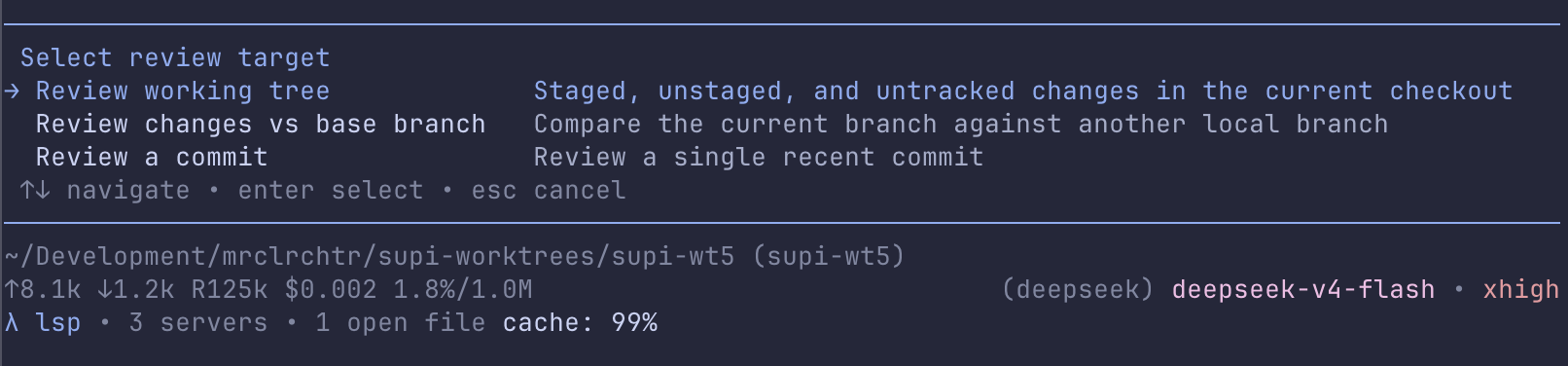
/supi-review walks you through:
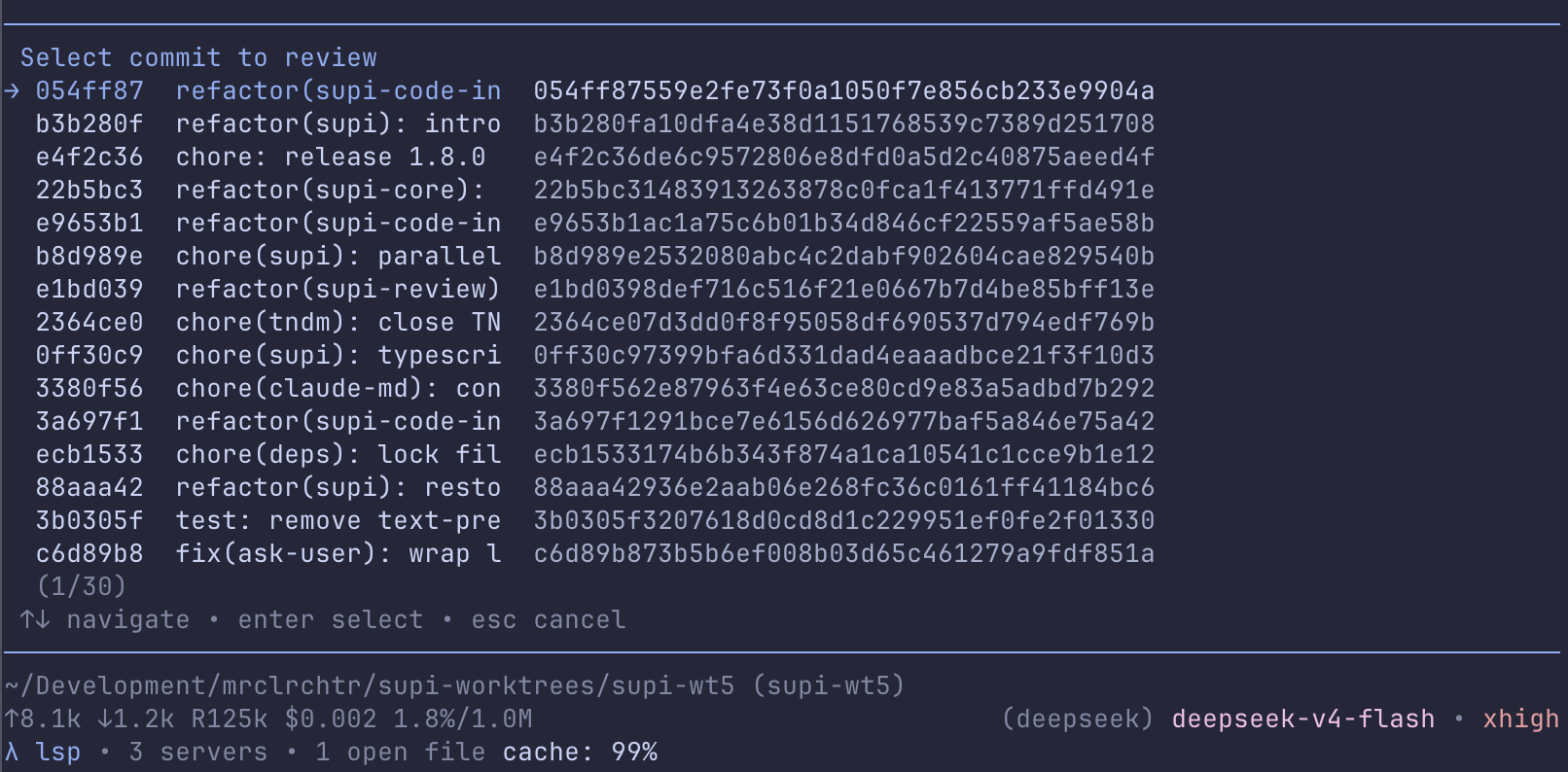
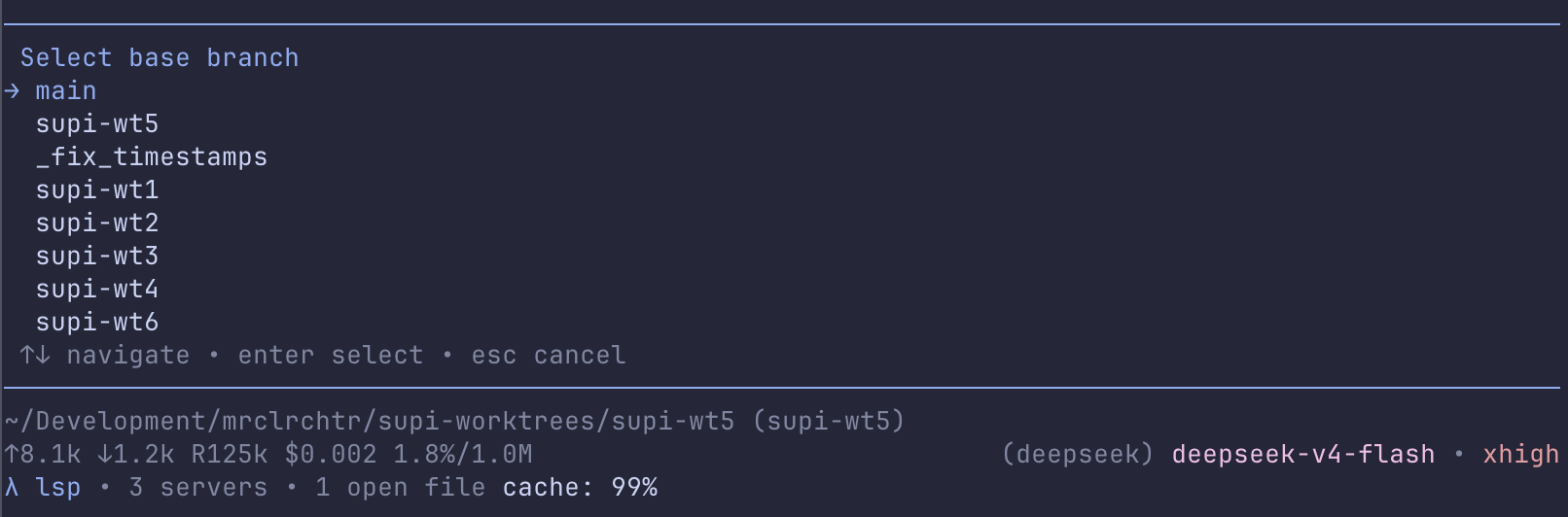
- choose a review target
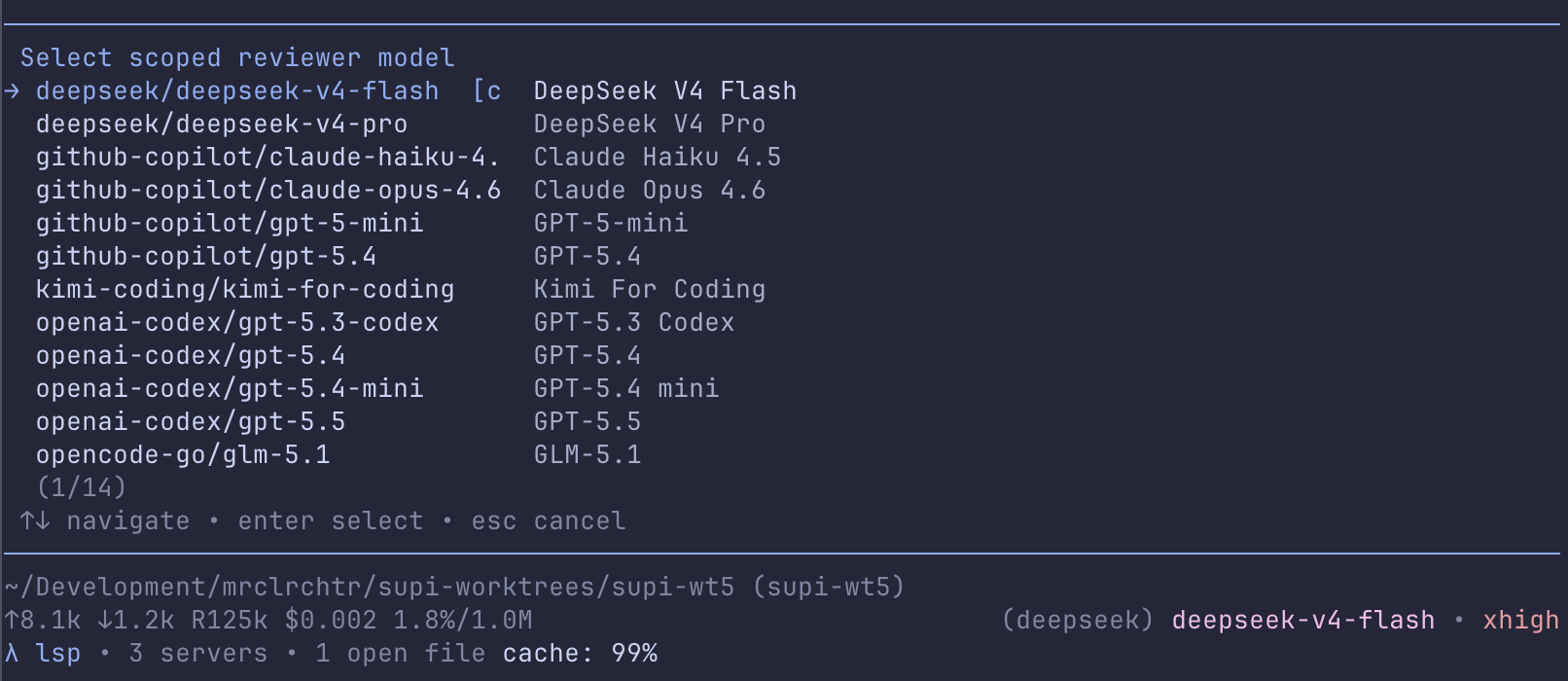
- choose the reviewer model
- optionally add a short note
- resolve the snapshot
- synthesize a review brief from the current session history
- preview the synthesized brief + compact prompt preview, then press
vfor an in-app inspector (Overview first, Raw Prompt viatab, export viae) - the reviewer fetches per-file diffs on demand via snapshot-aware tools; live progress widget shows activity
- normalize the submitted review items into a host-derived verdict + structured result
- if review items exist, hand off to the main agent so it can ask what to do next with fixed options (
Fix all,Fix selected,Verify findings,Skip)
Review targets
Current targets:
- working tree
- branch diff vs a selected local base branch
- one recent commit
Session-aware brief synthesis
The generated review prompt is not just a static diff wrapper.
Before the actual review starts, the package:
- resolves the active session branch into the current LLM-visible context
- serializes that resolved context into a compaction-style transcript
- feeds the serialized transcript (plus snapshot + optional note) to a dedicated brief synthesizer
- synthesizes a structured brief with:
- summary
- intended outcome
- constraints to preserve
- focus areas
- risky files
- unresolved questions
reviewInstructionBlockIdsselected from a fixed host-owned catalog
The synthesizer also receives a bounded diff excerpt from the snapshot so it can reason about actual code changes, not just filenames.
That synthesized brief is then combined with the git snapshot into a compact reviewer prompt. The host owns a fixed catalog of review instruction blocks, and the brief selects zero or more block IDs from that catalog when extra review guidance is warranted. The resulting prompt contains the brief, file manifest, per-file overview, and any brief-selected mandatory review instructions, but no large inline diffs. Instead, the reviewer session gets snapshot-aware tools (read_snapshot_diff, read_snapshot_file) to fetch exact per-file diffs and before/after file contents on demand.
The session-transcript approach mirrors how Pi summarizes context for compaction: the entire resolved conversation is rendered in a readable label format and sent to the model as a whole, rather than relying on heuristic excerpt ranking.
Review-plan inspector
Before the reviewer runs, the plan preview stays inside Pi:
vopens an in-app inspector instead of spawning an external pager- the inspector opens in Overview mode first
tabtoggles between Overview and Raw Prompt↑↓orj/kscroll long content in the inspectorqorescreturns to the summary preview without canceling the revieweexports the raw prompt to a temp file as a debugging fallback
The Overview mode uses the same structured packet data that feeds the reviewer prompt: mandatory review instructions, file overview rows, and truncated snapshot notes all come from shared packet derivation rather than re-parsing the raw prompt text.
Model selection
Every /supi-review run asks you to choose the reviewer model.
- the picker only shows scoped models from Pi's
enabledModelsconfiguration - the current session model is preselected only when it is inside that scoped set
- the selected model is used for both brief synthesis and the final review
- no review model is persisted in settings
Result shape
A successful review includes:
- a host-derived binary verdict:
PATCH IS CORRECTPATCH HAS ISSUES
- overall explanation
- overall confidence score
- normalized action/category summary counts
- structured review items with:
- title
- body
- category
- impact
- effort
- recommended action
- confidence score
- suggested fix
- verification hint
- optional code location
- the synthesized brief that drove the review
The renderer also handles failed, canceled, and timed-out reviews.
The reviewer model does not decide the final binary verdict directly. It submits review items plus overall explanation/confidence, then the host derives the verdict from the normalized items (must-fix items => PATCH HAS ISSUES).
When a successful review contains review items, supi-review also injects an agent-visible hidden follow-up message that asks the main agent to decide the next step with the user. If ask_user is available, the main agent is instructed to use it and offer:
- Fix all
- Fix selected
- Verify findings
- Skip
Source
src/review.ts— command orchestration and interactive flowsrc/model.ts— explicit model selection helperssrc/git.ts— git snapshot resolutionsrc/history/collect.ts— compaction-style session-context serializationsrc/history/synthesize.ts— brief synthesis orchestrationsrc/review-result.ts— review-item normalization, verdict derivation, and summary countssrc/target/review-instruction-blocks.ts— fixed catalog of host-owned review instruction blockssrc/target/packet.ts— final reviewer packet builder + shared preview-data derivation for the inspectorsrc/tool/brief-runner.ts— brief synthesis child sessionsrc/tool/review-runner.ts— read-only reviewer child session with snapshot-aware toolssrc/tool/snapshot-tools.ts— per-file diff and before/after content tools scoped to the selected snapshotsrc/ui/review-plan-inspector.ts— in-app summary/inspector preview with Overview + Raw Prompt modes and export fallbacksrc/ui/renderer.ts— structured result rendering