@mrclrchtr/supi-tree-sitter
SuPi Tree-sitter extension — structural AST analysis for pi
Package details
Install @mrclrchtr/supi-tree-sitter from npm and Pi will load the resources declared by the package manifest.
$ pi install npm:@mrclrchtr/supi-tree-sitter- Package
@mrclrchtr/supi-tree-sitter- Version
1.14.0- Published
- Jun 18, 2026
- Downloads
- 2,627/mo · 405/wk
- Author
- mrclrchtr
- License
- MIT
- Types
- extension
- Size
- 19.3 MB
- Dependencies
- 3 dependencies · 3 peers
Pi manifest JSON
{
  "extensions": [
    "./src/extension.ts"
  ],
  "image": "https://raw.githubusercontent.com/mrclrchtr/supi/main/packages/supi-tree-sitter/assets/logo.png"
}
Security note
Pi packages can execute code and influence agent behavior. Review the source before installing third-party packages.
README
@mrclrchtr/supi-tree-sitter
Adds focused structural code analysis tools to the pi coding agent using Tree-sitter parsers.
Install
pi install npm:@mrclrchtr/supi-tree-sitter
For local development:
pi install ./packages/supi-tree-sitter
What you get
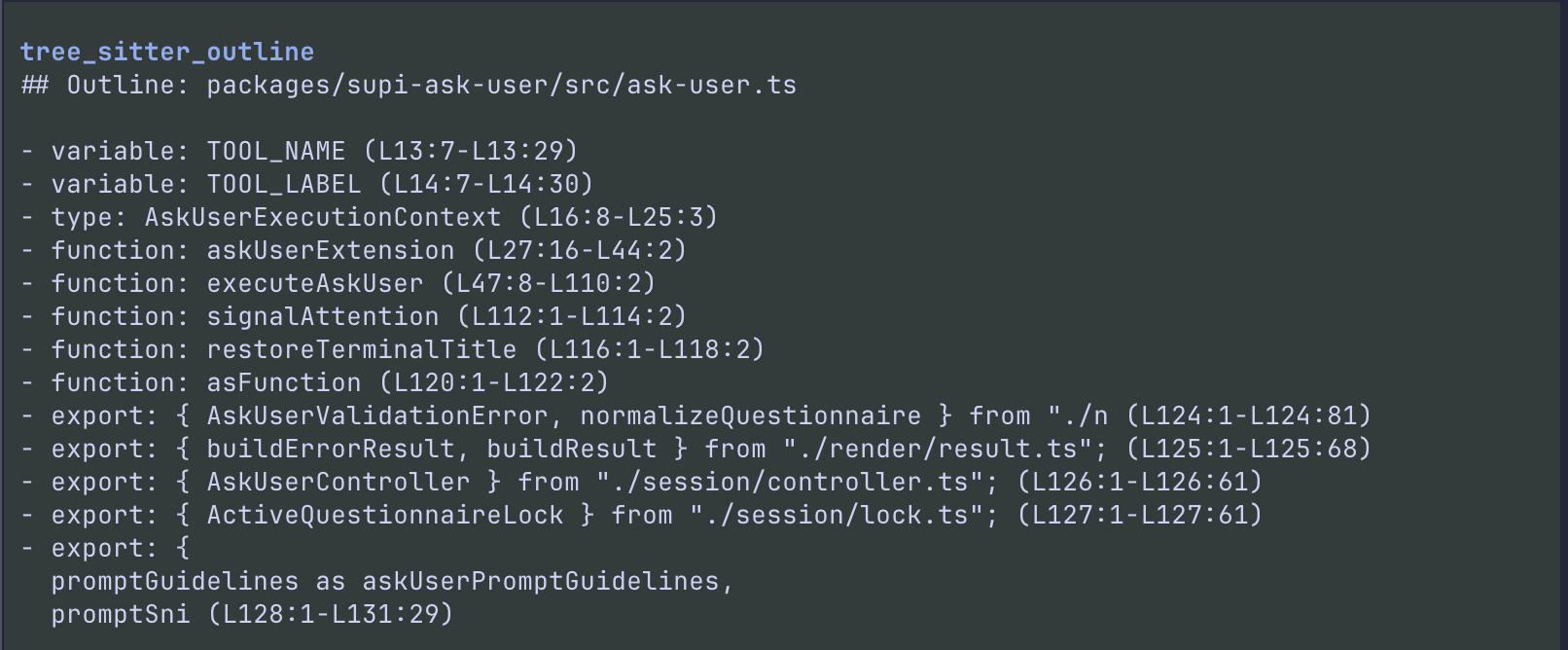
After install, pi gets 6 focused tools for parser-based structural analysis:
tree_sitter_outline— shallow structural outline of declarations in JavaScript/TypeScript filestree_sitter_imports— list imports in JavaScript/TypeScript filestree_sitter_exports— list exports in JavaScript/TypeScript filestree_sitter_node_at— find the exact syntax node and ancestry at a position (any supported grammar)tree_sitter_query— run a custom Tree-sitter query against a file (any supported grammar)tree_sitter_callees— find outgoing calls from the enclosing function or method at a position (most grammars)
Outline, imports, exports
These three tools work on JavaScript, TypeScript, JSX, and TSX files. They provide parser-level structural information without needing a language server:
tree_sitter_outline— top-level declarations plus class/interface/enum memberstree_sitter_imports— module specifiers and source locations for each importtree_sitter_exports— kind, name, and module specifier (for re-exports) of each export
Node-at, query, callees
These tools work across all or most supported grammars:
tree_sitter_node_at— exact syntax node type and ancestry at a given file positiontree_sitter_query— custom Tree-sitter query pattern matching on any supported grammartree_sitter_callees— outgoing calls from the enclosing function or method at a given position
Coordinates use 1-based line and character columns. Character positions use UTF-16 code units. Relative paths resolve from the session cwd, and a leading @ on file paths is stripped.
Supported file families
- JavaScript / TypeScript (
.js,.jsx,.ts,.tsx,.mjs,.cjs,.mts,.cts) - Python (
.py,.pyi) - Rust (
.rs) - Go (
.go,.mod) - C / C++ (
.c,.h,.cpp,.hpp,.cc,.cxx,.hxx,.c++,.h++) - Java (
.java) - Kotlin (
.kt,.kts) - Ruby (
.rb) - Bash / shell (
.sh,.bash,.zsh) - HTML (
.html,.htm,.xhtml) - R (
.r) - SQL (
.sql)
Architecture
@mrclrchtr/supi-tree-sitter is the structural substrate in SuPi's
code-understanding stack. It depends on @mrclrchtr/supi-core and
@mrclrchtr/supi-code-runtime for shared contracts, and provides structural
analysis via a session-scoped Tree-sitter service that publishes its
capabilities into the shared workspace runtime.
supi-code-runtime  ← shared contracts + workspace runtime
    ↑
supi-tree-sitter  ← Tree-sitter WASM + session-scoped service + runtime capabilities
Package surfaces
@mrclrchtr/supi-tree-sitter/api— reusable parsing session factory, shared session-scoped structural service access, and shared result types@mrclrchtr/supi-tree-sitter/extension— pi extension entrypoint@mrclrchtr/supi-tree-sitter/provider/tree-sitter-provider— shared StructuralProvider adapter
Owned session example:
import { createTreeSitterSession } from "@mrclrchtr/supi-tree-sitter/api";

const session = createTreeSitterSession("/project");

const parseable = await session.canParse("src/index.ts");
const outline = await session.outline("src/index.ts");
const callees = await session.calleesAt("src/index.ts", 42, 10);

session.dispose();
Shared session-scoped service example:
import { getSessionTreeSitterService } from "@mrclrchtr/supi-tree-sitter/api";

const state = getSessionTreeSitterService("/project");
if (state.kind === "ready") {
  const outline = await state.service.outline("src/index.ts");
}
Source
src/tool/tool-specs.ts— single source of truth for the public tool surfacesrc/tool/guidance.ts— prompt surfaces derived from tool specssrc/tool/register-tools.ts— focused tool registration driven by tool specssrc/tree-sitter.ts— extension entrypoint (thin wire-up)src/session/runtime.ts— parser and query runtimesrc/session/session.ts— runtime-backed service helpers and owned session APIsrc/session/service-registry.ts— shared session-scoped structural service registrysrc/tool/outline.ts,src/tool/imports.ts,src/tool/exports.ts,src/tool/node-at.ts,src/tool/callees.ts— structural analyses