@mu-crew/mu
A persistent, observable crew of pi agents running in one tmux or herdr session per workstream, coordinated through a built-in task DAG.
Package details
Install @mu-crew/mu from npm and Pi will load the resources declared by the package manifest.
$ pi install npm:@mu-crew/mu- Package
@mu-crew/mu- Version
3.5.0- Published
- Oct 4, 2026
- Downloads
- 636/mo · 636/wk
- Author
- martintrojer
- License
- MIT
- Types
- package
- Size
- 5.9 MB
- Dependencies
- 9 dependencies · 0 peers
Security note
Pi packages can execute code and influence agent behavior. Review the source before installing third-party packages.
README
mu
A small control plane for a crew of AI coding agents working in parallel. Agents run in multiplexer panes you can attach to. Work is a task DAG in SQLite. Each agent gets its own VCS workspace.
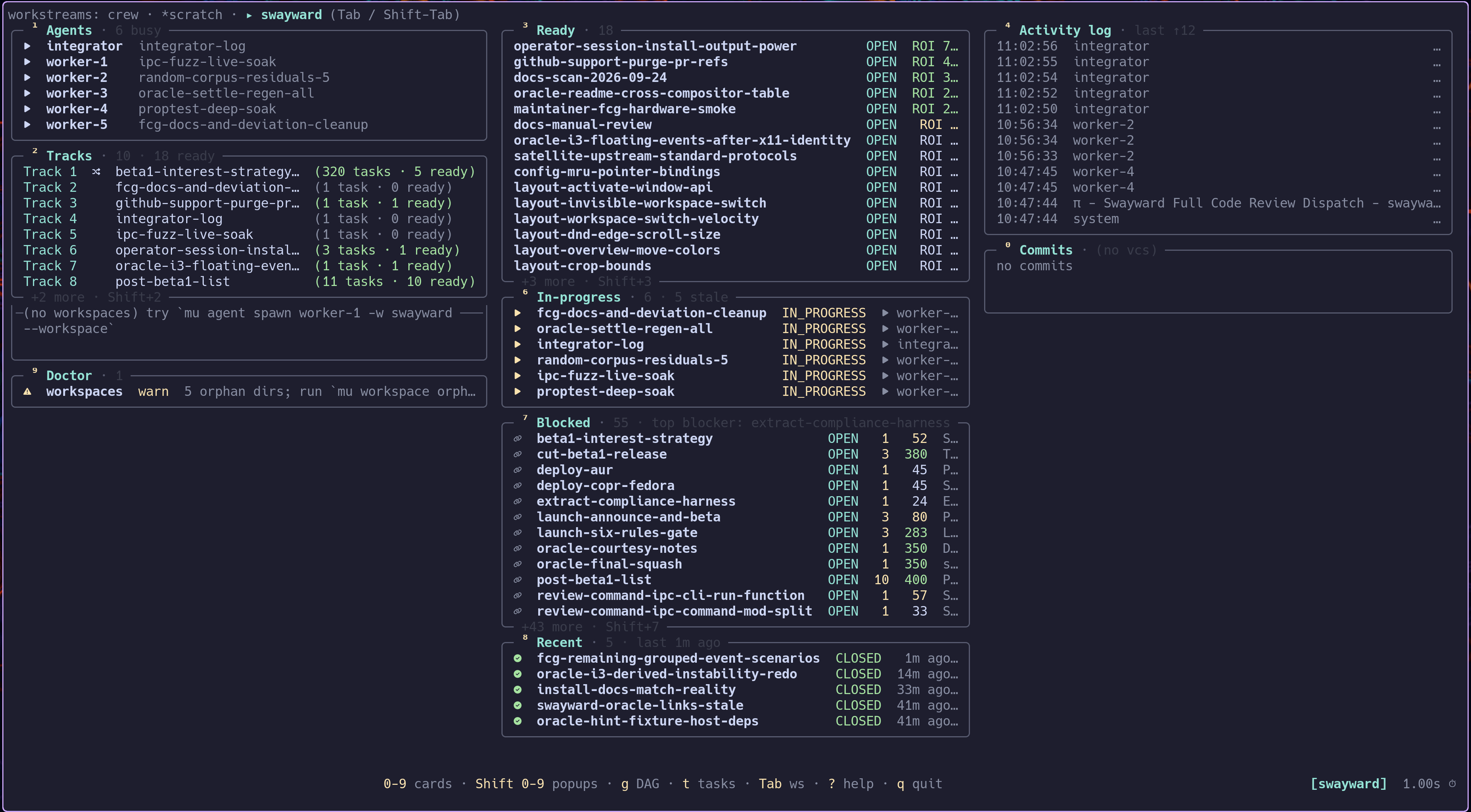
Bare mu opens a read-only dashboard: agents, tracks, ready,
in-progress, and blocked tasks, the log tail, workspaces, and doctor.
- Parallel work that does not collide. Per-agent workspaces (jj
workspaces, sl shares, or git worktrees) and a task DAG with
blocksedges keep agents out of each other's way. - State that outlives a pane. One SQLite DB holds agents, tasks,
owners, notes, and workspaces. An append-only ops log records every
change, so
mu undo <group>reverses one action andmu rebuildreplays the whole history. - Exact control of pi agents. mu's pi extension serves a control socket inside each agent, so send, state, wait, and abort are exact, locally and over ssh. The pane stays pi's normal TUI.
mu persists state and coordinates handoffs. Every read path has
--json, and every change goes through a typed CLI verb. See
What mu is not.
Install
npm i -g @mu-crew/mu
mu link pi       # pi extension (control socket, mu_delegate) + the mu skill
mu doctor
To drive mu from another agent CLI (claude-code, codex), install the
skill with npx skills add mu-crew/mu instead of mu link pi.
You need:
- Node 22.12–26 (see
.nvmrc). - tmux ≥ 3.0 or herdr.
mu doctorreports which one is active. - pi, or another agent CLI.
- jj, sl, or git on
PATHfor--workspace.
murmur is optional for pi agents.
Non-pi agents on tmux need it for state: without it their state is
unknown, so mu agent wait and stall detection never fire for them.
On herdr, herdr reports state.
To update or run from a checkout, see How to upgrade mu.
Quick start
Run this inside tmux or herdr:
mu workstream init auth
mu task add design_auth --title "Design auth" --impact 80 --effort-days 2
mu task add build_auth  --title "Build auth"  --impact 80 --effort-days 5 --blocked-by design_auth
mu agent spawn worker-1 --workspace
mu task claim design_auth --for worker-1
mu agent send worker-1 --fresh 'Do task design_auth. Close it with evidence.'
mu task wait design_auth --first --on-stall exit   # exit 7 = worker needs you
mu                                                  # dashboard
mu workstream teardown --yes                        # without --yes: dry run
For one helper, ask pi to delegate (mu_delegate ships with mu link pi), or spawn into the reserved scratch workstream:
mu agent spawn scout-1 -w scratch.
Ultrathink, the mu way
Long agent runs fail in two ways: the agent stops at 35 of 50 items and calls it done, and it grades its own work generously. The fix is to take the plan out of the agent's head, fan the work out to fresh agents, and have other agents try to refute each result before it counts. Claude Code's ultracode does this with a hidden script. mu does it in the open:
- The plan is the DAG. Every unit, review gate, finding and round
is a task before an agent spawns.
mu stateshows 35 of 50 done, so nobody can declare victory early. - Findings are tasks. A reviewer records each problem as a task in triage (findings), and it blocks the review until someone accepts it as work or closes it rejected or duplicate. The graph holds the whole review.
- Checks are calls. Refuters, claim checkers and judges are delegate calls: fresh agents, ideally on another model, whose verdicts land on the task they judged. A 50-unit run adds about 50 units, 50 review gates and the findings that survive, not a task per check.
- Every agent is a pane. Attach to any worker, reviewer, or judge mid-run and steer it.
- Nothing lives only in a context window. Verdicts, evidence, and stop rules are task notes. The run survives compaction, crashes, and a new orchestrator.
Not every review needs a record. Reviewing someone's PR or a doc runs as delegates only: findings come back in their answers, and nothing lands in the ops log.
Ask your orchestrator to ultrathink a job, and it follows skills/mu/recipes/ultrathink.md. That recipe composes smaller ones you can also use on their own:
| Recipe | Shape |
|---|---|
| fan-out | one task per unit, merged as each closes |
| adversarial-review | a review gate per unit: a fresh agent tries to reject it before it ships |
| refute | finders record findings, one refuter call per finding, report from the graph |
| hypothesis-panel | independent theories from separate evidence, each attacked |
| tournament | competing attempts, judged in pairs |
| loop-until-done | rounds until a stop rule written up front holds |
| backlog-triage | quarantined readers classify, a trusted actor acts |
| deep-research | searchers by angle, one checker per claim, a cited report |
| review-panel | one reviewer per angle on a diff; delegates by default, tasks when fixes follow |
| rules-audit | one checker per AGENTS.md rule plus a skeptic; or mine repeated corrections into new rules |
In pi, mu link pi adds them as commands: /ultrathink <job>,
/mu-research <question>, /mu-review [target], /mu-refute <scope>,
/mu-tournament <task>, /mu-rules-audit [check <target> | mine],
/mu-debug <symptom>, /mu-sweep <change>, and /mu-until <stop rule>.
All recipes, including the orchestrator loop and remote workers, are in skills/mu/recipes/.
What mu is not
- Not a hidden subagent. Every agent, including a one-off
mu_delegatehelper, is an ordinary agent in a pane: attach, steer, abort, or keep talking to it. That costs a pane and a pi process per agent; for many tiny calls a hidden subagent is lighter. See the comparison. - Not a workflow engine. No DSL, no hidden plan, no script runner. The plan is the task DAG; recipes are instructions an agent follows, and every step is a CLI verb.
- Not a model router. mu does not pick models, thinking levels, or
tools. Pass them in the spawn command (
--cli pi_big). - Not a chat bus. Agents coordinate through task notes, claims, and the ops log, not messages to each other.
- Not a daemon or a service. No background process, config file, web UI, or RPC. State is one SQLite file; sync rides on ordinary commands.
- Not a test runner or a judge.
--evidencerecords what an agent observed; checking it is the orchestrator's job, and the recipes say how.
The full list, with reasons: VISION § What it is not and ROADMAP § Anti-feature pledges.
Documentation
- Getting started: the first workstream, end to end. Start here.
- User guide: how-tos for dispatch, remote workers, sync, recovery, and the dashboard.
- skills/mu/SKILL.md: what an orchestrating agent reads. skills/mu/recipes/ holds the recipes it points to, such as remote workers.
- ARCHITECTURE.md and docs/architecture/: the module map and deep dives.
- VISION.md: the design pillars. ROADMAP.md: what is next and what is rejected.
- VOCABULARY.md: canonical terms.
- CHANGELOG.md: release notes.
mu <verb> --help is the reference for every flag.
License
MIT. Part of mu-crew. Written mostly by AI coding agents, with a human reviewing what ships.