@nguyenquangthai/pi-subtask
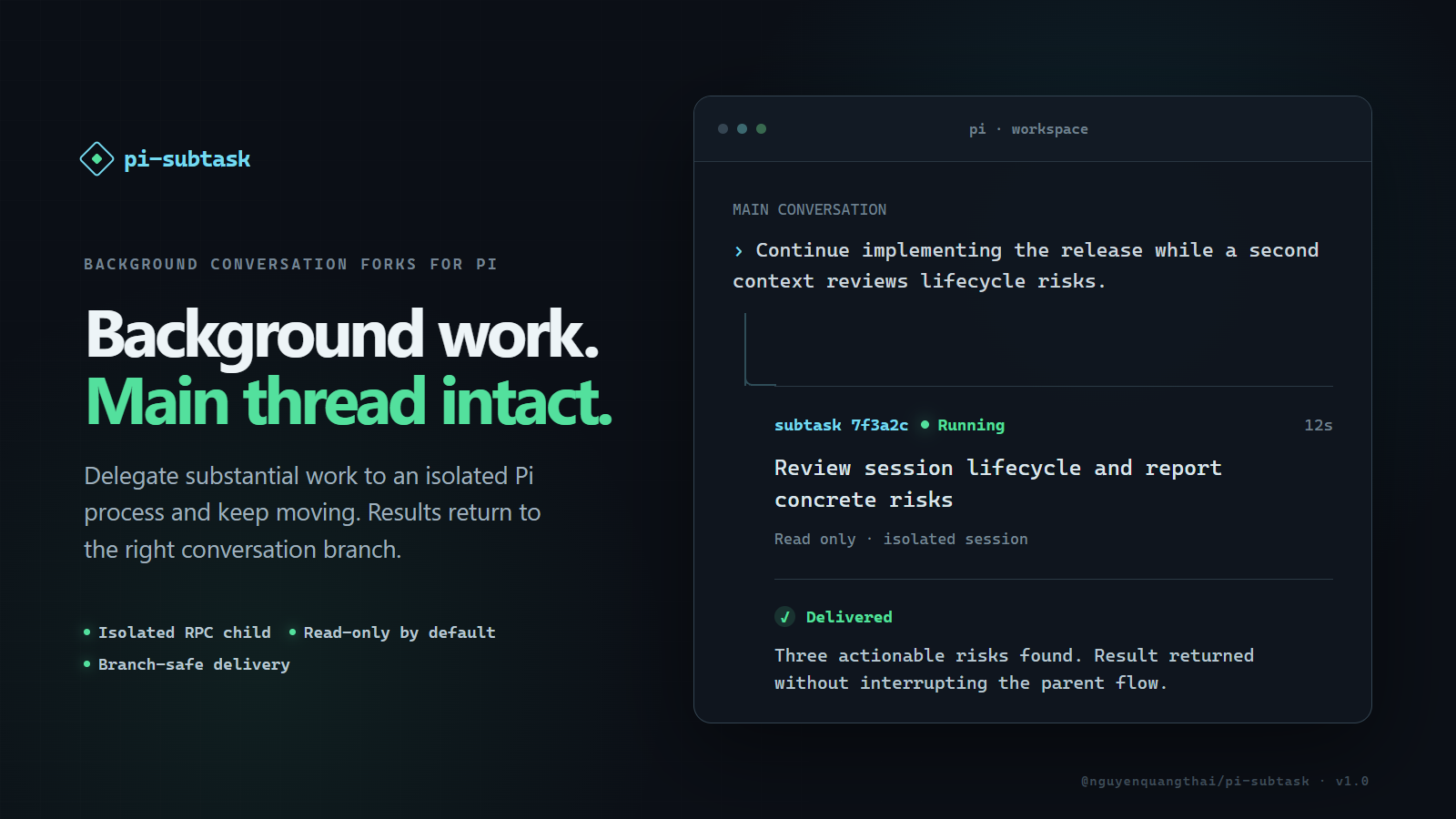
Isolated background conversation forks for Pi with branch-safe result delivery and a terminal-native control UI.
Package details
Install @nguyenquangthai/pi-subtask from npm and Pi will load the resources declared by the package manifest.
$ pi install npm:@nguyenquangthai/pi-subtask- Package
@nguyenquangthai/pi-subtask- Version
1.0.1- Published
- Aug 19, 2026
- Downloads
- 315/mo · 12/wk
- Author
- nguyenquangthai
- License
- MIT
- Types
- extension
- Size
- 89.4 KB
- Dependencies
- 0 dependencies · 3 peers
Pi manifest JSON
{
  "extensions": [
    "./src/index.ts"
  ],
  "image": "https://raw.githubusercontent.com/QuangThai/pi-subtask/v1.0.1/assets/pi-subtask-preview.png"
}
Security note
Pi packages can execute code and influence agent behavior. Review the source before installing third-party packages.
README
pi-subtask


Isolated background conversation forks for Pi.
pi-subtask runs delegated work in isolated pi --mode rpc processes. Each child
receives a snapshot of the parent's active conversation branch, uses its own context
window and session file, and reports its final result back automatically.
Features
/subtask <task>starts a background fork with the user's active tool set./subtask stop <id>stops an active run and its process tree./subtasksopens a keyboard-first Control Tower for active and recent runs.- The model-facing
subtasktool starts a strict read-only fork and returns a receipt immediately. - Parent branch checks prevent results from being injected into an unrelated branch.
- Child prompts use RPC stdin; prompts and API keys are never copied into process arguments.
- Concurrency, wall-clock, inactivity, stderr, JSON-line, and result-output limits are enforced.
- Nested subtask fan-out is disabled in child processes.
Defaults are intentionally conservative: four concurrent runs, 30-minute wall-clock timeout, five-minute inactivity timeout, and a 50 KiB / 2,000-line delivered result. The complete result remains available in the child session.
Control Tower UI
While runs are active, a compact themed activity rail appears below the editor with
status, short run ID, elapsed time, and capability. Completion messages render a
concise result by default; press Ctrl+O to expand provenance, output metrics, and
the child session path.
Open /subtasks for the focused inspector:
↑/↓orj/k: select a runEnter: toggle expanded detailss: stop the selected active runEsc: close and restore editor focus
The UI uses Pi theme semantics and never replaces the user's editor component.
Install
Requires Node.js 22.19+ and Pi >=0.84.2.
pi install npm:@nguyenquangthai/pi-subtask
Pin a release for reproducible environments:
pi install npm:@nguyenquangthai/pi-subtask@1.0.1
# or install the matching Git tag
pi install git:github.com/QuangThai/pi-subtask@v1.0.1
Pi packages execute with the permissions of your user account. Review third-party extension source before installation.
Development
git clone https://github.com/QuangThai/pi-subtask.git
cd pi-subtask
npm install
pi --extension ./src/index.ts
Public interface and versioning
Version 1.x treats these user-facing interfaces as stable:
/subtask <task>starts a background run with the user's active tools./subtask stop <id>stops an active run and its process tree./subtasksopens the run inspector.- The model-facing
subtasktool accepts{ task: string }, starts a read-only run, and returns a receipt immediately.
Breaking command or tool-schema changes require a new major version. Child session internals and the
custom completion-message payload are implementation details. Pi compatibility remains constrained by
the peer dependency range declared in package.json.
See CHANGELOG.md for user-visible changes and the release checklist for maintainer steps.
Security model
- Model-created runs only receive active
read,grep,find, andlstools. - User-created
/subtaskruns inherit the parent's active tools and should be treated accordingly. - Child prompts use RPC stdin; prompts and API keys are not copied into process arguments.
- Process lifetime, concurrency, stderr, protocol records, and delivered output are bounded.
- Child output is untrusted delegated output and should be reviewed before consequential use.
Verify
npm run check
npm test
npm pack --dry-run

# Basic real-model E2E (incurs provider usage)
npm run e2e -- D:/path/to/a/project-with-pi-subtask-installed

# Edge-case matrix (incurs provider usage)
npm run e2e:matrix -- D:/path/to/a/project-with-pi-subtask-installed
The test suite exercises session snapshots, strict JSONL parsing, headless dialog cancellation, startup/wall/inactivity timeouts, stop behavior, process-tree termination, concurrency reservation, tool ceilings, branch-safe delivery guards, and strict UTF-8-safe output caps. Real-model E2E artifacts contain prompts and outputs, are created with private file permissions where the platform supports POSIX modes (Windows inherits directory ACLs), and should be deleted when no longer needed.
Current limitations
- Parent sessions must be persisted and contain at least one entry.
- Runs are not reconciled after parent restart or extension reload.
- Completion delivery is not durably acknowledged; a parent crash between child completion and message injection can leave the result only in the child session.
- Live child transcript, steering, and resume are not implemented yet.
- Model-created runs are limited to active
read,grep,find, andlstools. - Use stored credentials or provider environment variables. A transient parent
--api-keyis deliberately not forwarded to child process arguments.
Child session files are written against Pi's exported session version. Pi 0.84.2 is
the minimum tested baseline; compatibility must be revalidated before relying on newer
Pi APIs.